"Value Coins" vs "MEME Coins": Who Holds the Future of the Next Bull Market?
TechFlow Selected TechFlow Selected
"Value Coins" vs "MEME Coins": Who Holds the Future of the Next Bull Market?
History repeats itself, but not in a simple way.
 Navigating Web3 tides with focused insights
Author: Icefrog
Foreword:
As Trump swept through American politics with a historic victory, the tide turned overnight. Bitcoin reached new all-time highs, yet within the crypto world itself, Bitcoin and other cryptocurrencies are fundamentally two entirely different realms.
Under the banner of "Build," so-called "value tokens"—claimed as the cornerstone of the crypto space—are facing unprecedented application challenges and FUD (fear, uncertainty, doubt). Meanwhile, the MEME wave is surging once again, prompting us to reconsider: In this visibly bullish market, should we believe in value tokens again—or is MEME truly the future?
Origins in the Calm
Small Certainties in Value Discovery, Amplified by Liquidity
Before discussing MEMEs, it's important to briefly trace their development history in the crypto world. From a timeline perspective, we can roughly divide it as follows:
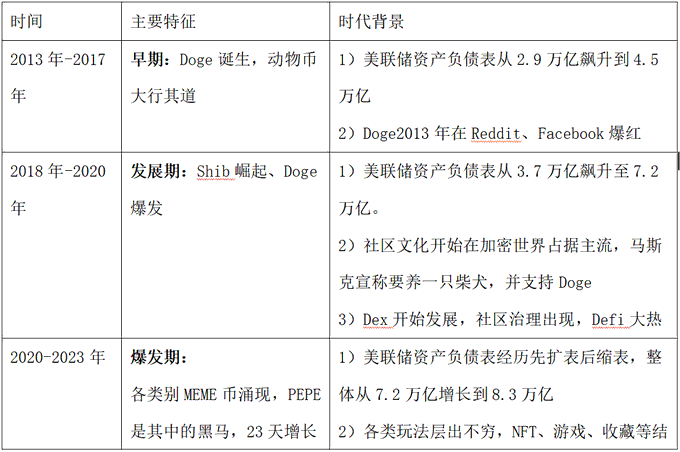
From this evolutionary path, several key trends emerge:
-
Liquidity expansion is foundational: MEMEs originate in bull markets, and explosive price movements often coincide with expansions in USD liquidity.
-
Celebrity influence is the greatest catalyst: The rise of image-based MEMEs like Shiba Inu or Dogecoin was significantly boosted by celebrity endorsements—Elon Musk being a prime example.
-
Spiritual resonance with cultural zeitgeist: From animal-themed images and internet memes to AI-driven MEMEs, each reflects the most contagious spirit of its time, carrying increasingly rich emotional undertones.
-
Rapidly shortening lifecycle: With the emergence of fair-launch platforms like Pump.fun, token creation has become near-instantaneous, reducing project lifespans to mere hours.
The era of Doge’s rise coincided with millennials coming of age—the smartphone generation—where image and emoji communication became mainstream. By 2020, Gen Z took center stage. Internet meme culture had become second nature, but compared to millennials, they faced greater frustration and resignation. Yet they were also more anti-authority and anti-elitist, drawn to absurdity and satire—exemplified by PEPE. By 2024, AI stands as the most cutting-edge and disruptive technology, with Gen Z leading the charge. While baby boomers still question AI’s potential, Gen Z is already monetizing it, embracing change alongside the most forward-thinking tech leaders.
With platforms like Pump.fun enabling mass fair launches, 5,000–10,000 new MEME tokens emerge daily. October data shows only 1.4% of users earned over $1,000, while more than 80% lost money.
Today, there’s widespread discussion about the roots of MEMEs—from cultural context, generational sentiment, and viral dynamics—all offering theoretical grounding. But regardless of angle, one certainty remains: MEMEs cannot be judged by utility or practicality. That would be an overly narrow definition of value. In an era of irreversible monetary expansion, it is the times that have chosen MEMEs—and blockchain is simply the ideal soil for them to flourish.
MEMEs grow from the emotional needs and new value systems of younger generations. They reject grand narratives and overarching ideals, instead finding joy in small certainties and using humor to defy abstract authority. A single meme creating a moment of shared understanding is, for youth, both visibility and personal triumph. This triumph explodes into immense value within the blockchain world. Rationality and idealism are seen as outdated; entertainment reigns supreme, consumption is king. They feel no shame calling crypto a casino—because to them, MEMEs are part of everyday life, another form of play.
Yet while MEMEs are created by the young, it’s older generations of capital that turn them into speculative assets. For those born in the '60s, '70s, and '80s, the default stance is clear: “I don’t understand it—but that won’t stop me from harvesting yields.”
The Collapse of Value Tokens via Real-World Disproof
Falls Aren't Scary—Disproof Can Be Fatal
For veterans who’ve lived through multiple crypto cycles, sharp drops aren’t unusual or even frightening. Even BTC has crashed hard before. What erodes faith in value/VC tokens isn’t volatility per se—not the classic up-down cycle—but rather the reality that retail investors often enter at the absolute peak, watching helplessly as prices descend from Mount Everest down past sea level, plunging into the Mariana Trench.
The current state is this: tokens have become the product, while actual products are ignored. Discussions around high-market-cap, low-circulating-supply value tokens are just as prevalent as those on MEMEs. Causes are manifold: inflated valuations during bear-to-bull transitions; unequal token distribution under regulatory frameworks; unbalanced, unhealthy ecosystem structures.
At its core, the decline of value tokens stems from multiple failures: narratively undermined by lack of real use cases; financially broken by unfair distributions; ecologically corrupted by pretentious elitism. For countless altcoins, dancing between buzzwords and minor protocol tweaks became fashionable—terms like chain abstraction, Layer2, Layer3, intent-centric architectures keep emerging. But usage metrics tell the truth: without genuine applications, user demand is neither essential nor irreplaceable. As such, project data relies entirely on incentives—airdrops, points, etc. And when these mechanisms themselves suffer from unfairness or insider dealings, they devolve into what Murad described: the token becomes the final product, while the actual product gathers dust.
As shown below, under mainstream industry narrative logic, every stakeholder in a value token project holds different wealth-driven motivations. Sadly, none revolve around the project’s intrinsic value. Or put more bluntly: narratives serve merely as cloaks for yield farming, because nearly all stories can be quickly disproven—while what gets confirmed too often turns out to be copy-paste schemes or Ponzi dynamics.
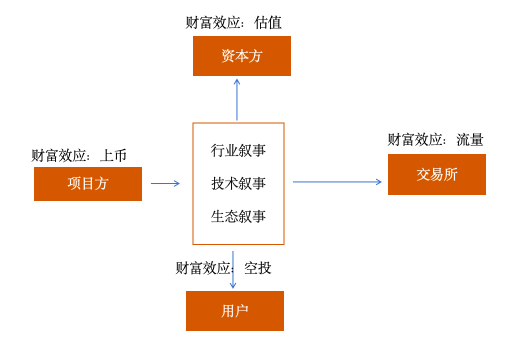
Hundreds of public chains, hundreds of L2s, hundreds of cross-chain bridges, thousands of DeFi protocols, and countless conceptual narratives—within this maze of ideas, towering logical edifices appear flawless—until struck by the simplest reality check. When external liquidity fails to expand widely and narratives become homogenized, the situation worsens dramatically.
The final nail in the coffin is the hypocritical elitism infecting many project teams: they look down on "digital beggars" while secretly running insider wallets. They preach disruption, revolution, innovation—yet wield nothing but scalpels, large knives, and even bigger scythes.
You stare into the abyss, and the abyss stares back. Attract capital and users with grand narratives, then redistribute wealth unfairly—once the narrative collapses, the consequences will inevitably crash down. But the bottom for value tokens may be far deeper and longer than anyone expects.
The Future of MEMEs vs. Value Tokens
History Repeats, But Never Simply
Victory is always written by the victors. Value is only universally recognized at the moment it materializes. The dominant ideology in crypto remains tokenization. Before a token achieves success, there's no inherent distinction between a value token and a MEME coin—only differences in execution paths.
The advantage of value tokens lies in their methodological clarity: from cold start to positive price feedback loop, there’s a structured playbook to follow, making outcomes relatively predictable—though capped in upside. Ultimately, they aim to fulfill users’ functional needs.
MEME coins, by contrast, lack a replicable formula (compared to value tokens) and involve higher randomness. Yet their ceilings are much higher, and today’s MEME operations are increasingly professionalized and capital-savvy—rivaling the maturity of traditional value projects. Their ultimate goal? Fulfilling users’ need for community belonging and identity.
A project’s original sin isn’t lacking utility—it’s failing to let users profit. Long-term, we must accept that the blockchain world is inherently pluralistic in values. Whether value tokens face FUD or MEMEs enjoy hype doesn’t determine which model deserves to survive. These opposing forces reflect power struggles between different capital groups—not objective truths. For most market participants, one simple principle holds: In a fair environment, any project that lets people earn money is valuable. That is almost the sole criterion.
Thus, predicting the future of value tokens versus MEMEs comes down to answering two questions: Which offers relative fairness? Which provides better risk-reward ratio?
Fairness depends on institutional design; risk-reward ratio hinges on narrative evolution and liquidity. Together, they shape cycle rotations and the future of crypto.
Following Trump’s return to power, improved regulatory conditions are likely—but whether this will reverse the current dysfunctional landscape of value tokens remains uncertain.
In terms of risk-reward, the sustainability of value token narratives depends on whether new entrants join en masse. However, if these fail to deeply integrate with real-world needs, disproof will come swiftly. Worse, acceleration is difficult—blockchain won’t become globally mainstream overnight. On liquidity, value tokens currently hold an edge: established investment institutions still prefer allocating capital to value sectors. But without fundamental improvements in narrative logic, the shortage of fresh “lambs” to harvest is shifting from joke to reality.
If we project forward under these conditions—modest institutional improvement, slow narrative progress, continued liquidity spillover—value tokens are unlikely to die or go to zero. Instead, like China’s real estate sector post-bubble, they’ll face a prolonged period of culling and adjustment. Within this process of creative destruction, true value tokens may eventually emerge.
For MEMEs, a golden age of diversity is dawning. Increasingly sophisticated capital operations and exchange traffic support are accelerating momentum. But for retail investors, profitability isn’t guaranteed. Still, as long as the wealth effect persists, most will continue believing: This time, I’ll succeed in PVP (player versus player).
Only when profits occur in a fair environment can sustainability exist. Every cycle brings new stories. Countless value tokens and MEMEs have died. Those that endure share not some ideological purity, but something far simpler: broad community recognition and user trust.
If there’s one final takeaway, it’s this: There is no eternal universal value. Value tokens and MEMEs aren’t ranked hierarchically. Historically, only those projects that consistently earn community support and user trust manage to stay relevant over time—that is the true essence of value.
Money never sleeps. New stories are already unfolding. And this time—may you win!
Join TechFlow official community to stay tuned
Telegram:https://t.me/TechFlowDaily
X (Twitter):https://x.com/TechFlowPost
X (Twitter) EN:https://x.com/BlockFlow_News
 @Ice_Frog666666