








How Vlayer Is Restructuring the Data Layer with $10M in A-Series Funding Led by a16z
TechFlow Selected TechFlow Selected
How Vlayer Is Restructuring the Data Layer with $10M in A-Series Funding Led by a16z
Building "verifiable data infrastructure," innovating "Solidity 2.0."
 Navigating Web3 tides with focused insights
Author: Pzai, Foresight News
Communication between on-chain and off-chain data is key to bridging the gap between two economic systems. While many current solutions focus on transmitting asset prices and event outcomes, they face limitations in multi-chain interactions and broader internet integration paradigms.
Vlayer, selected for a16z's September-announced crypto startup accelerator (CSX) program, recently raised $10 million in a seed funding round. The round was backed by a16z CSX, Credo Ventures, and BlockTower Capital, with participation from Remco Bloemen of World (formerly Worldcoin), Jakub Florkiewicz of Tools For Humanity, and Zac Williamson, Joe Andrews, and Kev Wedderburn of Aztec.
Since 2023, Vlayer has been building a "verifiable data infrastructure," which it refers to as "Solidity 2.0," leveraging zero-knowledge proofs to enable Ethereum developers to verify and integrate off-chain data directly within smart contracts. Hubert Rachwalski von Rejchwald, co-founder and CEO of Vlayer, stated: "We provide direct access from Solidity code to additional verifiable data sources, meaning zero-knowledge proofs will ultimately become a familiar and easy-to-use tool for any Solidity smart contract developer." This article dissects its technical architecture and explores how it integrates relevant data.
Architecture
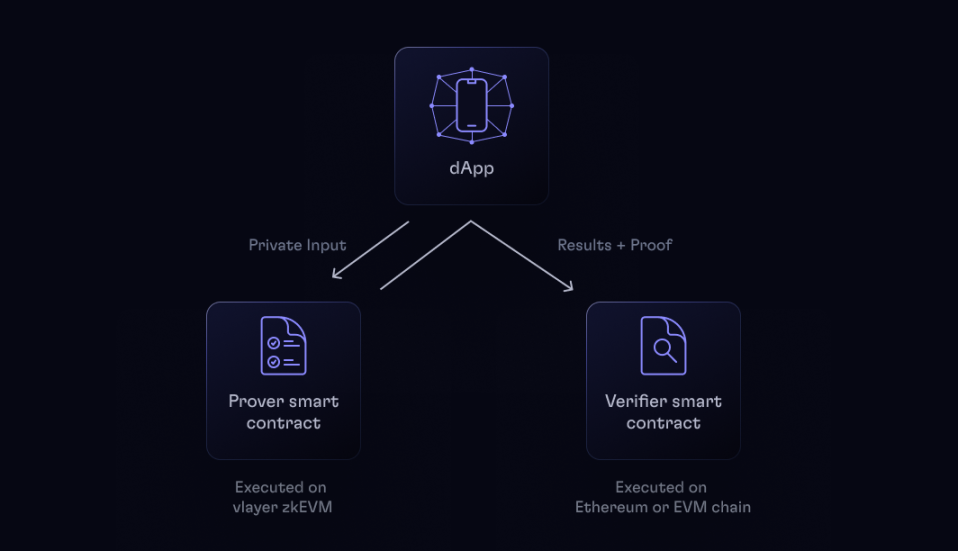
Vlayer introduces two new types of contracts: Prover and Verifier. Prover code runs on an off-chain zkEVM, generating proofs for specific data structures. The Verifier then validates these proofs and executes code on EVM-compatible chains. Correspondingly, applications can take privacy-preserving inputs and trigger on-chain execution based on results and proofs generated by the Prover.
Features
Vlayer introduces several capabilities into off-chain zkEVM execution, including retrospective access to data from specific blocks ("time travel"), cross-chain contract interaction (Teleport), and off-chain data verification using zkTLS.
On-Chain Data
For on-chain smart contracts, state access is typically limited to a single block. "Time travel" enables EVM state interaction with specific blocks or ranges of blocks. Deterministic retrieval of historical data enables various on-chain functionalities such as calculating token holding duration and averages, emission tracking, and monitoring changes in lending and liquidation volumes.
For EVM-compatible chains, multi-chain data calls can be achieved via Teleport’s multi-chain invocation (setChainId). This allows, for example, minting tokens on a specific chain after verifying holdings across multiple chains.
These features address interoperability bottlenecks inherent in Solidity due to differences in on-chain environments. However, for some chains, asynchronous finality caused by their consensus mechanisms may impact data immutability. Therefore, developers are advised to prioritize blocks with confirmed finality.
Off-Chain Data
Integrating user interactions from traditional internet applications into on-chain economic systems has long been a challenge for many projects. Today, zkTLS technology (web proving) bridges this critical gap by enabling proof of data authenticity from any server.
Unlike direct API calls—often restricted due to closed APIs—zkTLS allows permissionless, direct access to website data. By integrating this technology into on-chain smart contract execution, Vlayer brings trusted off-chain interactive data onto the blockchain, opening the door to large-scale applications. Additionally, Vlayer can generate proofs for email activities.
This technology can be applied to use cases such as:
-
Automatically minting fan tokens based on music app listening counts (or fandom support actions)
-
Automated incentive programs (e.g., rewarding users based on Twitter post metrics)
-
AI Agent execution (e.g., synchronizing off-chain operations performed by an agent with on-chain states)
Conclusion
The eve of mass adoption always requires laying countless foundations. By introducing zkTLS technology, Vlayer builds a trusted data bridge between blockchain and the traditional internet, enabling verifiable off-chain data to enter the on-chain world. Its technical vision manifests across multiple concrete application scenarios.
The project is currently in open alpha, actively recruiting early developers in DeFi, RWA, and gaming sectors for testing and development. Its testnet, mainnet, and token are expected to launch in 2025 or later. For developers, this represents an opportunity to participate in early-stage development. As the divide between on-chain and off-chain systems continues to close, we look forward to welcoming truly transformative applications in a deterministic future.
Join TechFlow official community to stay tuned
Telegram:https://t.me/TechFlowDaily
X (Twitter):https://x.com/TechFlowPost
X (Twitter) EN:https://x.com/BlockFlow_News
 Foresight News






