Finding High-Premium L1 Tokens: Yield-Bearing Assets You Need and That Work for You
TechFlow Selected TechFlow Selected
Finding High-Premium L1 Tokens: Yield-Bearing Assets You Need and That Work for You
The best products don't need to rely on tokens, and the best tokens don't need to rely on products.
 Navigating Web3 tides with focused insights
Author: sam.frax, Founder of Frax Finance
Translation: TechFlow
There's been a lot of discussion recently about how to evaluate different crypto assets—especially in the context of the AI and memecoin booms—but I want to explain the correct way to assess the most important large-scale crypto assets: L1 tokens versus what I call "Type 2" tokens—dapp/L2/"equity-like" tokens.
L1 tokens have a mysterious “L1 premium” that hasn't yet been systematically explained. Many believe it’s a speculative Ponzi scheme, but the truth is the opposite. The L1 premium is more fundamental than most realize.
L1 assets (like ETH, SOL, NEAR, TRX, etc.) are the “sovereign scarce assets” within a chain economy. They become the most liquid asset in that economy. Other projects accumulate these assets, use them to build infrastructure/DeFi, and incentivize liquidity with them—making them safe-haven assets during crises.
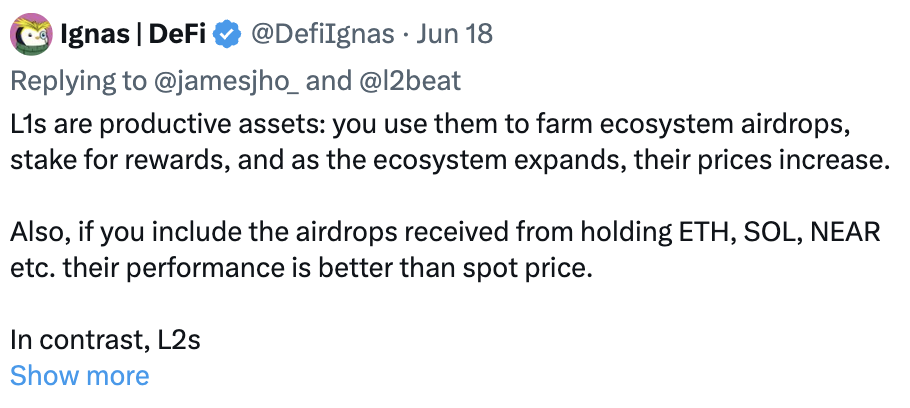
When this happens, these assets become “yield-bearing” by distributing other project tokens to holders through liquidity provision, ICOs, DeFi, airdrops, and other innovations. As @DefiIgnas put it well:
L1s are seen as productive assets: you can use them to capture ecosystem airdrops, earn staking rewards, and benefit from price appreciation as the ecosystem expands.
Moreover, when factoring in airdrop yields earned while holding ETH, SOL, NEAR, etc., these assets outperform based on spot price alone.
Within a sovereign economy (a chain), dapp tokens represent the actual labor and GDP created by people in that economy. The scarce L1 asset, meanwhile, earns yield from the labor invested in building the digital economy (the chain).
This is why “Type 2 tokens”—dapp/L2 tokens—are often compared to “equity” and valued using P/E and DCF models, while fundamental analysts remain puzzled by the mysterious “L1 premium.” But it’s not necessarily an L1 premium—it’s a premium for sovereign economic assets.
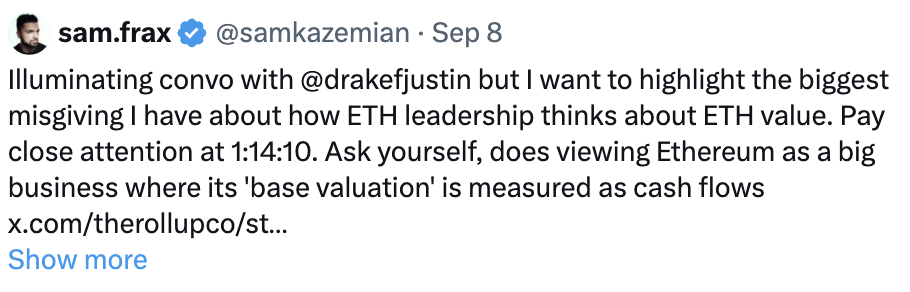
Many may know that I disagree with ETH thought leaders like @justindrake, who communicate to the market that ETH should be treated as a business whose value comes from selling blockspace and data blobs, to be valued via P/E metrics. They are turning $ETH into a “Type 2” token—and they’ve had some success (though I regret this):
L2 tokens are generally not the sovereign scarce asset within their digital economy, even if they have some elements like a blockchain, active developers, and users. They are “Type 2” tokens, typically valued using P/E and DCF models. In fact, some L2s don’t even have their own token, such as @base.
$SOL has performed so well not because of TVL growth or expectations of future SOL burns or revenue generation in some distant year. Despite $ETH having generated billions in revenue and burn, it hasn’t outperformed SOL.
$SOL is rising because Solana’s sovereign economy needs it—for liquidity pools, memecoin trading, and DeFi—and you need it to participate in the operation of the Solana network.
People actively build projects that convert their labor into tokens (as Type 2 / dapp / PE tokens) to pay interest and rewards to $SOL holders, stakers, and liquidity providers. Meanwhile, ETH thought leaders are trying to turn $ETH into a DCF equity token with little value beyond cash flows from product sales by the Ethereum Foundation (EF).
As @MustStopMurad elegantly pointed out, the best products don’t need a token, and the best tokens don’t need a product. Sovereign scarce assets (Type 1 / L1 tokens) can be viewed as memecoins—a serious meme, without pictures of cats or dogs (those exist within digital nations).
@balajis once deeply explored the concept of network states. The power of this meme is finally being understood. Type 1 (L1) and Type 2 (PE/equity/labor/L2) tokens are fundamentally different. Communities can transform one type into another, but it takes time.
Most importantly: gas fees and staking security are technical signals reflecting social consensus around the sovereign scarce asset—not features that inherently create massive value themselves. People are finally realizing this, including renowned thinker @danrobinson.
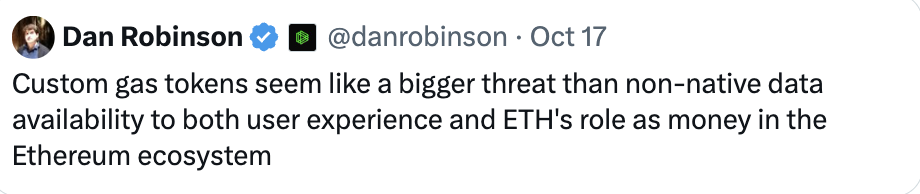
So it’s not really an “L1 premium,” but rather the sovereign asset of a digital nation—the Type 1 token. It’s arguably the strongest, most fundamentals-focused meme—one without funny images, yet economically real and highly potent within meme culture. My view is: there are only two types of tokens.
Next month, @fraxfinance will release its biggest announcement ever: our Vision 2030 Roadmap. A central component will be how to transform a Type 2 / L2 / governance / PE token into a sovereign asset. I expect many “Type 2” tokens will take this as a blueprint and follow suit.
Join TechFlow official community to stay tuned
Telegram:https://t.me/TechFlowDaily
X (Twitter):https://x.com/TechFlowPost
X (Twitter) EN:https://x.com/BlockFlow_News
 @samkazemian