Reviving Ethereum Culture? What Magic Potions Does Monad Have?
TechFlow Selected TechFlow Selected
Reviving Ethereum Culture? What Magic Potions Does Monad Have?
Monad combines Ethereum's cultural characteristics with Solana's scalability.
 Navigating Web3 tides with focused insights
Author: 100y
Translation: Luffy, Foresight News
1. The Fallen Ethereum Village
Once upon a time, in the Ethereum village lived a community of green Pepe frogs. This was once one of the most vibrant kingdoms, where high decentralization and strong security fostered a thriving economy.

Guided by these principles, villagers regularly held elections based on their interests, appointing leaders to oversee the creation of blocks—each recording transactions—every 12 seconds. In this way, they diligently managed the prosperity of the village's economy.
Now, Ethereum’s former glory is fading. A meme virus is spreading rampantly, weakening the village’s strength. Shadows hang over the streets as green Pepe frogs drag their feet, aimlessly wandering through the desolate, darkened village.
Yet, some green Pepe frogs still yearn to restore Ethereum’s lost splendor. They support the "L2 Reform," a movement aimed at revitalizing the village. Through their efforts, Ethereum begins to flourish again, achieving an economic vitality once thought impossible.
However, L2 reform has its limitations. Nearby villages such as Solana and Sui, though young and unstable, are rapidly advancing through unprecedented technological revolutions. Their innovations enable seamless complex financial transactions, while Ethereum, despite reforms, continues to struggle. As a result, rumors circulate among the Pepe frogs about the possibility of relocating to these neighboring villages.
Then, on a fateful day, a purple Pepe wizard appeared in the Ethereum village.
2. The Arrival of the Purple Pepe Wizard
Dressed in purple robes, the Pepe wizard gazed sadly at the faded glory of the Ethereum village and resolved to build a new nation called Monad.

One day, he appeared before the green Pepe frogs and announced his grand plan to establish the Monad village. He gathered the green Pepe frogs in the central square and began listening to their thoughts.
Green Pepe Frog 1 spoke up: "I hope life in Monad will be just like on Ethereum. Although Ethereum lacks the scalability of Solana or Sui, I never considered leaving because their culture is so different from ours."
Green Pepe Frog 2 added: "Maintaining the same lifestyle and culture is important, but I also hope for a system as efficient as other villages. Ethereum is secure, but it’s not fast or agile enough for enterprises that prioritize speed."
The wizard took their wishes to heart, promising to create a Monad with Ethereum’s cultural traits and the scalability of Solana and Sui. He pondered the powerful incantations needed—an Ethereum-compatible village capable of meeting the efficiency demands of a progressive new era.
Then, he shared his vision with the eager Pepe frogs awaiting the new village, igniting their hope for a home that could truly offer the best of both worlds.
3. Secret Spell One: Deferred Execution

One limitation to Ethereum’s scalability lies in processing every transaction during the consensus process—an essential step in generating each new block.
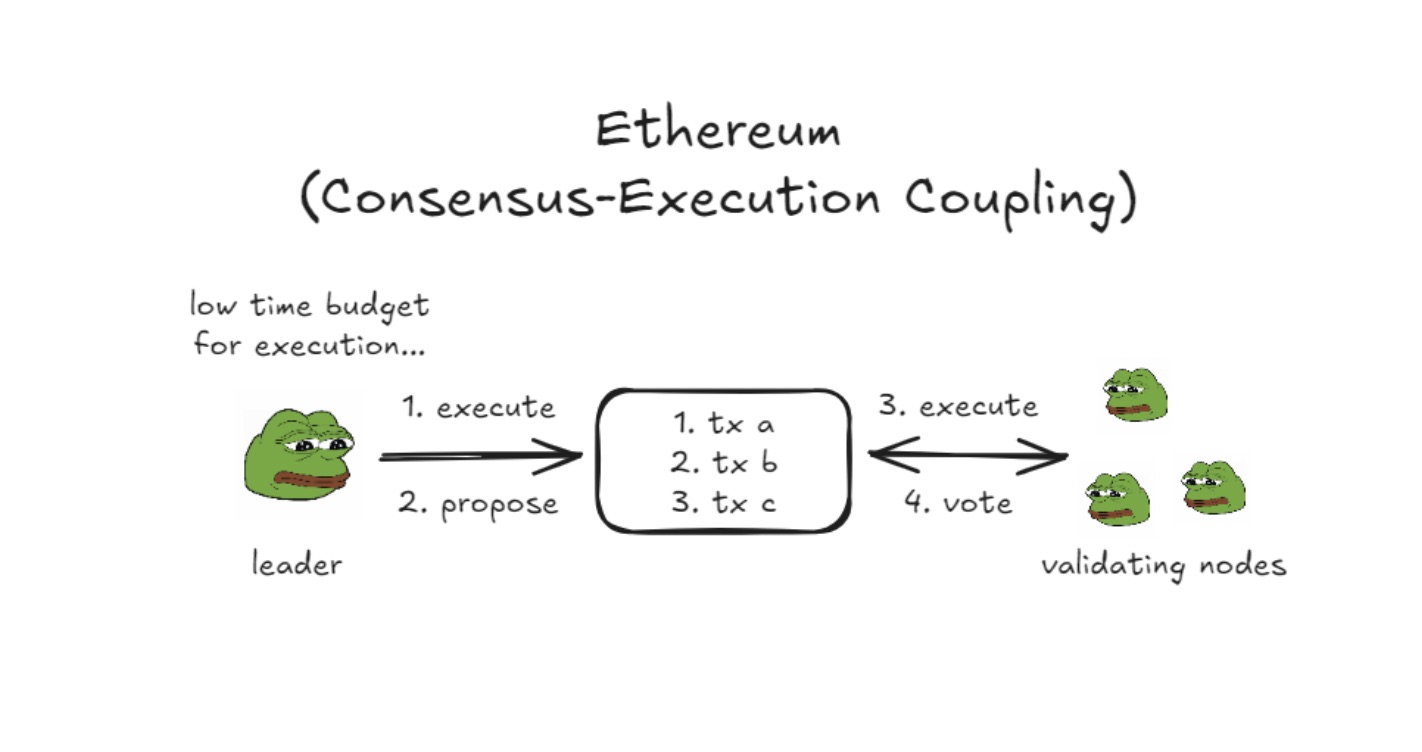
In Ethereum, the leader proposing a block must compute all transactions within the block before submission to ensure each transaction’s outcome. Additionally, validator nodes receiving this block must also recompute all transactions to verify its validity and cast votes.
Since the consensus process involves computation and communication among villagers, the time budget allocated for transaction processing is extremely limited, ultimately restricting scalability.
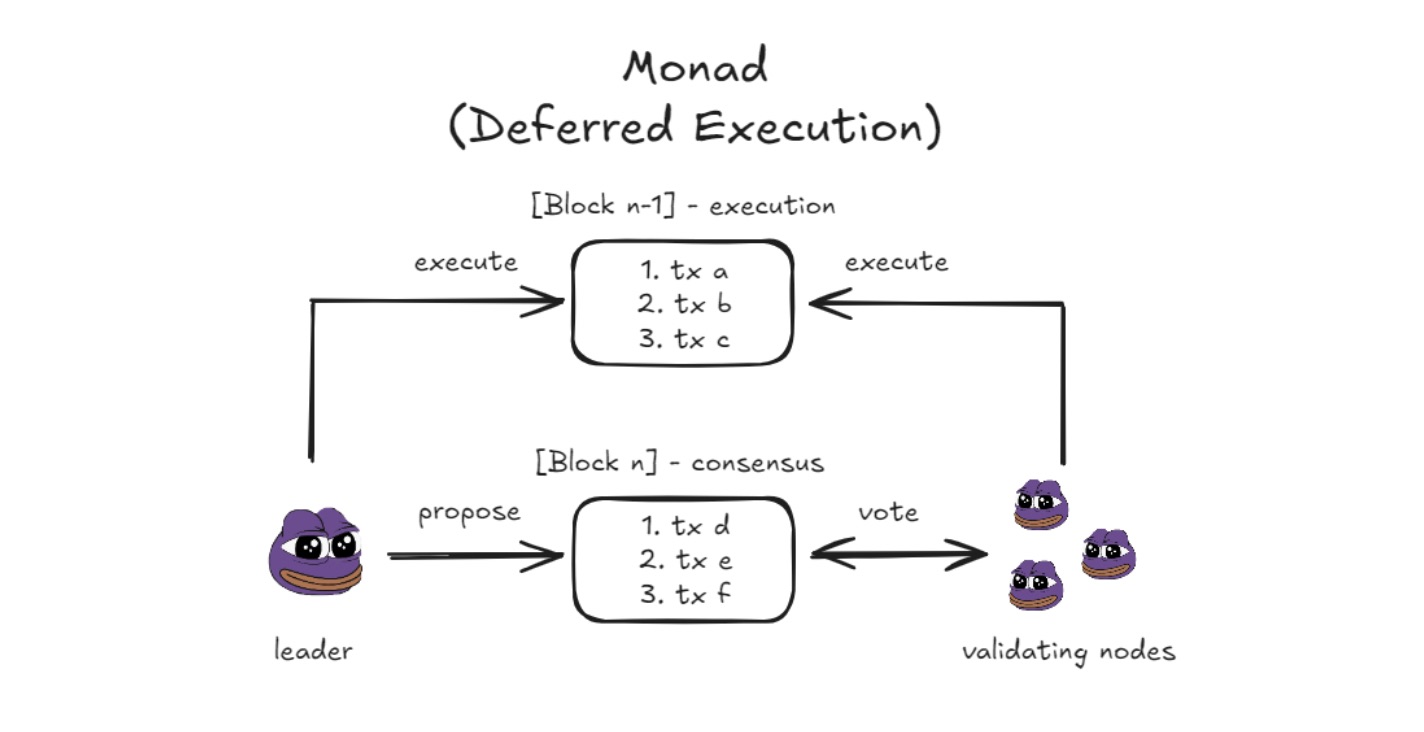
To solve this, the purple Pepe wizard introduced a new spell called "deferred execution." This spell separates the "consensus" phase (ordering villagers' transactions) from the "execution" phase (computing the results of those transactions).
In simple terms, instead of performing consensus and execution simultaneously for each block, consensus is performed on block N while execution occurs on block N-1 (whose transaction order has already been finalized).
By allowing a full block time for execution, this method significantly increases the number of transactions that can be processed within the same timeframe.
Advanced Spell: Deferred Merkle Root
In Ethereum, nodes perform computations before reaching consensus, thus ensuring block validity. However, in Monad’s deferred execution system, consensus and execution are decoupled. This opens the possibility for malicious nodes to ignore previously agreed-upon transactions or arbitrarily alter computational states.
To prevent this, Monad embeds the Merkle root (the computation result of block N-10) into the proposal of block N. If more than two-thirds of the nodes reach consensus on block N, it implies agreement on the computation result of block N-10.
If any node’s computation result for block N-10 does not match the Merkle root included in block N, that node will be excluded from consensus starting at block N. The 10-block delay of the Merkle root ensures timely detection of any computational errors.
Notably, Monad has a 1-second block time, but this does not mean finality takes 10 seconds. Thanks to Monad’s MonadBFT system, single-slot finality is achieved—finality in just 1 second.
4. Secret Spell Two: Transaction Hashes

The clever purple Pepe wizard pondered how village leaders could quickly broadcast block proposals to other nodes.
In Ethereum, the entire block proposal—including all transactions—is typically packaged and sent across the network.
However, the wizard realized that if Monad adopted this method, broadcasting block proposals containing large volumes of transactions would be arduous and inefficient.
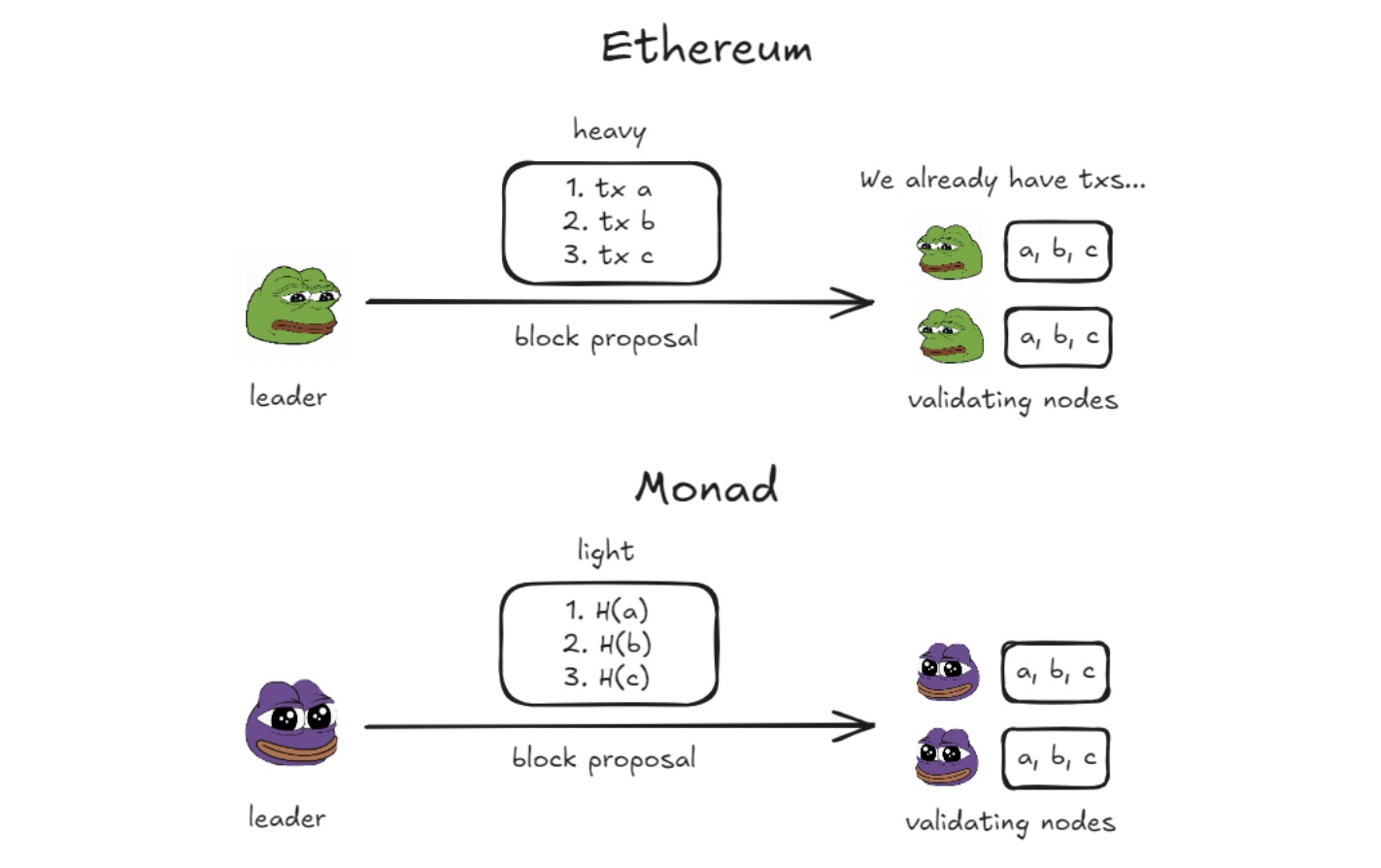
To address this, the purple Pepe wizard introduced the concept of "transaction hashes." Since all transactions submitted by villagers have already been propagated across the network, each node maintains a record of Monad village transactions in its own mempool.
This means leaders no longer need to transmit complete transaction lists in every block proposal. Instead, leaders can simply reference transactions by sending only their hash values.
Thus, Monad’s block proposals contain only the hash of each transaction. Upon receiving these hashes, other nodes can easily cross-reference them with their own transaction records.
5. Secret Spell Three: MonadBFT

In the Monad village, transaction ordering within each block and consensus on block creation are governed by MonadBFT, a high-performance consensus mechanism based on HotStuff. This phased BFT (Byzantine Fault Tolerance) algorithm enables consensus in two steps.
The role of block leader is randomly selected based on each participant’s stake share. In Monad, block construction is more efficient than in the Ethereum village because each block N proposal is transmitted together with the quorum certificate (QC) of the previous block N-1, indicating that more than two-thirds of nodes have validated that block.

Here’s how it works:
-
Leader N broadcasts the proposal for block N, along with the QC for block N-1.
-
Validators then verify block N and send their votes to Leader N+1.
-
Leader N+1 shares the proposal for block N+1, along with the QC for block N.
-
However, even with QC N, validators cannot immediately finalize block N, because the nature of blockchain cannot guarantee all participants are synchronously online.
-
To fully secure block N, validators must send their "yes" vote on block N+1—which includes QC N—to Leader N+2. When Leader N+2 generates QC N+1, it confirms the successful completion of round N+1, thereby finalizing block N.
Thus, through ingenious magic, the purple Pepe wizard ushered Monad village into a new era.
6. Secret Spell Four: Parallel Execution

In Monad, to handle the vast volume of villagers’ transactions, the purple Pepe wizard devised a new spell: unlike Ethereum village, which processes transactions sequentially, Monad processes them in parallel.
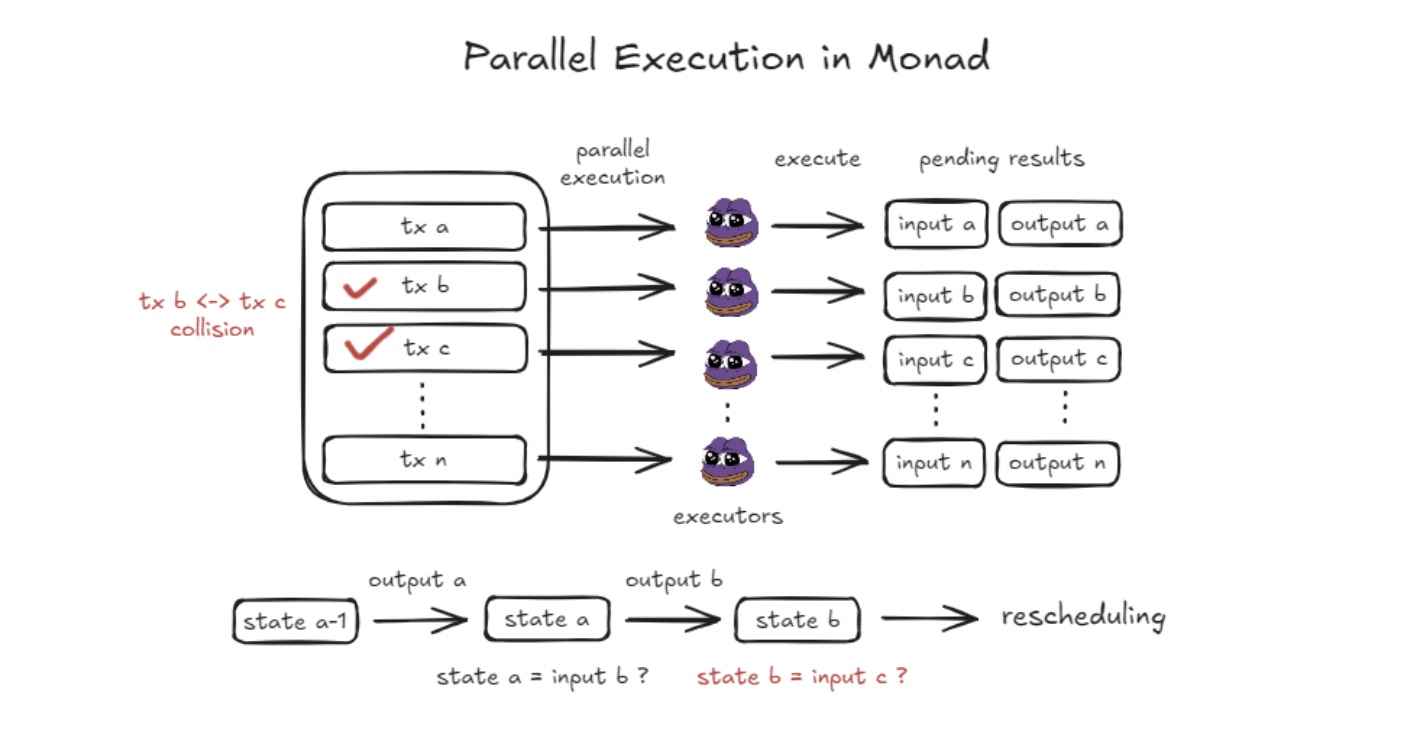
With deferred execution, execution only begins after transaction ordering within the block has reached consensus. The Monad village consists of many skilled executors, each responsible for processing transactions, independently computing inputs and outputs, and creating pending lists.
These inputs and outputs do not immediately alter the village’s state but wait in suspended magical form, ready to be committed in the order determined by consensus. This commitment merges outputs one by one into the current state, like threads weaving a seamless and orderly tapestry.
However, a twist arises. Parallel processing introduces the possibility of transaction conflicts—a rarity in the orderly Ethereum village but a new challenge in Monad.
For example, if one transaction (transaction b) shows Villager A sending 1 ETH to Villager B, and another transaction (transaction c) shows B spending that ETH at the village inn, their order becomes critical. If transaction c attempts to execute before transaction b, it will fail. In such cases, conflicting transactions are rescheduled—transaction c waits until transaction b completes before executing.
Therefore, in Monad, the core of parallel execution lies in ordering: results are computed in parallel, but state updates are merged in the precise required sequence.
7. Secret Spell Five: MonadDb

The purple Pepe wizard’s ingenuity did not stop there. He conjured MonadDb, a custom-built database unique to the Monad village, specifically designed for storing blockchain state. Ethereum relies on the complex Merkle Patricia Trie—a structure renowned for its resilience but notorious for inefficiency with external clients.
MonadDb was designed with the village’s parallel execution in mind, supporting multiple simultaneous reads and writes with high precision. Unlike traditional databases that require each task to finish before moving to the next, MonadDb possesses asynchronous I/O magic, allowing tasks to seamlessly overlap and opening the door to true parallel transaction processing.
8. Come Visit the Monad Village
Through a series of wondrous spells and intricate magic, the purple Pepe wizard created the Monad village. Here, Ethereum’s trusted accounts, cryptography, transaction formats, languages, and wallets blend effortlessly with the scalability of Solana and Sui. Now, Monad is flourishing, racing toward the dream of achieving 10,000 transactions per second.
Born from wisdom and hope, can the Monad village save a world plagued by the meme virus and help Ethereum reclaim its glory? Only time will tell.
Join TechFlow official community to stay tuned
Telegram:https://t.me/TechFlowDaily
X (Twitter):https://x.com/TechFlowPost
X (Twitter) EN:https://x.com/BlockFlow_News
 @100y_eth