Nansen Research Report: GameFi on the Brink of Explosion – A Comprehensive Comparison of Illuvium, Axie Infinity, and Seraph
TechFlow Selected TechFlow Selected
Nansen Research Report: GameFi on the Brink of Explosion – A Comprehensive Comparison of Illuvium, Axie Infinity, and Seraph
The blockchain gaming market is experiencing rapid growth and could reach a market size of $301.5 billion by 2030.
 Navigating Web3 tides with focused insights
Author: Slice Analytics
Translation: TechFlow
"Games are a form of communication and a bridge connecting people. They're like a thread that tightly binds individuals together." — Hideo Kojima, Creator of Metal Gear.
Introduction
The blockchain gaming market is experiencing rapid growth, with an estimated compound annual growth rate (CAGR) of approximately 68% from 2024 to 2030, potentially reaching a market size of $301.5 billion by 2030. This expansion is driven by the decentralized nature of blockchain technology, which enables players to truly own in-game assets such as NFTs and tokens. This ownership distinguishes GameFi from traditional gaming ecosystems by uniquely combining entertainment and financial incentives in ways not possible on conventional platforms.
While all GameFi genres are expected to thrive over the next decade, role-playing games (RPGs) are particularly well-suited to benefit from GameFi's decentralized model due to their emphasis on character progression, immersive worlds, and in-game economies. In traditional RPGs, players invest significant time developing characters, acquiring rare items, and exploring intricate storylines—yet the value of these achievements is often confined within the game’s ecosystem. In contrast, GameFi allows players to truly own and trade assets like rare items and characters, transforming in-game accomplishments into tangible real-world value and enhancing player engagement through additional progression incentives. According to a 2023 report by Game7, RPGs are considered the most popular Web3 game genre, accounting for 22% of all Web3 games, followed by action games at 17%. This further demonstrates the strong synergy between RPGs and GameFi.
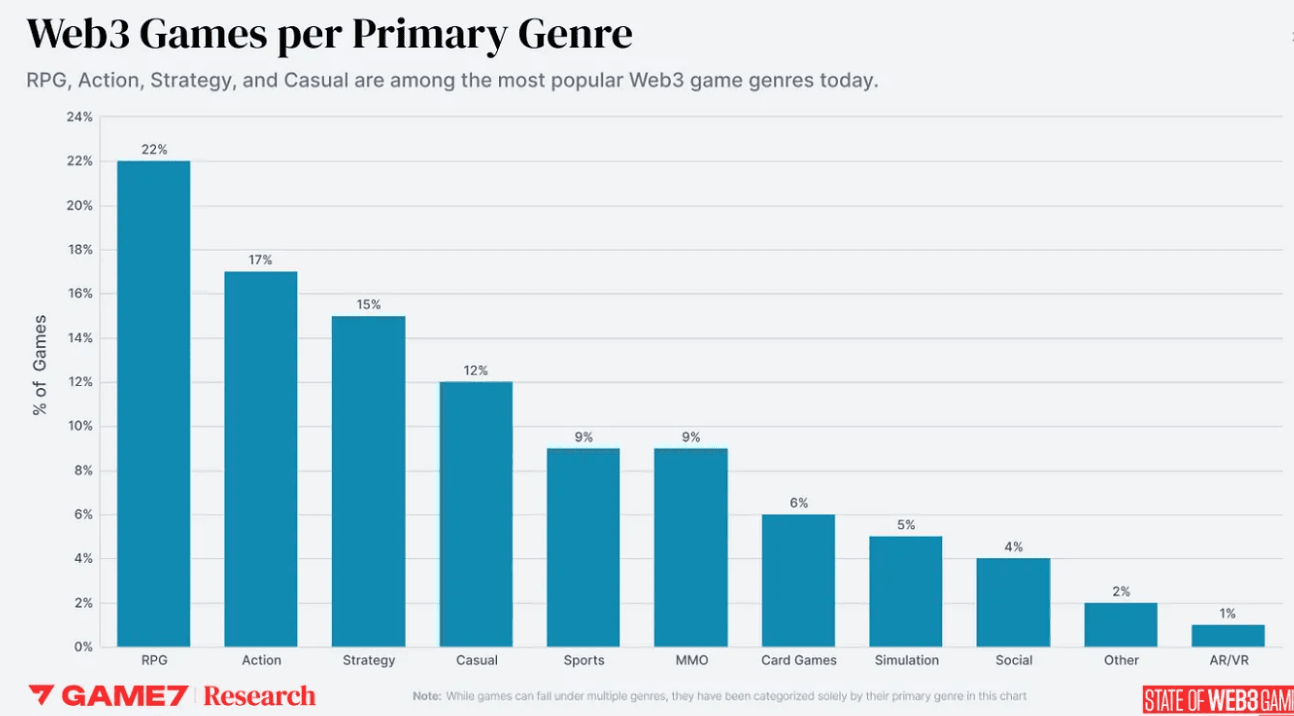
Source:Web3 Games by Genre
Another indicator of growth in the Web3 GameFi space is the rise of AAA and AA games. AAA games typically receive at least $25 million in funding, are backed by publishers, and developed by experienced large teams. These games bring unprecedented quality and immersive experiences to blockchain gaming. While AAA games currently make up only 1% of GameFi titles, AAA and AA games combined account for 6%, surpassing the 4% share of AAA and AA games on traditional Web2 platforms like Steam, according to Steam data. The higher investment concentration in GameFi may stem from the technical complexity required in Web3 development—such as mastering blockchain technology and smart contracts—or from the fact that 71% of daily users on Steam interact with AA or AAA games. This suggests a user preference for high-production-value games, indicating that AAA games in GameFi are meeting market expectations.
Beyond analyzing RPG and action-based GameFi genres and economic and social growth trends, this report also compares key metrics across top games and blockchains.
Differentiating Factors in Web3 Gaming
Games like Illuvium, Axie Infinity, and Seraph exemplify how high-quality gameplay can be integrated with decentralized economic systems in Web3 gaming. Illuvium focuses on delivering a visually stunning 3D world combining PvE (player versus environment) and PvP (player versus player) mechanics. Axie Infinity is renowned for its "play-to-earn" model, enabling players to earn real income through gameplay, though it has faced challenges with user retention. Seraph stands out with its variable rarity loot and gacha system, where randomness ensures that even low-spending players have a chance to obtain high-value rewards. This “degen” reward structure, common in crypto circles, drives excitement and encourages sustained participation. As a PC and mobile loot-based game, Seraph uses NFTs to verify rare virtual assets earned or purchased in-game. Integrating NFTs enables free trading and monetization of assets, creating a powerful cycle of player engagement and continuous involvement. Below is an example of Seraph’s dynamic reward system, where luck introduces significant variability in reward rarity.
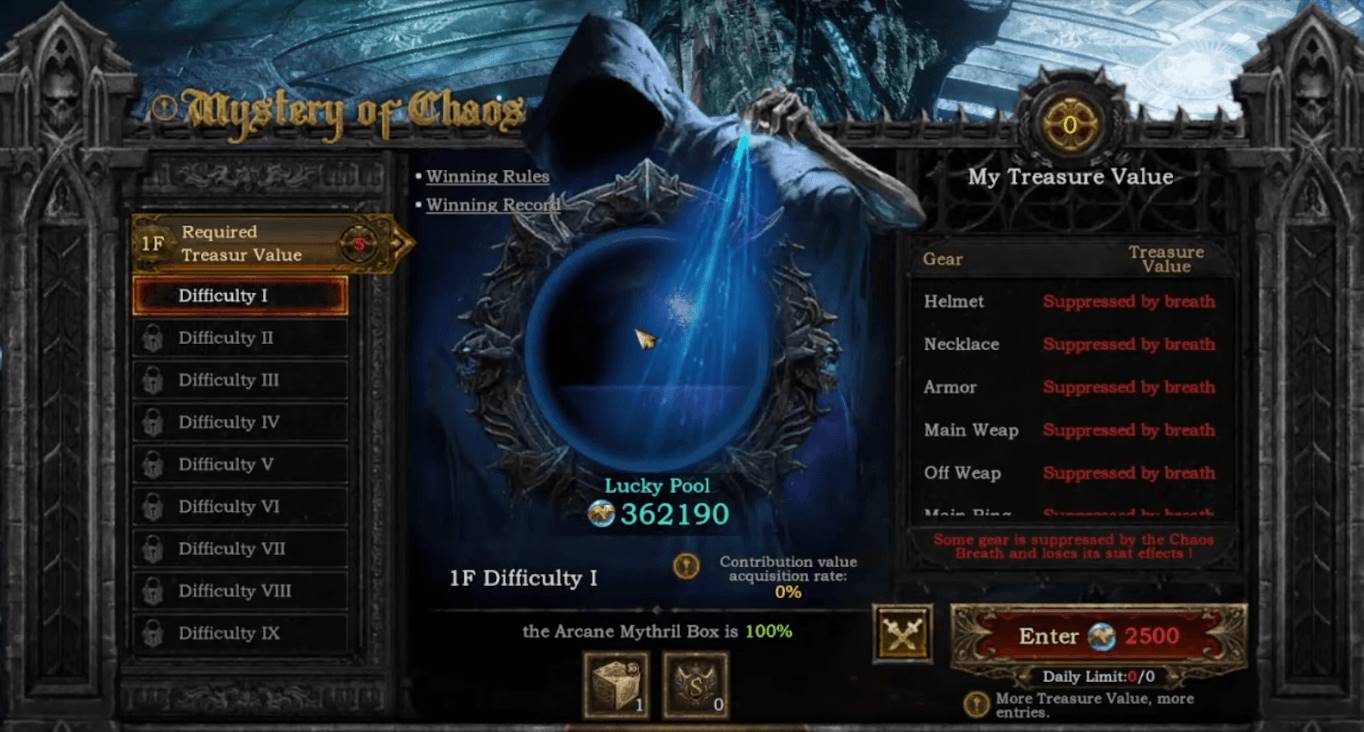
Source:Seraph, Mystery of Chaos
In-Game Economy Comparison
In successful Web3 games, the design and mechanics of in-game economies are critical for driving player interaction and engagement. Axie Infinity features one of the most recognized dual-token economic models, consisting of Smooth Love Potion (SLP) and Axie Infinity Shards (AXS). SLP is a functional token earned through gameplay, used primarily for breeding new Axies, forming a circular economy where participation yields rewards. SLP can also be traded on secondary markets, converting in-game effort into real-world value. AXS serves as the governance token, allowing holders to vote on key decisions about the game’s future and earn additional rewards through staking.
Illuvium leverages a robust NFT marketplace where players trade rare assets such as Illuvials. By integrating collectible elements into its "play-to-earn" model, Illuvium adds value and depth to its economic framework.
Seraph adopts a single-token model, keeping its functional token off-chain. This strategy promotes a stable economic loop, enabling seamless movement of funds inside and outside the game while concentrating user capital and engagement around a single currency.
Below is a comparison table of in-game economies for Seraph, Axie Infinity, and Illuvium (2024):
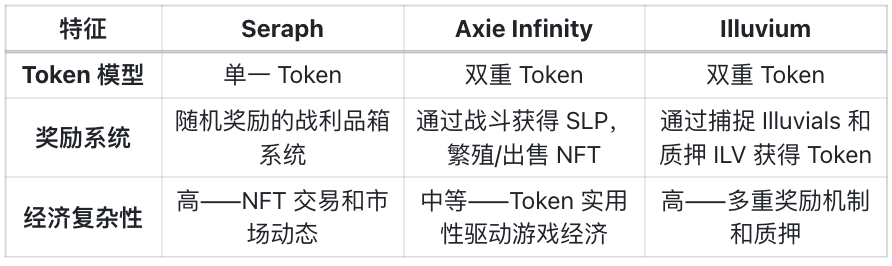
Source: Comparison of In-Game Economies – Seraph, Illuvium, and Axie Infinity (2024)
Social Engagement
In Web3 gaming, community engagement on social platforms is crucial for building a strong player base and sustaining interest. X (formerly Twitter), Discord, and Telegram are essential tools developers use to release updates, interact with players, and foster a sense of belonging within the game ecosystem. High follower counts on these platforms often reflect a game’s ability to cultivate a dedicated and active community—an essential factor for long-term success in decentralized environments.
Axie Infinity boasts 869K Twitter followers and 591K Discord members, making it one of the most active communities in the space, laying the foundation for early user growth and influence. Seraph also has a strong community presence with 374K Twitter followers, 321K Discord members, and 92K Telegram members, fueling its rapid development. Illuvium, though slightly smaller, still maintains a substantial audience with 399.5K Twitter followers, 116K Discord members, and 17K Telegram members, underscoring the importance of maintaining active communication channels. While all major competitors have considerable total followings, Seraph has shown particularly strong recent growth, adding 52K Twitter followers in the past month compared to just 1.9K for Axie and 2.1K for Illuvium.
Below is a comparison table of social impact for Seraph, Illuvium, and Axie Infinity (2024):

Social Influence Performance Across Seraph, Illuvium, and Axie Infinity (2024)
Maintaining large, active user bases across multiple social platforms enables games to keep players informed, engaged, and excited about upcoming features and developments. Additionally, recent follower growth reflects effective short-term capture of user attention.
Quantitative Metrics Comparison
Despite broader challenges in the crypto market, blockchain gaming saw an 8.94% increase in daily transactions in August 2024. When examining performance across the year, Seraph leads significantly in daily active wallets (DAW) with 537K, far exceeding Illuvium’s 200+ and Axie Infinity’s 154K. However, Axie Infinity dominates the current NFT market cap at $34 million, followed by Seraph at $15 million and Illuvium at $2.8 million. In terms of NFT trading volume, Seraph leads by a wide margin with $65.5 million, vastly outpacing Axie Infinity’s $22 million and Illuvium’s $3.1 million. A key driver behind Seraph’s high DAW could be its 66% seven-day retention rate during its pre-season, indicating sustained engagement among new users.
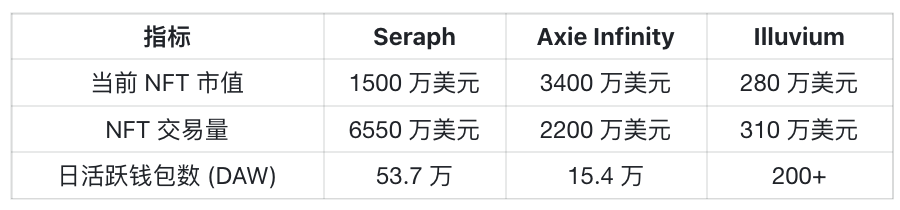
Source: Metric Comparison – Seraph, Illuvium, and Axie Infinity (2024)
Sources: DappRadar, Footprint, CryptoSlam, Immutable.com, ActPass
Comparison of Top GameFi Blockchains
When evaluating leading GameFi blockchains such as opBNB, Ronin, Polygon, and Immutable X, key factors include gas fees, transactions per second (TPS), and scalability. These metrics are especially important for NFT gaming ecosystems, which require fast and cost-effective transactions to support high-volume activity.
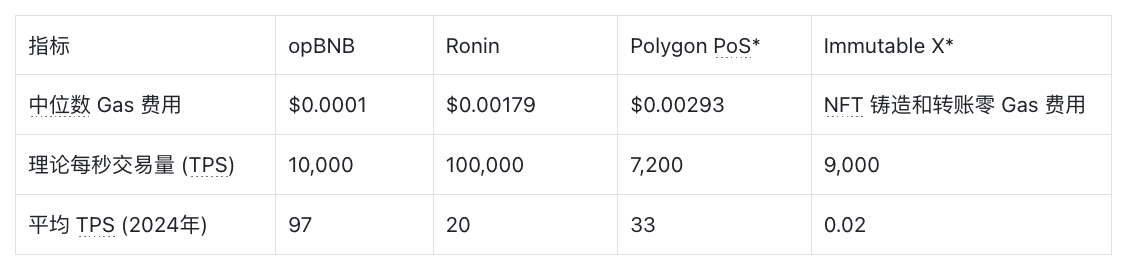
*Polygon PoS and Immutable X have recently introduced zk-rollup solutions
Source:Key Metrics of Leading Gaming Chains: opBNB, Ronin, Polygon PoS, and Immutable X
Below is a detailed analysis of key metrics:
-
Gas Fees: Gas fees are critical in GameFi ecosystems due to frequent microtransactions and NFT trades. Among major chains, opBNB offers the lowest median gas fee at just $0.0001, making it highly cost-efficient for gaming applications. Ronin follows closely with a median fee of $0.00179, while Polygon PoS charges $0.00293. Immutable X excels in NFT minting and transfers by charging zero gas fees.
-
Theoretical Transactions Per Second (TPS): High TPS is essential for handling the volume required by real-time multiplayer games and frequent asset trading. As of October 2024, Ronin leads with 100,000 TPS, surpassing Immutable X’s 9,000 TPS and Polygon PoS’s 7,200 TPS. opBNB ranks among top-tier chains with 10,000 TPS, ensuring scalability for large-scale NFT transactions.
-
Average TPS: While theoretical maximum TPS reflects network capacity potential, actual usage varies. Currently, opBNB averages 97 TPS, far below its 10,000 TPS theoretical limit. Ronin averages 20 TPS, Polygon PoS handles 33 TPS, and Immutable X lags at just 0.02 TPS. Since average TPS figures remain well below theoretical peaks, scalability is not yet an urgent constraint. However, as the gaming industry expands and account abstraction (AA) adoption increases—especially in complex game ecosystems—high TPS will become vital for managing increased load and ensuring seamless user experiences.
Fast transaction speeds, low gas fees, and strong scalability remain key to supporting the growing demands of NFT-driven gaming economies. With the highest average TPS at 97 (2024), opBNB demonstrates its capability to handle high transaction volumes. As GameFi continues to scale, these chains will play pivotal roles in shaping the future of blockchain gaming.
Key Factors in GameFi Blockchains
To assess a blockchain network’s success in the gaming industry, several key performance indicators must be evaluated, including daily active wallets (DAW), total value locked (TVL), and the number of games hosted per chain. Comparing opBNB, Ronin, Polygon, and Immutable X reveals how these metrics reflect ecosystem vitality, user engagement, and platform liquidity. Additionally, security remains a critical concern, as major breaches on leading chains could undermine user trust in GameFi.
Below is a comparison of key gaming metrics for opBNB, Ronin, Polygon PoS, and Immutable X:
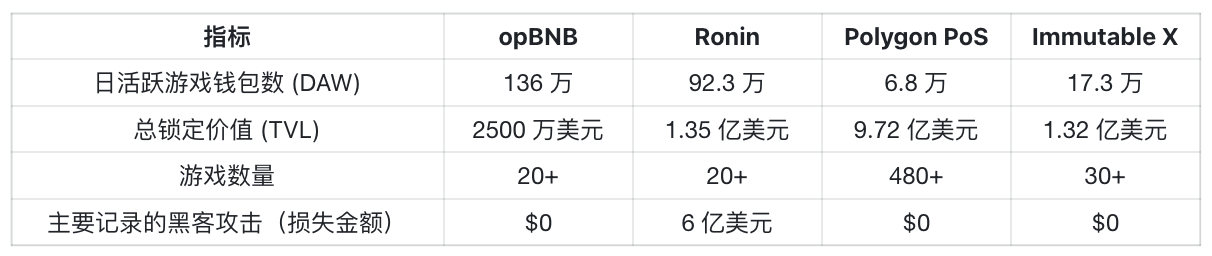
Source: Game-Specific Metrics – opBNB, Ronin, Polygon PoS, and Immutable X
Sources: DappRadar, Footprint, Defillama, Crypto Briefing, CNN
Our findings include:
-
Daily Active Game Wallets: As of October 2024, opBNB achieved a 72% month-over-month increase in DAW, reaching 1.36 million daily active players—highlighting its scalability and superior performance in gaming. In contrast, despite being a widely used platform, Polygon recorded only 68,000 DAW, reflecting a decline in its gaming user base. Ronin and Immutable X reported DAWs of 923K and 173K respectively, indicating stable user engagement within their ecosystems.
-
Total Value Locked (TVL): Polygon leads with $972 million in TVL, reinforcing its significance in the gaming sector. Ronin and Immutable X follow with $135 million and $132 million respectively. Meanwhile, opBNB, as a newer Layer 2 solution, is rapidly rising with $25 million in TVL.
-
Number of Games: Polygon hosts over 480 games, establishing itself as a developer hub. opBNB follows with over 20 games, demonstrating rapid expansion in the GameFi space. Ronin and Immutable X host over 20 and over 30 games respectively, focusing on niche areas such as Axie Infinity on Ronin and NFT-driven games on Immutable X.
-
Major Recorded Hacks (Loss Amount): opBNB and Immutable X have had no documented hacks to date, maintaining strong security records. Polygon faced a potential vulnerability but was alerted by a white-hat hacker who warned the team in time. In contrast, Ronin suffered the most severe security incident—a $600 million hack enabled by attackers exploiting private keys to validate network transactions. Following the breach, Ronin implemented security upgrades, including increasing validator count and introducing Hardware Security Modules (HSM), to prevent future vulnerabilities.
Conclusion
In summary, the GameFi ecosystem is undergoing a significant expansion phase, projected to reach a market value of $301.5 billion by the end of 2030. This rapid growth is fueled by decentralized ownership of in-game assets such as NFTs and tokens, which offer real-world value and unique financial incentives unattainable in traditional gaming ecosystems. Despite broader market challenges, daily active wallet counts grew by 8.94% in August 2024, further demonstrating the resilience of the current GameFi landscape.
With ongoing improvements in blockchain infrastructure—delivering higher transaction throughput, lower gas fees, and enhanced scalability—GameFi projects, especially those powered by NFT-driven economies and strong social engagement, are well-positioned for growth. Leading chains like opBNB, Ronin, and Immutable X are attracting developers and players alike due to their advantages in speed, low cost, and scalability.
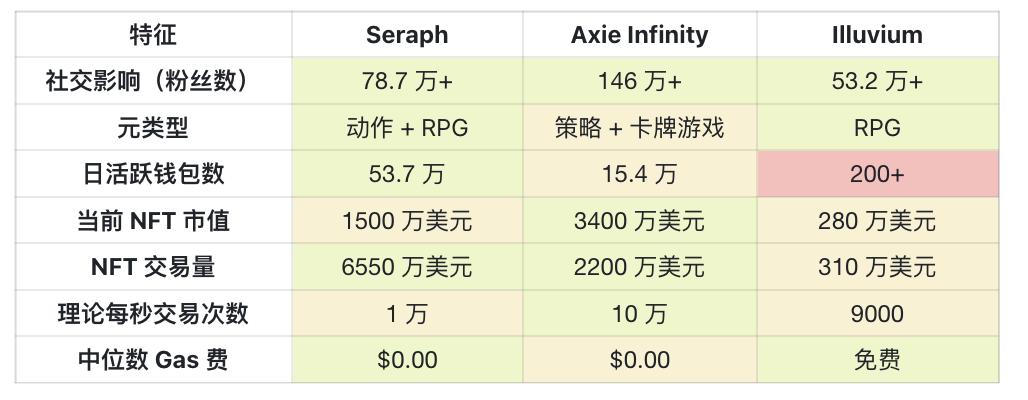
Color coding: Green indicates good, yellow indicates moderate, red indicates below average
Source: Key Feature Comparison Matrix – Seraph, Axie Infinity, and Illuvium
Disclaimer: The following report was authored by Nansen and Slice Analytics under an existing service agreement with Seraph (“Client”). Although Seraph has the right to review and provide feedback on the report, Nansen retains full editorial control over its publication. The views expressed herein are independent opinions of Nansen research analysts (i.e., the authors referenced in this report). This report is for informational purposes only and does not constitute investment, financial, professional, or other advice. For more information, please refer to the disclaimer at the end of this report and our terms of service.
Join TechFlow official community to stay tuned
Telegram:https://t.me/TechFlowDaily
X (Twitter):https://x.com/TechFlowPost
X (Twitter) EN:https://x.com/BlockFlow_News
 Nansen