Multi-perspective Argumentation: Why Unichain Is Inevitable?
TechFlow Selected TechFlow Selected
Multi-perspective Argumentation: Why Unichain Is Inevitable?
Dan Elitzer predicted in 2022 that Unichain would emerge due to inefficiencies and value leakage within the Uniswap system, and today this OP Stack-based Layer 2 solution has been launched to improve DeFi trading efficiency and liquidity.
 Navigating Web3 tides with focused insights
Author: Eren, Heechang
Translation: Baishuo Blockchain
In 2022, Dan Elitzer stated that Unichain was an inevitable evolution, driven by inefficiencies and value leakage within the existing Uniswap ecosystem. He noted that Uniswap traders currently face three costs: swap fees paid to liquidity providers, transaction fees paid to Ethereum validators, and MEV (Maximal Extractable Value) costs.
This prediction has now become reality. Uniswap, the most widely used decentralized exchange protocol in crypto, has announced its own Layer 2 solution—Unichain. Built as an OP Stack-based rollup, this new chain aims to address key challenges in the DeFi ecosystem by improving transaction execution environments, enhancing user experience, and solving the issue of fragmented liquidity.
1. Background: The Rationale Behind Unichain
1) Dan Elitzer’s Prediction
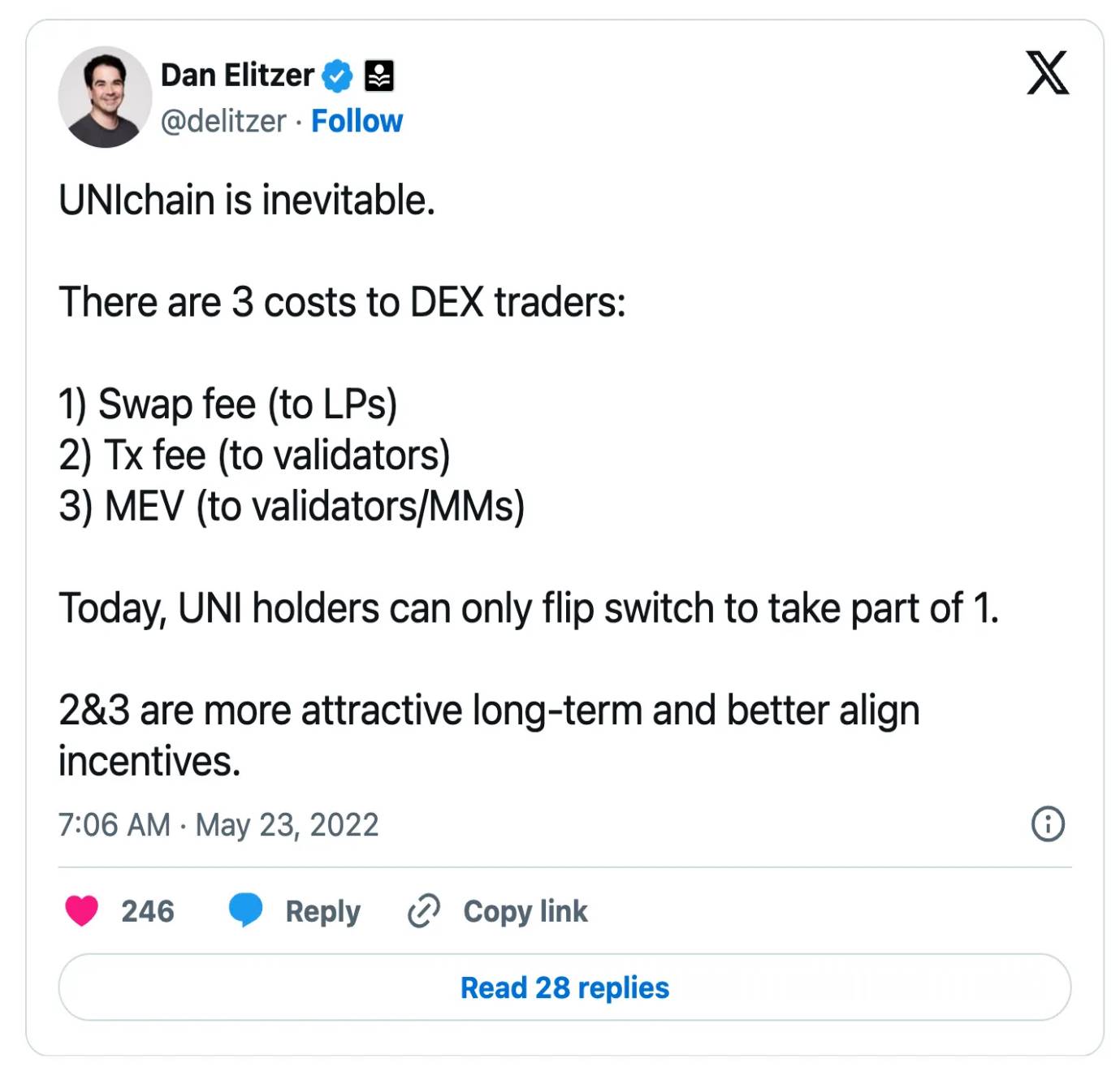
Dan's research revealed that transaction fees and MEV costs paid to Ethereum validators and market makers exceed the swap fees earned by liquidity providers. This means external entities are capturing more value than participants within the Uniswap system, resulting in value that should belong to Uniswap users, LPs, or UNI token holders being siphoned off externally.
To summarize his argument for Unichain's necessity: Unichain could help reduce inefficient value extraction caused by transaction fees and MEV, thereby returning greater value to UNI holders. By operating its own chain, Uniswap can significantly lower transaction costs—especially beneficial for small traders. Additionally, solutions like threshold encryption or batched swaps can help traders minimize MEV exposure.
The most significant advantage of Unichain lies in better incentivizing Uniswap participants. Currently, UNI holders have limited value accrual options, primarily restricted to governance decisions such as adjusting swap fees. A dedicated chain would allow UNI holders to earn from transaction fees and internalized MEV, strengthening the token’s value proposition. This approach not only rewards UNI holders but also creates a more efficient trading environment, potentially solidifying Uniswap’s position as the leading decentralized trading platform.
2) Unichain: Capturing More Value, Unifying the Platform
Source: Uniswap, Flashbots, and OP-Stack: The Trinity Behind Unichain — 100y
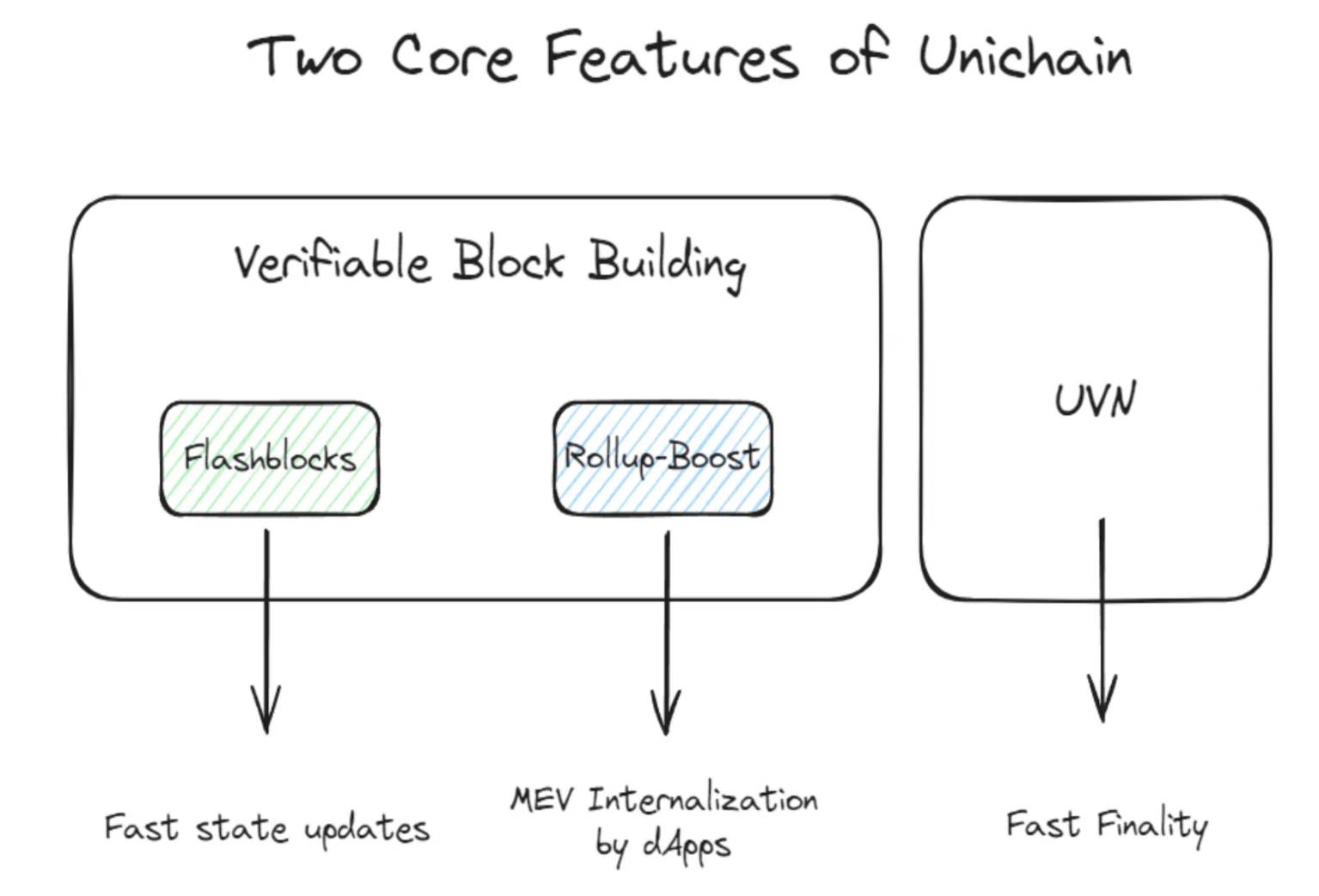
Unichain leverages the OP Stack to build a Superchain, introducing two major innovations aimed at improving L2 efficiency, user experience, and liquidity management.
The first key feature is Verifiable Block Building (VBB), developed in collaboration with Flashbots. This system includes a mechanism called Flashblocks, which divides each block into four sub-blocks, reducing effective block times to 200–250 milliseconds and accelerating state updates. Moreover, Unichain uses Trusted Execution Environments (TEE) to separate the sequencer from the block builder and implements a priority ordering mechanism that taxes MEV opportunities, allowing applications to directly extract and internalize MEV.
The second major innovation is the Unichain Verification Network (UVN), a decentralized network of node operators that independently verify blockchain states. UVN enables fast finality and economically secure cross-chain settlement. When a new block is created on Unichain, validators must prove the legitimacy of the chain, mitigating security risks associated with a single centralized sequencer. To become a validator, one must stake UNI tokens, and based on their stake weight, selected nodes perform verification and receive corresponding rewards. This model allows UNI holders to delegate their stakes to validator nodes and earn distributed rewards.
2. Key Takeaways: The Direction of DeFi Evolution Proposed by Unichain
DeFi is no longer confined to single applications but is pursuing increasingly complex development paths. DeFi apps are actively internalizing value that was previously extracted externally, launching their own app chains or L2s, and building wallet services. Application-Specific Sequencing (ASS), which enables apps to directly capture MEV, is gaining attention. Within these trends, Unichain’s launch clearly signals a future where large-scale DeFi protocols will secure their own infrastructure.
1) DeFi Is Getting "Fatter"
DeFi is evolving toward greater complexity to internalize value lost to external actors, improve user experience, and offer independent “money legos” through interoperability among native financial products.
This trend manifests in applications adopting ASS designs instead of relying on standard L2/L3 execution, preventing MEV leakage during transaction ordering. For example, controlling the order of transactions dependent on external oracle data allows applications to directly capture MEV (Oracle Extractable Value, OEV). Alternatively, intent-based batch auctions via solver networks prevent MEV exposure altogether.
Other applications enhance UX by developing auxiliary infrastructure such as application-specific wallets or mobile interfaces, preventing value from flowing to third-party platforms.
A. Application-Specific Sequencing (ASS): CoW AMM
CoW AMM protects liquidity providers (LPs) from MEV by batching trades off-chain into single batches and auctioning arbitrage opportunities. Whenever an arbitrage opportunity arises in CoW AMM, solvers compete for the right to rebalance the pool. The solver offering the best trade terms for LPs while leaving the highest surplus for the liquidity pool wins the right to execute the rebalancing. Through this batch auction mechanism, CoW AMM captures the MEV typically extracted by arbitrage bots when rebalancing price discrepancies across pools, eliminating LPs’ risk of loss due to rebalancing (LVR).
B. Mobile / Wallet: Jupiter / Uniswap Wallet
Current device usage statistics show mobile devices account for 63% of usage, compared to 37% for desktops, indicating substantial growth in mobile adoption. As a result, building mobile-first experiences has become increasingly important in crypto application development.
Recently, Jupiter launched its mobile app, enabling users to handle all operations—from swapping and slippage settings to priority fee adjustments and onboarding—in a mobile environment. Users can trade at optimal prices via Jupiter routing without paying fees, receiving an optimized DeFi experience.
Additionally, Uniswap has developed and deployed its own wallet service, allowing users to seamlessly swap using routes from Uniswap’s liquidity pools. Uniswap Labs earns front-end fees from wallet-initiated swaps, creating a sustainable revenue stream.
In this way, DeFi is moving beyond implementing standalone DEXs, lending markets, or options contracts. By integrating ASS or building additional infrastructure internally, DeFi applications are becoming increasingly sophisticated. This enables them to gain competitive advantages by maximizing value internalization—either redistributing it to participants or delivering enhanced user experiences. However, Unichain’s choice of a dedicated L2 reflects a broader vision: becoming the “home for cross-chain DeFi and liquidity.” This suggests that expanding beyond single applications to full L2 ownership is a critical path toward unlocking greater potential.
2) From Dapp to L2

With the launch of Unichain, the roadmap for apps scaling to L2s has become clearer. Many applications have already begun migrating to L2s to improve infrastructure and user experience, starting with core DeFi products like stablecoins or liquid staking, then gradually expanding their scope. This transition to L2 creates significant value for apps in two main ways:
First, L2 infrastructure can generate diverse forms of value through unique mechanisms. For instance, selling blockspace based on demand has long been a proven business model in crypto, and sequencer revenue along with MEV extraction provides L2 operators with substantial cash flow. Unichain’s architecture introduces new possibilities for MEV operations through Priority Ordering. By separating the block builder and sequencer via Trusted Execution Environment (TEE), Unichain allows applications to directly control MEV and operate on captured MEV after agreements with users. In other words, Unichain offers a platform environment where applications and users—not sequencers—can govern MEV under consistent rules, demonstrating a meaningful methodology for application-specific L2s in MEV control.
The second major value enhancement comes from a tokenomics perspective. Historically, demand for Uniswap’s $UNI token has been limited, with little utility beyond governance. Early proposals like the Fee Switch aimed to distribute Uniswap revenues to $UNI holders, but regulatory concerns slowed progress.
In this context, Unichain presents a breakthrough opportunity for UNI utility. Participation in the UVN as a validator requires staking UNI, establishing cryptoeconomic security. UNI holders can delegate stakes to validator nodes and earn distributed rewards. Thus, transitioning to an L2 opens multiple avenues for native tokens to accumulate value—from sequencer revenue and MEV to staking rewards.
While the L2 transition significantly enhances value in both dimensions, is it truly ideal for the Ethereum ecosystem? Like any solution, it carries trade-offs. From the broader perspective of the Ethereum ecosystem, over 100 distinct L2s are fragmenting liquidity across Ethereum. Furthermore, relative to L2 activity levels, relatively little value flows back to Ethereum’s mainnet, creating a parasitic economic dependency of L2s on Ethereum.
3) Weakened Value Accrual for Ethereum
Source: Artemis
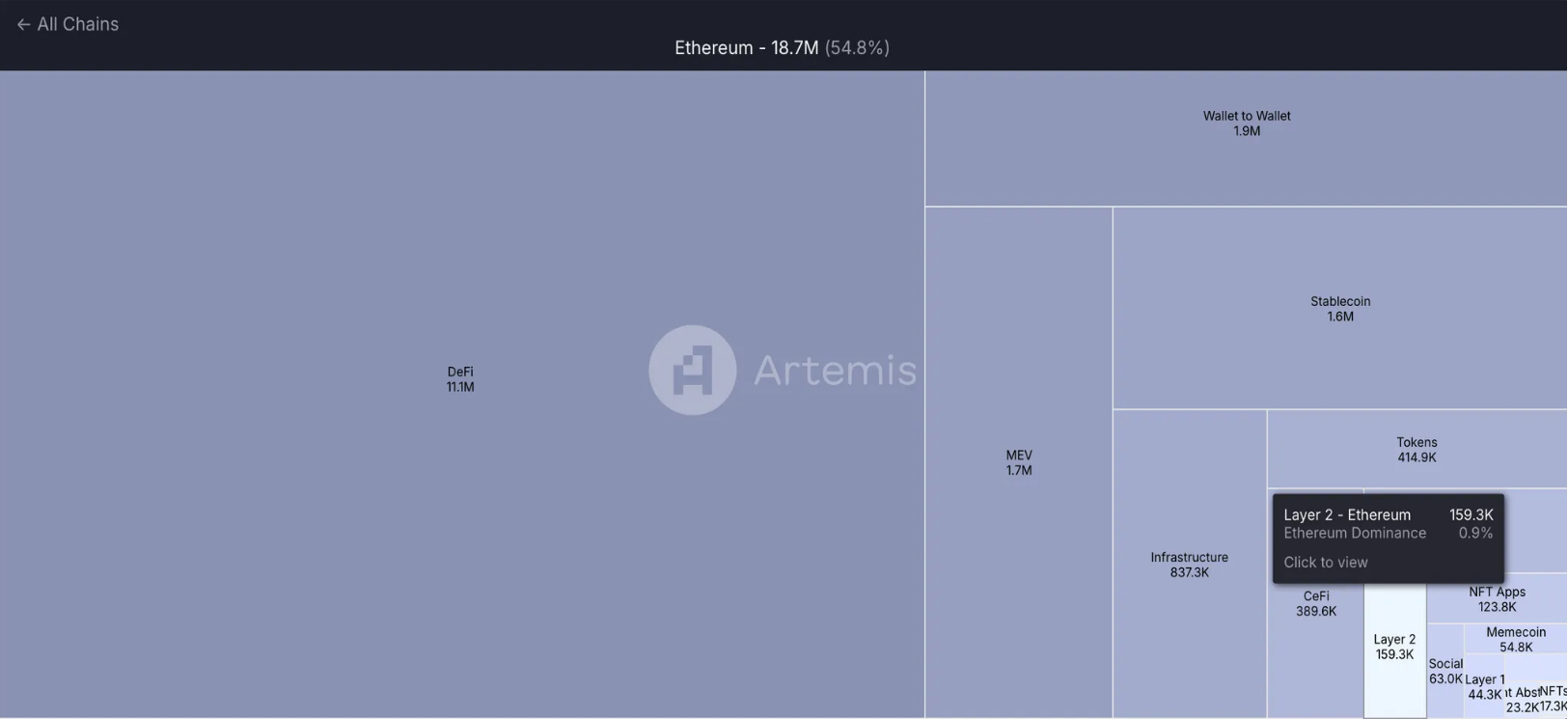
Ethereum’s current system for capturing value from L2 solutions faces structural issues, which grow more apparent as more applications build their own L2s. Currently, L2s account for only about 0.9% of total Ethereum gas usage, highlighting a disconnect between L2 growth and value accrual on the mainnet. Recent upgrades like EIP-4844 further reduce fees paid by L2s to Ethereum, potentially decreasing demand for ETH as gas.
This situation raises concerns that L2s may become economic parasites on Ethereum. Despite Ethereum’s vast ecosystem and strong developer base, its economic model is under scrutiny. Reduced fees mean lower network income for Ethereum, potentially weakening ETH’s value. While L2s benefit from Ethereum’s mature infrastructure, they may not be adequately supporting the health of the base layer economy.
However, as the L2 ecosystem expands, it could attract more liquidity and potentially establish ETH as the primary currency for economic activity within Ethereum. While this might sustain ETH’s use as an asset, the question remains: can it continue to grow as an asset?
3. Perspectives from Others
1) Jon Charboneau
Jon Charboneau’s view: “Saying L2s are Ethereum is as logical as saying Tesla is California.” (Source: X (@jon_charb))
2) Mason Nystrom from Pantera
Key insights on Unichain and its significance:
Token value accrual: UNI evolves from a governance token into a fee-accruing token. Validators with the largest UNI stakes earn rewards by securing the network and collecting fees. Unichain supports the “fat app” thesis: applications take control of economics and blockspace by launching their own chains. Uniswap’s chain will capture fees from various activities—including trading, lending, and perpetuals—going beyond traditional DEX functions. MEV internalization: Unichain’s verifiable block building and Flashblocks sequencing show promise. Applications are exploring ways to internalize MEV or redistribute it to users and stakeholders. Unichain vs. Ethereum: Unichain could significantly impact Ethereum’s mainnet. DeFi activity may shift to Unichain due to UNI staking for sequencer rights and improved pricing for users. Vertical integration: Larger apps are incentivized to control the entire stack—from applications (Uniswap Wallet, frontend + Uniswap X) and protocols (Uniswap V4, V3, V2) to the chain itself (Unichain).
3) Ryan Watkins from Syncracy Capital
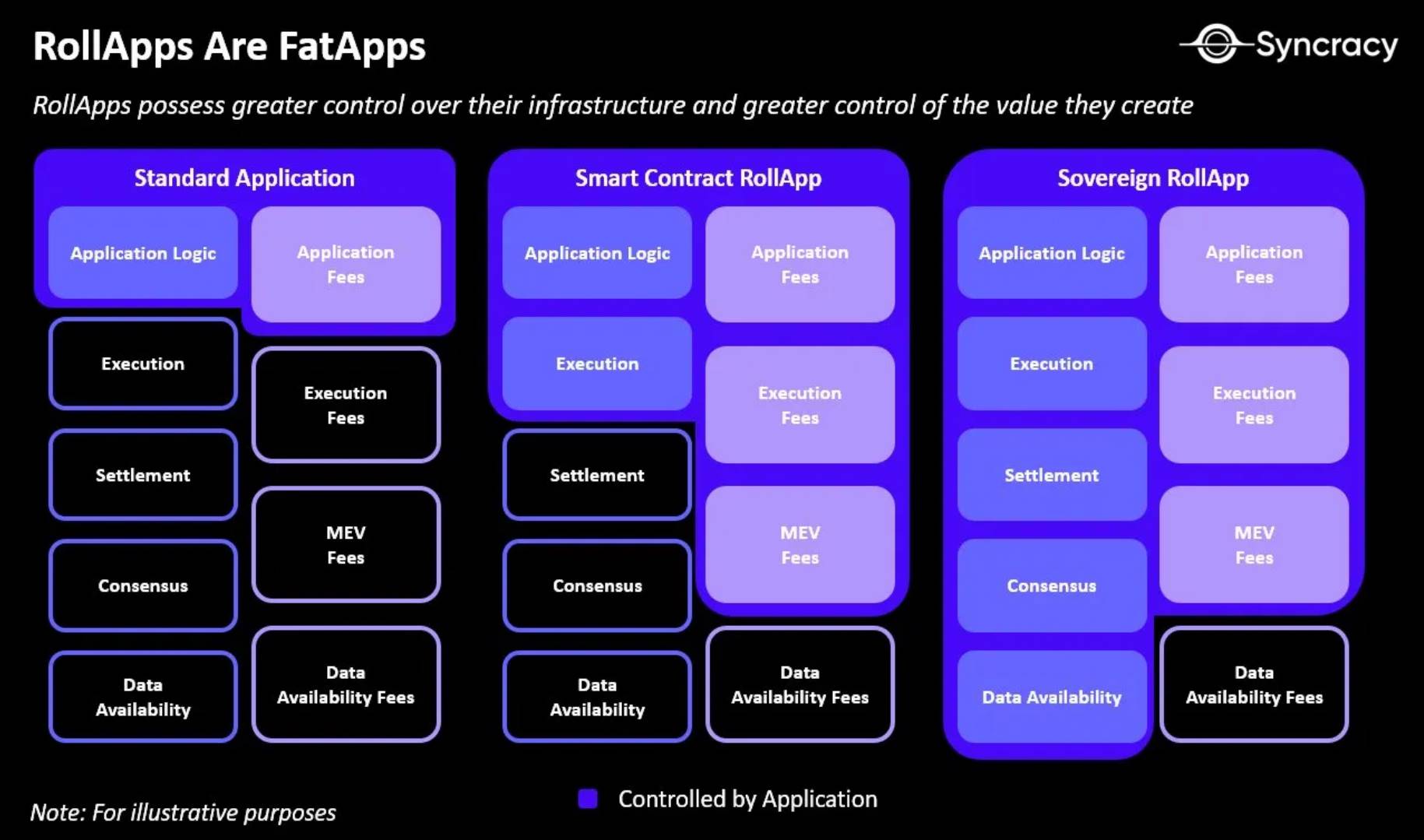
Source: Apps Capture Fees, Blockchains Store Value — Syncracy Capital
Ryan Watkins challenges the notion that “only Bitcoin and stablecoins are valuable blockchain applications.” He argues we’ve entered an era of multi-application blockchains. Platforms like Ethereum and Solana now host numerous applications generating significant revenue and rapid growth. Yet, these apps remain undervalued relative to foundational blockchain infrastructure. Trends indicate that applications are capturing an increasing share of blockchain fees, often surpassing infrastructure assets. This shift likely marks a pivotal turning point in blockchain development.
The rise of fat apps on blockchains represents a move toward greater application autonomy. The drive behind fat apps stems from demands for better scalability, improved user experience, and greater economic control compared to base-layer infrastructure. As chain abstraction and smart wallets evolve, this application-centric approach is expected to become increasingly seamless, potentially reshaping how value and control are distributed across the blockchain ecosystem.
Join TechFlow official community to stay tuned
Telegram:https://t.me/TechFlowDaily
X (Twitter):https://x.com/TechFlowPost
X (Twitter) EN:https://x.com/BlockFlow_News
 Four Pillars