Stablecoin, Layer 2, Cross-chain Bridge, and Staking Overview: USDe Market Cap Reaches $1.56 Billion, Base TVL Surpasses $2 Billion
TechFlow Selected TechFlow Selected
Stablecoin, Layer 2, Cross-chain Bridge, and Staking Overview: USDe Market Cap Reaches $1.56 Billion, Base TVL Surpasses $2 Billion
In September of this year, Solana's TVL reached 66% of Ethereum's, with over $58 billion staked.
 Navigating Web3 tides with focused insights
Author: OurNetwork
Translation: TechFlow
Editor's Note
This week, we co-hosted the first-ever on-chain data hackathon with Artemis—a one-day chart-building competition that brought together data analysts, developers, and investors from across the industry to uncover stories only on-chain data can tell.
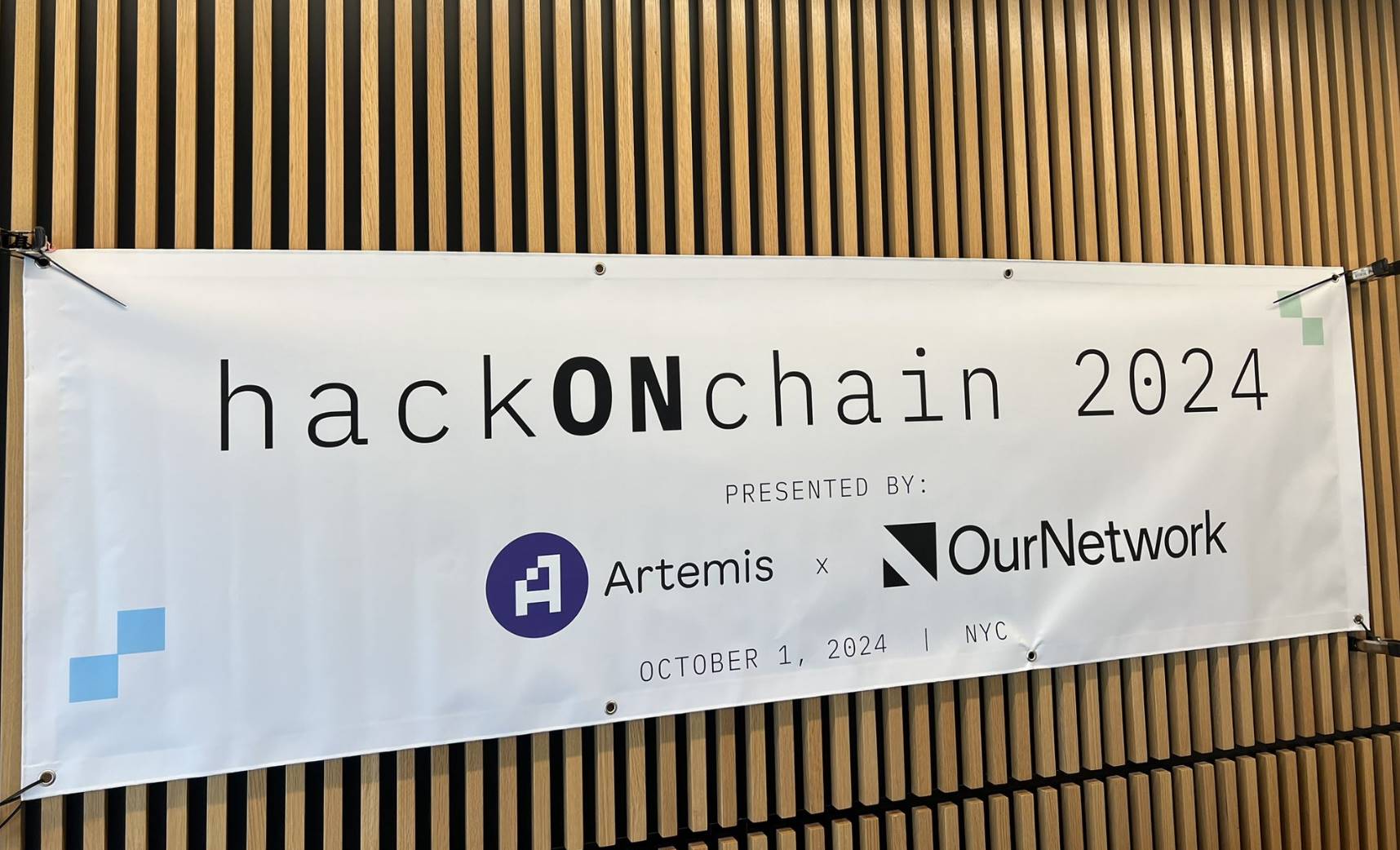
Today’s content features a collection of industry-grade reports compiled from submissions to the hackathon.

Stablecoins: Ethena, MakerDAO, Curve | Layer 2s: Base, Arbitrum, Celo | Cross-chain Bridges: LiFi | Staking: Ethereum vs Solana
Stablecoins
Delleon Mcglone | Twitter | Artemis Dashboard
Decentralized Stablecoin Giants: USDe Reaches $1.56B Market Cap, Mixed Q3 Performance
-
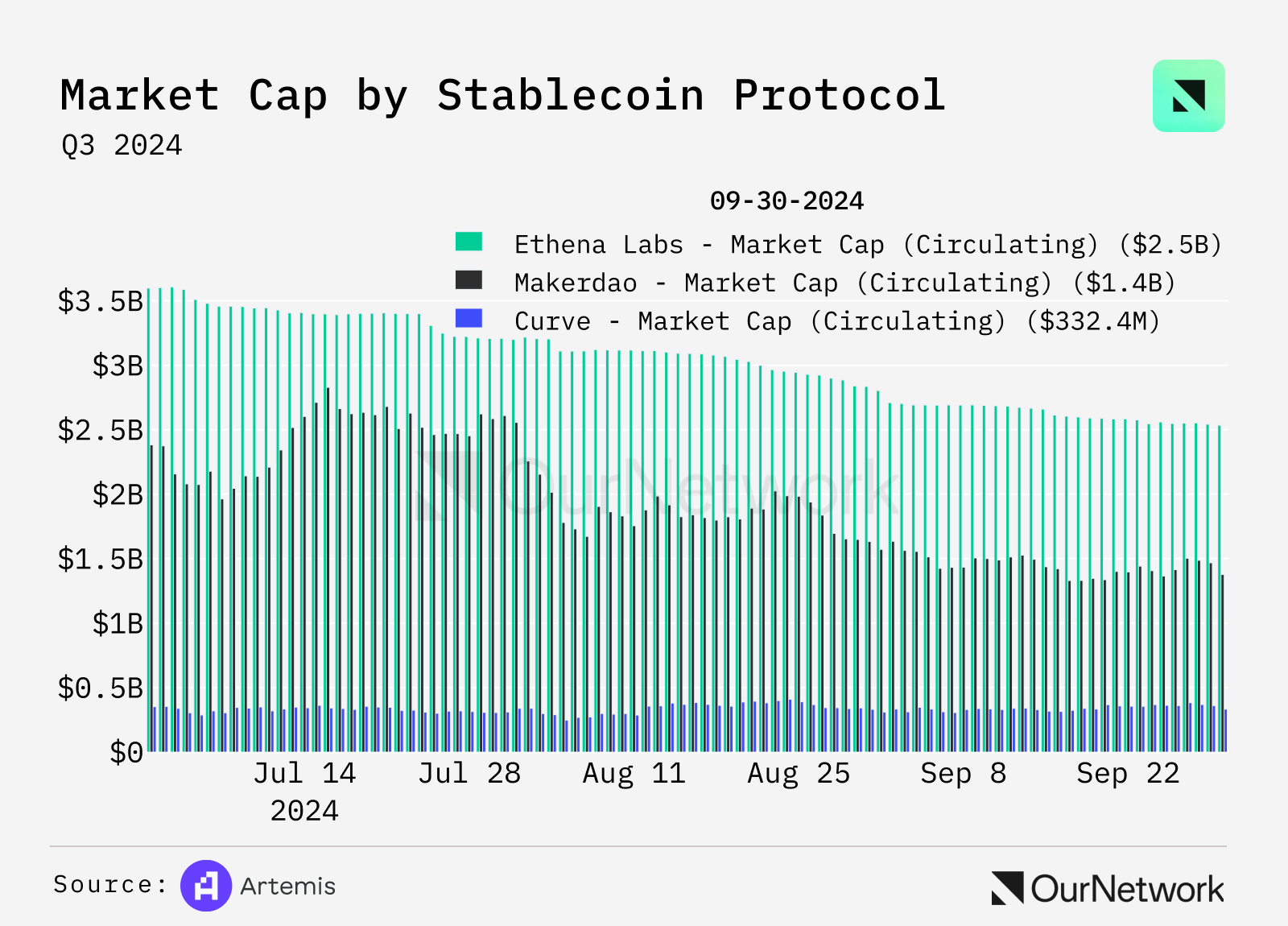
Ethena has consistently maintained the highest market cap at $3.1 billion, followed by MakerDAO (now known as Sky) at $2.16 billion, while Curve has the smallest but most stable market cap at $351.4 million. Overall, all three protocols show a downward trend: Ethena’s market cap declined significantly from $3.61 billion to $2.54 billion (-29.64%). This decline continued for MakerDAO, dropping from $2.3 billion to $1.5 billion (-45%), whereas Curve saw slight growth from $352 million to $359 million (+1.99%). Ethena’s decline was primarily driven by regulatory uncertainty, reduced liquidity (-35.33%), and decreased market cap (-24.2%).
-
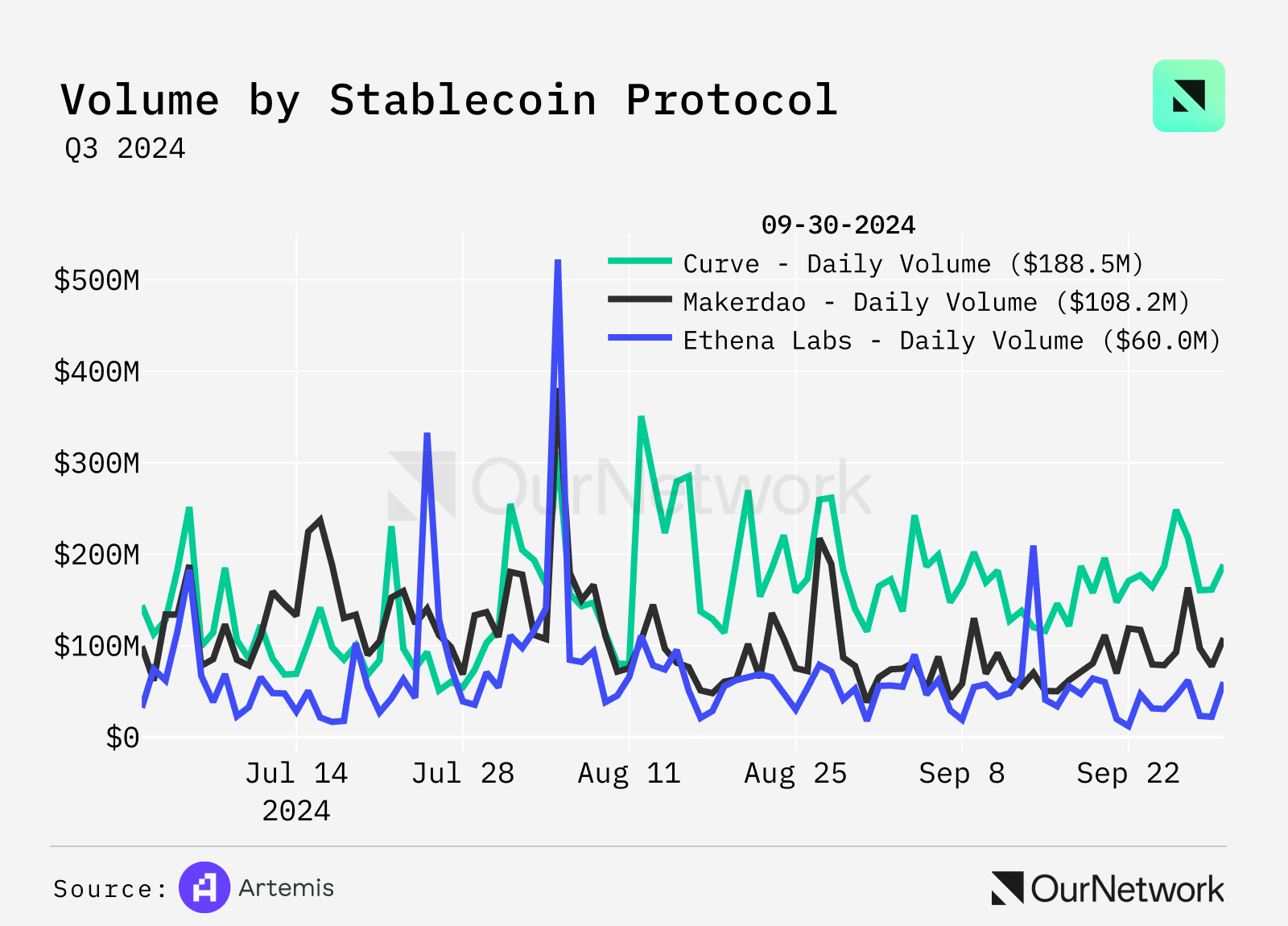
In terms of trading volume among decentralized stablecoins, Curve leads, capturing approximately 60% of the market share across these protocols. MakerDAO ranks second with a daily trading volume of $100 million, accounting for 25% of total volume, while Ethena Labs averages $50 million in daily volume (15% of total), occasionally experiencing volume spikes.
-
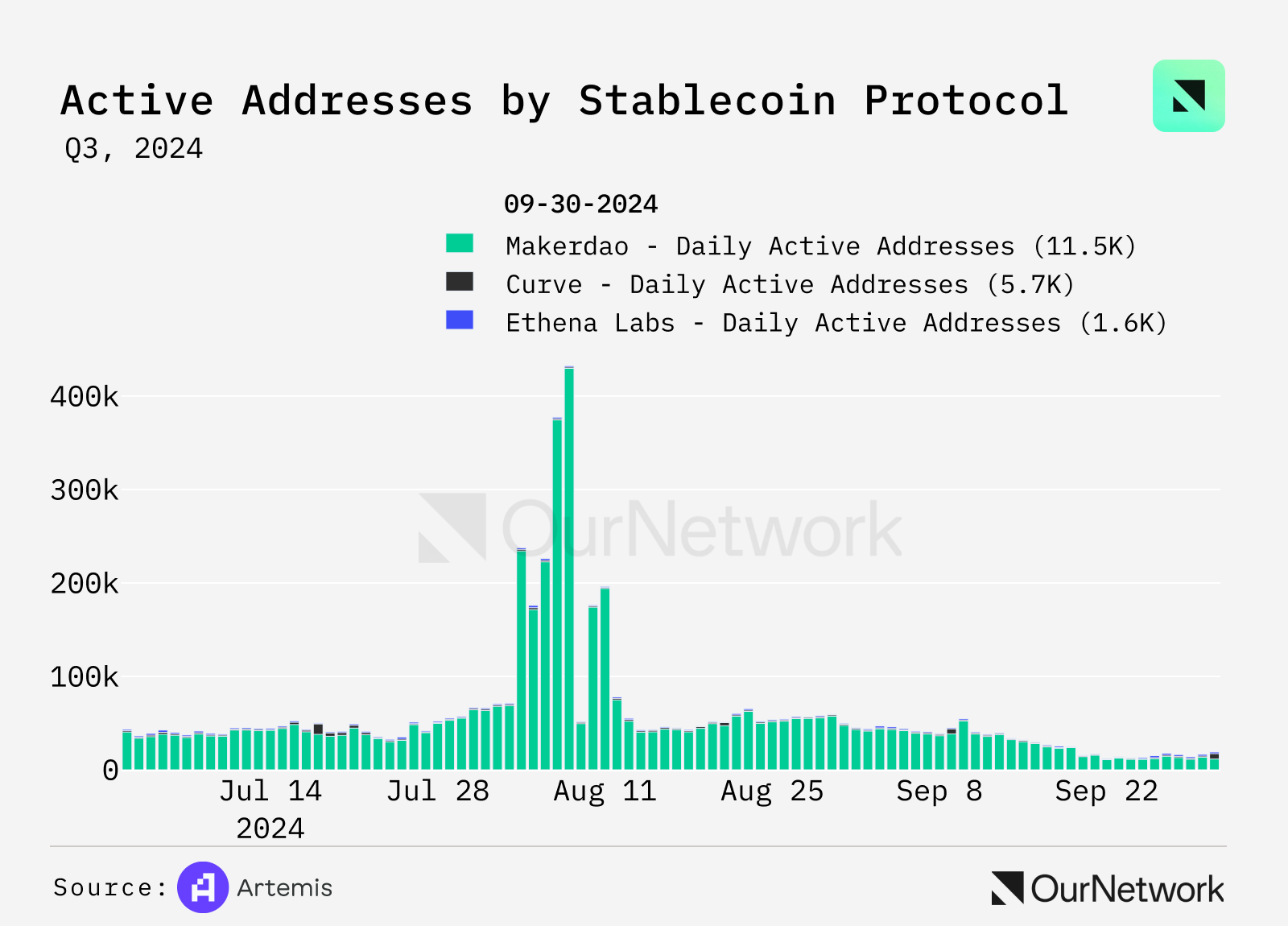
MakerDAO consistently leads in usage, representing around 90% of daily active addresses (DAAs), averaging about 50,000 addresses per day. On August 10, DAAs spiked significantly to nearly 450,000—an 800% increase over the average. In contrast, Curve and Ethena exhibit much lower activity levels, each with fewer than 5,000 daily active addresses.
-
Transaction Highlight: The surge in MakerDAO’s active addresses on August 10 may have been triggered by Grayscale’s announcement of launching a MakerDAO investment trust fund, which increased interest and activity within the ecosystem. The event led to a 7.47% price increase, a rise in active addresses, and an influx of short-term holders. This highlights how institutional participation can significantly impact blockchain activity and token prices.
Layer 2s
Cody | Twitter | Artemis Dashboard
Base Shows Strong Performance in L2 Race, Surpassing 1 Million Daily Active Addresses, $2B+ TVL, and Over 5 Million Daily Transactions
-
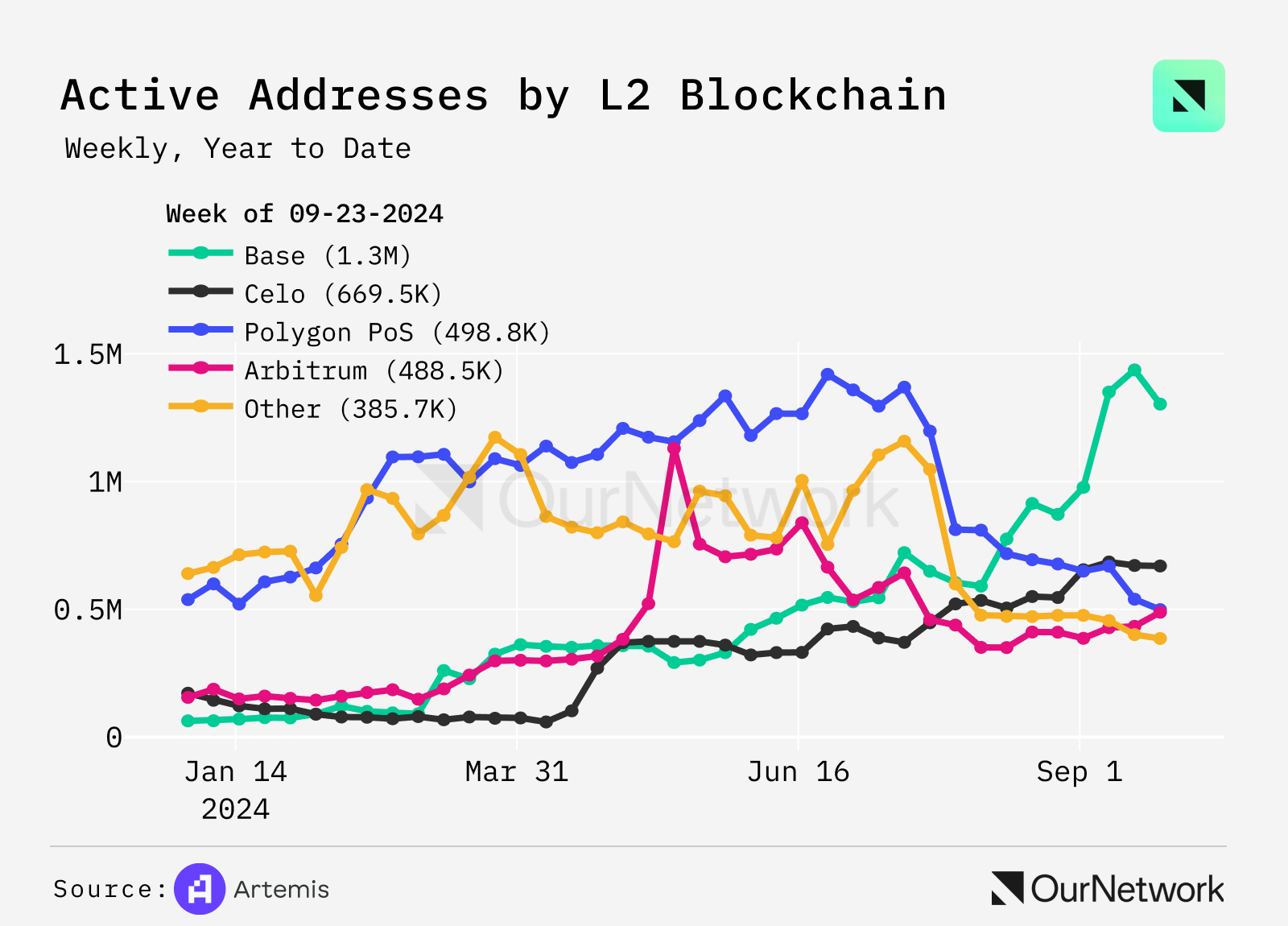
The L2 competition is intensifying. Driven by its Onchain Summer campaign, Base saw daily active users surge beyond 1.5 million in September. During the same period, Polygon’s daily active addresses dropped by 65%—from 1.4 million to 500,000. Although Celo has the lowest average DEX trading volume among all L2s, its daily active addresses surged to over 680,000—ranking third—as its stablecoin continues gaining traction across Africa.
-
A mature DeFi ecosystem is a key indicator of an L2 network’s health and product-market fit.
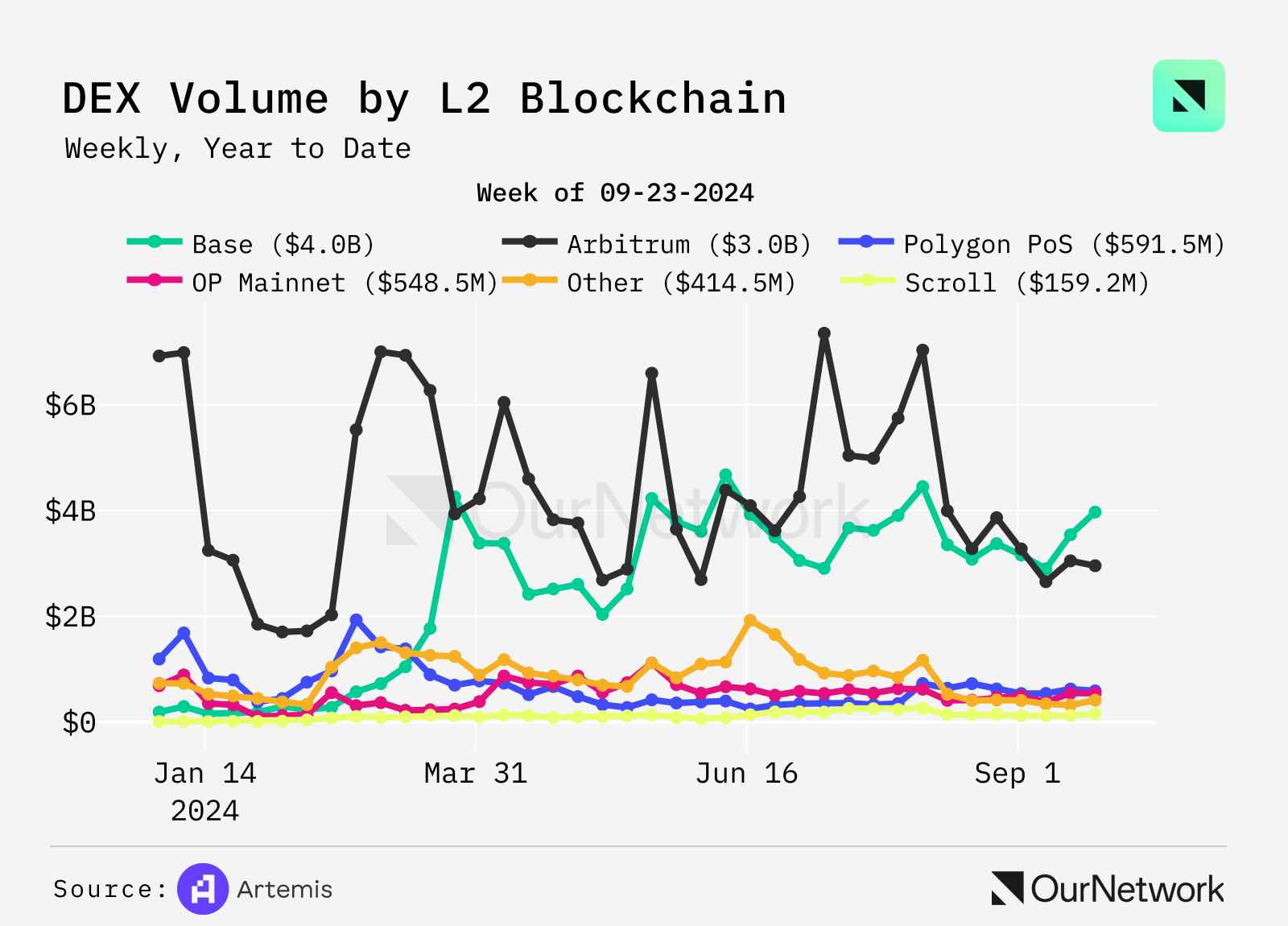
DEX Trading Volume: Base leads in this category, achieving over $4 billion in 7-day trading volume in September, fueled by the growth of Aerodrome, its leading on-chain decentralized exchange. Arbitrum follows closely as a major hub for derivatives trading, recording $3.5 billion in 7-day volume. By comparison, all other L2s combined generated just $1.9 billion during the same period.
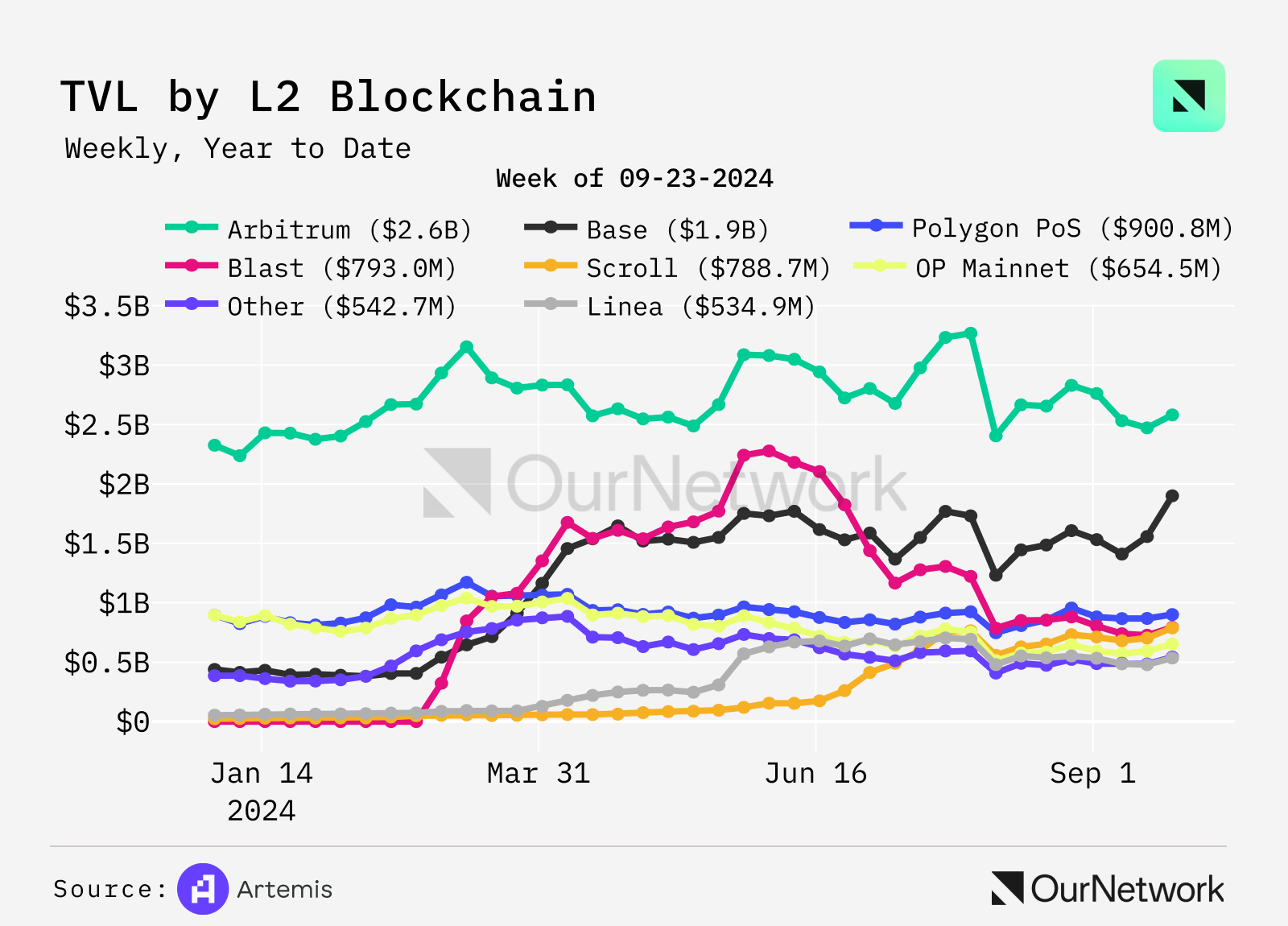
TVL: Arbitrum leads with $2.5 billion in TVL, followed by Base at $2.2 billion. Polygon, Scroll, and Blast each have TVL between $750 million and $990 million, further underscoring Base and Arbitrum’s dominance in the L2 DeFi landscape.
-
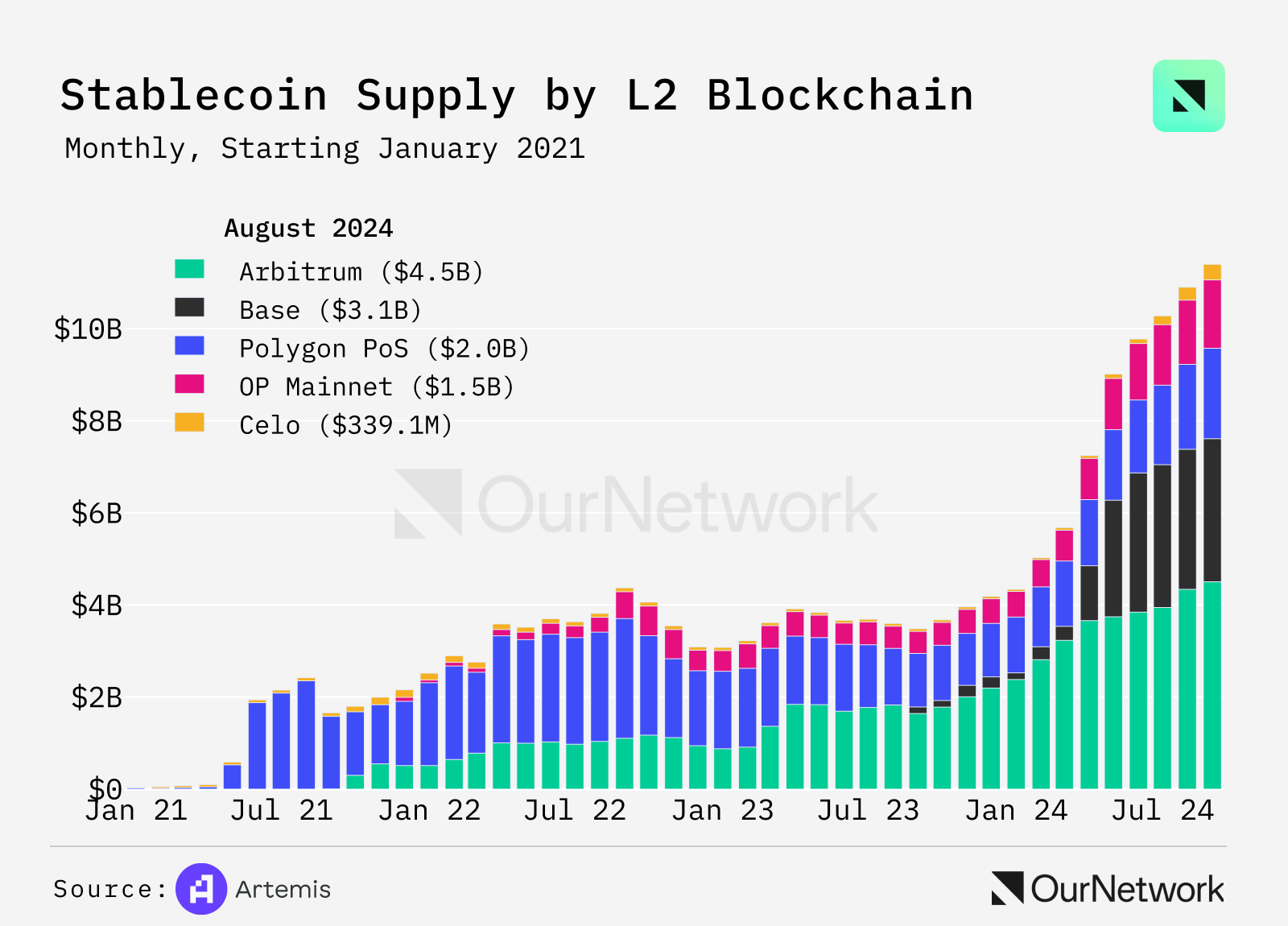
In the past 30 days, total stablecoin transaction volume on L2s reached $344.7 billion, involving 5.2 million wallets, with an average transaction size of $1,936.46. Stablecoin supply on L2s has grown from $4.3 billion at the start of the year to $11.4 billion—an increase of 165%. Of this, 68% is concentrated on Arbitrum ($4.4 billion) and Base ($3.4 billion), followed by Polygon ($1.8 billion), OP Mainnet ($1.4 billion), and Celo ($300 million).
Bridges
Anthony Loya | Twitter | Dune Dashboard
Li.Fi v2 Exceeds 8.7 Million Cross-chain Transactions
-
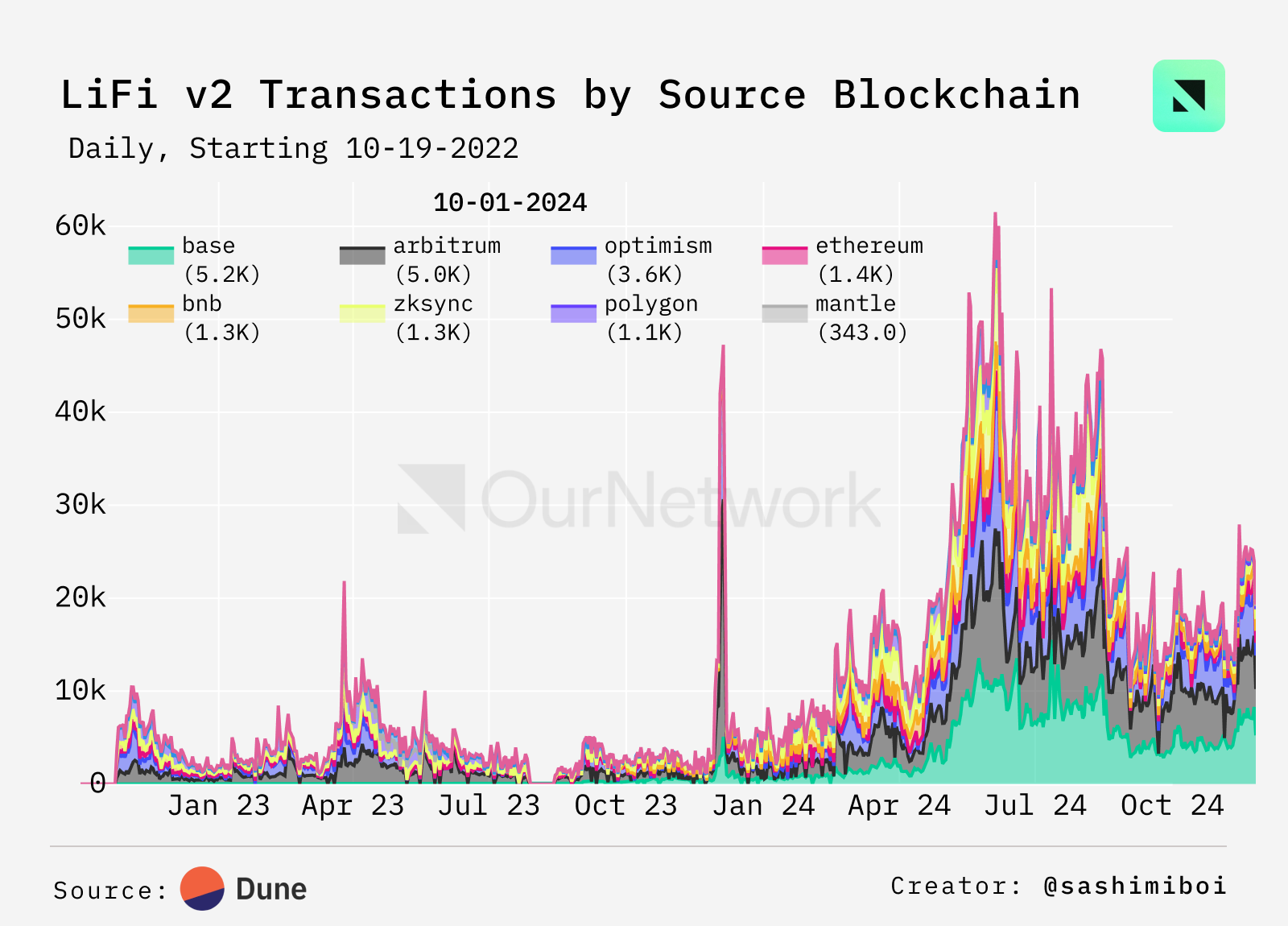
LiFi is a cross-chain solution offering price execution for swaps and bridging transactions across major blockchains. Through APIs, it integrates with decentralized exchange aggregators, bridges, and intent-based systems to optimize cross-chain operations. LiFi’s platform finds the most efficient routes between protocols, enabling its V2 Jumper.exchange to reach 4.2 million transactions—surpassing Metamask Bridge (529k), Layer3 (450k), Pocketfi (349k), and TransferTo.xyz (235k)—thereby enhancing interoperability.
Dune - @sashimiboi
-
Bridge activity peaked at the end of 2022 and beginning of 2023, with particularly high usage of debridge, celerCircle, and omni. However, activity noticeably declined throughout most of 2023. Entering Q4 2024, bridge usage is rebounding, led by Stargate v2.
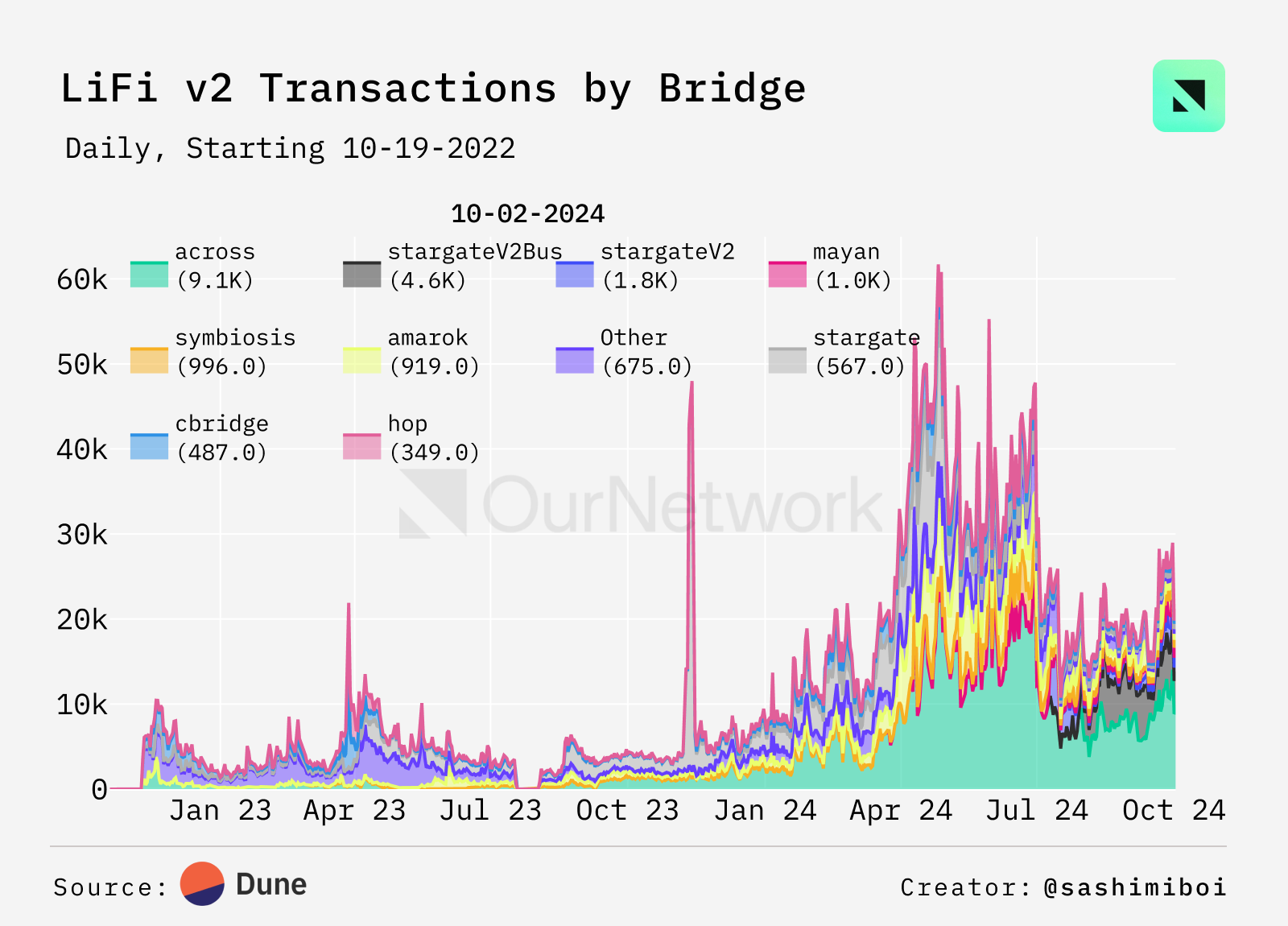
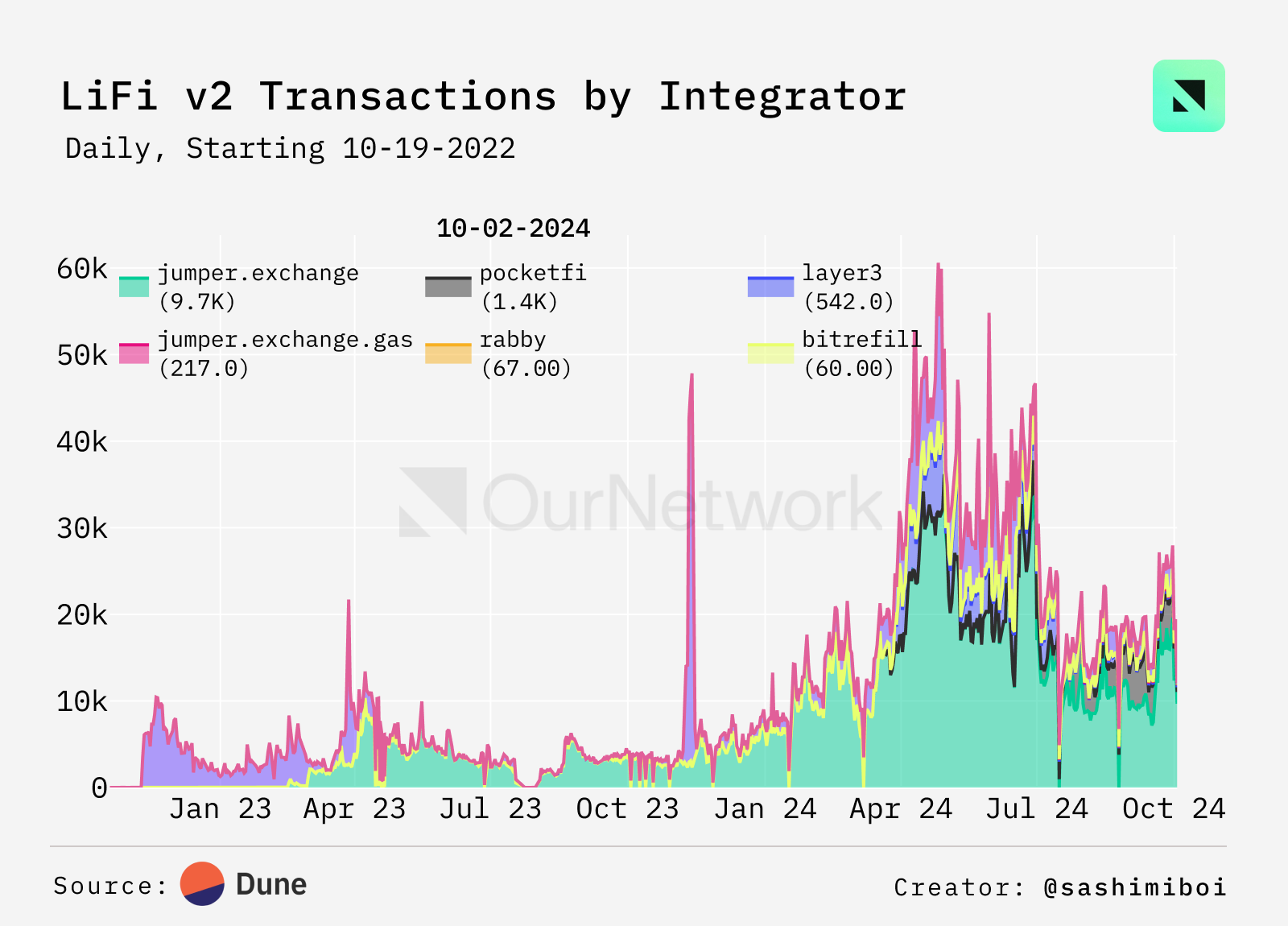
Dune - @sashimiboi
-
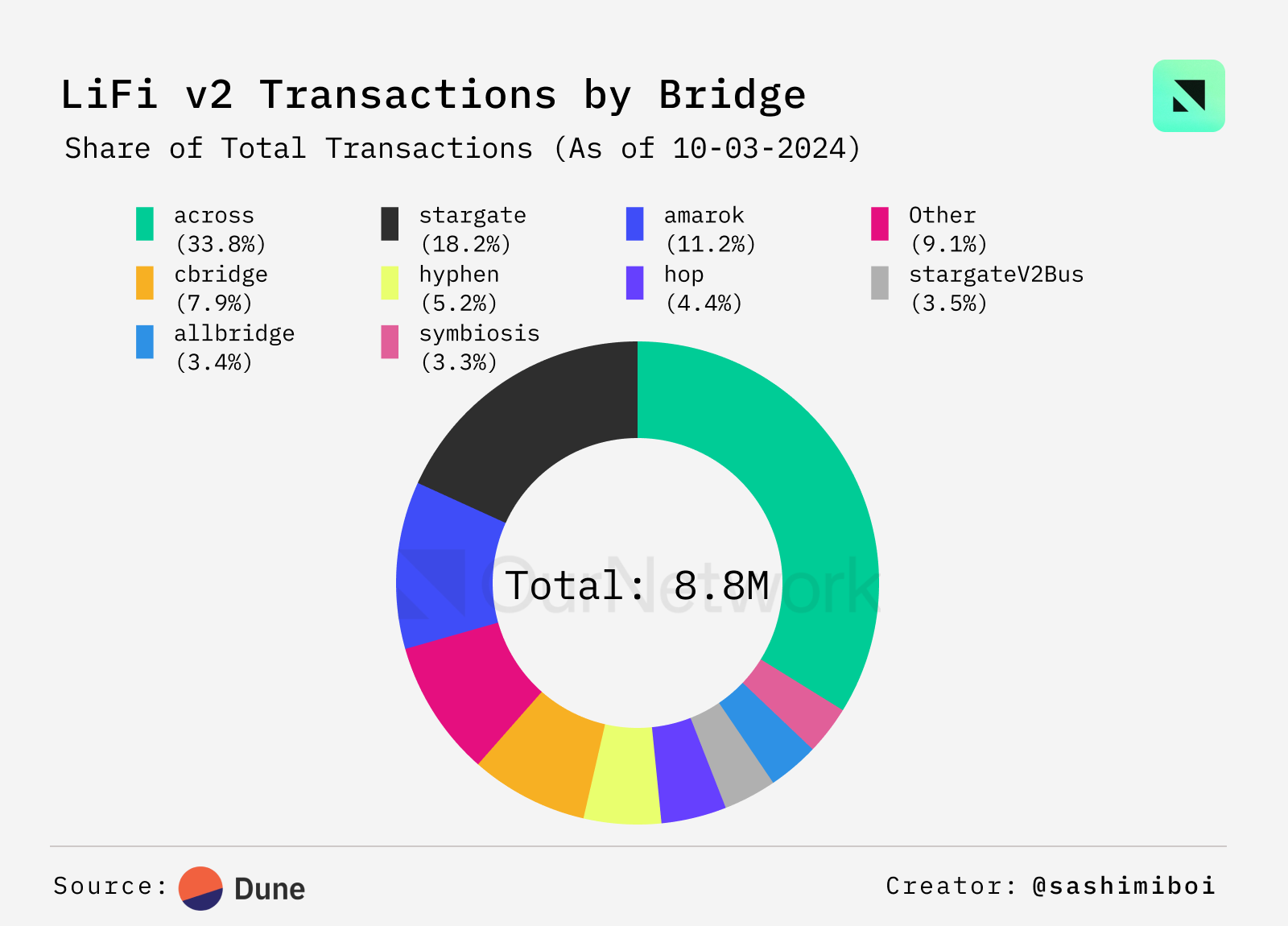
The chart shows Across dominating the bridge market with a 33.8% market share. Its significant share of total transaction volume indicates Across’s greater adoption and influence in cross-chain transactions compared to other protocols.
Dune - @sashimiboi
-
Transaction Highlight: A large USDC transfer was executed via the Stargate bridge, totaling 3,219,490.835919 USDC (approximately $3.2 million). The transfer first moved from address 0xd553294B to 0x1231DEB6, then from 0x1231DEB6 to 0xe8CDF27A, facilitated by LiFi Diamond and Stargate’s USDC pool.
Staking
Brandyn Hamilton | Twitter
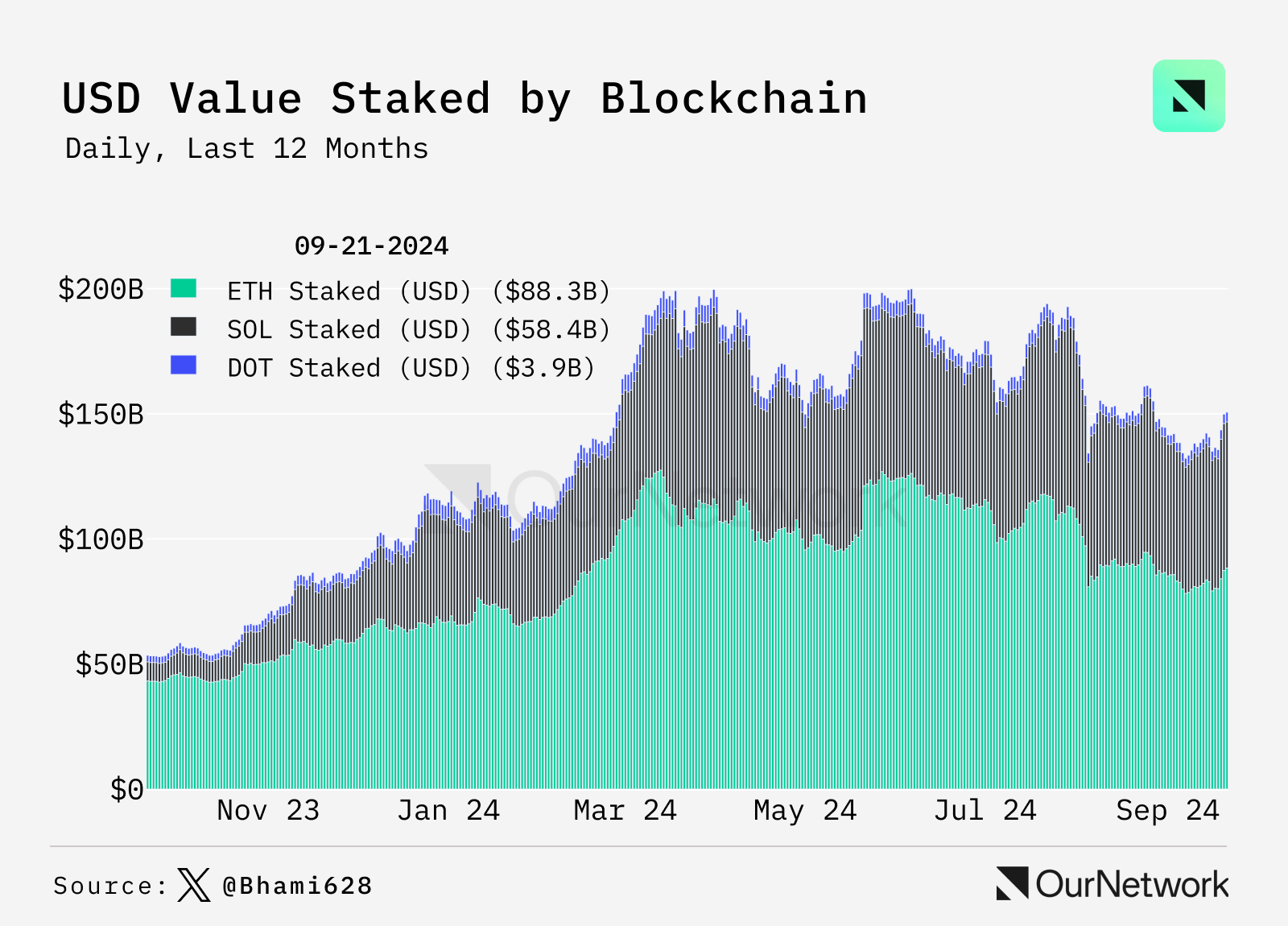
Solana’s staked TVL reached 66% of Ethereum’s in September 2024, with over $58 billion staked.
-
Staking is crucial for securing Proof-of-Stake (PoS) blockchains. Ethereum, Solana, and Polkadot are among the largest PoS blockchains by value of staked tokens. As of September 2024, Ethereum leads in this metric with over $88 billion staked. However, Solana’s staked value has grown dramatically—from $7.5 billion in September 2023 to over $58 billion in September 2024.
Twitter | @Bhami628
-
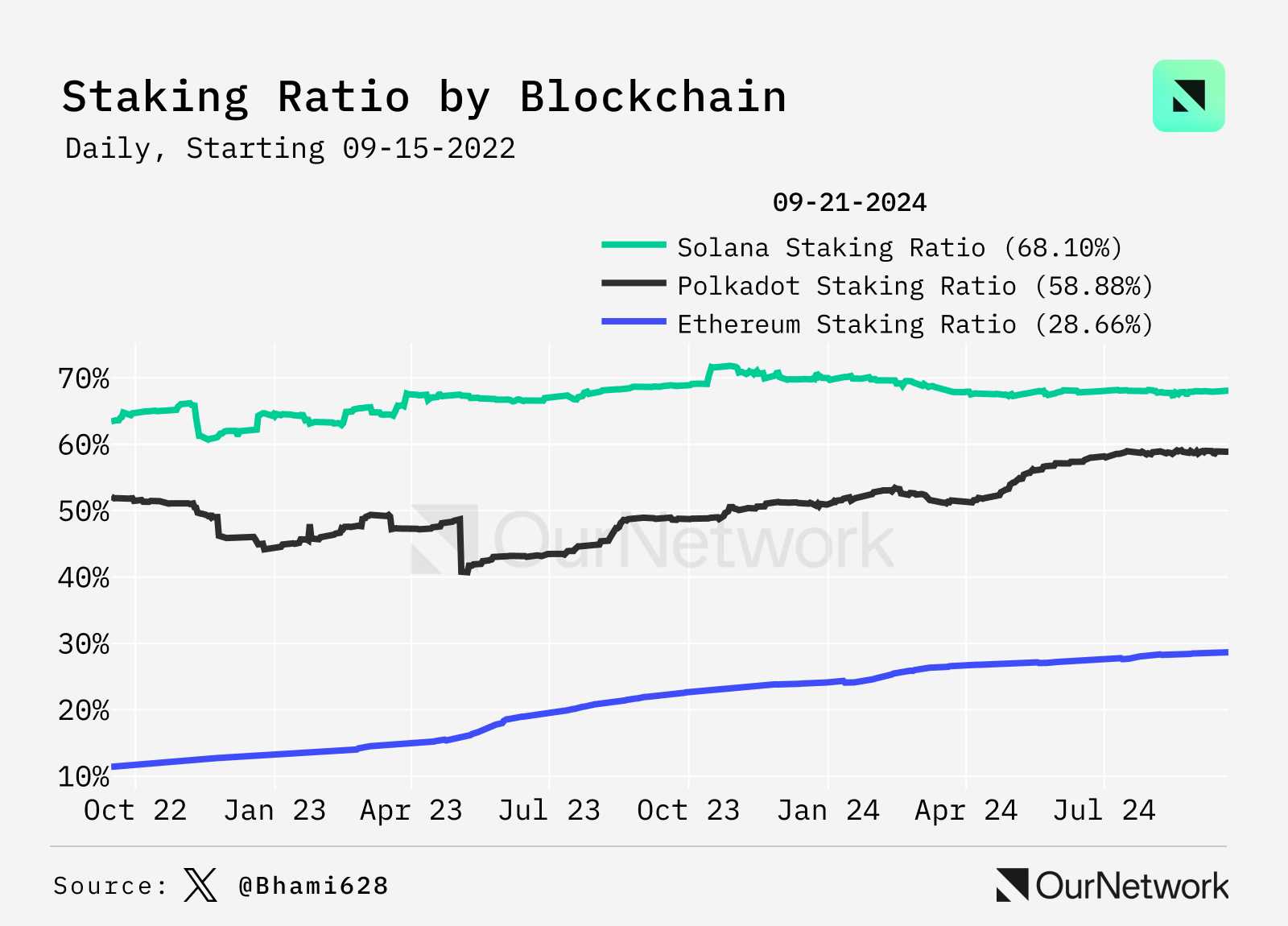
Another key metric for PoS blockchains is the staking ratio—the percentage of total tokens participating in staking. In this regard, Solana and Polkadot have consistently outperformed Ethereum. Nevertheless, Ethereum’s staking ratio has been steadily rising and reached approximately 28% by September 2024.
Twitter | @Bhami628
-
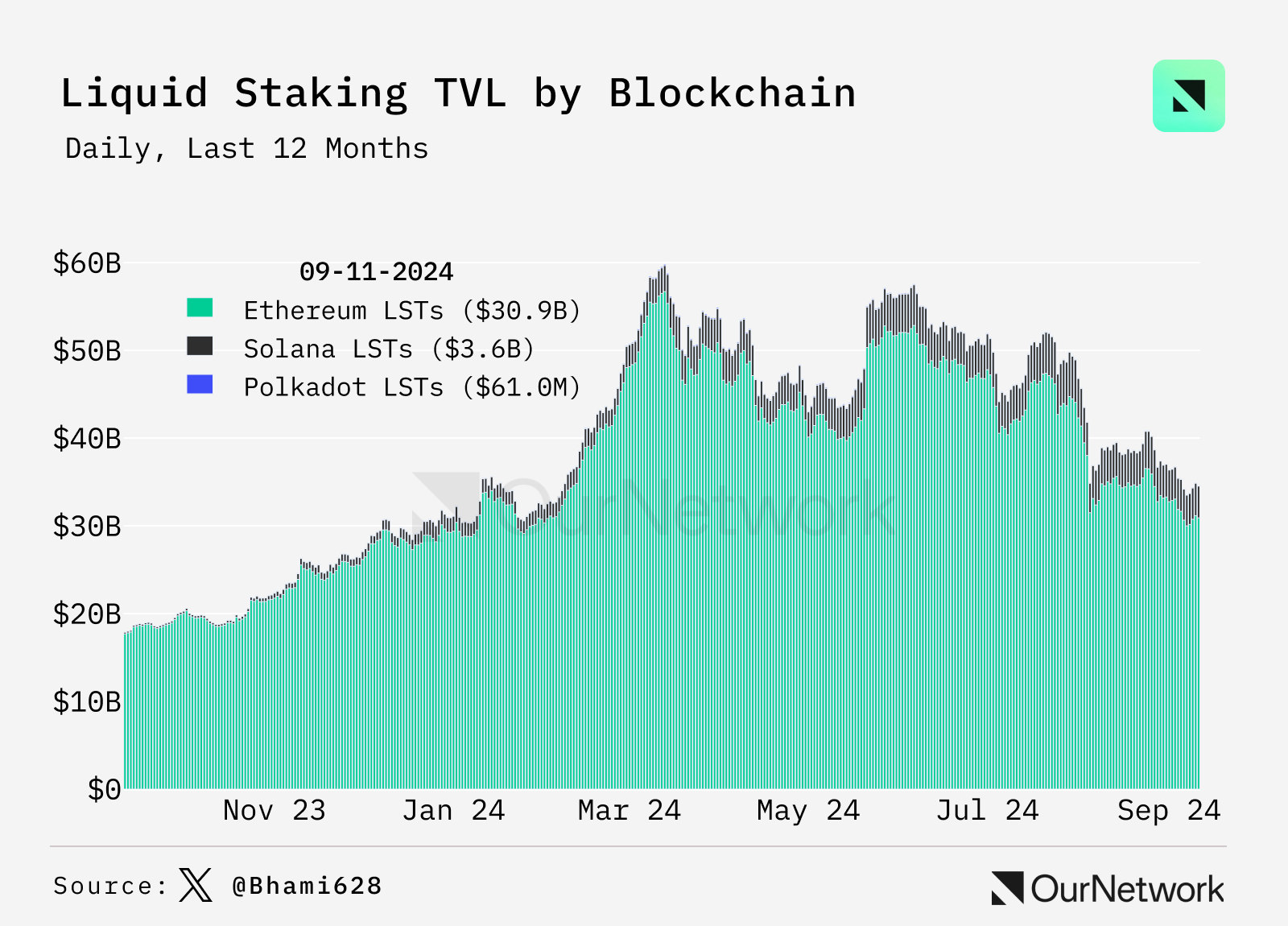
Liquid Staking Tokens (LSTs) represent staked assets on PoS blockchains, offering users a simple way to earn staking rewards. While Ethereum’s LST market cap exceeds $30 billion—maintaining leadership—Solana’s LSTs are rapidly gaining popularity and may continue expanding their market share.
Twitter | @Bhami628
Join TechFlow official community to stay tuned
Telegram:https://t.me/TechFlowDaily
X (Twitter):https://x.com/TechFlowPost
X (Twitter) EN:https://x.com/BlockFlow_News
 @ournetwork__