Consumer crypto is everywhere these days—does it represent an emerging trend or just old wine in new bottles?
TechFlow Selected TechFlow Selected
Consumer crypto is everywhere these days—does it represent an emerging trend or just old wine in new bottles?
Despite rapid innovation in cryptocurrency technology, many products still fail to address real consumer pain points or deliver genuine entertainment value.
 Navigating Web3 tides with focused insights
Author: Ruthy
Translation: TechFlow

The term "consumer crypto" has been popping up frequently in recent discussions, promoted by builders and thought leaders, seemingly emerging as a new trend or hot topic.
But what does it actually mean?
Is this truly a new frontier, or is it a repackaged concept gaining attention under different market conditions?
To understand consumer crypto, we need to dive into its definition, current relevance, potential drivers for growth, and the challenges it faces.
What exactly is consumer crypto?
It refers to the integration of cryptocurrency into everyday consumer products, services, and behaviors. This means people can use crypto in real-life scenarios—not just for speculation or decentralized finance (DeFi) protocols.
Consumer crypto focuses on end-user experience, embedding crypto into daily-use products like gaming, social platforms, e-commerce, and media.
Why is this topic gaining traction now?
-
Is it because consumer-facing products with massive market potential—like @Polymarket—are emerging and showing signs of broad adoption?
-
Is it because blockchain-native intellectual property projects—such as @pudgypenguins—are capturing global attention?
-
Is it due to growing disillusionment, especially among younger generations, with traditional financial systems?
-
Is it because blockchain technology and applications have matured to a point where user experience has become the priority?
It's likely a combination of all these factors.
Looking ahead to 2025, we may see more products from the Web3 space breaking into the global mainstream. Venture capital firms are also shifting focus toward investing in user experience solutions—such as the $14 million raised by @initiaFDN and the $65 million secured by @infinex_app.
Recent announcements of major companies integrating crypto into their offerings signal that we're moving toward a world where crypto becomes mainstream—and a breakthrough moment may be near.
-
PayPal announced crypto services for business accounts
-
Visa is partnering with Transak to facilitate crypto-to-fiat transactions
I personally even ordered a card from @biptapofficial to test this direct crypto-to-fiat payment model. It could make life significantly more convenient.
What are the challenges we face?
Incentives and target audience
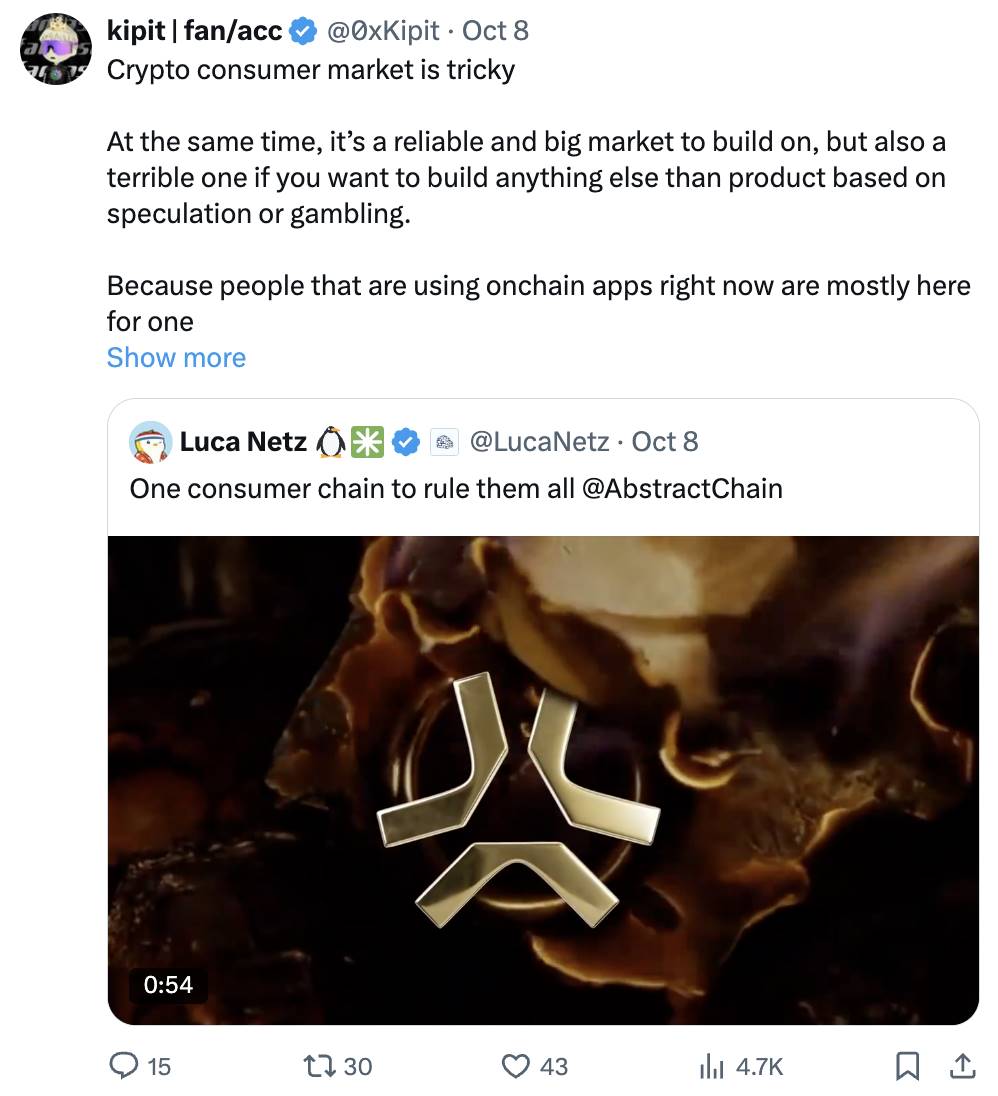
Many teams claim to be at the forefront of consumer crypto, building apps for global markets. Yet they often overly focus on attracting early Web3 users through speculative and profit-driven incentive models. They view this approach as part of achieving product-market fit and user onboarding.
But what happens when those incentives are removed?
Fragmentation and friction
Different blockchains and platforms often operate in silos, creating friction. For users, fragmentation means dealing with multiple interfaces, wallets, and token standards—adding complexity. With assets spread across platforms, liquidity is fragmented and efficiency drops.
This fragmentation has led to the rise of purpose-built chains like @AbstractChain and @Ronin_Network, which build vertically integrated ecosystems. Meanwhile, @infinex_app takes a horizontal integration approach by unifying cross-chain user experiences into a DEX-like platform, positioning itself as a UX layer.
In conversations with my team, I noticed a striking similarity between Abstract’s vision and the achievements of super-apps like WeChat or KakaoTalk.
Our team (Abstract) is committed to making the chain the go-to destination—an internet experience designed to be the most fun place online. I call it the “digital amusement park of crypto” or “Disneyland of the internet.” The image below illustrates our dedication to delivering seamless, frictionless user experiences. Over time, we aim to attract users with new products and eventually evolve into a general-purpose chain.
WeChat started as a messaging app in China and has since grown into a vast ecosystem offering social media, payments, shopping, news, mini-programs, and more.
Abstract can be seen as a similar ecosystem app—one that begins with a core use case and expands horizontally after establishing a strong, vertically integrated foundation.
Could this be the path forward for purpose-built chains like @abstractchain and @Lucanetz?
Product-market fit remains a key challenge. Despite rapid innovation in crypto, many products still fail to solve real consumer pain points or deliver genuine entertainment value.
So far, only a few Web3 products—like Polymarket and Axie Infinity—have broken into the mainstream, but these remain isolated cases. For consumer crypto to go widespread, we need more products that solve practical problems or offer meaningful entertainment. This means developing engaging games beyond just “play-to-earn,” or creating financial tools that genuinely improve lives—not just attract speculators.
What do you think adoption really means?
Adoption of consumer crypto involves different stakeholders with divergent incentives—especially between builders and traders. While both benefit, their motivations and approaches differ significantly.
Builders develop the infrastructure, applications, and ecosystems that drive crypto adoption. Their goals extend beyond short-term price movements; they focus on delivering user value, generating revenue through usage, and attracting investment via product-market fit.
Traders, on the other hand, view adoption differently. To them, adoption means increased liquidity and more opportunities for profitable exits.
What’s your take? Feel free to share your thoughts.
Join TechFlow official community to stay tuned
Telegram:https://t.me/TechFlowDaily
X (Twitter):https://x.com/TechFlowPost
X (Twitter) EN:https://x.com/BlockFlow_News
 @ruthybuilds