The Battle Between Ethereum Scaling and Decentralization: Where Should Independent Stakers Go?
2024.10.08
Share Share to X (Twitter) Navigating Web3 tides with focused insights
Share to WeChat
Share to WeiboShare to WeChat
Share by Link
Share by Image
TechFlow Selected TechFlow Selected
The Battle Between Ethereum Scaling and Decentralization: Where Should Independent Stakers Go?
The real question is not "whether and how we should scale," but "are we ready to scale now?"
2024.10.08 - 10:40:12
以太坊
Navigating Web3 tides with focused insightsThe real question is not "whether and how we should scale," but "are we ready to scale now?"
Written by: Nero_eth
Translation: Baicai Blockchain
In recent weeks, discussions around increasing blob throughput in Pectra have intensified, giving rise to two opposing camps. One side supports increasing throughput, while the other remains cautious, preferring to wait for clearer data before making such a change. In my view, one sentiment within the community has become very clear: solo stakers are the heart of Ethereum. Although there is no consensus yet on minimum requirements for validators (see sassal.eth's 12th tweet), the Ethereum community has made one thing evident: we are unwilling to sacrifice solo or home stakers for linear scalability. To me, this reflects a healthy direction for Ethereum and underscores the community’s emphasis on the viability of solo staking. However, it also raises an important question: "Where is the line?" Specifically, at what point does the contribution of low-bandwidth, weaker stakers to decentralization no longer outweigh their limiting impact on Ethereum’s scalability? In this article, I aim to provide additional data points to help the community make a more informed decision about whether to pursue higher blob throughput in Pectra. As Prysm core developer Potuz1 put it, the real question isn't “whether and how we should scale,” but rather “are we ready to scale now?”1. Who Is Experiencing Reorgs? (October 2023 – October 2024)
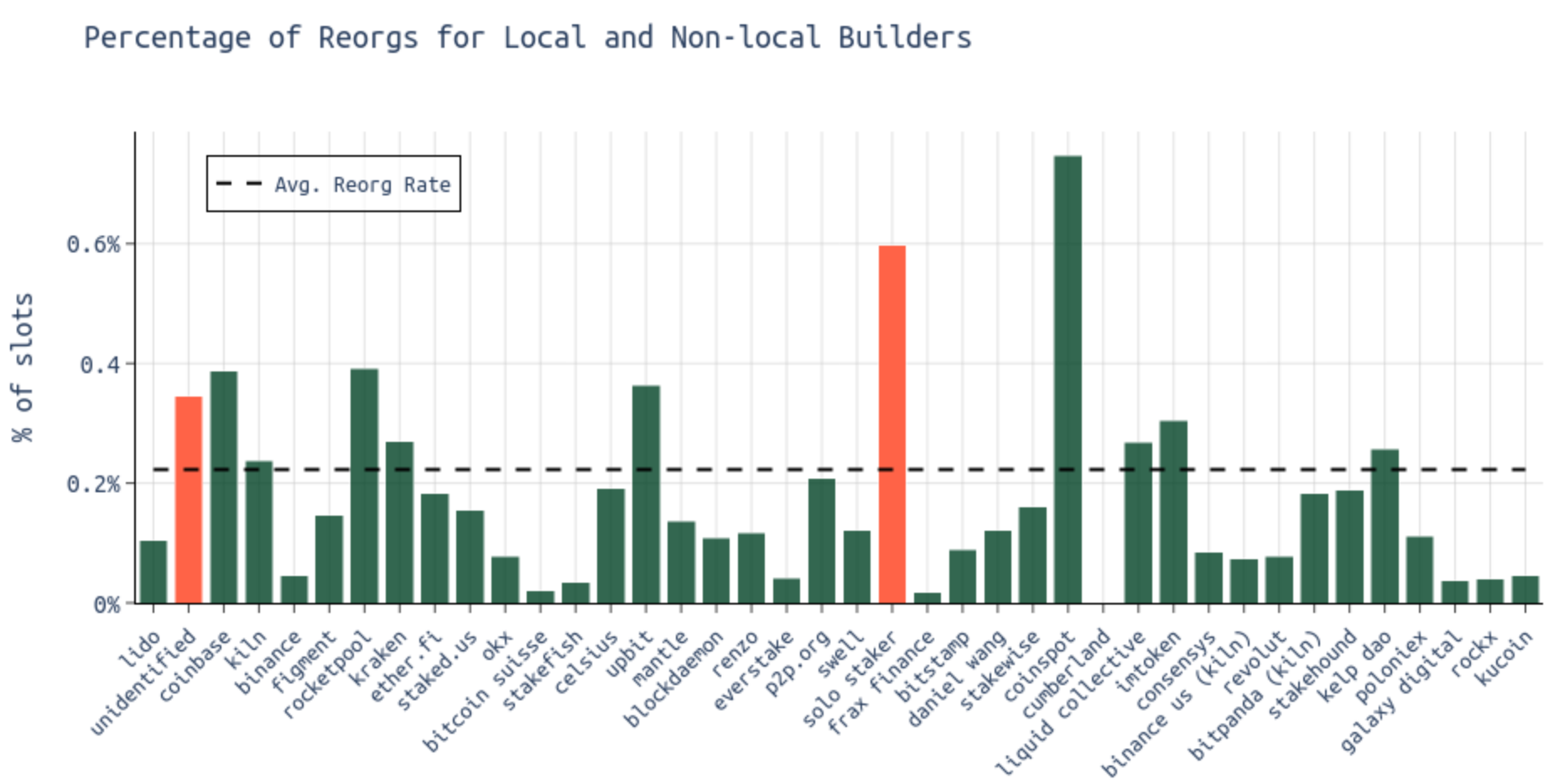 On average, approximately 0.2% of blocks are reorged (reorged blocks are part of orphaned blocks). Professional node operators (NOs) such as Lido, Kiln, Figment, and EtherFi experience reorgs at a rate below the average.
Less professional operators—such as solo stakers, Rocketpool operators, and the "unidentified" category (which likely includes many unidentified solo stakers)—experience reorgs more frequently.
As shown in prior analysis 1, since the Dencun hard fork, reorg rates have been trending downward.
In the chart below, we can see that this effect varies across different entities:
On average, approximately 0.2% of blocks are reorged (reorged blocks are part of orphaned blocks). Professional node operators (NOs) such as Lido, Kiln, Figment, and EtherFi experience reorgs at a rate below the average.
Less professional operators—such as solo stakers, Rocketpool operators, and the "unidentified" category (which likely includes many unidentified solo stakers)—experience reorgs more frequently.
As shown in prior analysis 1, since the Dencun hard fork, reorg rates have been trending downward.
In the chart below, we can see that this effect varies across different entities:
 Since Dencun, reorg rates among solo stakers and unidentified nodes have declined.
Rocketpool operators, along with large operators like Lido, Coinbase, Figment, and OKX, have also seen reduced reorg rates.
Since Dencun, reorg rates among solo stakers and unidentified nodes have declined.
Rocketpool operators, along with large operators like Lido, Coinbase, Figment, and OKX, have also seen reduced reorg rates.
2. How Are Local Block Builders Performing? (October 2023 – October 2024)
 The reorg rate for local builders is approximately 1.02%.
The reorg rate for MEV-Boost builders is approximately 0.20%.
Local builders are about five times more likely to suffer reorgs than MEV-Boost builders.
The reorg rate for local builders is approximately 1.02%.
The reorg rate for MEV-Boost builders is approximately 0.20%.
Local builders are about five times more likely to suffer reorgs than MEV-Boost builders.
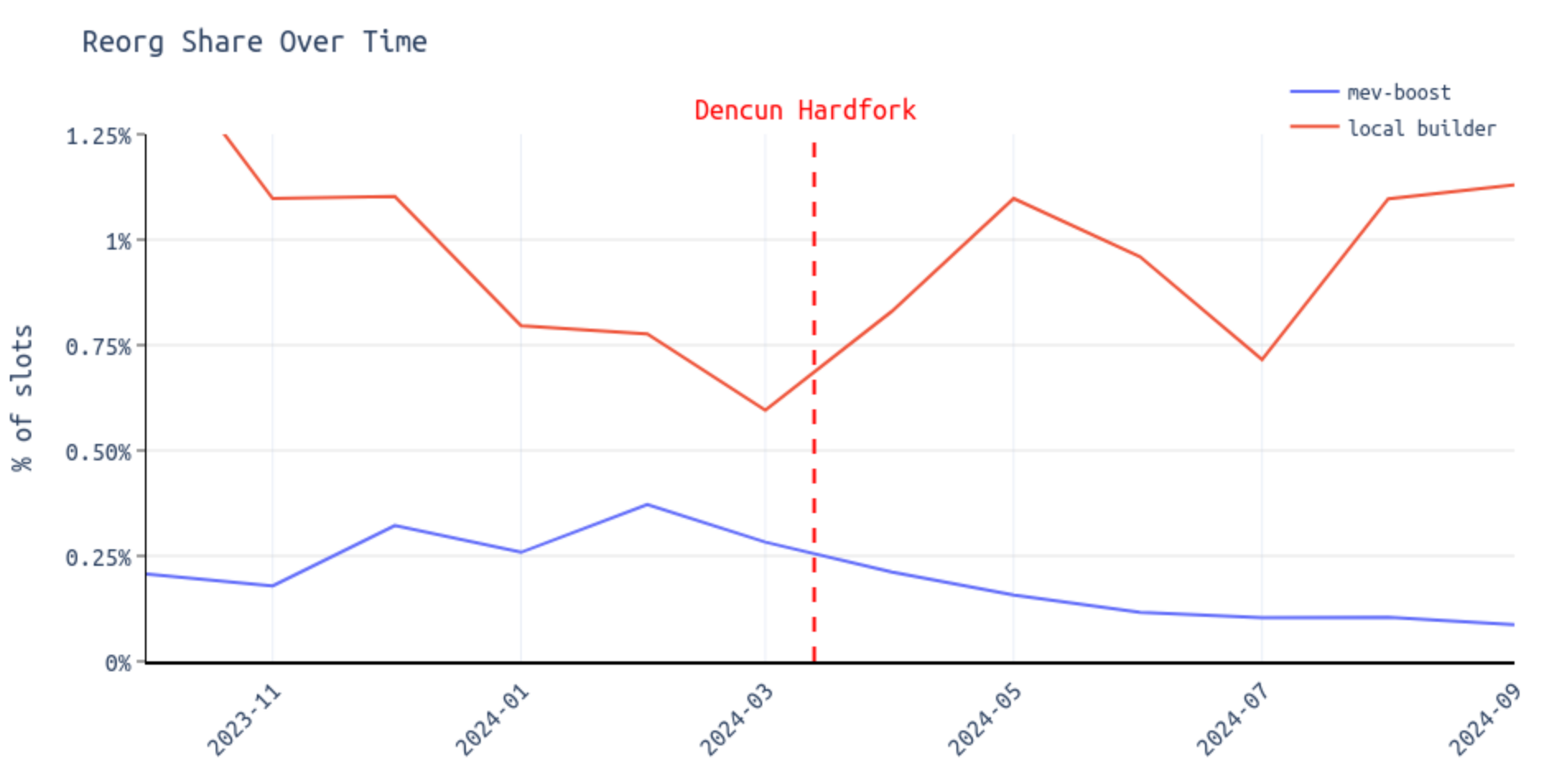 The proportion of reorgs among local block builders appears unchanged—or even slightly increased—after the Dencun hard fork.
In contrast, for MEV-Boost users, reorg rates have consistently trended downward since Dencun.
Notably, previous analysis shows that local builders include more blobs on average in their blocks. We also observed that after Dencun, blocks containing six blobs initially faced some challenges, but eventually stabilized. This may explain why the reorg rate for local builders has not decreased.
The proportion of reorgs among local block builders appears unchanged—or even slightly increased—after the Dencun hard fork.
In contrast, for MEV-Boost users, reorg rates have consistently trended downward since Dencun.
Notably, previous analysis shows that local builders include more blobs on average in their blocks. We also observed that after Dencun, blocks containing six blobs initially faced some challenges, but eventually stabilized. This may explain why the reorg rate for local builders has not decreased.
3. Who Are the Local Builders? (October 2023 – October 2024)
 Solo stakers (labeled here as "Solo Stakers," though many fall under the "unidentified" category) represent the largest group within the "local builder" category.
Additionally, some Lido node operators either do not use MEV-Boost at all or use the minimum bid flag.
Solo stakers (labeled here as "Solo Stakers," though many fall under the "unidentified" category) represent the largest group within the "local builder" category.
Additionally, some Lido node operators either do not use MEV-Boost at all or use the minimum bid flag.
Key Insights
- Compared to professional validators, solo stakers are more prone to missing slots. - Solo stakers typically choose to build blocks locally rather than using MEV-Boost. - Local block builders do not benefit from the fast propagation advantages provided by MEV-Boost relays. - Relays employ timing strategies (e.g., relay delays, holding back to await more profitable blocks). - Epoch boundaries lead to increased reorgs. - Multiple factors can cause reorgs, making it difficult to pinpoint exactly why certain validators (like solo stakers) experience them more frequently than others.Join TechFlow official community to stay tuned
Telegram:https://t.me/TechFlowDaily
X (Twitter):https://x.com/TechFlowPost
X (Twitter) EN:https://x.com/BlockFlow_News
Add to Favorites
Share to Social Media
Author
Nero_eth