Will Based Rollups Have a Place in Ethereum's Future?
TechFlow Selected TechFlow Selected
Will Based Rollups Have a Place in Ethereum's Future?
If Ethereum's rollup ecosystem had been Based from the beginning, its narrative position today would likely be stronger.
 Navigating Web3 tides with focused insights
Author: BREAD
Translation: TechFlow
If you've ever listened to discussions about L2s, you've likely heard of "Based" rollups.
They differ from "Optimistic" and "Zero-Knowledge (ZK)" rollups because they're considered more synergistic with Ethereum's mainnet.
Here's why—with visual explanations.
We'll start from the basics (simple term definitions—I promise it’s brief), then discuss "regular" blockchains, and finally dive into the structure of Based™ rollups.
Terminology Breakdown
First, let’s understand some key terms and roles.
Roles
-
Sequencer: A machine operated by an L2 team responsible for collecting user transactions, determining their order in L2 blocks, and ultimately batching them to L1.
-
Block Builder: These actors function within Ethereum’s mainnet as part of the sequencing pipeline. They receive user transactions (public or private), reorder them to maximize profit, and pass them to validators to form blocks.
Key Terms
-
Base Fee: The minimum fee users must pay to enter a block, priced based on network congestion. (For example, if gas usage in block #10 exceeds 50%, the base fee for block #11 increases.) This fee is burned on Ethereum and some L2s.
-
Priority Fee: An additional fee or “tip” paid on top of the base fee to gain priority ordering in a block (i.e., having your transaction executed first).
With these concepts clear, you can now see how Based rollups differ from what we’re used to.
Ethereum Block
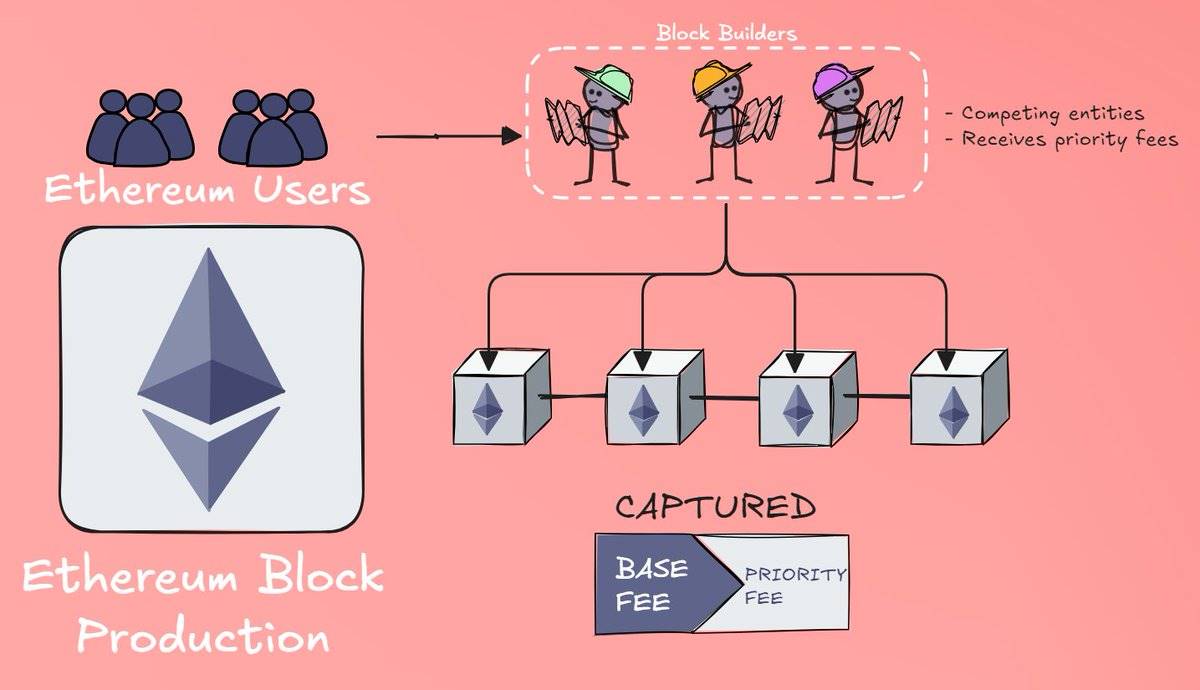
First, let’s examine how Ethereum blocks are produced and which terms are critical.
See the diagram below:
Now, let’s walk through the process step-by-step:
-
Ethereum users submit their transactions to block builders.
-
These transactions specify the maximum fee the user is willing to pay, which covers the base fee (burned) and leaves the remainder as the priority fee/tip (kept by the builder).
-
The builder then delivers these blocks to validators for inclusion in Ethereum’s main chain.
In the end, all fees paid by users are either captured by $ETH (via burning) or received by participants in Ethereum’s block-building supply chain (like builders).
The former mechanism is seen as a neutral alternative to direct public goods funding, while the latter incentivizes key players in Ethereum’s block-building process. Both are generally viewed as positive for overall network value.
Now, let’s look at a typical L2.
Traditional Rollup Block
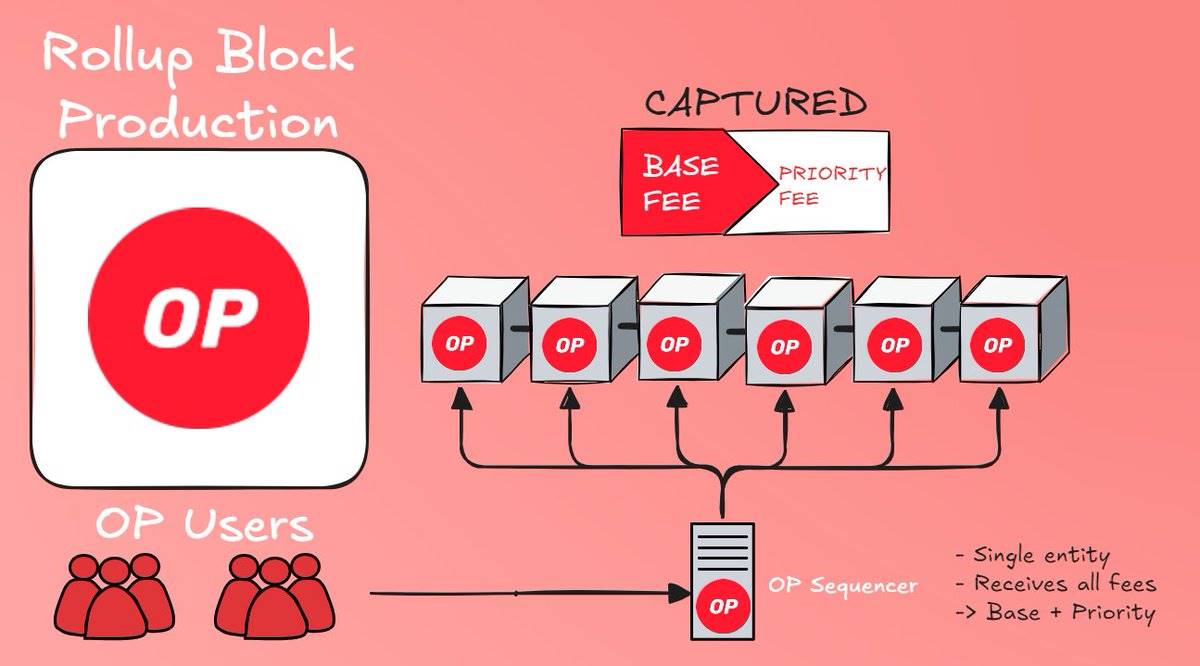
Taking Optimism as an example, we keep a structure similar to Ethereum but replace builders (a set of competitive entities) with a sequencer (a single machine operated by the team behind Optimism).
Visualization:
The process looks very similar:
-
Optimism users submit transactions to the OP sequencer.
-
Similar to Ethereum, these transactions indicate the user’s maximum fee, covering the base fee (burned on OP Stack chains—though not all L2s do this, e.g., Arbitrum), with the leftover difference becoming the priority fee/tip (retained by the team operating the sequencer).
-
The sequencer then orders transactions, proposes the next block for the canonical chain, and updates the L2’s state/world view onto Ethereum mainnet.
Note that the entire user relationship—and 100% of the fees they pay—belongs solely to the sequencing entity (i.e., they remain within the L2 ecosystem). Whether it’s Optimism, Base, Arbitrum, or Blast, how these fees are used is entirely up to them.
-
Some burn the base fee and keep the priority fee (Base).
-
Some distribute both portions to token holders (Arbitrum).
-
Others return part of the funds to developers on-chain (Blast).
But BREAD, if the L2 captures all these fees, how does Ethereum benefit?
Let’s explore how these two block-building processes connect.
Traditional Rollup + Ethereum Block
As usual, let’s start with visualization:
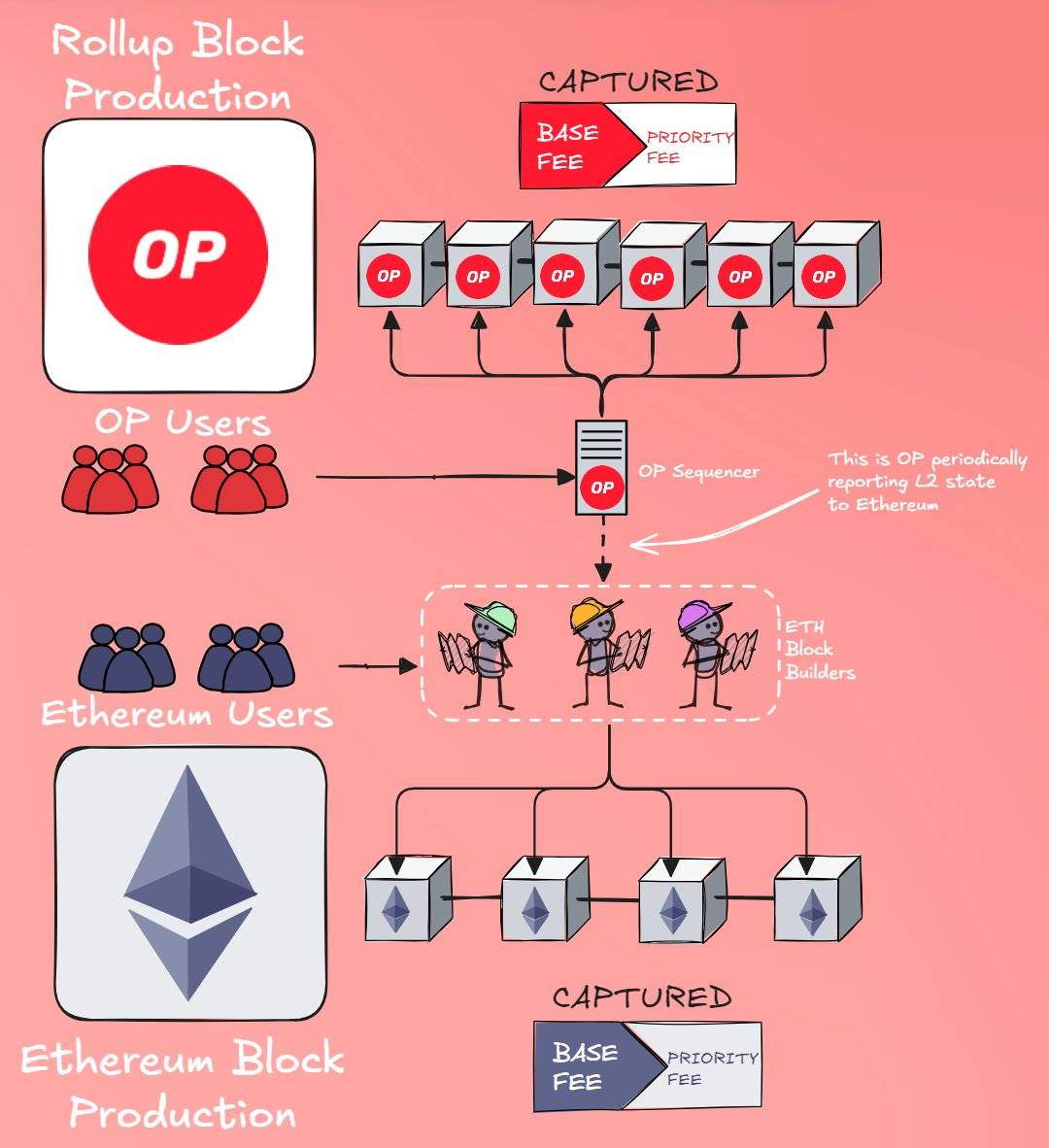
As you can see, connecting these two independent block-building processes adds little beyond a single line.
This line represents the L2 sequencer periodically publishing data to Ethereum mainnet, providing users with certain security guarantees (e.g., forced inclusion).
Note that Ethereum cannot control when any specific L2 publishes transactions—meaning publication frequency and efficiency are fully at the discretion of the submitter.
Overall, this setup strongly benefits traditional L2s, as they capture 100% of fees generated within their ecosystem and also control the largest cost—the submission to mainnet—which remains entirely voluntary.
Midpoint Recap
We’ve laid the groundwork for what comes next. Here are the most important points from the traditional model, so we can focus on what makes Based unique:
-
Ethereum blocks are built by competing, unrelated parties.
-
Traditional rollup blocks are built by sequencers operated by the rollup team.
-
Each block-building process captures 100% of fees within its own ecosystem, and the link between Ethereum and L2 is maintained via voluntary L2 data publication frequency.
Now, let’s dive into Based™.
Based Rollup + Ethereum Block
We don’t need to start with a diagram showing only Based components because the construction of Based rollups is relatively simple (which is precisely where their elegance lies).
They asked a simple question: “Why don’t we just use Ethereum as the sequencer?” And they achieved this by leveraging the builders we discussed in the Ethereum block-building section.
Visualized using @taikoxyz:
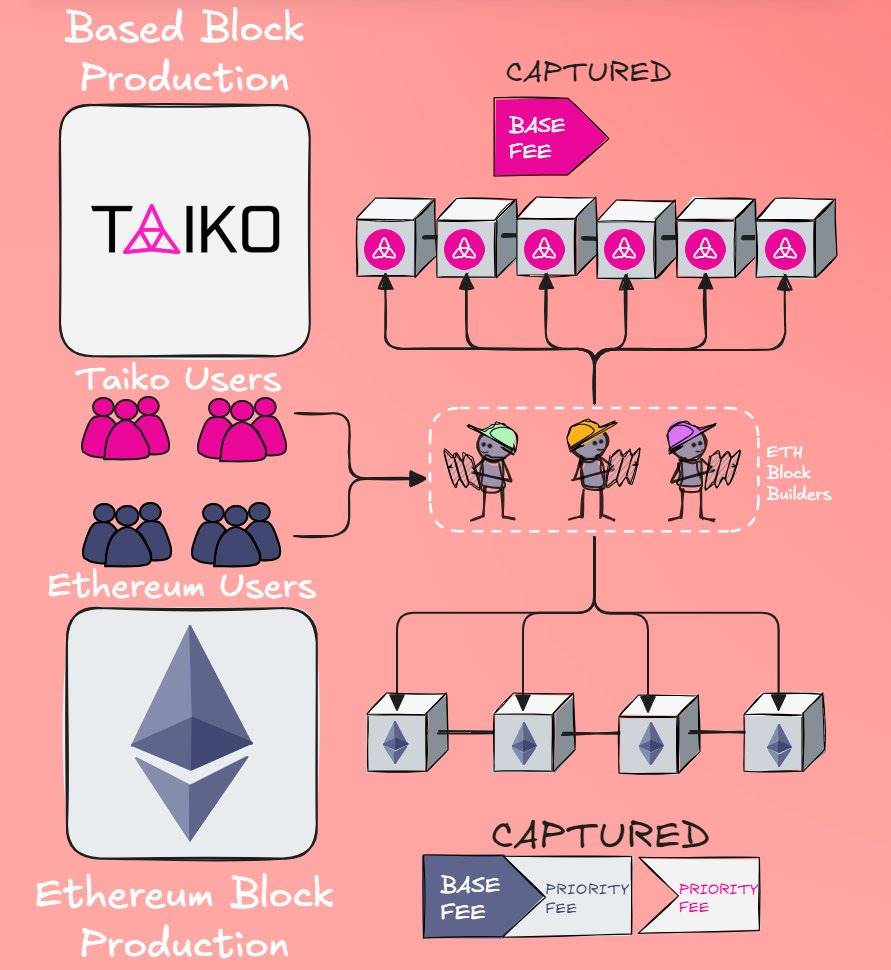
You might wonder—how does this process work? In practice, the flow isn’t vastly different from traditional rollups, though there are subtle differences in user experience.
The process is as follows:
-
Users send transactions to L1 builders who choose to build blocks for both Ethereum and the Based L2.
-
Users specify the maximum fee they are willing to pay.
-
The L2 captures the base fee (determined by L2 congestion) and passes the priority fee/tip to the L1 builder, who handles transaction ordering.
In this paradigm, Ethereum captures not only 100% of fees within its own ecosystem but also a portion of L2 tips and the cost of settlement publications.
In return, Based L2s inherit several advantages:
-
Liveness from Ethereum (as long as Ethereum is producing blocks, the Based L2 continues operating; whereas if a traditional rollup’s single sequencer fails, the chain may halt),
-
Atomic composability with L1 state (meaning transactions on the L2 can directly interact with L1 liquidity—for example, a swap on L2 can utilize L1 liquidity).
Of course, this tight coupling with Ethereum comes with trade-offs. Based teams must sacrifice part of their profitability (such as priority fees) and deal with challenges inherent to Ethereum’s mechanisms (e.g., its 12-second block time).
While issues like these can be mitigated via mechanisms such as pre-confirmations, they still require careful consideration.
Recap and Outlook
So, do Based Rollups solve our L1<>L2 economic alignment problem and represent Ethereum’s future?
Possibly. I’m skeptical that many teams will adopt Based Rollups, as it directly impacts their profitability. However, the advantages in L1 atomic composability are attracting developer interest, so we’ll at least see experimentation in this space.
There’s ongoing research between @gwyneth_taiko and @Spire_Labs called “Next-Gen Based Rollups.” They emphasize how L1 applications could run their own Based app-chains, capture priority fees, and maintain composability with L1 contracts. This is a direction I’ll be watching closely.
If Ethereum’s rollup ecosystem had been Based from the start, I believe its narrative position today would be stronger—but that’s just how things unfolded.
Join TechFlow official community to stay tuned
Telegram:https://t.me/TechFlowDaily
X (Twitter):https://x.com/TechFlowPost
X (Twitter) EN:https://x.com/BlockFlow_News
 @0xBreadguy