
A strong bullish candle has boosted market confidence, but BTC's upward momentum still lacks innovative drivers.
TechFlow Selected TechFlow Selected
A strong bullish candle has boosted market confidence, but BTC's upward momentum still lacks innovative drivers.
The recent surge in Bitcoin was primarily driven by the Federal Reserve's 50 basis point interest rate cut.
 Navigating Web3 tides with focused insights
By Asher Zhang
On September 11 at 7:00 AM, I scheduled the publication of an article titled "Has the Crypto Bull Market Ended? So Far, BTC Has Never Disappointed Anyone Who Held On." The article was written several days before its release, at a time when market sentiment was pessimistic and fearful amid a downturn. Looking back now, Bitcoin indeed hasn't disappointed those who stayed committed. With the Federal Reserve cutting interest rates by 50 basis points, both macroeconomic and crypto markets are undergoing significant shifts. How will these changes impact Bitcoin? And what subtle transformations are taking place within the crypto space?
Bitcoin Breaks Downward Trend Line, Resistance Turns into Key Support
Spurred by news such as the Federal Reserve's rate cut, Bitcoin has surged recently. The fear index has climbed sharply in recent days and is now above 50, signaling a notable shift in market sentiment.
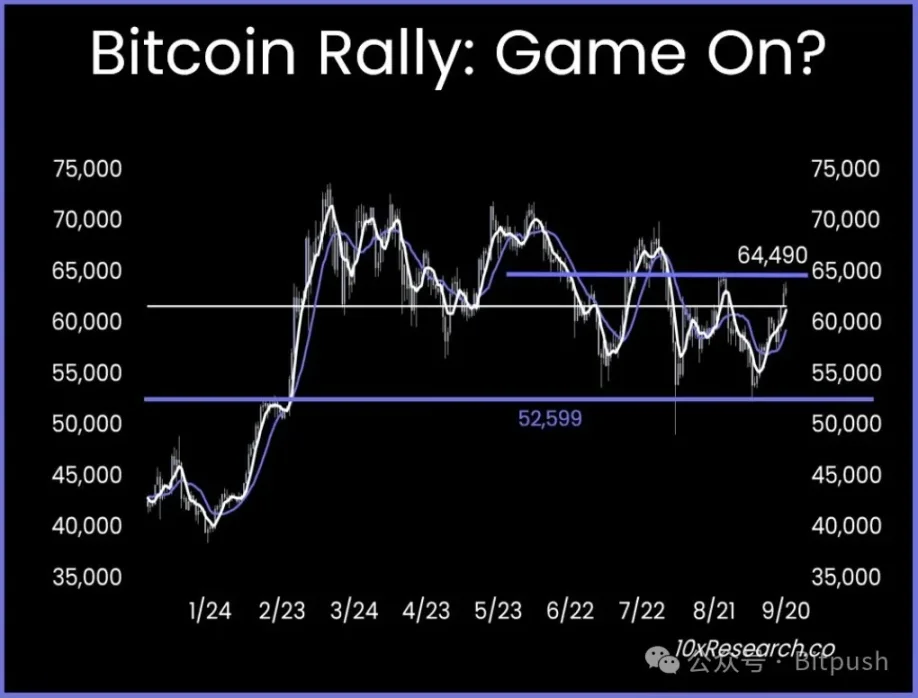
From a technical analysis perspective, Bitcoin has clearly broken out of its bearish pattern. Crypto research firm 10x Research noted on X that Bitcoin remains one of the most attractive assets in terms of risk/reward potential. BTC’s breakout above its downward trend line may indicate stronger upward momentum. The 21-week simple moving average (at $60,996) serves as a key indicator to determine whether Bitcoin is in a bull (above) or bear (below) market. A break above this level could set BTC’s target at $65,000—a level now well within reach. Notably, trading signals have for the first time shifted net long positions to account for 70% of total longs. Historical patterns suggest this shift may present attractive buying opportunities for both Bitcoin and Ethereum over the next 2–3 months.
Risk Appetite Rises Post-Rate Cut, Bitcoin Gains Favor in Financial Markets
In the early hours of September 19, the Federal Reserve announced a 50-basis-point rate cut, lowering its overnight lending rate from 5.25%-5.5% to 4.75%-5%, marking its first rate reduction in four years. By early morning Beijing time on the 20th, U.S. stocks rose, led by tech stocks. The Dow Jones surged over 500 points, and the S&P 500 closed above 5,700 for the first time—both reaching record highs. Bitcoin, which previously tended to fall with the market but lagged in rallies, delivered a standout performance this time.
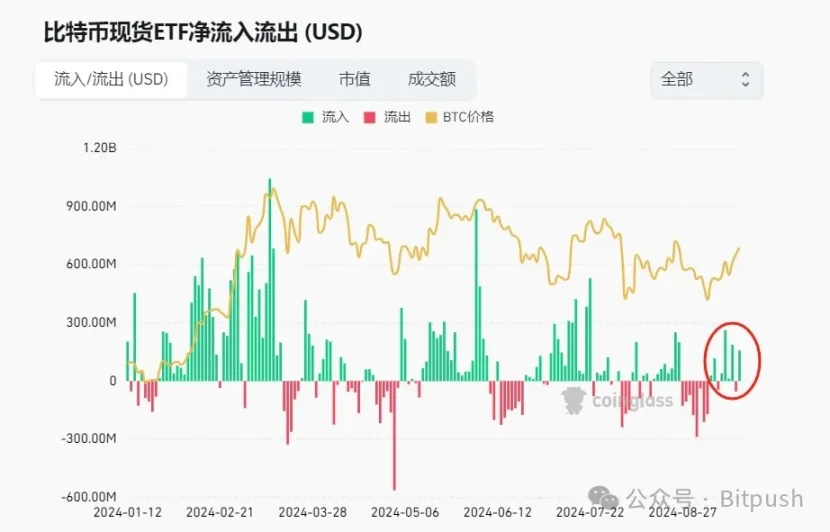
The strong performance across both traditional and crypto markets can be attributed to the Fed's substantial 50-basis-point cut. Prior expectations had centered on a more modest 25-basis-point reduction, so the larger-than-expected move surprised some investors—but was generally welcomed. Before the announcement, markets were primarily concerned about two scenarios: either a weakening U.S. economy forcing aggressive cuts, or a strong economy leading to slow easing and continued tight liquidity. Now, with a robust economy coinciding with aggressive monetary easing, optimism has surged. Risk appetite has risen accordingly, boosting demand for risk assets like Bitcoin. As a result, net inflows into Bitcoin spot ETFs have been steadily increasing.
Regarding the 50-basis-point cut, Jeremy Siegel, emeritus professor at the University of Pennsylvania's Wharton School, said on Thursday: "This is the best news I've heard from the Fed in years. It's fantastic for the markets and great for the economy."
As for why the Fed cut rates by 50 basis points, Chair Jerome Powell stated after the Wednesday FOMC meeting that initiating a policy pivot with a sizable cut while the economy remains strong helps reduce the risk of a downturn. "No one should interpret this as setting a new pace," he added. "We are adjusting policy toward a more neutral stance based on evolving economic conditions, moving at a pace we believe appropriate."
Overall, the 50-basis-point rate cut has significantly boosted confidence in a soft landing for the U.S. economy and elevated investor risk appetite. This has reversed Bitcoin’s prior weakness, driving renewed market interest and sustained capital inflows. However, it's important to note that the Fed’s approach remains flexible—not a commitment to continuous rate cuts. Going forward, U.S. economic data will continue to heavily influence the crypto market.
Fed Impact Is Significant, But Industry Innovation Still Drives Bitcoin
Bitcoin is fundamentally a novel high-risk asset, distinct from traditional financial risk assets. Few nations adopt risky assets as legal tender, yet Bitcoin—despite being similarly volatile—is increasingly recognized as official currency by some smaller countries. This reflects its unique financial attributes such as decentralization and scarcity. Therefore, analyzing Bitcoin cannot rely solely on traditional financial asset frameworks. This aligns with my long-standing view: while Bitcoin is a high-risk asset, its core driver lies in blockchain technological innovation and application. In traditional finance, Bitcoin may be labeled merely as a speculative instrument, but within the crypto and Web3 ecosystem, it is widely regarded as digital gold. As the blockchain industry evolves, this underlying technological foundation becomes ever more pronounced.
Currently, even traditional financial institutions are recognizing that Bitcoin’s risk profile differs fundamentally from conventional risk assets. BlackRock noted in a research report: "Due to its high volatility, Bitcoin is clearly a high-risk asset. However, the drivers of its risks and potential returns are fundamentally different from those of traditional high-risk assets." As a scarce, non-sovereign, decentralized global asset, Bitcoin is increasingly seen by some investors as a hedge during market panics or geopolitical turmoil. In the long term, Bitcoin’s adoption trajectory may be driven by concerns over global monetary stability, geopolitical uncertainty, U.S. fiscal sustainability, and political stability—factors that typically affect traditional risk assets in the opposite way.
Overall, beyond the Fed’s rate cut, Bitcoin’s recent rally is also closely tied to increased on-chain activity fueled by ecosystem development.
Recently, Fractal Bitcoin has drawn significant market attention. Launched by the Unisat team, Fractal Bitcoin is a Layer 2 solution for Bitcoin, branded as the "only native Bitcoin scaling solution." It emphasizes strong compatibility with Bitcoin and shared security, enhancing transaction speed without altering Bitcoin’s base code. It reduces confirmation times to 30 seconds—compared to at least 10 minutes on Bitcoin’s mainnet—and increases TPS by over 20x.
Besides Fractal Bitcoin, Stacks—the most well-known Bitcoin Layer 2—completed its Nakamoto upgrade on August 28. This upgrade marks a major milestone for Stacks, bringing four key improvements: 1) Block rewards reduced from 1,000 STX to 500 STX per Bitcoin block; 2) Block production on Stacks is decoupled from Bitcoin’s block timing, reducing confirmation time from over 10 minutes to just 10 seconds, increasing TPS by over 60x; 3) A new consensus mechanism writes Stacks’ chain history into Bitcoin blocks, making Stacks’ data immutable without altering Bitcoin’s own data; 4) The decentralized pegged asset sBTC has launched.
Conclusion
In summary, the primary catalyst behind Bitcoin’s recent rally has been the Fed’s 50-basis-point rate cut. However, deeper underlying factors include positive developments within Bitcoin’s ecosystem, which have contributed to a rebound in on-chain activity. I remain optimistic about the outlook, but the crypto industry still urgently needs meaningful application innovation. Amid the current lack of compelling use cases, Bitcoin’s upward trajectory lacks strong internal momentum. Additionally, while the Fed’s easing path appears favorable overall, future decisions will remain data-dependent—warranting cautious optimism.
Join TechFlow official community to stay tuned
Telegram:https://t.me/TechFlowDaily
X (Twitter):https://x.com/TechFlowPost
X (Twitter) EN:https://x.com/BlockFlow_News
 比推 BitpushNews