









With $15 million in funding, how is Hemi building a Layer 2 for Bitcoin and Ethereum?
TechFlow Selected TechFlow Selected
With $15 million in funding, how is Hemi building a Layer 2 for Bitcoin and Ethereum?
Hemi is a modular L2 that enables scalability, security, and interoperability. Its testnet is currently live, with the mainnet scheduled to launch in the fourth quarter of this year.
 Navigating Web3 tides with focused insights
By 1912212.eth, Foresight News
Although the market has at times questioned whether there's an overabundance of infrastructure projects, venture capital continues to stand by its convictions and double down on investments.
New entrants continue to emerge in the L2 space. Recently, Hemi Labs—founded by legendary Bitcoin developer Jeff Garzik—secured $15 million in funding led by Binance Labs, Breyer Capital, and Big Brain Holdings, with participation from Crypto.com and Jihan Wu. The funds will be used to develop and launch Hemi Network, a Layer 2 solution built atop both Bitcoin and Ethereum.
The L2 sector is already crowded and often underperforms across market cycles—so what makes Hemi stand out to attract strong VC backing?
What is Hemi?
Hemi is a modular Layer 2 network designed to deliver scalability, security, and interoperability. Unlike most L2 protocols that focus exclusively on either Bitcoin or Ethereum, Hemi treats both blockchains as components of a single unified super-network, unlocking greater programmability and asset portability.
At the core of Hemi is its virtual machine, which integrates a full Bitcoin node directly into the Ethereum Virtual Machine (EVM). Combined with its Bitcoin toolkit, this enables developers to build smart contracts that seamlessly interact with both Bitcoin and Ethereum.
How Does It Work?
Hemi operates as an Ethereum L2 secured by Bitcoin’s Proof-of-Work (PoW). To date, cross-chain DeFi bridge hacks have resulted in losses exceeding $2.8 billion. Hemi addresses this by having its miners post network data onto the Bitcoin blockchain. Once confirmed by Bitcoin, this data inherits the same level of security as Bitcoin itself—effectively protecting transactions via Bitcoin’s PoW.
To further optimize performance and security, Hemi employs a specialized node architecture consisting of: Bitcoin Deterministic Regulators, Bitcoin Security Sorters, PoP Miners, and Verification Challengers.
After PoP miners bundle and validate transactions, Verification Challengers monitor and verify the correctness of transactions and state proofs before final confirmation on the Bitcoin network.
Core Consensus: Proof of Proof (PoP)
Most blockchain protocols today rely on either Proof-of-Work (PoW) or Proof-of-Stake (PoS). While PoS networks function well under normal conditions, they face two critical vulnerabilities.
The first is "weak subjectivity"—an attacker could accumulate old private keys from former PoS validators and use them to gain majority control at a past checkpoint, enabling the creation of an alternative chain.
The second is censorship: a malicious actor with majority voting power could selectively ignore or block transactions, gaining control over the network and undermining decentralization and fairness.
PoS networks lack protocol-level defenses against these attacks. Hemi addresses this by introducing a novel mechanism called Proof of Proof (PoP), which inherits Bitcoin’s battle-tested security while preserving Ethereum’s flexibility.
In this design, Hemi deploys dedicated PoP miners responsible for:
- Collecting critical network data and publishing it onto the Bitcoin blockchain, thereby directly anchoring Hemi’s security to Bitcoin’s mature consensus system.
- Generating cryptographically complex proofs essential for network security.
- Leveraging Bitcoin’s security to ensure the integrity of the Hemi network, providing a dual-layer protection model.
Integration with Bitcoin adds an extra layer of security, using Bitcoin’s PoW as the foundation for dispute resolution and trust verification.
Additionally, every new block on Hemi receives confirmation from the Bitcoin network, significantly increasing the difficulty and cost of potential attacks.
Through Tunnels, Hemi also provides a Bitcoin-secured channel for safely moving assets across chains. This enables multiple asset transfer methods beyond the traditional bridging models and trust assumptions.
Hemi offers advanced programmability features such as on-chain routing, allowing users to program and automate multi-step transactions, including rerouting or invoking transactions in case of errors.
In summary, the PoP consensus allows miners to indirectly protect Hemi without participating in its internal consensus process. This expands transaction throughput within the Hemi ecosystem and raises the bar for network reorganization attacks—enhancing security while introducing new functionalities to the protocol.
Team Members
Hemi Labs was co-founded by early Bitcoin developer Jeff Garzik and blockchain security pioneer Max Sanchez. Jeff worked alongside Satoshi Nakamoto and has long been a central figure in open-source development and commercialization of Bitcoin technology. He served as a core Bitcoin developer for five years. Notably, Jeff hosts a YouTube series recounting his early experiences with Bitcoin and stories about Satoshi Nakamoto.
He also spent ten years at Red Hat and previously served on the board of directors for the Linux Foundation.
Besides being Hemi’s co-founder, Jeff is also co-founder and CEO of Bloq, established in 2016. Bloq is a blockchain solutions provider housing an open-source development lab and is a member of the Enterprise Ethereum Alliance.

Maxwell serves as co-founder and Chief Technology Officer. He co-created the Proof of Proof (PoP) protocol and led the design of a new protocol optimized specifically for PoP. Additionally, he launched the first testnet using post-quantum cryptography, released open-source GPU mining software, and discovered and disclosed vulnerabilities in multiple blockchain protocols—demonstrating deep technical expertise and extensive experience.
The startup currently has nearly 30 team members, most of whom are experienced software engineers.
Testnet
Hemi Network launched its incentivized testnet in July this year. Regular users can earn points through invitation links—inviters receive 10% of the points accumulated by invited users.
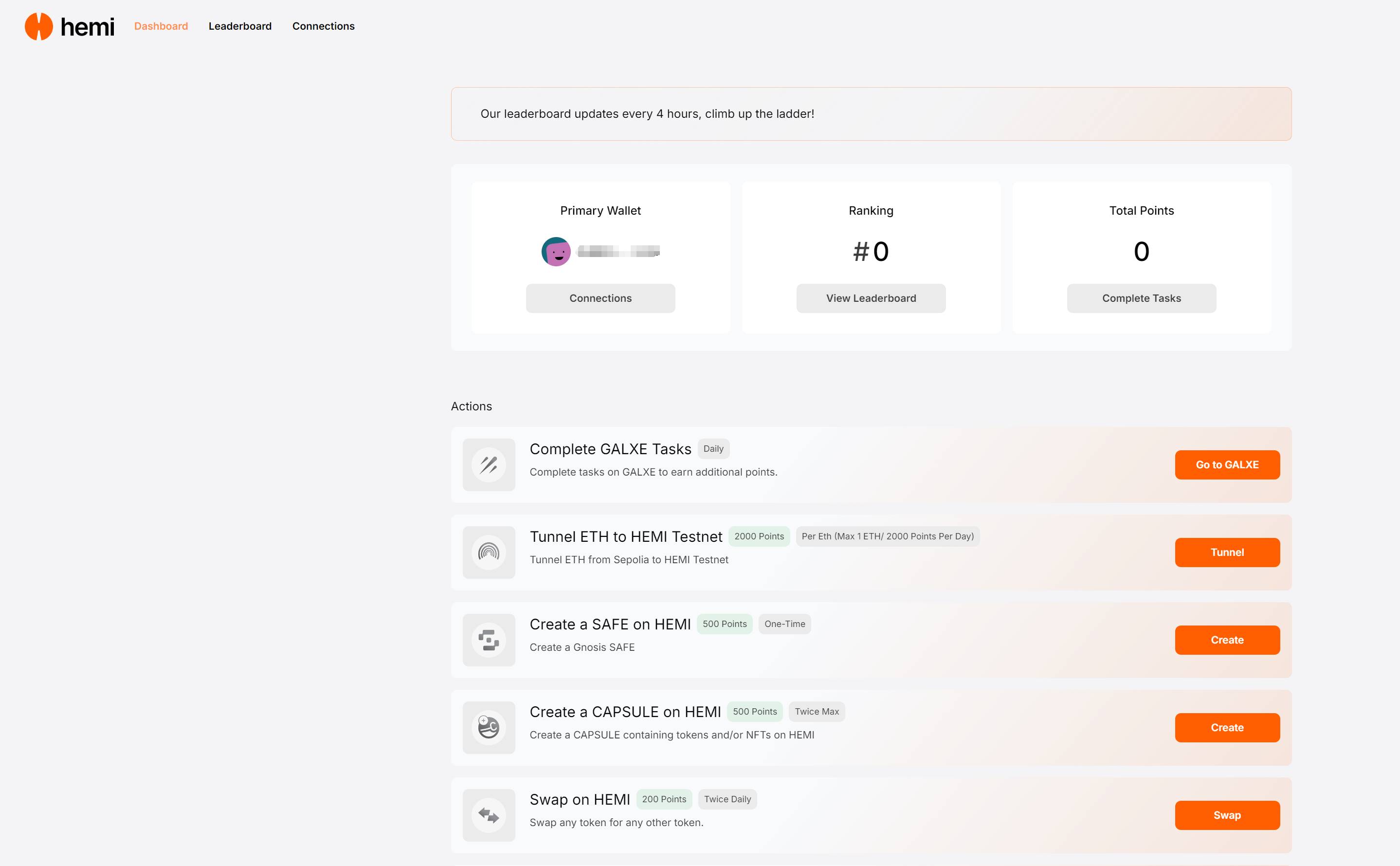
Users earn points and rankings by completing official tasks such as on-chain interactions. The leaderboard updates every four hours. In addition to on-chain activity, contributions to network growth via social platforms and community engagement are also eligible for point rewards.
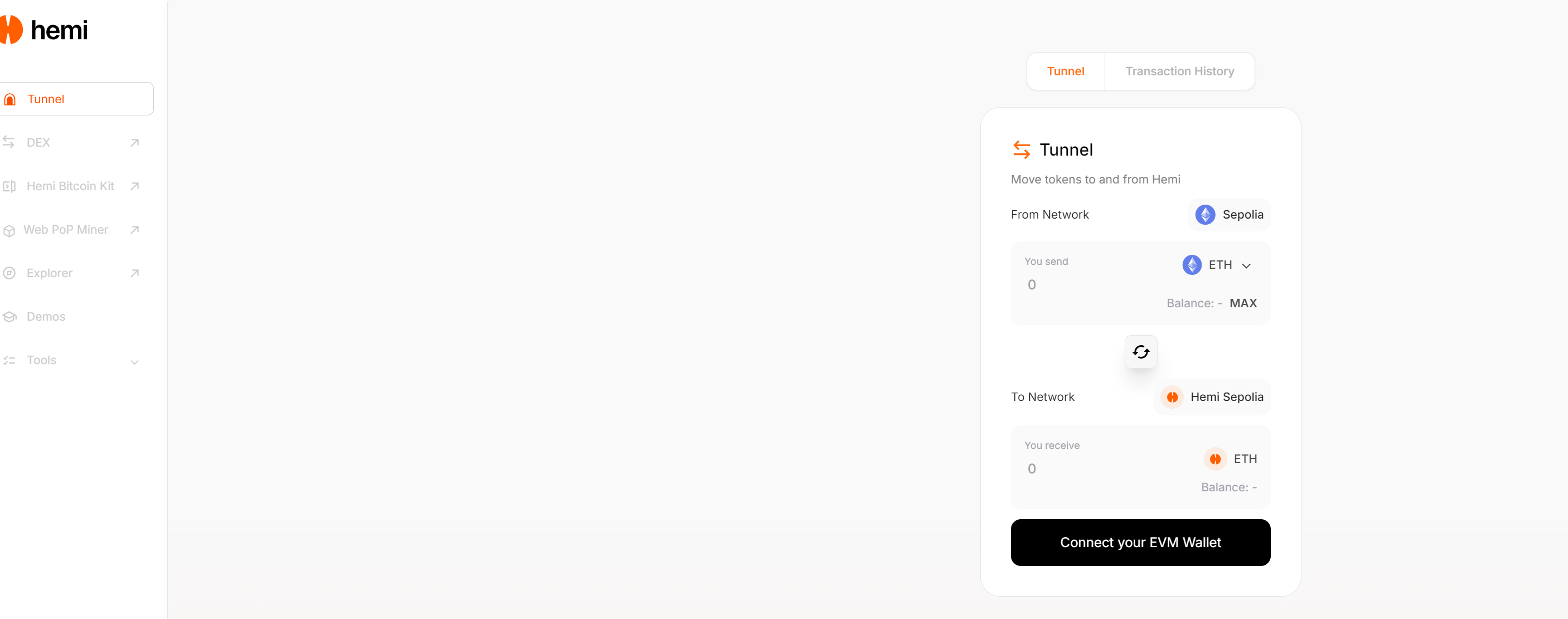
This is the first season of the testnet incentive program, with second and third seasons planned to follow.
Hemi is scheduled to launch its mainnet in Q4 this year.
Join TechFlow official community to stay tuned
Telegram:https://t.me/TechFlowDaily
X (Twitter):https://x.com/TechFlowPost
X (Twitter) EN:https://x.com/BlockFlow_News
 Foresight News






