When all coins are restaked, it's not security being guaranteed—it's profit.
TechFlow Selected TechFlow Selected
When all coins are restaked, it's not security being guaranteed—it's profit.
Restaking allows crypto asset holders with higher risk tolerance to earn additional returns.
 Navigating Web3 tides with focused insights
Author: Marco Manoppo
Translation: TechFlow

Hello everyone,
It's been a while since I last shared these thoughts with you. Lately, I've been reflecting on the future of restaking, which has been the dominant theme in the market over the past 18 months.
To simplify the discussion, I may refer to EigenLayer or AVS when describing the broader concept of restaking. However, I'm using this term broadly to encompass all restaking protocols and the services built on top of them—not just EigenLayer.
EigenLayer and the concept of restaking have opened Pandora’s box.
Conceptually, extending the economic security of a highly liquid and globally accessible asset makes perfect sense. It enables developers to build applications on-chain without having to create an entirely new ecosystem around their project-specific token.
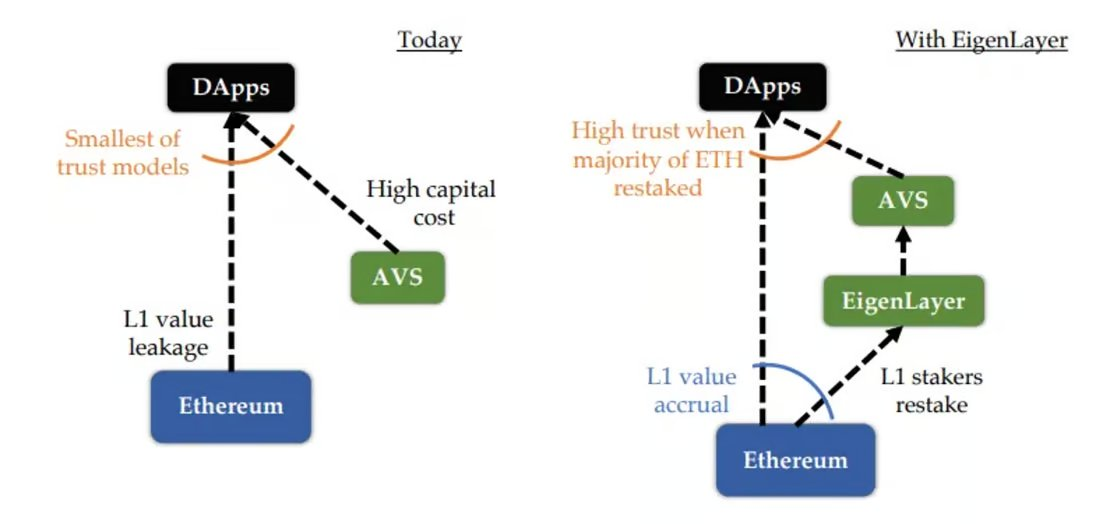
Source: EigenLayer Whitepaper
Ethereum (ETH) is considered a premium asset based on two premises:
1. For developers, leveraging its economic security to build products is rational—because it enhances security, reduces costs, and allows products to focus on core functionality.
2. It delivers a better product experience for end users. Yet, after 18 months of development since the release of the EigenLayer whitepaper, the restaking landscape has evolved.
We now have Bitcoin restaking projects like Babylon, Solana restaking such as Solayer, and multi-asset restaking platforms like Karak and Symbiotic. Even EigenLayer has started supporting permissionless tokens, allowing any ERC-20 token to become restakable without permission.
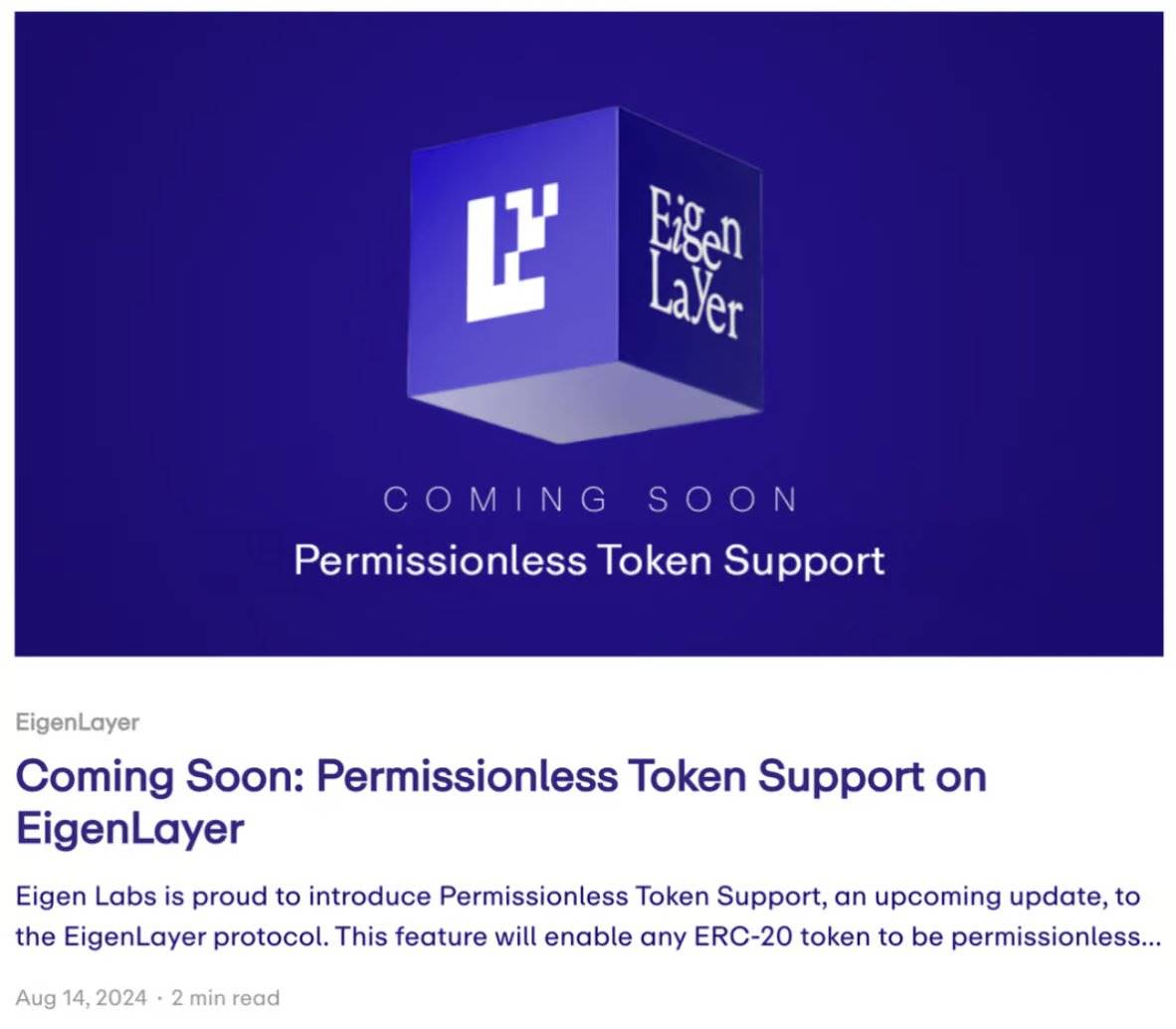
Source: EigenLayer Blog
The market has made one thing clear: every token will be restaked.
The core of restaking is no longer solely about extending ETH’s economic security—it’s about issuing a new type of on-chain derivative: restaked tokens (and by extension, liquid restaked tokens).
Moreover, with the emergence of liquid staking solutions like Tally Protocol, it’s foreseeable that the future of restaking will include all crypto tokens, not just L1 assets. We’ll see stARB being restaked into rstARB, then further wrapped into wrstARB.
So what does this mean for the future of crypto? What happens when economic security can be extended from any token?
The Supply and Demand Dynamics of Restaking
These are the two key factors shaping the future of restaking.
You could write long threads diving deep into subjective tokens and human coordination—but that’s slightly beyond my scope. If a restaking project wants to offer me some advisor tokens, I might consider writing about it. But I digress.
In crypto, there are always two immutable truths:
-
People always chase higher yields
-
Developers always want to create more tokens
People Chase Higher Yields
Restaking protocols have achieved the best product-market fit (PMF) on the supply side.
From our Wall Street predecessors, we see that the crypto market is rapidly evolving into one obsessed with ever-higher risk. Example? Polymarket already has a derivatives market dedicated to news events. We’re all heading toward extremes.
Restakers earn additional yield through AVS (services built atop restaking protocols). Ideally, developers choose to build on restaking protocols and incentivize restakers to stake their assets into these services. To do so, they may share revenue or reward restakers with their native tokens.
Let’s run a quick calculation:
As of September 7, 2024:
-
$10.5 billion worth of ETH is restaked on EigenLayer.
-
Assume most of this restaked ETH consists of liquid staking tokens (LSTs), already earning ~4% APY, seeking additional yield via restaking.
-
To deliver just 1% extra APY annually, EigenLayer and its AVS would need to generate $105 million in value—not accounting for slashing or smart contract risk.
Clearly, if restaking only offers an extra 1% APY, the risk/reward ratio isn’t compelling. I’d argue you’d need at least 8%+ APY for capital allocators to consider the risk worthwhile. That implies the restaking ecosystem must generate at least $420 million in annual value.
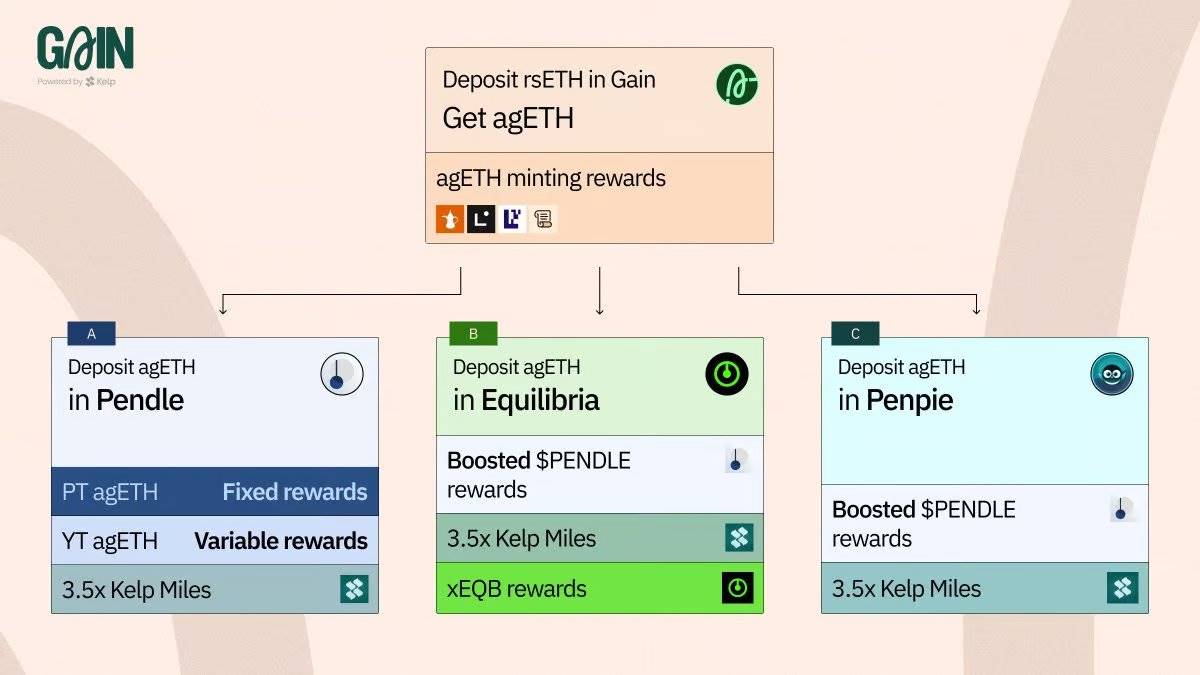
Source: KelpDAO
Currently, the high yields seen in restaking are primarily driven by the upcoming EIGEN token launch and points programs from liquid restaking protocols—paling in comparison to actual or projected revenue.
Imagine a scenario: 3 restaking protocols, 10 liquid restaking protocols, and over 50 AVSs. Liquidity becomes fragmented. Developers (i.e., consumers) face confusion due to too many choices rather than confidence in existing ones. Which restaking protocol should I pick? Which assets should I use to secure my project’s economics? And so on.
Therefore, we either need to drastically increase the amount of restaked ETH or accelerate native token issuance.
In short, restaking protocols and their AVSs must keep the supply side engaged by issuing large amounts of their own tokens.
Developers Want to Create Tokens
On the demand side, restaking protocols assume that developers will prefer using restaked assets over issuing their own dedicated tokens because it’s more economical and secure.
While this may hold true for applications requiring extreme trust and security (e.g., bridges), in reality, issuing your own token and using it as an incentive mechanism is critical to the success of any crypto project—whether a chain or an application.
Incorporating restaked assets as an added feature can bring benefits, but should not dictate the core value proposition of the product, nor be designed in a way that undermines the value of its own token. Some, like Kyle from Multicoin, take an even stronger stance—that economic security isn’t a key driver of product growth at all.
Integrated Kyle e/acc: “Multicoin is likely the largest holder by market cap of tokens that could qualify as AVS.
This includes Livepeer, Render, Helium, Hivemapper, Pyth, Wormhole, LayerZero.
There are also other tokens not yet circulating or publicly announced.
Never once has a founder—or any of the 200+ founders across our portfolio—called me saying: ‘Kyle, I think one of the main constraints on our growth is the quantity and quality of liquidity securing our system’s cryptoeconomic security.’
Not once.”
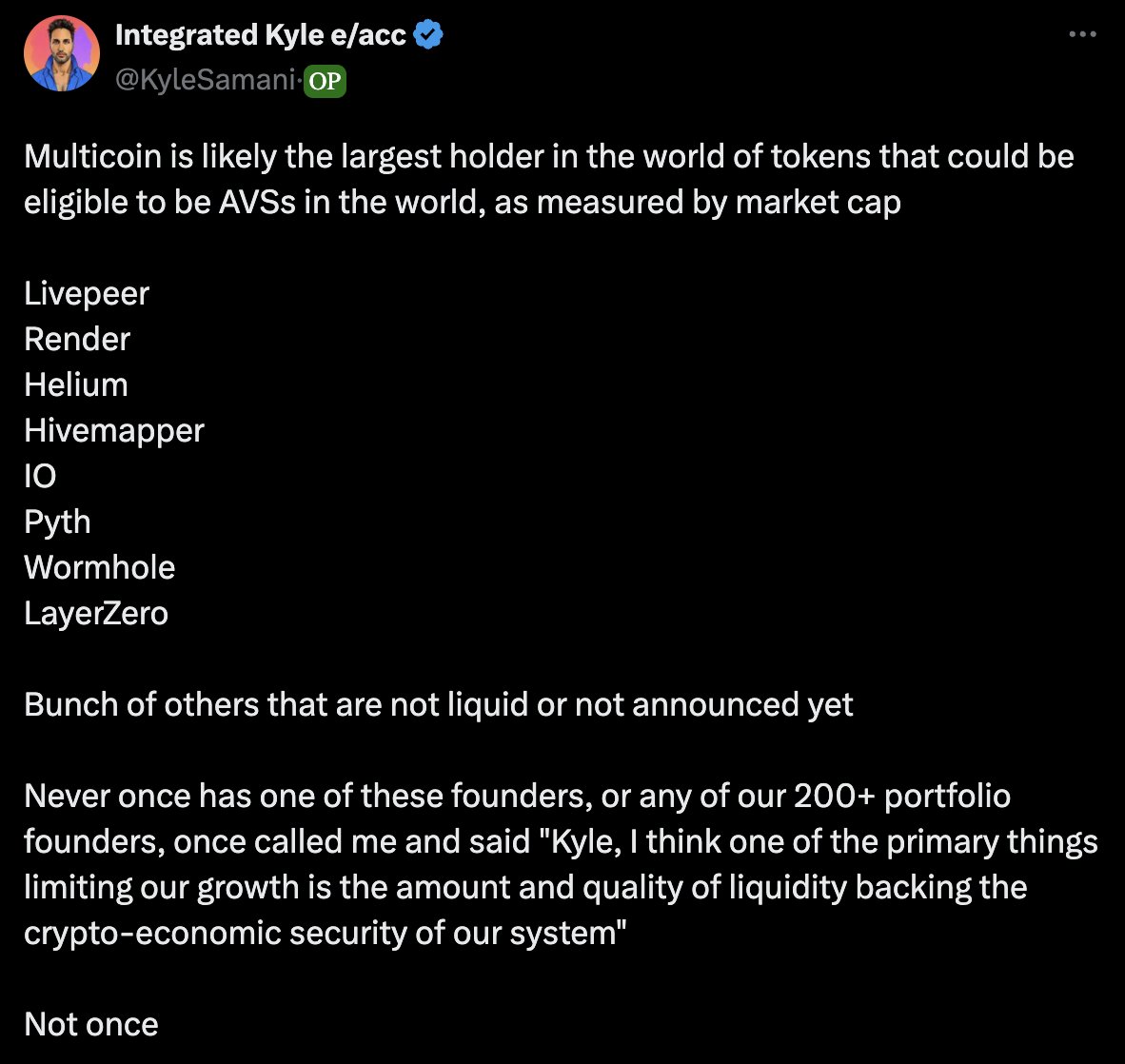
To be honest, it’s hard to argue with him.
I’ve been in crypto for seven years and never heard another crypto-native or industry peer—someone who stores most of their net worth on-chain—tell me they chose one product over another because of its economic security.
From an economic standpoint, Luca from M^0 wrote an excellent piece explaining how, due to market inefficiencies, using a project’s local token might actually be cheaper than using ETH.
When do tokens get issued? Frankly, regardless of whether they legally qualify as securities, project-specific tokens with governance, utility, economic design, or scarcity claims have always been viewed by investors as symbols of project success or prominence. Even without residual financial or control rights, this market sentiment persists. In a niche industry like crypto, tokens are often more tied to narrative or expected liquidity shifts than cash flows. It’s clear and well-documented that token proxy markets in crypto are far from efficient—and above-rational token prices translate into below-rational capital costs for projects. Lower capital costs typically manifest as less dilution in venture rounds or higher valuations compared to other industries. Due to inefficiencies in the capital structure hierarchy, native tokens effectively offer developers lower capital costs than $ETH .
Source: Dirt Roads
Fairly speaking, EigenLayer seems to have anticipated this, hence designing a dual-staking system. Now, its competitors are even marketing multi-asset restaking as a differentiating feature.
If all tokens will eventually be restaked, what is the real value proposition of restaking protocols to developers?
I believe the answer lies in insurance and enhancement.
The Future of Multi-Asset Restaking Will Bring Diversification of Choice
If projects aim to improve and differentiate their products, restaking will become an integrable add-on feature.
-
Insurance: It provides an additional layer of assurance that the product works as advertised, backed by more capital.
-
Enhancement: The best strategy for restaking protocols is to reframe the entire narrative and convince developers to embed restaking as a default technical component in any product because “it makes everything better.” Oh, you’re an oracle vulnerable to price manipulation attacks? What if we were an AVS too?
Whether end users care remains to be seen.
All tokens will compete to become preferred restaking assets, as this confers perceived value and reduces sell pressure. AVSs can choose from multiple types of restaking assets based on their risk appetite, incentive models, specific features, and desired ecosystem alignment. This is no longer just about core economic security—it’s about insurance, restaking, and politics. As every token gets restaked, AVSs will have abundant options.
-
Which assets should I use for economic security? What kind of political alignment do I want? Which ecosystem best fits my product?
Ultimately, the decision comes down to what delivers the best functionality for my product. Just as apps deploy across multiple chains and eventually become app-chains, AVSs will ultimately leverage the economic security of assets and ecosystems that provide the greatest benefit—sometimes even multiple ones simultaneously.
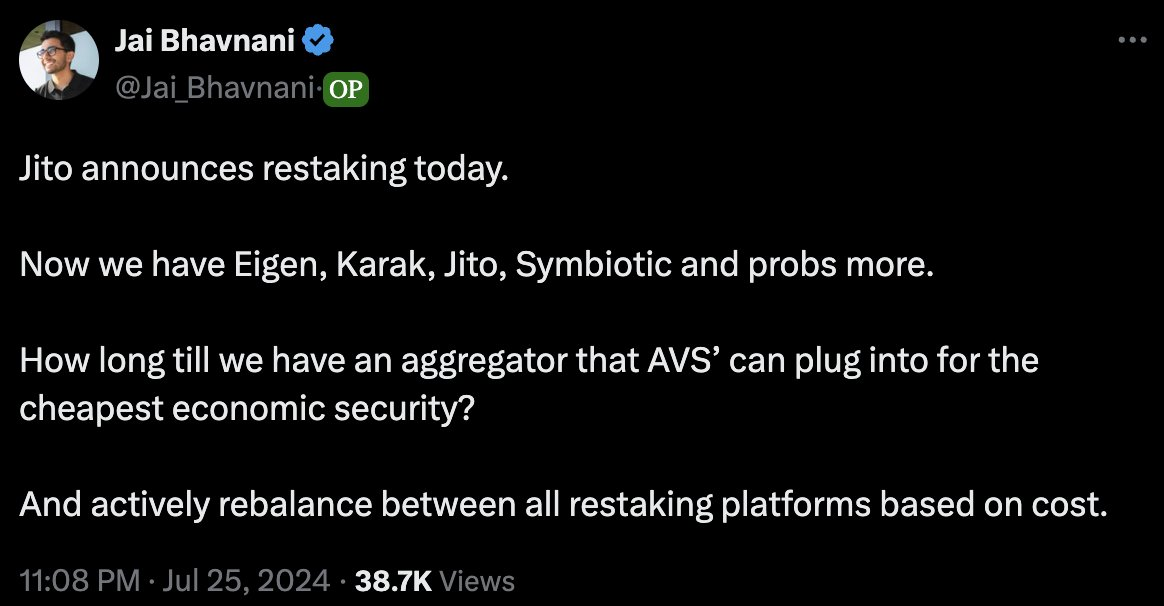
Jai’s tweet perfectly captures how most developers view the advantages of restaking.
It’s worth mentioning: we’re already seeing projects like Nuffle working to address this very issue.
Jai Bhavnani: “Jito today announced support for restaking. Now we have Eigen, Karak, Jito, Symbiotic, and possibly more. How long until we get an aggregator that AVSs can plug into to access the most cost-effective security? One that actively rebalances across all restaking platforms based on cost?”
Conclusion
Crypto Twitter tends to think in absolutes. In reality, restaking is an interesting foundational tool that expands developer options and impacts on-chain markets by introducing a new type of derivative—but it’s not revolutionary.
At minimum, it allows risk-tolerant crypto holders to earn extra yield, expands technical choices, and reduces engineering overhead for developers. It provides developers with a supplementary feature and creates a new derivative market for on-chain asset holders.
Many assets will be restaked, giving developers diverse options when integrating restaking. Ultimately, developers will choose restaking asset ecosystems the same way they select new chains to deploy on—opting for those that offer the greatest benefit to their product, sometimes even multiple.
Tokens will compete to become restaking assets, as the new derivative market created by restaking will benefit these tokens, increasing their utility and perceived value.
It was never about economics or security—it’s about insurance, restaking, and politics.
Join TechFlow official community to stay tuned
Telegram:https://t.me/TechFlowDaily
X (Twitter):https://x.com/TechFlowPost
X (Twitter) EN:https://x.com/BlockFlow_News
 @ManoppoMarco