








Coinbase Research: Restaking, When Everything Old Is New Again
TechFlow Selected TechFlow Selected
Coinbase Research: Restaking, When Everything Old Is New Again
EigenLayer's restaking protocol is expected to become the cornerstone for various new services and middleware on Ethereum.
 Navigating Web3 tides with focused insights
Written by: Coinbase Research
Translated by: TechFlow
Ethereum’s Proof-of-Stake (PoS) consensus mechanism represents the largest economic security pool in crypto, totaling nearly $112 billion. However, validators securing the network are no longer limited to earning base rewards on staked ETH. Liquid staking tokens (LSTs) have long enabled participants to bring their ETH and consensus-layer yields into DeFi—where they can be traded or re-staked as collateral. Now, re-staking introduces another layer through liquid restaking tokens (LRTs).
Ethereum’s relatively mature staking infrastructure and surplus security budget have enabled EigenLayer to grow into the second-largest DeFi protocol by total value locked (TVL), reaching $12.4 billion. EigenLayer allows validators to earn additional yield by re-staking their staked ETH to secure active validation services (AVSs). As a result, intermediary protocols in the form of liquid restaking protocols have become increasingly common, driving LRT growth.
That said, we believe re-staking and LRTs may introduce additional risks compared to existing staking products—both from security and financial perspectives. As the number of AVSs grows and LRTs diversify their operational strategies, these risks could become increasingly opaque. Nevertheless, re-staking (and staking) rewards are laying the foundation for a new class of DeFi protocols. Separate discussions around reducing native staking issuance to a minimal viable issuance (MVI) could further increase the relative importance of re-staking yields in the long run if implemented. Consequently, attention on re-staking opportunities is becoming one of the biggest themes in crypto this year.
Ethereum Re-Staking Basics
EigenLayer’s re-staking protocol launched on Ethereum’s mainnet in June 2023, with AVSs set to go live in the next phase of its multi-stage rollout (in Q2 2024). In practice, EigenLayer’s concept of “re-staking” enables validators to protect new Ethereum functionalities—such as data availability layers, rollups, bridges, oracles, cross-chain messaging—and potentially earn additional rewards in the process. This represents a new revenue stream for validators in the form of “security-as-a-service.” Why has this become such a hot topic?
As the largest PoS cryptocurrency, ETH currently holds a massive economic base protecting its network from hostile majority attacks. At the same time, the growing number of validators and staked ETH arguably exceeds what is strictly necessary to secure the network. At The Merge (September 15, 2022), 13.7 million ETH were staked—presumably sufficient to secure the network’s then TVL of 22.1 million ETH. As of publication, approximately 31.3 million ETH are now staked—an almost threefold increase in ETH-denominated terms—while Ethereum’s TVL in ETH terms is actually lower today (compared to end-2022) at 14.9 million ETH (see chart below).
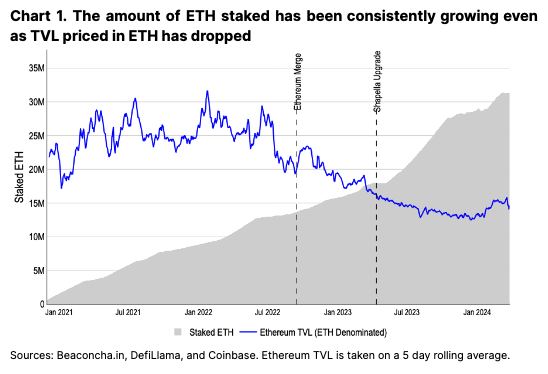
This excess staked Ethereum, along with the underlying asset’s security, liquidity, and reliability, uniquely positions it to help secure other decentralized services. In other words, we believe re-staking as a concept is largely inevitable as an extension of Ethereum’s inherent value. However, there’s no such thing as a free lunch. To ensure service correctness, re-staking is used for behavioral validation and may be subject to slashing penalties—similar to traditional staking. Likewise, re-stakers earn additional ETH (or AVS tokens) for their services.
Exploring Re-Staking
To date, EigenLayer’s TVL growth has been remarkable, second only to Lido (Ethereum’s leading liquid staking protocol). EigenLayer achieved this while maintaining deposit caps across much of its rollout and before launching any live AVSs. That said, it’s difficult to separate ongoing re-staking demand from user interest in short-term points and potential airdrops. While the amount of re-staked ETH may continue to grow over the long term as the protocol matures, we believe TVL could see short-term declines when point farming ends or early AVS rewards fall below expectations.
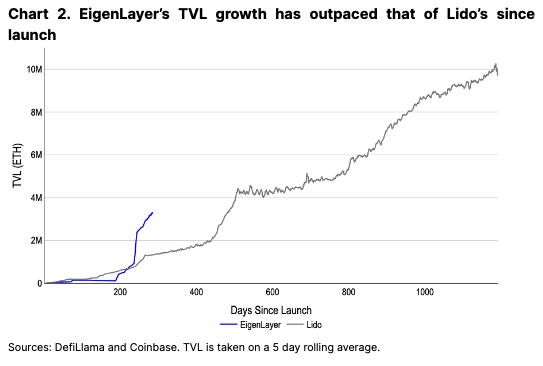
EigenLayer builds on the existing staking ecosystem by accepting various underlying LST pools or natively staked ETH (via EigenPods). Procedurally, validators point their withdrawal credentials to EigenPods to earn EigenPoints, which will later be redeemable for protocol rewards. LSTs locked in EigenLayer (1.5 million ETH) represent about 15% of all LSTs, while total ETH locked in EigenLayer accounts for nearly 10% of all staked ETH (3.1 million ETH). Indeed, we believe that renewed interest in new validator participation after stabilizing demand post-October 2023 was driven by re-staking. In February 2024, over 2 million additional ETH were staked—coinciding with a temporary suspension of EigenLayer’s deposit cap. In fact, some LST providers are increasing their target APYs as a way to leverage re-staking interest to attract new users to their platforms.
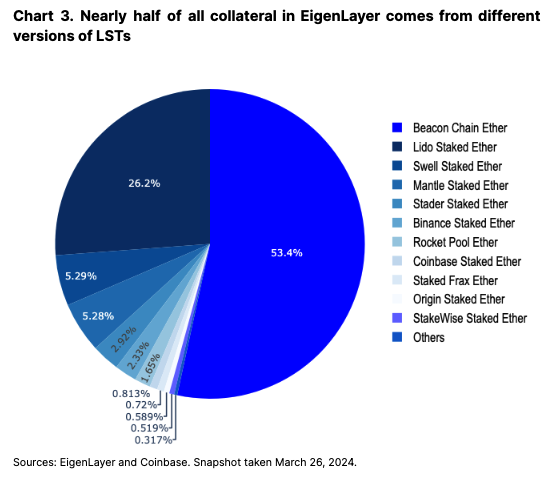
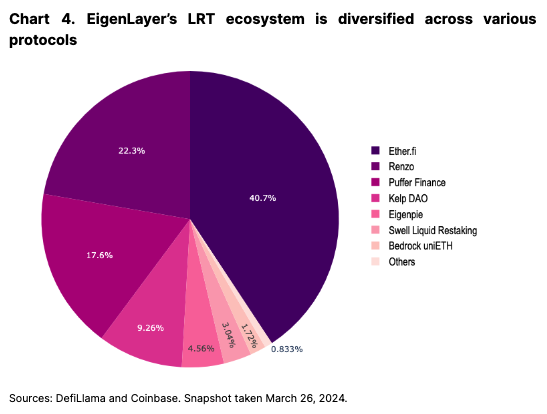
Learning from the popularity of LSTs, a rich LRT ecosystem has emerged, with over six protocols offering liquidity restaking token variants with various points and airdrop schemes. Of the 3 million ETH secured within EigenLayer, approximately 2.1 million (62%) are wrapped by secondary protocols. We’ve previously seen similar patterns in the liquid staking market and believe diversity of alternatives will be important as the industry evolves.
In the long run, if native staking yields decline due to higher participation rates (as more validators join and dilute returns), re-staking could become an increasingly important channel for Ethereum yield. Separate discussions around reducing native staking issuance could further increase the relevance of re-staking yields (though still in early stages of discussion).
AVS yields are expected to be relatively low upon launch, which could pose challenges for LRTs in the near term. For example, Ether.fi, one of the largest LRTs, charges a 2% annual platform fee on total value locked for “vault management.” Not all LRTs have identical fee structures, leaving room for competition. However, using this 2% fee as a breakeven benchmark, AVSs would need to pay roughly $200 million annually (on $12.4 billion in restaked value) to cover costs—more than what Aave or Maker collected in fees over the past year. This raises the question of how much business AVSs must generate to meaningfully boost total returns for ETH stakers.
The Rise of Active Validation Services
To date, no AVS has launched on mainnet. The first upcoming AVS (scheduled for early Q2 2024) will be EigenDA, a data availability layer likely fulfilling a role similar to Celestia or Ethereum’s blob storage. Following the Dencun upgrade, which reduced L2 fees by up to 90%, we believe EigenDA will become another tool for cheap L2 transactions. However, building or migrating L2s to leverage EigenDA is a slow process, and it may take months before the protocol generates significant revenue.
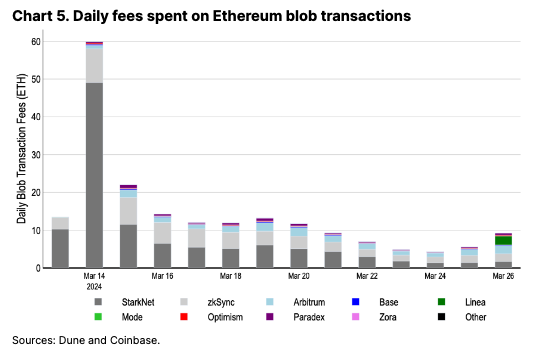
To estimate EigenDA’s initial yield, we can compare it to Ethereum’s blob storage costs. Currently, many major L2s spend around 10 ETH per day on blob transactions—including Arbitrum, Optimism, Base, zkSync, and StarkNet (see chart below). If EigenDA sees similar usage levels, our conservative estimate suggests annualized restaking rewards of approximately 3,500 ETH—equivalent to an extra ~0.1%. While adding multiple AVSs could rapidly increase yields, we believe initial fees may fall short of high market expectations in the first few months.
Other AVSs being built within the EigenLayer ecosystem include interoperability networks, fast finality layers, proof-of-location mechanisms, and security bootstrapping for Cosmos chains. The opportunity space for AVSs is vast and expanding. Re-stakers can selectively choose which AVSs to back with their ETH collateral, though this process becomes increasingly complex with each new AVS.
Potential Issues
This raises the question: how will different LRTs handle AVS selection, potential slashing, and ultimate token financialization? In traditional staking, the one-to-one mapping between validator responsibility and income is clear, making LSTs relatively straightforward. But with re-staking, the many-to-one structure introduces non-trivial complexities in how rewards and losses are accumulated and distributed, compounded by diversity among LRT issuers. LRTs pay not only base ETH staking rewards but also a range of AVS security rewards. This means potential payouts from different LRT issuers will vary.
At this stage, many LRT models remain unclear. However, given most projects aim for a single LRT, all token holders within a given protocol may be uniformly subject to AVS incentives and slashing conditions. These mechanisms may differ significantly across LRT providers.
One proposal involves a tiered approach, where LRT issuers adopt a mix of “high-risk” and “low-risk” AVSs—though this would require establishing undefined risk standards. Additionally, depending on architecture, final rewards for token holders might still be paid based on overall AVS performance, undermining the purpose of risk layering. Alternatively, decentralized autonomous organizations (DAOs) could decide which AVSs to support, raising questions about who controls key decisions within DAOs. Otherwise, LRT providers could act as interfaces to EigenLayer, allowing users to retain control over AVS selection.
Emerging Risks
At launch, the re-staking process should be relatively simple for operators, as EigenDA will be the only available AVS to secure. However, one feature of EigenLayer is that ETH committed to one AVS can be further re-staked to other AVSs. While this can boost yields, it may also amplify risks. Submitting the same staked ETH to multiple AVSs creates challenges in disentangling slashing and claim conditions across services. Each service sets custom slashing rules, potentially leading to scenarios where one AVS slashes re-staked ETH for misconduct, while another wants to use those funds to compensate affected participants—resulting in finality conflicts. That said, EigenDA will not have slashing conditions at initial launch.
Further complicating this setup is EigenLayer’s “pool security” model, where AVSs leverage a shared pool of staked ETH for protection, optionally enhanced via “attributable security.” In this model, individual AVSs can receive additional re-staked ETH dedicated solely to securing their specific service—a form of insurance or safety net for AVSs willing to pay a premium. As more AVSs launch, operator roles become more technically complex, and slashing rules harder to follow. LRTs abstract many of these potential strategies and risks away from token holders.
This is problematic because ultimately, people will gravitate toward LRTs offering the highest rewards. Thus, LRTs may be incentivized to maximize yields to gain market share—but at the cost of higher, hidden risk configurations. In other words, we believe risk-adjusted returns matter more than absolute rewards, but transparency here may be difficult. As LRT DAOs are incentivized to re-stake repeatedly to stay competitive, this could introduce additional risks.
Moreover, if LRTs distribute rewards entirely in ETH, they may create sell pressure on non-ETH AVS rewards. Specifically, if LRT payouts are fully denominated in ETH, value accrual for re-staking could be constrained by recurring sell pressure, as LRTs may need to convert native AVS tokens into ETH (or ETH equivalents) to redistribute rewards to LRT holders.
Additionally, LRTs carry significant valuation risks. For example, during prolonged staking withdrawal queues (with Dencun reducing validator churn limits from 14 to 8), temporary decoupling between LRTs and their underlying value is possible. If LRTs become widely accepted collateral within DeFi (e.g., in lending protocols like LSTs), this could inadvertently exacerbate liquidations—especially in low-liquidity markets.
This assumes DeFi protocols can first accurately assess LRT collateral value. In reality, LRTs represent diverse portfolios whose risk profiles evolve over time. Holdings can be added or removed, and AVSs themselves may change their reward or solvency risk parameters. Hypothetically, we might see market downturns simultaneously affecting multiple AVSs, destabilizing LRTs and amplifying forced liquidations and market volatility. Recursive borrowing would only magnify these losses. On the other hand, protocols capable of splitting LRTs into principal and yield components could help mitigate risks—using tokenized principal as primary collateral and tokenized yield for interest rate swaps.
Finally, in extreme cases, large-scale failures in re-staking mechanisms could threaten Ethereum’s base consensus protocol, as emphasized by Ethereum co-founder Vitalik Buterin. If the amount of re-staked ETH becomes sufficiently large relative to total staked ETH, there could be economic incentives to execute incorrect decisions that destabilize the network.
Conclusion
EigenLayer’s re-staking protocol has the potential to become a foundational pillar for a wide range of new services and middleware on Ethereum, creating a meaningful source of ETH rewards for future validators. From EigenDA to Lagrange’s AVSs, these innovations could greatly enrich the Ethereum ecosystem itself.
Nonetheless, LRT adoption layered atop base protocols may introduce hidden risks stemming from opaque re-staking strategies or temporary dislocations from underlying value. How different issuers choose which AVSs to support and how they allocate risks and rewards to LRT holders remains an open question. Additionally, initial AVS yields may fall short of lofty market expectations, though we expect this to improve as AVS adoption grows. Nevertheless, we believe re-staking lies at the heart of Ethereum’s open innovation and will become a core component of the ecosystem’s infrastructure.
Join TechFlow official community to stay tuned
Telegram:https://t.me/TechFlowDaily
X (Twitter):https://x.com/TechFlowPost
X (Twitter) EN:https://x.com/BlockFlow_News






