








What are the legal compliance issues when Web3 games go global and launch secondary markets?
TechFlow Selected TechFlow Selected
What are the legal compliance issues when Web3 games go global and launch secondary markets?
Build in-house or partner with a third-party platform?
 Navigating Web3 tides with focused insights
Authors: Liu Honglin, Liu Fuqi, Shanghai Manqin Law Firm
The development of overseas Web3 games faces various complex challenges. According to the Footprint Analytics Web3 Gaming Report for July, there were 3,362 Web3 games in total during that month, with only about one-third remaining active—and just 289 attracting more than 1,000 monthly active on-chain users (MAU). This has sparked market discussions on the sustainable development of Web3 gaming.
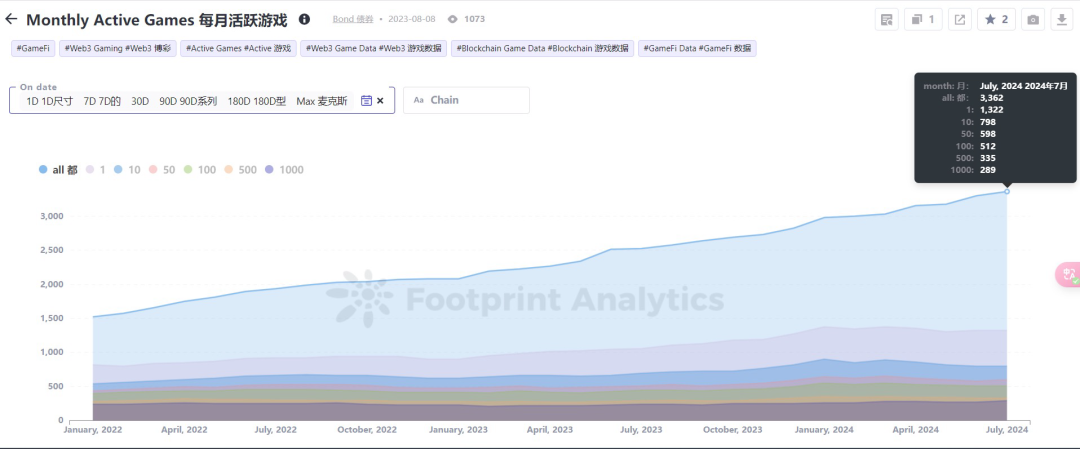
Active users are fundamental to the sustained revenue of Web3 games. Therefore, beyond earning income through direct sales of in-game items via primary markets, project teams employ various strategies to enhance revenue sustainability. For instance, some projects implement dual-token systems during development to stabilize the in-game economy. Additionally, establishing secondary markets has become a key factor influencing the operation and growth of blockchain games by enhancing liquidity within the in-game economy.
Recently, at the 76th Manqin Afternoon Tea event hosted by Manqin Law Firm, seasoned Web3 gaming practitioners were invited to discuss compliance issues faced at different stages of Web3 game development, including insights on secondary markets.
Currently, the industry generally opts for collaboration with third-party platforms when building secondary markets. However, Manqin lawyers have also received numerous inquiries regarding self-built secondary markets. Based on this, this article explores the differing strategies between self-built and third-party partnered secondary markets and provides corresponding compliance recommendations.
Why Establish a Secondary Market?
A secondary market is a platform that allows players to freely trade in-game assets (such as NFTs and virtual items), offering opportunities to derive value from rare or virtual assets.
The role of secondary markets in Web3 games can be summarized into four main aspects:
Enhancing Asset Liquidity. Secondary markets provide players with a venue to buy, sell, or exchange NFTs, in-game items, and other virtual assets. This functionality not only increases asset liquidity but also strengthens player engagement and retention within the game ecosystem.
Increasing User Engagement and Earnings. Through secondary markets, players can generate value within the game—such as profiting from trading rare items or selling upgraded assets. This sense of participation and profit potential attracts more users to blockchain games and fosters community growth.
Ensuring Market Pricing and Value Discovery. Secondary markets regulate the prices of in-game assets based on supply and demand, enabling more accurate reflection of their market value. This benefits both developers and players, as transparent pricing enhances trust across the entire ecosystem.
Promoting Sustainable In-Game Economic Cycles. The existence of a secondary market contributes to a healthier and more sustainable in-game economy. Players can recoup funds through continuous trading and reinvest them, maintaining economic vitality within the game.
Comparison Between Self-Built and Third-Party Models
Secondary markets are crucial for the sustainability of Web3 games. So how should project teams choose between building their own or partnering with third parties?
A complete Web3 game secondary market consists of four main components: front-end user interface, back-end management system, smart contract layer, and blockchain network. The table below offers a clear comparison between the two models.
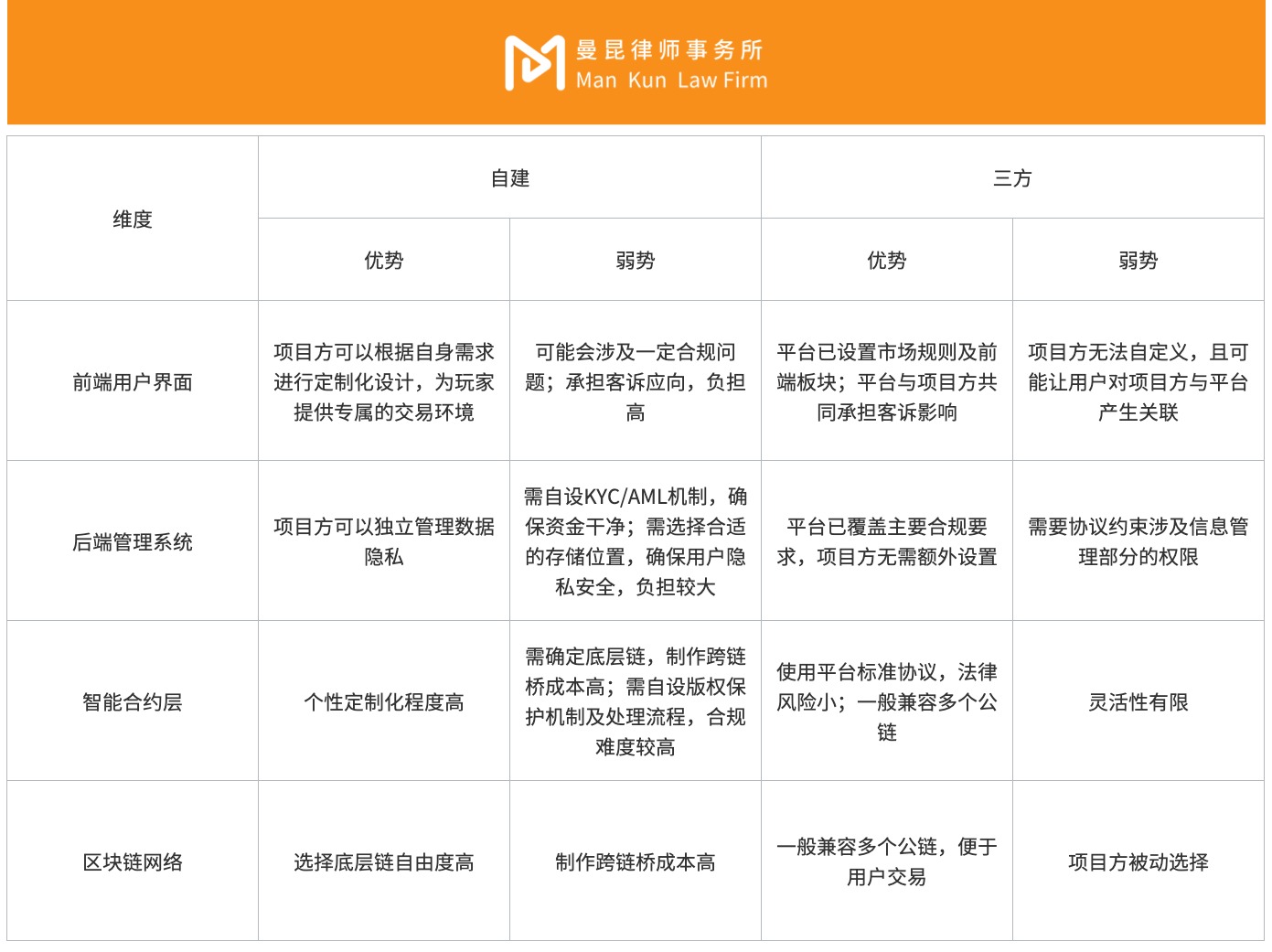
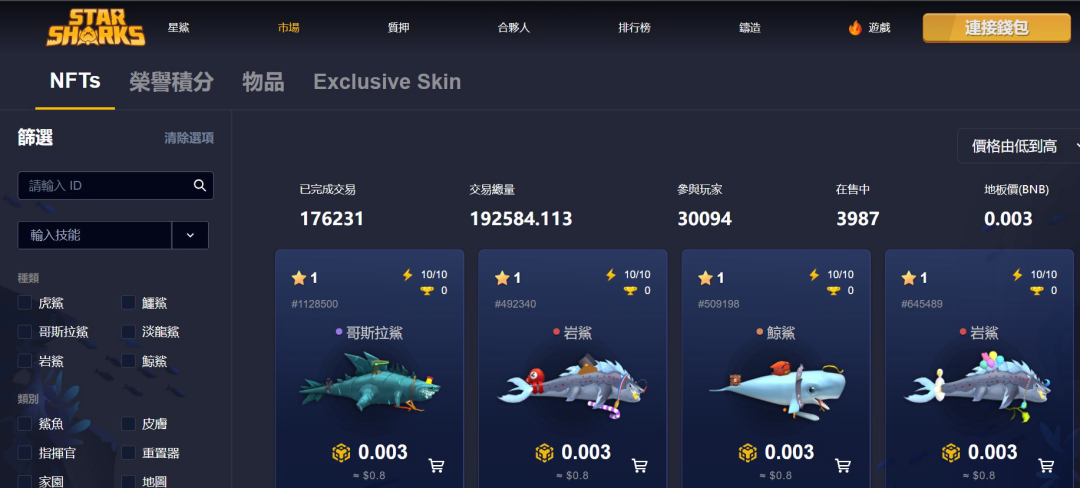
As shown, the core advantage of a self-built secondary market lies in full control by the project team over the platform. From market rules and fee structures to user experience, teams can customize every aspect according to their needs. This flexibility enables deeper integration with brand strategy, enhancing user loyalty and market stickiness. For example, the popular game Starshark leveraged its self-built marketplace to strengthen its brand identity, delivering a user experience fully aligned with its core brand and increasing user belonging and interaction frequency.
However, self-built markets face complex compliance requirements—such as setting trading rules and conducting fund reviews—that dramatically increase technical and resource costs. With multiple layers of smart contracts, market liquidity may be constrained. Without stable buyers and sellers, asset prices could fluctuate significantly, undermining user trust and leading to increased customer complaints. Additionally, self-hosting requires solving cross-chain asset and data transfers, including building bridges, further increasing technical complexity and cost.
In contrast, partnering with third-party secondary markets significantly reduces legal and compliance risks. By isolating the core game operations from the secondary market, project teams avoid direct involvement in monetary transactions. As a result, if price volatility or losses occur, users are more likely to view these as market behaviors rather than the project’s responsibility, reducing claims risk. This separation helps maintain legal distance from secondary market activities, especially in relation to potential criminal liabilities. It also mitigates future legal risks, particularly those related to virtual currency transactions and regulatory scrutiny. Major platforms like OpenSea and Magic Eden have already established mature KYC and AML compliance frameworks and assume most regulatory responsibilities. Moreover, large platforms typically have robust copyright protection mechanisms to swiftly address potential IP disputes, reducing the risk for project teams.
While partnering with third parties limits customization options regarding market rules, fee structures, and UI design, these platforms offer broad user bases and well-developed trading ecosystems. They usually support multiple public blockchains, allowing projects to quickly access liquidity and leverage existing user communities to expand market reach. This model is particularly beneficial for early-stage projects seeking rapid market entry without having to build liquidity from scratch.
Manqin Legal Insights
Projects Suitable for Building Their Own Secondary Market
Self-built secondary markets are suitable for projects with strong technical teams, abundant resources, and a desire for deep control over branding and user experience. For projects already possessing a large user base and capable of bearing compliance and operational pressures, building an independent marketplace is a viable option. However, it's critical to avoid any mechanisms involving RMB conversion—whether officially providing redemption channels for game points or tokens, or allowing peer-to-peer cash transactions—as these carry extremely high criminal liability risks.
Projects Suitable for Third-Party Collaboration
For projects in the early development stage, prioritizing reduced compliance risk and fast access to liquidity makes third-party collaboration a more prudent choice—the prevailing approach among most blockchain game teams today. This model enables rapid market entry while minimizing technical and operational burdens and lowering initial investment costs. That said, users may perceive an association between the project and the third-party platform. To prevent misunderstandings, project teams should clearly define the independence of both parties through explicit user agreements and partnership disclosures.
Potential for a Hybrid Model
Some projects may consider starting with third-party platforms and gradually transitioning to a self-built secondary market once mature. For example, Pixeis, currently ranked at the top of popular blockchain games, adopts such a hybrid approach.
This strategy allows teams to ensure liquidity and compliance while gradually accumulating technical and market resources for a smooth transition. However, it must be emphasized that game points should not be integrated into third-party secondary markets for trading—even if off-chain, such points possess token-like characteristics. Project teams would then bear responsibilities related to data synchronization, privacy, security, and additional customer complaints. Therefore, restricting cash-out interfaces and ensuring off-chain tokens are used solely for purchasing in-game items can prevent them from being classified as cash-out tools, thereby reducing compliance risks.
Manqin Legal Summary
In conclusion, when choosing a secondary market model, blockchain game teams must make decisions based on their own resources, technical capabilities, and compliance needs. For teams aiming for rapid market entry and lower compliance risks, partnering with third-party platforms is the optimal solution. For those pursuing brand independence and deep user control, building a proprietary secondary market offers greater advantages. Regardless of the chosen path, project teams should align their secondary market strategy with long-term goals, remain flexible, and rigorously manage compliance issues to adapt to evolving market dynamics and regulatory environments.
Join TechFlow official community to stay tuned
Telegram:https://t.me/TechFlowDaily
X (Twitter):https://x.com/TechFlowPost
X (Twitter) EN:https://x.com/BlockFlow_News






