OKX Ventures: A Deep Dive into the Six Core Asset Markets in the RWA Sector
TechFlow Selected TechFlow Selected
OKX Ventures: A Deep Dive into the Six Core Asset Markets in the RWA Sector
So far this year, RWA narrative growth has ranked second, rising 117%, just behind Meme.
 Navigating Web3 tides with focused insights
Author: Esme Zheng, OKX Ventures
In the current market environment, "Real-World Assets" (RWA) are rapidly emerging. In July this year, CoinGecko's Q2 2024 Crypto Industry Report identified meme coins, artificial intelligence, and RWA as the hottest categories, collectively capturing 77.5% of network traffic.
Traditional financial giants such as Citigroup, BlackRock, Fidelity, and JPMorgan have also entered the space. According to data from Dune Analytics, RWA narratives ranked second in growth this year, increasing by 117%, trailing only meme coins. This article provides a comprehensive overview of the current state and future opportunities within the RWA sector.
TL;DR
-
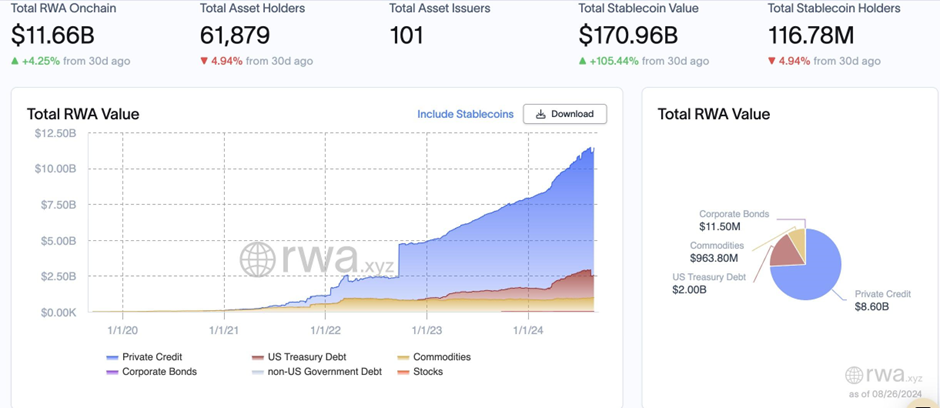
RWA is one of the fastest-growing areas in DeFi, with total value locked (TVL) doubling in 2023 and growing another 50% since the beginning of 2024, reaching $12 billion (excluding stablecoins). The largest and fastest-growing segments are private credit markets (76%), U.S. Treasury products (17%), followed by precious metals-backed stablecoins led by gold, real estate tokens, and others.
-
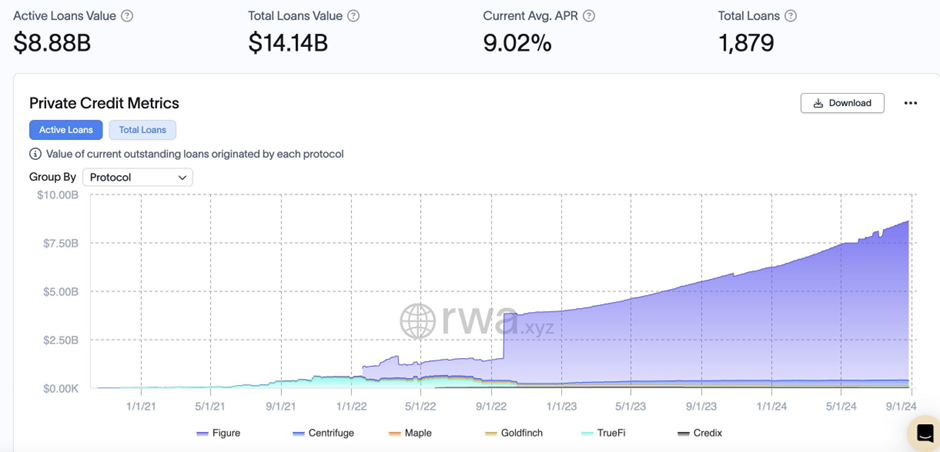
Currently, nearly 15 major issuers offer over 32 tokenized U.S. Treasury-related products, with total assets exceeding $2 billion—a 1,627% increase from the start of the year. Six leading on-chain credit protocols—Figure, Centrifuge, Maple, Goldfinch, TrueFi, Credix—collectively hold $8.88 billion in active loans, up 43% from年初.
-
Following the successful adoption of stablecoins on-chain and attractive net interest margins for off-chain centralized issuers, the next stage of RWA evolution will be driven by tokenized U.S. Treasuries. In this process, token holders capture the majority share of net yield spreads by directly investing in short-duration, liquid, government-backed real-world assets.
-
The on-chain private credit lending market faced significant challenges after defaults collapsed in centralized finance but is now recovering under the momentum of the RWA narrative. Although on-chain credit currently represents less than 0.5% of the traditional $1.5 trillion private credit market, strong upward trends indicate substantial potential for further expansion.
-
Tokenization of real-world assets involves extensive issuance and trading operations in traditional finance. For financial institutions holding core assets, compliance and security are primary concerns. RWAs must exist within “trusted finance” or “verifiable finance,” and require being “regulated cryptocurrencies.” Especially in the context of stablecoins, they still rely heavily on off-chain intermediaries for auditing, compliance, and asset management—functions that demand a foundation of trust.
I. Current State of the RWA Sector
1. Market Supply and Demand
- The core logic of RWA is mapping the rights to returns from real-world financial assets—such as U.S. Treasuries, income-generating fixed-income securities, and equity instruments like stocks—onto blockchains. This allows users to gain exposure to these yields while using off-chain collateral to unlock liquidity on-chain. For physical assets like gold and real estate, tokenization brings them onto the blockchain, leveraging distributed ledger technology to enhance transaction efficiency and transparency.
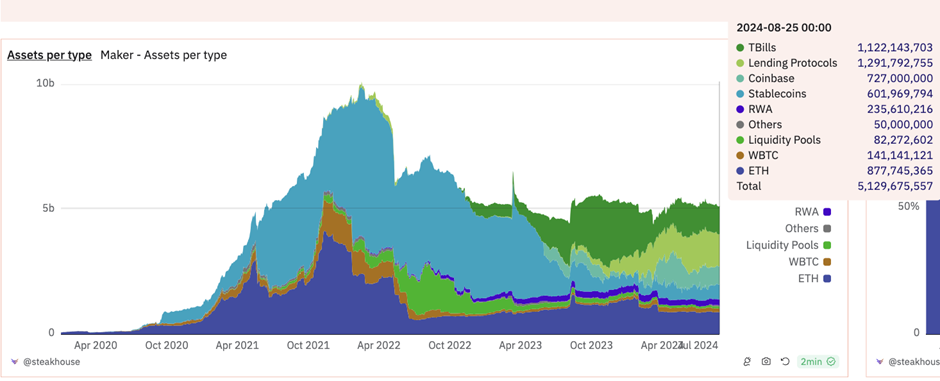
- Amid the Federal Reserve’s prior cycle of rate hikes and balance sheet contraction, high interest rates significantly impacted risk asset valuations, while quantitative tightening drained liquidity from crypto markets, causing DeFi yields to decline steadily. During this period, the ~5% risk-free yield offered by U.S. Treasuries became highly attractive within the crypto ecosystem. A prominent example was MakerDAO's large-scale purchase of Treasuries as reserve assets—not only diversifying holdings and stabilizing exchange rates, but most importantly fulfilling crypto’s one-sided demand for real-world financial asset yields.
Source: Dune / @steakhouse
- There is a vast amount of stablecoins in circulation. In a high-interest-rate environment, holders earn no yield and effectively pay an opportunity cost. Centralized stablecoin issuers privatize profits while socializing losses. More types of RWA assets are needed to efficiently utilize these stablecoins, generate returns for users, and inject additional liquidity into the DeFi ecosystem.
- For well-known asset managers such as Franklin Templeton and WisdomTree, tokenization represents a new distribution channel to reach a younger, digitally-native clientele who prefer holding assets on blockchains rather than in traditional brokerage or bank accounts. For them, tokenized Treasuries serve as their "beachhead market."
- Traditional finance is increasingly integrating with DeFi technologies through asset tokenization to reduce costs, improve efficiency, and address systemic issues. Mapping real-world assets—stocks, derivatives, currencies, equities—onto blockchains expands the use cases of distributed ledger technology and enables faster settlement and exchange. Beyond exploring new distribution channels, the focus lies on the tangible efficiencies and innovations enabled by the technology for legacy financial systems.
2. Market Size:
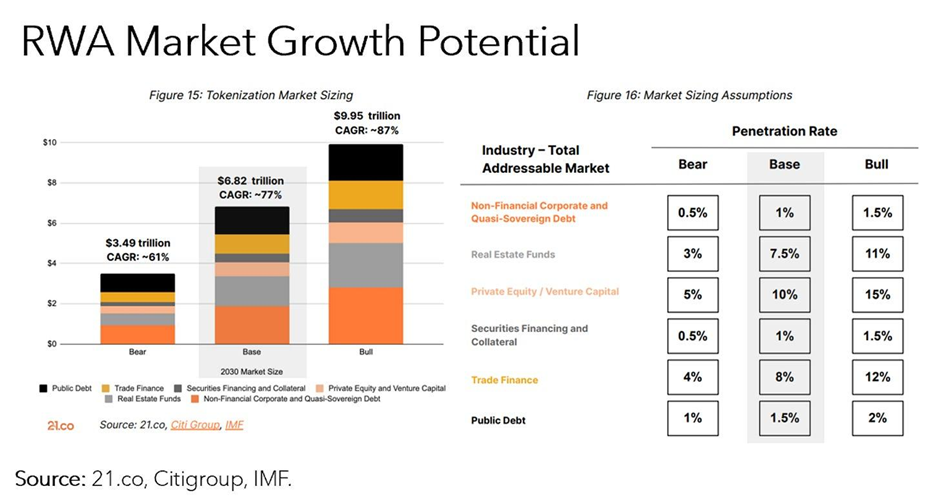
- The on-chain RWA asset base is approximately $12 billion, with the total including stablecoins exceeding $180 billion. By digitizing traditional financial assets via blockchain, transparency and efficiency are enhanced, attracting more participants to this emerging market. According to reports from 21.co, Citigroup, and the IMF, the total value of tokenized assets could reach $6.8 trillion by 2030 under baseline market conditions.
Source: 21.co, Citigroup, IMF
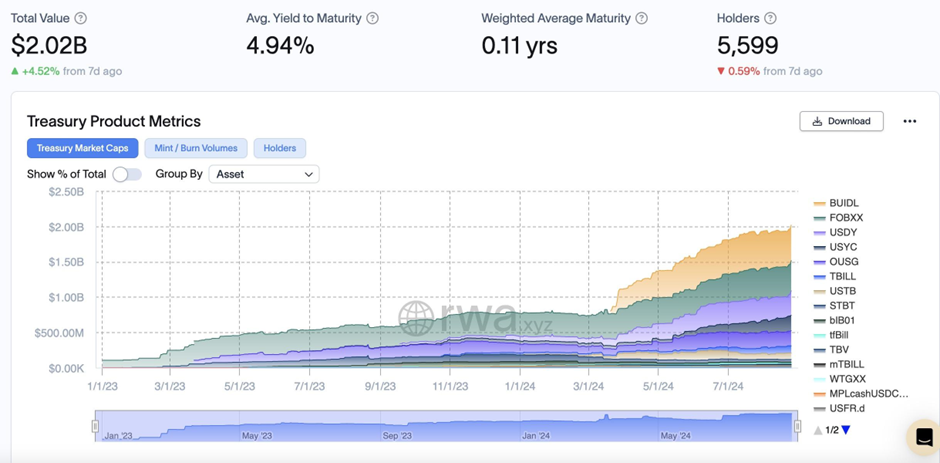
- Private credit and U.S. Treasuries are the dominant tokenized assets—growing from millions to a private credit market with $8.8 billion in total loan value (63% annual growth) and a Treasury market exceeding $2 billion (2,100% annual growth). Tokenized Treasuries remain an emerging field with immense potential—Franklin Templeton, BlackRock, and WisdomTree are early leaders.
Source: rwa.xyz
- Federal Reserve policy has a direct and significant impact on the expansion and structure of the RWA DeFi sector:
- In Q3 2022, private credit-backed RWAs accounted for 56% of total RWA TVL, while U.S. Treasury-backed RWAs held 0%.
In Q3 2023, private credit-backed RWAs dropped to 18%, while Treasury-backed RWAs rose to 27%.
As of late August 2024, private credit-backed RWAs account for 76% of total TVL, with Treasury-backed RWAs stabilizing at 17%.
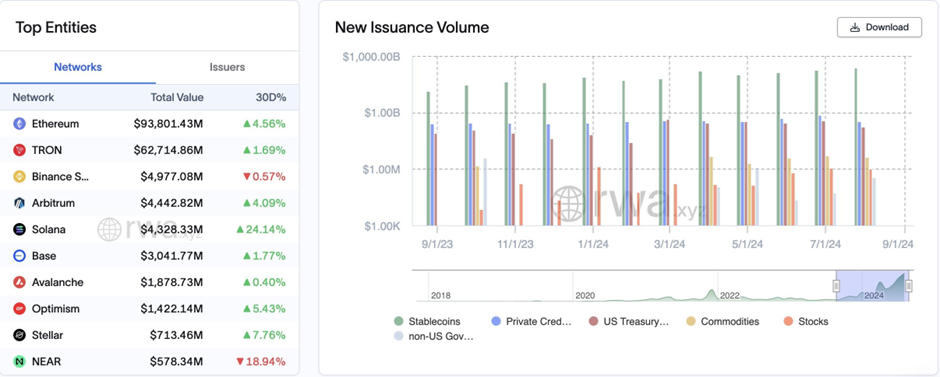
Source: rwa.xyz
1) Market Drivers:
Yield-bearing RWA growth has been rapid. From the beginning of 2024, non-stablecoin RWA on-chain value has increased by $4.11 billion, primarily from Treasuries, private credit, and real estate tokens. Overall growth and ecosystem maturity can be attributed to three main factors:
- Institutional interest and new products, e.g.,
- BlackRock, Superstate launching new on-chain Treasury products and T-bill funds.
- Ondo launching USDY, Centrifuge partnering with Maker and BlockTower, etc.
- Infrastructure improvements, e.g.,
- M^0 Labs developing institutional-grade stablecoin middleware usable as building blocks for other products.
- Ondo Global Markets creating a two-way system enabling seamless transfers between on-chain tokens and off-chain accounts.
- Integration with DeFi, e.g.,
- Morpho enabling non-custodial vaults to pass RWA yields to DeFi users; integration with Centrifuge supports collateralized lending.
- TrueFi launching Trinity, allowing users to deposit tokenized Treasuries as collateral to mint USD-pegged assets usable across DeFi.
- DAO treasury diversification (e.g., Maker)
Given recent dovish signals from Fed Chair Powell—the first since the rate hike cycle began—indicating a shift in focus from inflation control to supporting economic growth and employment, a rate cut cycle appears increasingly likely. The CME FedWatch tool currently shows the highest probability for a 25-basis-point cut in September. However, upcoming August CPI and non-farm payroll data may push expectations toward a 50-basis-point cut if figures exceed forecasts.
While T-bills will remain the preferred choice for idle capital during sustained high rates, an ongoing rate cut trend will profoundly affect markets. On one hand, lower rates may drive investors to seek higher yields, funneling capital into high-yield DeFi sectors. On the other, declining traditional asset yields may incentivize greater RWA tokenization to pursue higher returns on DeFi platforms. This could shift competitive dynamics, drawing more capital into high-yield RWA applications combining DeFi tech, further accelerating the development of the on-chain economy.
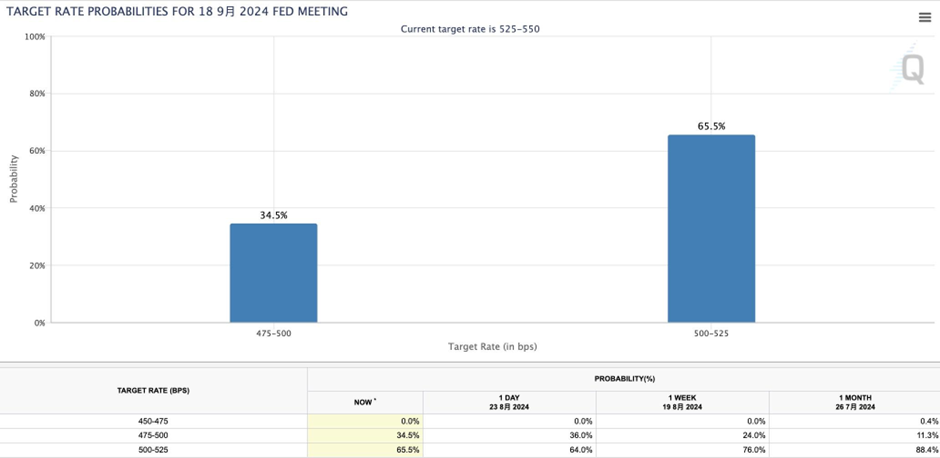
Source: CME FedWatch
2) Key User Profile:
According to Galaxy Digital’s full-year 2023 statistics, most on-chain demand for RWA is driven by a small number of native crypto users, not new entrants or traditional finance users transitioning on-chain. Most addresses interacting with RWA tokens were already active on-chain before these assets existed. The following analysis focuses solely on addresses holding tokenized Treasuries and major private credit assets:
- Unique addresses: 3,232 UA held RWA assets as of August 31, 2023. By August 26, 2024, this grew to 61,879 addresses—an increase of 1,815%.
- Average address age: 882 days (~2.42 years), indicating user activity since around April 2021.
- Average RWA age: 375 days, showing these assets are relatively new compared to user addresses.
- The oldest interacting address dates back to March 22, 2016—2,718 days ago.
- Distribution shows concentration of wallet ages around 700–750 days.
Number of addresses by age group:
- <1 year: 17% (545 addresses)
- 1–2 years: 27% (885 addresses)
- 2–3 years: 36% (1,148 addresses)
- 3+ years: 20% (654 addresses)
According to Transak’s mid-2024 report, Ethereum alone hosts over 97,000 RWA token holders, totaling over 205,000 unique addresses. These tokens added approximately 38,000 new holders last year.
Since the beginning of 2024, overall DEX trading volume for RWA tokens has surged. Monthly DEX volume was about $2.3 billion in December 2023 and exceeded $3.6 billion by April 2024.
With the significant increase in traditional financial institutions adopting RWA, we anticipate a growing influx of traditional finance users into crypto, bringing fresh momentum and incremental capital.
II. Deep Dive into Six Core Asset Classes
The tokenized RWA market is divided into six major categories by asset class, ranked by market cap: stablecoins, private credit, government bonds (U.S. Treasuries), commodities, real estate, and stock securities:

Source: OKX Ventures, rwa.xyz, Statista, 21.co
The total market cap of on-chain real-world assets (RWA) is $18.312 billion, while off-chain traditional assets stand at $685.5 trillion. If off-chain assets grow by just 1 basis point (0.01%) daily, that adds ~$6.85 billion—nearly 37% of the current on-chain market cap. This illustrates how even minor growth in off-chain assets can significantly propel on-chain equivalents.
-
Stablecoins
Stablecoins have demonstrated clear product-market fit (PMF) and created significant monetization opportunities. In Q1 this year, although Tether managed far fewer assets than BlackRock ($70B vs $8.5T), it generated higher profits ($1.48B vs $1.16B).
Market Overview:
Stablecoins currently have a market cap of ~$170 billion, monthly trading volume of $1.69 trillion, over 17 million monthly active addresses, and more than 117 million holders.
-
Centralized stablecoins dominate: USDT holds ~70% market share (~$114.57B); USDC ~20% (~$33.44B).
-
Decentralized stablecoins remain stable: DAI ~3% (~$5.19B); Ethena ~2% (~$3.31B).
-
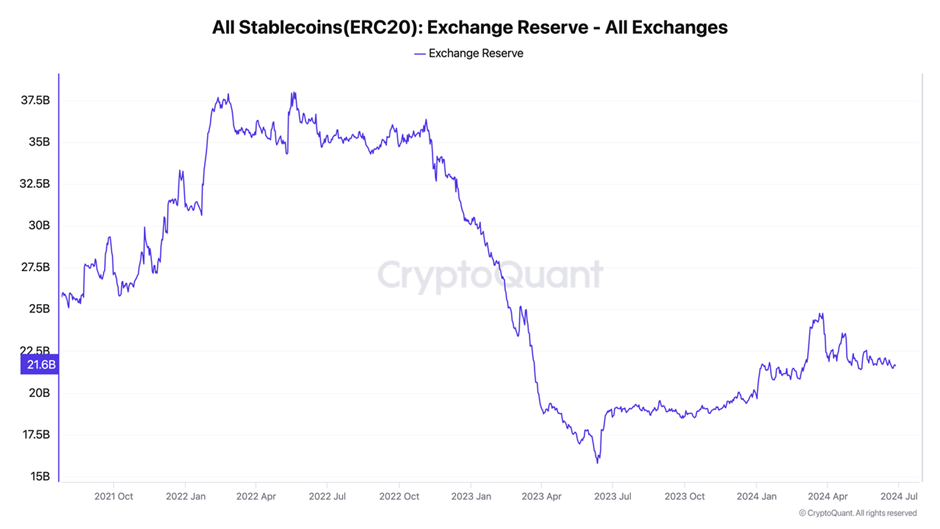
~$21.63B of stablecoins reside on centralized exchanges (13.2% of supply); ~48.38% circulate on Ethereum, ~35.95% on other chains like BSC, Arbitrum, Solana, Base, Avalanche, Polygon.


Source: CryptoQuant, Artemis
Key Market Issues:
-
Wealth Distribution Imbalance: Centralized stablecoins often privatize profits while socializing potential losses, leading to unequal benefit distribution.
-
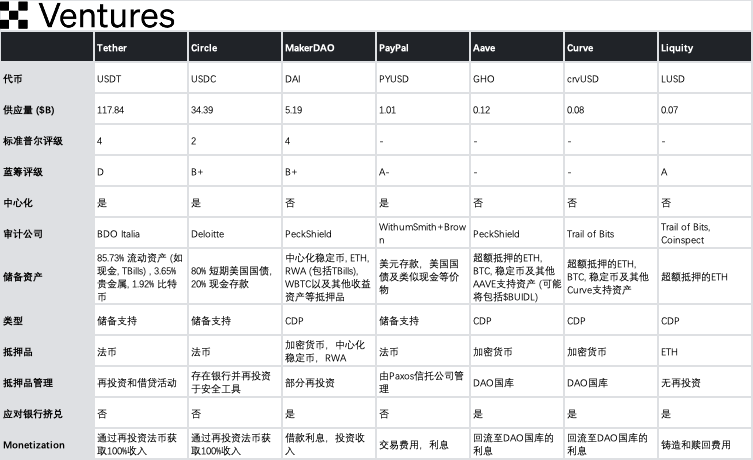
Lack of Transparency: Centralized stablecoins like Tether and Circle suffer from serious transparency issues, forcing users to take unnecessary risks. For instance, during SVB’s collapse, markets couldn’t determine whether Circle or Tether had any exposure to SVB or where their reserves were held. Tether uses part of its reserves for lending and investments. Per its audit report from BDO, ~6.5% of reserves are lent out, ~4% invested in precious metals, and ~2.5% classified as other investments. This model makes Tether vulnerable to bank runs, and liquidity crunches could become black swan events.
-
Scalability Limits for Decentralized Stablecoins: Decentralized stablecoins face scalability challenges due to reliance on over-collateralization. As demand grows, relying solely on crypto assets may prove insufficient. Poorly designed algorithmic stablecoins have repeatedly failed, exposing risks of under-collateralization and mechanism instability.
Notable Players:
-
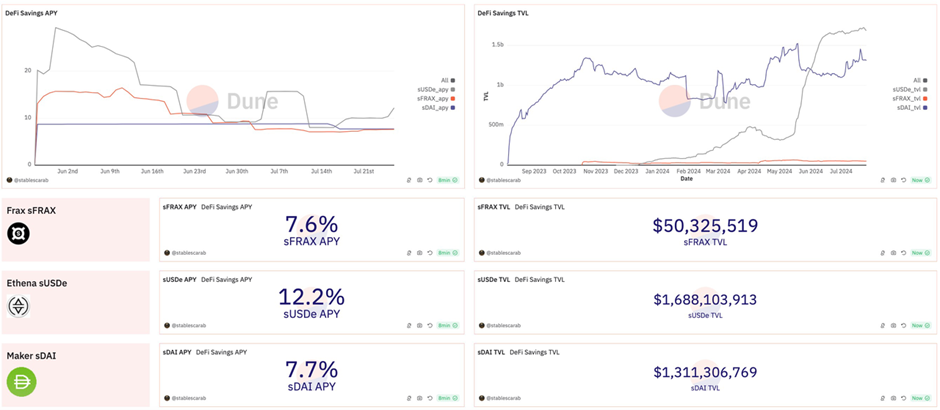
Ethena: Offers relatively high APY, up to 12.2%, with sUSDe TVL ~$1.7B—market cap up 978% since launch. Ethena’s delta hedge strategy is particularly appealing in bull markets. With long positions dominating, funding rates are typically favorable for shorts, allowing Ethena to maintain stability while attracting traders seeking volatility hedging and positive funding rate gains.
-
Maker (now Sky): APY 7.7%, sDAI TVL ~$1.3B; over $2B deposited in DSR, representing 38% of all circulating DAI. Since founder Rune announced ~8% yields last August, deposits rose 197%, market cap stabilized above $5B. Collateral TVL is $7.74B, with 147% collateral ratio. Integrating U.S. Treasuries diversifies revenue and enhances income stability. Staked stETH is accepted as collateral for DAI minting. Also eliminated the 15% penalty on unstaking, promoting stability and aligning holder incentives with ecosystem sustainability.

Source: Dune / @stablescarab
Overview of Major Stablecoins
Source: OKX Ventures
Future Outlook:
-
DAI’s success largely depends on massive subsidies paid by Curve holders to the 3pool, creating a strong moat. Maker’s transition toward a more centralized Sky ecosystem is pragmatic but controversial. Many fear USDS will erode Maker’s decentralization edge, eventually losing market share to more robust alternatives. Whether its vision of scaling Sky through Treasuries and subDAOs materializes remains to be seen.
-
In contrast, Liquity has taken the opposite path. Its v2 $BOLD is a fully Ethereum-native stablecoin backed solely by ETH (and LST), expected to attract significant collateral under current mechanisms. Will maximal decentralization and resilience make it a niche product? We await users’ real-money votes.
-
Growing popularity of low-volatility assets in stablecoins. After last cycle’s lessons, users now apply stricter risk controls to crypto financial assets, especially regarding collateral selection and risk mitigation behind money issuance. High-risk algorithmic stablecoins like LUNA have vanished.
-
Due to simple business models, regulatory costs are more manageable and consistent. Large financial firms are targeting the relatively profitable and accessible stablecoin space. PayPal’s PYUSD has reached $1B issuance, growing 155% since announcing Solana integration on May 29, with supply on Solana up nearly 4,685%. Similarly, JD.com’s planned HKD-pegged stablecoin aims to capture a share and explore new digital finance growth avenues.
-
The industry awaits further legislative guidance, especially on reserve reporting and liquidity requirements. Circle emphasizes transparency, switching auditors from Grant Thornton to Deloitte to bolster confidence in its reserves. Tether’s transparency issues have long been debated. While Tether claims every USDT is backed 1:1 by fiat, details on its reserves and independent audits remain opaque. In 2024, U.S. regulators are pushing for greater transparency and compliance, which Tether is expected to follow.
-
Private Credit:
Through credit protocols, financial institutions tokenize debt instruments to lend to businesses.
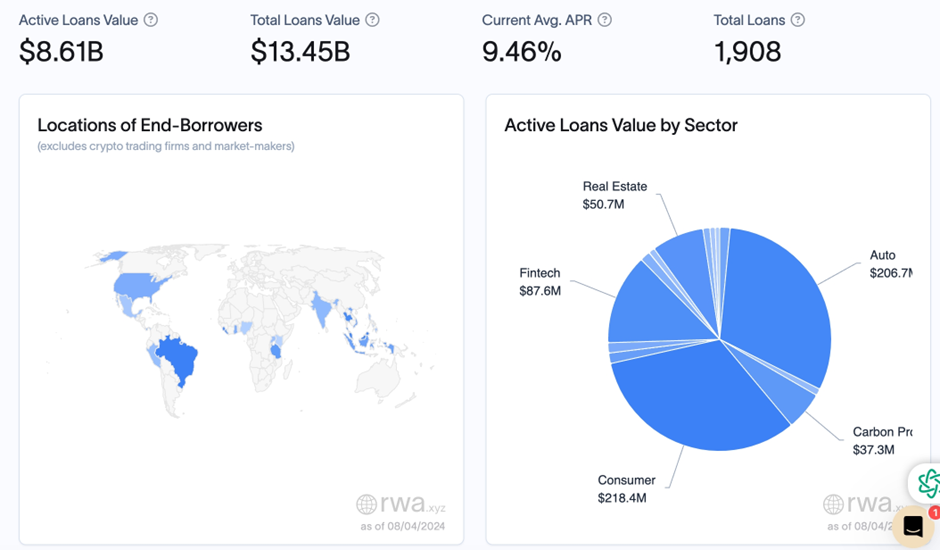
In traditional finance, private credit is a $1.5 trillion market. Crypto credit protocols have tokenized over $13 billion in loans, with over $8 billion lent to real-world enterprises, generating returns for on-chain lenders. For traders, private credit offers higher yield potential. For example, lending stablecoins via Centrifuge yields ~8.7% average APR, surpassing AAVE’s typical 4–5%, though with higher risk.



Source: rwa.xyz
Within the loan portfolio, Consumer loans are largest at $218.4M, reflecting strong demand. Auto loans follow at $206.7M. FinTech loans at $87.6M show rapid growth despite smaller size, highlighting tech’s financial impact. Real estate—including residential/commercial financing ($50.7M) and carbon project financing ($37.3M)—plays important roles in niche areas.
The advantages of on-chain credit issuance and distribution are most evident in significantly reduced capital costs. More efficient DeFi infrastructure saves capital and opens new distribution channels for existing and novel private credit products. Driven by banking retrenchment, this carve-out creates a key niche in traditional finance. The shift toward non-bank lending benefits private credit funds and other non-bank lenders, attracting interest from pension plans and endowments seeking smoother, higher returns.
As part of alternative assets, private credit has grown substantially over the past decade. Though still small relative to global debt markets, it holds immense growth potential.


Demand-Side Logic
- Financing Needs:
- Enterprises: Many real-world companies, especially SMEs, need low-cost financing for operations, expansion, or short-term working capital.
- Access Challenges: Traditional bank loans involve complex, lengthy procedures, making it hard for firms to access funds quickly.
- Credit Protocol Tokenization:
- Tokenization: Financial institutions convert debt instruments into tradable on-chain tokens representing corporate loans or receivables.
- Simplified Process: Tokenization streamlines financing, enabling faster, more efficient capital access.
Lender Perspective
- Opportunities:
- Higher Yields: Private credit often yields more than traditional debt, as firms pay higher rates for quick funding.
- Diversified Portfolio: Offers diversification, spreading investment risk.
- Risks and Challenges:
- Complexity: Users may struggle to understand private credit mechanics, especially off-chain components.
- Default Risk: Borrower default is a concern. If off-chain audits lack transparency, a single receivable might be used to borrow across multiple platforms, increasing default risk.
Representative Projects:
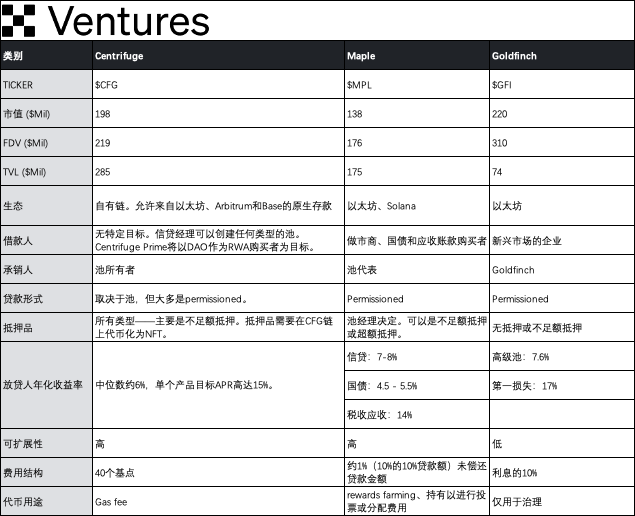
- Maple Finance: Provides on-chain private credit via tokenized credit agreements, offering fast enterprise financing and high-yield investment opportunities. Similar models include TrueFi (also offers U.S. Treasury products) and Goldfinch.
- Centrifuge: A matchmaking platform that tokenizes receivables and debt instruments, connecting lenders and borrowers via on-chain markets to streamline financing and reduce costs, meeting SME credit needs.
Source: OKX Ventures
Use Cases in On-Chain Supply Chain Finance:
- Smart Contract Auto-Payments: Payments to suppliers are automatically released upon fulfillment of predefined conditions, with clear default handling mechanisms protecting user interests.
- Invoice Tokenization: Invoices are tokenized to facilitate trading and provide liquidity to suppliers.
- Transparent Auditing: Blockchain provides immutable ledgers, simplifying audits and due diligence. Independent third-party auditors must rigorously verify off-chain assets to ensure authenticity and uniqueness, reducing multi-platform borrowing risks.
- Risk Assessment: Introduce on-chain credit scoring systems to evaluate borrower risk, aiding informed decisions.
Problems Solved On-Chain:
- Slow and Opaque Transactions: Blockchain increases transparency and speeds up supply chain finance, benefiting all parties.
- High Transaction Costs: Smart contracts automate many processes, reducing paperwork and intermediaries, lowering costs.
- Credit Access: DeFi democratizes financing for traditionally weaker SMEs.
-
Treasury Products:
Tokenized government debt instruments. Analogous to ETFs, these assets can be thought of as BTFs (Blockchain Transfer Funds). On-chain RWA Treasury tokens represent rights to income streams from these debts, not ownership of the Treasuries themselves, involving complex on/off-ramp and compliance considerations.
In high-rate environments, some crypto participants turn to traditional financial assets for portfolio diversification. Rising rates make safe, yield-stable assets like Treasuries naturally attractive.
The wave of Treasury tokenization is driven by two factors: shrinking DeFi yield opportunities (due to lower on-chain leverage demand) and a shift in trader preferences toward short-term monetary instruments benefiting from tight U.S. monetary policy. This mirrors the flow of bank deposits into money market funds, driven by low deposit rates and unrealized capital loss exposure. The emergence of institutional DeFi infrastructure is expected to further fuel global demand for safe, yield-generating, liquid real-world assets.
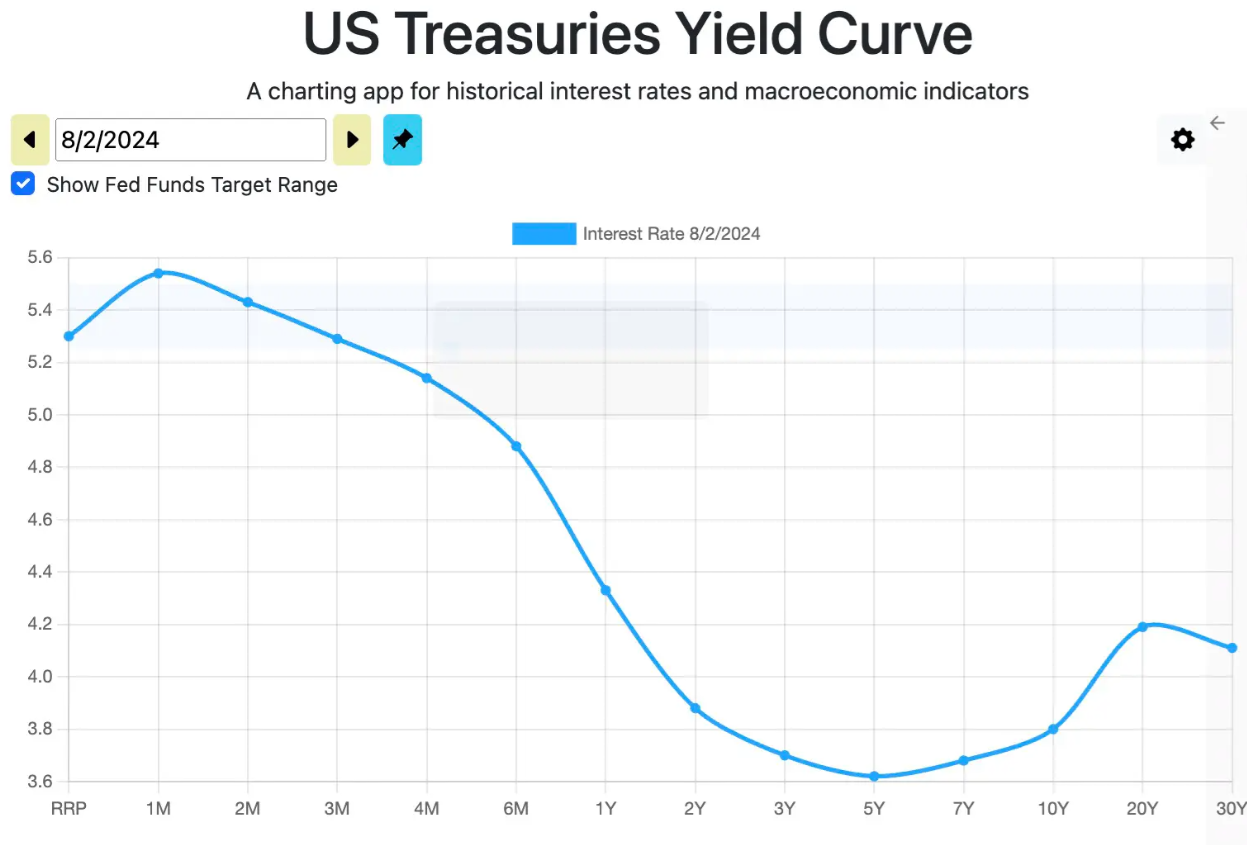
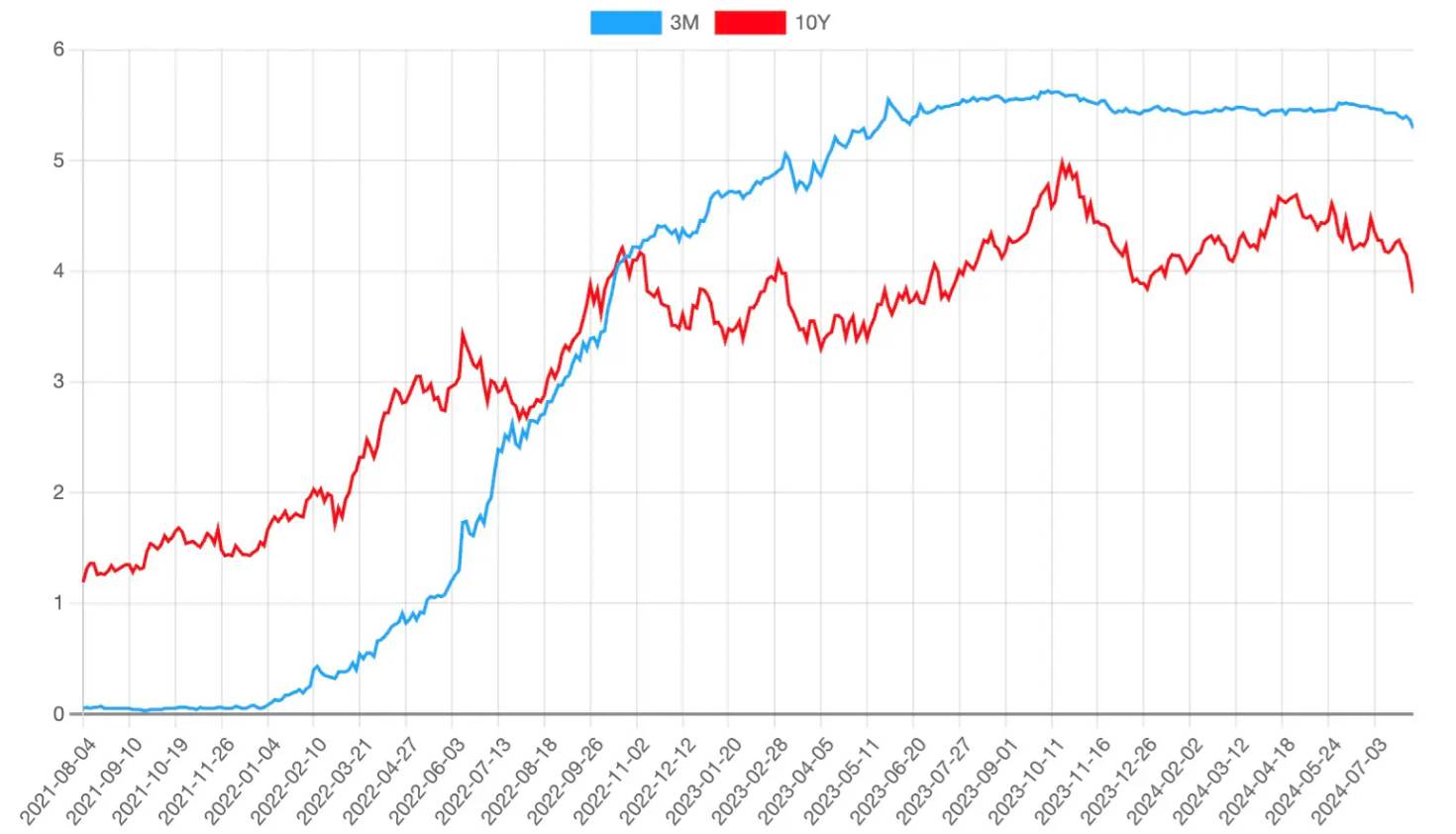
Current yield curve shapes—higher short-term, lower long-term rates—mean most products hold 1- to 6-month T-bills, some even overnight reverse repos and repo securities for higher yields.
Why U.S. Treasuries?
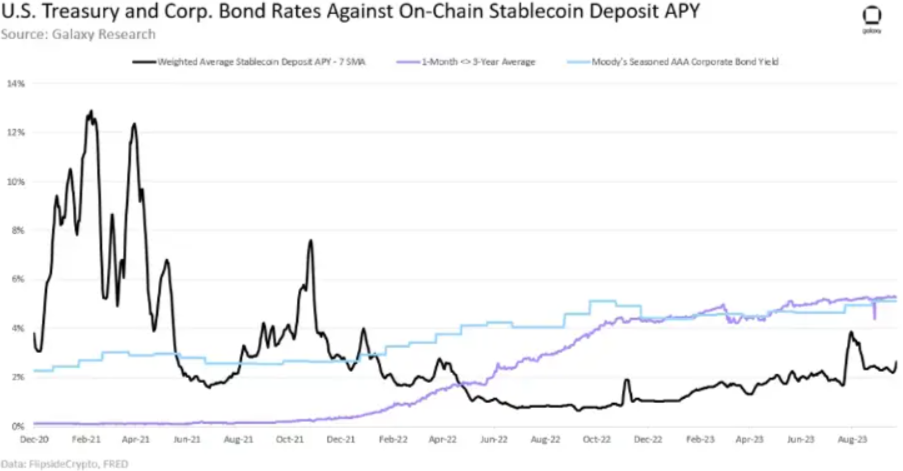
- Yield: Short-term U.S. Treasuries > AAA corporate bonds > DeFi stablecoin deposits (making tokenized Treasuries highly attractive)
Source: Galaxy Research
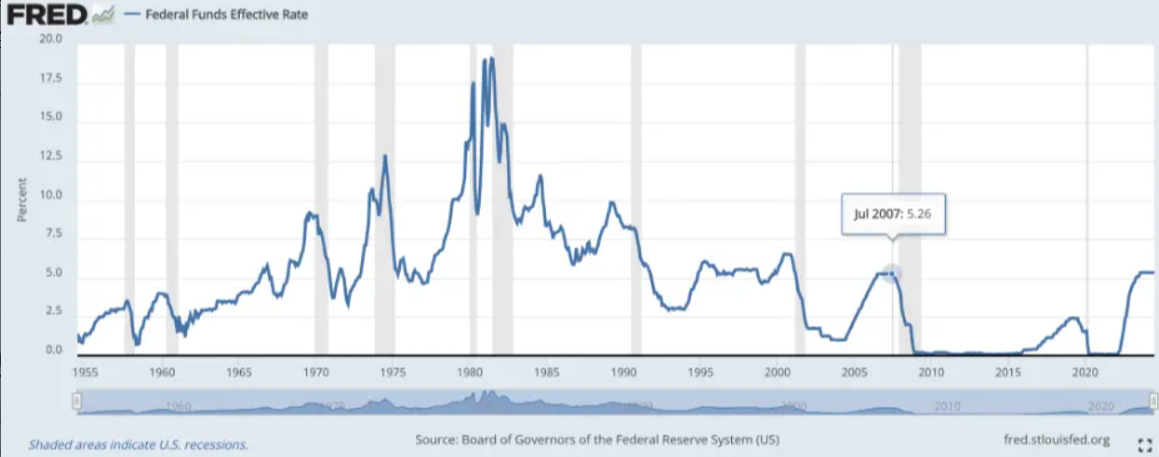
- The Fed’s sharp policy shift pushed benchmark rates to their highest since 2007 (5.33%), creating new demand among native-DeFi users for certain RWAs.
Source: fred.stlouisfed.org
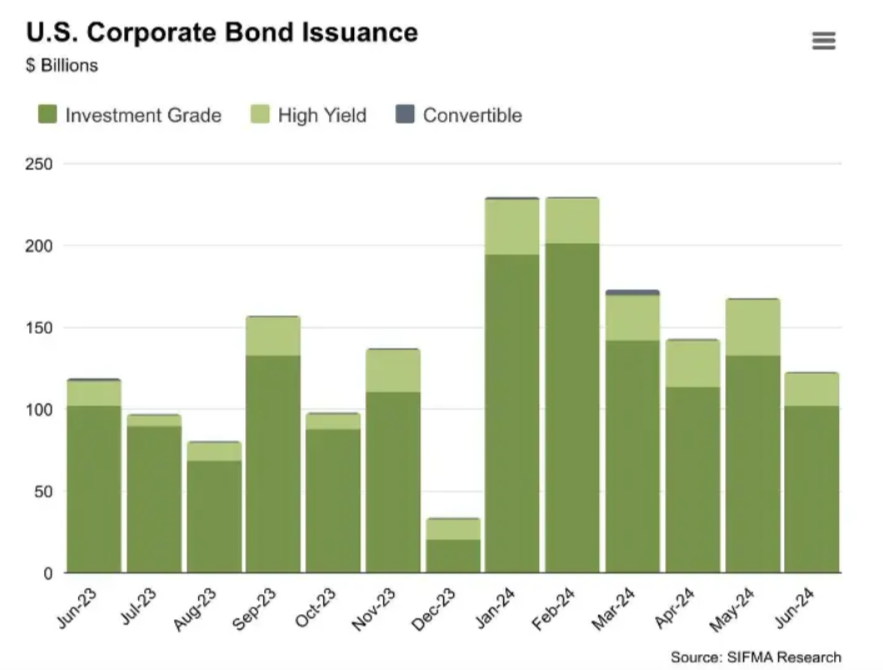
- U.S. Treasuries are government-backed debt securities (widely seen as safe, reliable yield assets, with risk limited to U.S. government default). Corporate bonds, issued by companies, may offer higher yields but carry greater risk. The global bond market grew to ~$7 trillion, up 5.9% YoY, showing continued strong growth. Just in Q1–Q2 2024, U.S. firms issued $1.06 trillion in corporate bonds—surpassing the $1.02 trillion issued in the first three quarters of 2023.
Source: SIFMA Research
Rising rates spurred launches of tokenized U.S. Treasury projects, such as:
- Franklin Templeton: Launched the Franklin On-Chain U.S. Government Money Fund (FOBXX) in 2021—the first publicly registered blockchain fund in the U.S. It offers a 5.11% yield and ~$400M market cap, ranking among the largest on-chain Treasury products.
- BlackRock (via Securitize): Launched the BlackRock USD Institutional Digital Liquidity Fund ($BUIDL) on Ethereum in March 2024. It leads the market with over $500M in AUM.
- Ondo: Launched Ondo Short-Term U.S. Treasury (OUSG), providing access to short-term U.S. Treasuries with a 6.8% yield and ~$240M market cap. Much of OUSG’s investment goes into BlackRock’s BUIDL. Ondo also offers USDY, a yield-bearing stablecoin with over $300M market cap.
As rates rise, Treasury yields become more attractive, driving category-wide growth. Other players include Superstate, Maple, Backed, OpenEden, etc.
Market Cap and Share:
Source: rwa.xyz
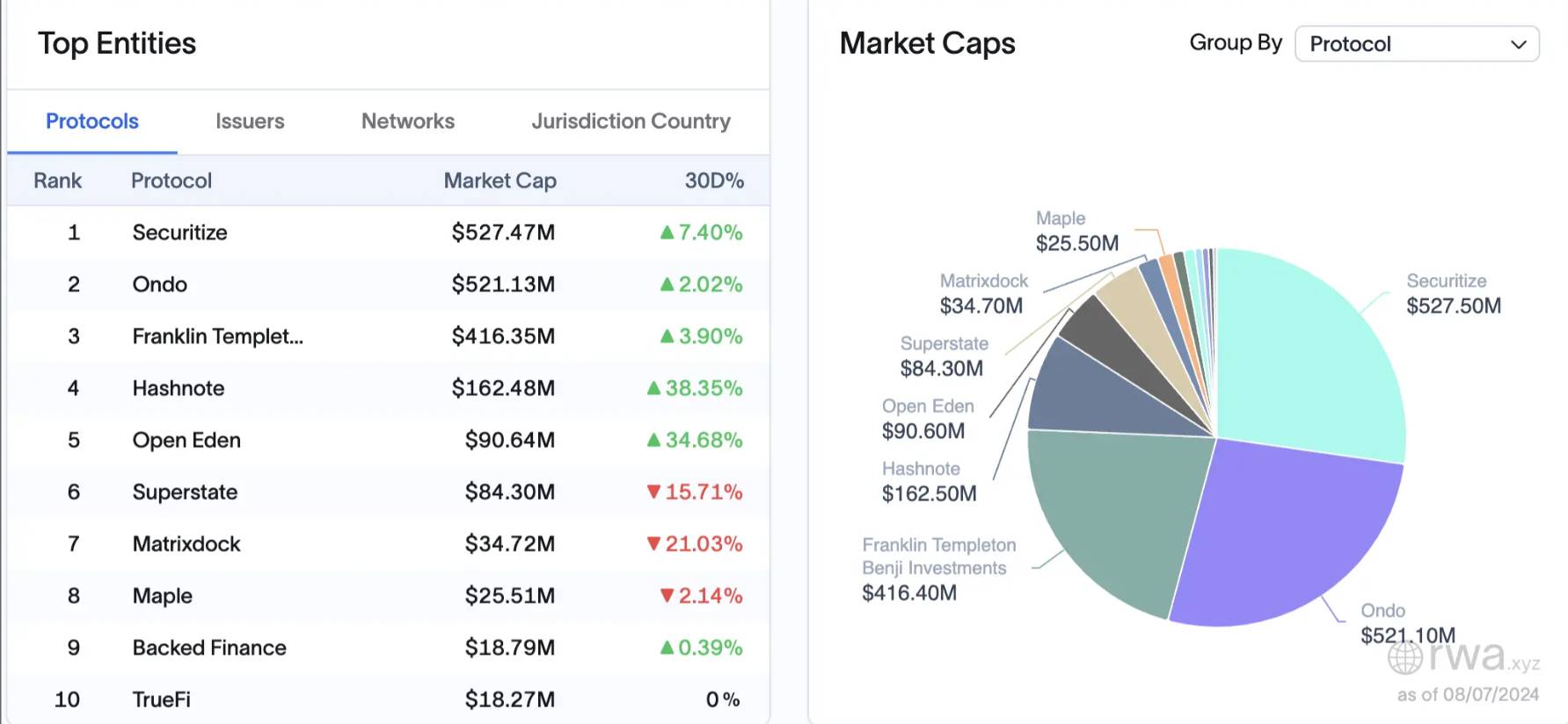
By market cap, the top five protocols are Securitize, Ondo, Franklin Templeton, Hashnote, and OpenEden. Top individual products:
- $BUIDL (BlackRock fund via Securitize), $510M, +74% quarterly;
- $FOBXX (Franklin Templeton), $428M, +12% quarterly;
- $USDY (Ondo), $332M, +155% quarterly;
- $USYC (Hashnote), $221M, +156% quarterly;
- $OUSG (Ondo), $206M, +60% quarterly;
- $TBILL (OpenEden), $101M, +132% quarterly.
Asset Classification:
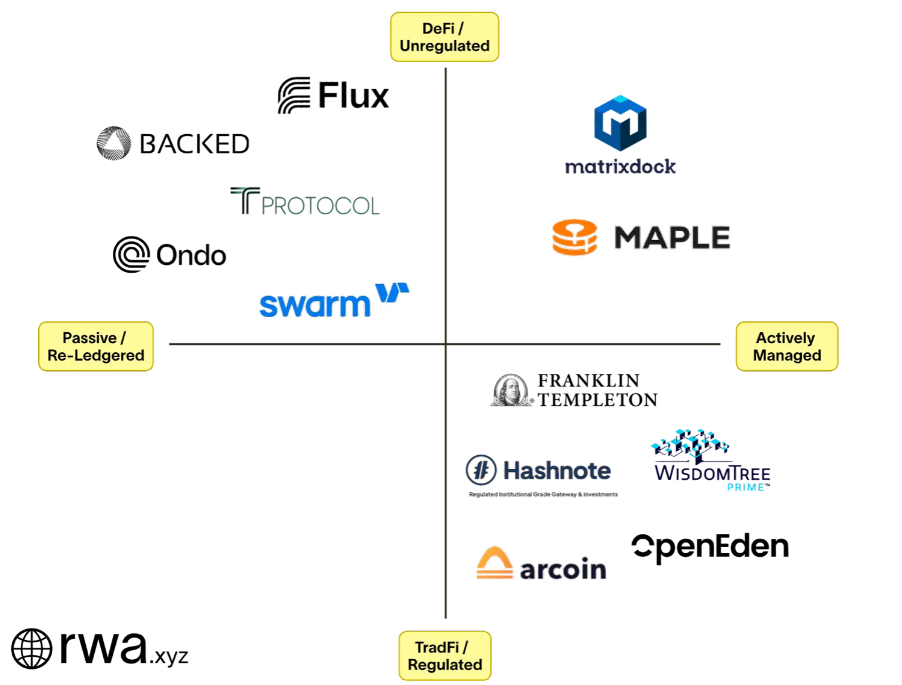
Actively Managed
- Definition: Treasury products actively managed by designated portfolio managers responsible for underlying asset allocation.
- Features: Seeks to optimize returns and manage risk through active strategies, resembling traditional actively managed funds.
Re-Ledgered
- Definition: Treasury products aim to simply represent or mirror off-chain financial instruments, such as publicly listed ETFs.
- Features: Typically passively managed, aiming to re-register existing instruments on-chain for trading and management.
Source: rwa.xyz
Ondo Finance, Backed, and Swarm all map BlackRock/iShares Short-Term Treasury ETFs. Ondo purchases from NASDAQ-based U.S. issuers (CUSIP: 464288679), while Backed and Swarm buy from Irish/UCITS issuers (ISIN: IE00BGSF1X88). To simplify, Ondo does not actively manage the Treasury portfolio—it outsources management to SHV, which is itself managed by BlackRock/iShares. Companies like Ondo act as distributors for BlackRock, avoiding the complexity of thousands of DeFi protocols interacting directly with asset managers. This is simpler for BlackRock, which avoids managing compliance for numerous small projects.
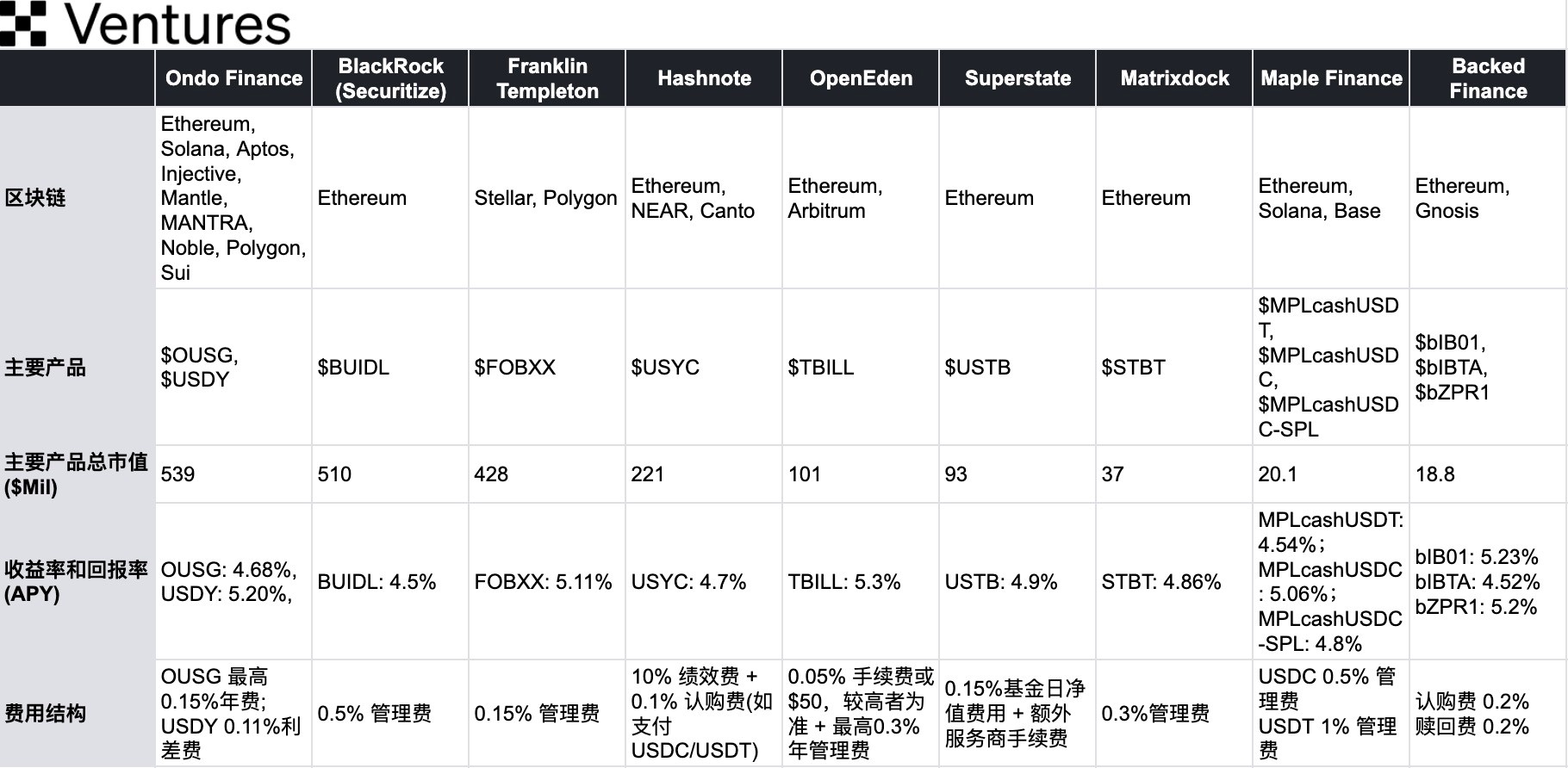
Source: OKX Ventures, rwa.xyz
For each protocol’s products, institutions and qualified investors can make decisions based on three key criteria: 1) principal protection; 2) yield maximization; 3) convenience.
Principal Protection:
- Some large institutional products operate in regulated jurisdictions, minimizing legal and compliance risks. They rely on regulated fund managers and custodians, offering greater transparency and investor protection. Others depend more on investment managers’ performance, requiring careful assessment of jurisdictional legal and regulatory frameworks.
Yield Maximization:
- Actively managed products rely on fund managers' strategies to optimize portfolios and maximize returns. These focus on short-term Treasuries and repos, aligning with the current yield curve. Re-ledgered products outsource portfolio management to ETF managers—investors can review historical performance to match their yield goals and risk appetite.
Convenience:
- Some institutional products offer mobile app access, improving UX and simplifying investment, ideal for self-directed retail. Others involve complex, multi-step manual processes with steep learning curves.
Going forward, actively managed products may undercut re-ledgered ones by compressing pricing. Additionally, users should consider whether these Treasury tokens merely serve as investment receipts or can also function as payment methods or collateral, expanding utility and yield sources.
Join TechFlow official community to stay tuned
Telegram:https://t.me/TechFlowDaily
X (Twitter):https://x.com/TechFlowPost
X (Twitter) EN:https://x.com/BlockFlow_News
 OKX Ventures