









Galaxy: With Durov's arrest, how resilient is TON?
TechFlow Selected TechFlow Selected
Galaxy: With Durov's arrest, how resilient is TON?
TON's value largely depends on its integration with Telegram.
 Navigating Web3 tides with focused insights
Author: Galaxy Research
Translation: 1912212.eth, Foresight News
Telegram founder and CEO Pavel Durov was arrested by French intelligence agents upon landing in Paris on Saturday. Following the news, the TON cryptocurrency dropped sharply but has since stabilized. At present, the charges do not appear directly linked to TON. It remains unclear whether this arrest signals a broader crackdown targeting decentralized systems including TON, or if it could extend to other social media/messaging apps or blockchain networks.
What happened: According to AFP, Pavel Durov was arrested after his private plane landed at a Paris airport. He faces charges related to organized crime, drug trafficking, fraud, cyberbullying, and terrorist propaganda. French media report these allegations stem from Telegram’s failure to prevent criminal abuse of its platform. The TON cryptocurrency associated with Telegram plunged as much as 25% following the arrest announcement and currently trades about 34% below its all-time high reached in June 2024. In a statement, Telegram said Durov has nothing to hide.
Cryptocurrency Involved: TON
Background on Telegram: Telegram has been in dispute with the European Commission over whether it qualifies as large enough to be required to register under the Digital Services Act (DSA). Telegram argues that since its monthly active users in Europe have not yet reached 45 million, it does not meet the threshold for registration and compliance under the DSA. Platforms classified as "very large online platforms" become liable for illegal content once they are notified of its presence. This “conditional liability” stands in fundamental contrast to the broad legal immunity granted to online platforms under Section 230 of the U.S. Communications Decency Act of 1996.
Given new reports indicating the arrest warrant was issued by Ofmin—an agency responsible for protecting minors from violence—it appears Durov is being charged under French domestic law rather than for violating the DSA. However, given France’s influential role within the EU and its strong support for DSA enforcement, this distinction may carry little practical significance.
According to Durov, Telegram has approximately 950 million monthly active users, making it one of the most widely used applications globally. Telegram is fundamentally a messaging app known for its robust group chat features, but it is also used for social media-like activities, with broadcast channels functioning similarly to Twitter feeds. These channels are frequently used by armed groups, including Ukrainian and Russian military forces.
Telegram is also widely used for communication within the crypto community—from large project-focused group chats to small professional circles, even including over-the-counter trading desks and their counterparties.
TON: In October 2019, the U.S. Securities and Exchange Commission (SEC) sued Telegram after the company raised $1.7 billion to launch its TON blockchain and token—a then-record-breaking token sale. Shortly afterward, a U.S. federal court sided with the SEC and blocked Telegram from issuing the tokens. Telegram initially appealed the injunction but later abandoned those efforts.
Telegram subsequently halted development of the project but had already open-sourced all code, including blockchain nodes, encrypted wallets, TON Payments, file storage components, and technical documentation on the TON consensus protocol. In 2020, Telegram agreed to a settlement requiring it to return funds to TON investors and pay an $18.5 million penalty to the SEC.
The TON network was ultimately launched by open-source developers in November 2019. Since then, Telegram has extensively integrated with The Open Network and TON assets, enabling users to access the blockchain and conduct transactions directly through Telegram.
Overview of the TON Network: TON is the native asset of The Open Network (TON), ranking as the 11th largest cryptocurrency by market cap—over $14 billion—placing it between Tron and Cardano. According to CoinGecko, TON’s fully diluted valuation (FDV) stands at $28.5 billion, with daily trading volume exceeding $1 billion on centralized exchanges.
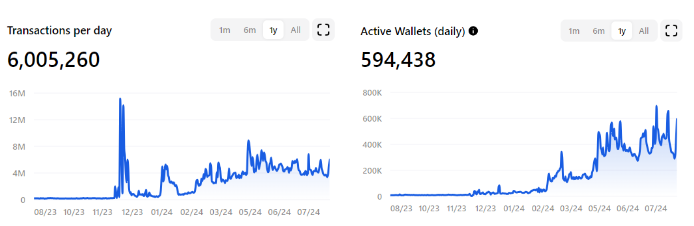
At the time of writing, the network hosts 600,000 wallets and processes 6 million transactions per day.
The proof-of-stake network is secured by approximately 370 validators who have staked $3.35 billion worth of TON across 28 countries, offering an annual yield of 4.2% (Tonscan.org).
As of this writing, TON DeFi (excluding staking and liquid staking protocols) has a total value locked (TVL) of approximately $300 million.
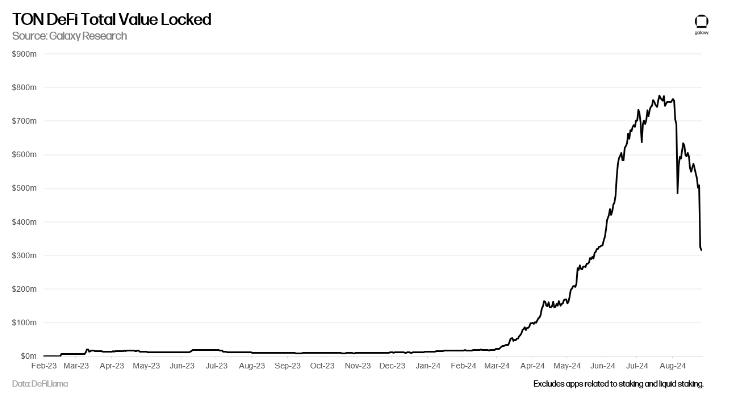
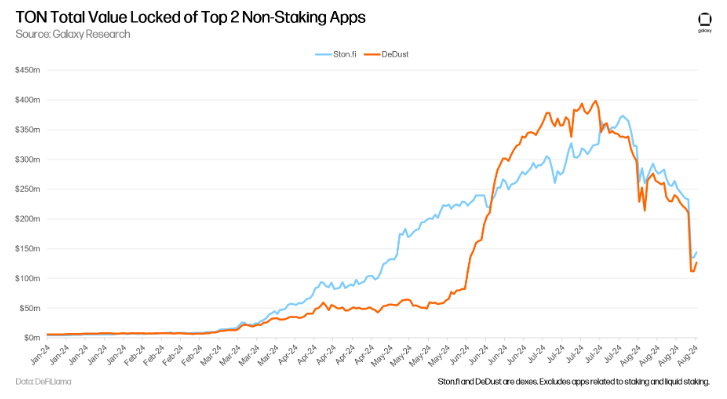
About 85% of TON’s DeFi TVL is concentrated in two decentralized exchange (DEX) applications: DeDust and Ston.fi. The majority of TVL in both platforms (76.6% on DeDust and 68.7% on Ston.fi) is held in their TON/USDT liquidity pools.
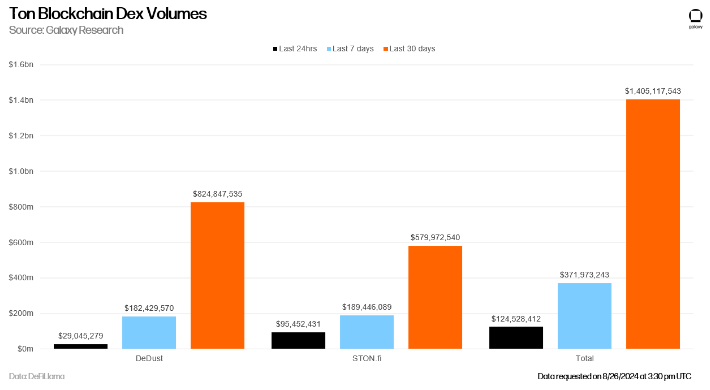
The 30-day trading volume across DEXs on the TON network totals approximately $1.4 billion.
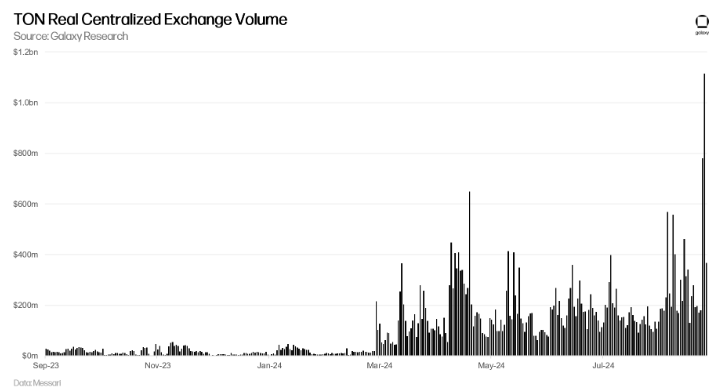
According to Messari’s calculations (after filtering out wash trading), recent daily trading volumes for TON on centralized exchanges range between $200 million and $600 million. On August 25, 2024 (Sunday), volume exceeded $1 billion—the highest single-day volume of the year.
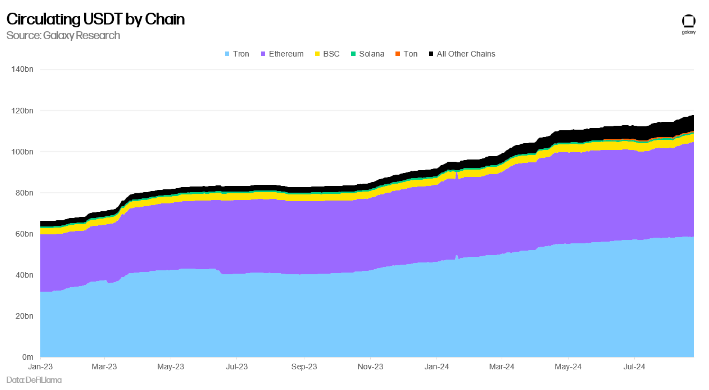
Approximately $730 million worth of USDT is circulating on the TON network, most of which is locked in TON/USDT liquidity pools. This represents only 0.61% of total USDT supply.
Analysis: It is likely that Telegram and Durov have resisted takedown or information requests from European or French authorities. It remains unclear to what extent the charges against Pavel relate to TON or Telegram’s integration with TON. Allegations of fraud or money laundering might center around Telegram’s integration with TON or the use of TON in illicit activities—but we lack clarity on this point. Currently, while TON appears to have over 350 validators globally, it is unknown how many (if any) are operated by Telegram or affiliated entities. Therefore, should France or another major government attempt to attack or shut down TON—either as part of Durov’s arrest or for other reasons—it remains uncertain how resilient TON would be. What we do know is that TON’s value is heavily dependent on its continued integration with Telegram.
In broader context, this marks the first major arrest of a globally recognized CEO of a messaging/social media company over alleged failure to adequately moderate their platform—and likely won’t be the last. Governments have long held adversarial positions toward encryption technology—from the U.S. government’s early 1990s campaign against PGP encryption to attacks on Apple’s iPhone encryption in the 2010s. Telegram is widely used across diverse global groups, including political dissidents, warring factions (both state and non-state), and potentially criminals or other undesirable actors. If Durov refuses to cooperate with government investigations into illegal activity on Telegram—or fails to comply sufficiently—he becomes an obvious target for law enforcement.
As noted by prominent crypto and free speech lawyer Preston Byrne, the central question now is whether Durov intentionally operated his service as a criminal enterprise, thereby distinguishing it substantially from platforms like WhatsApp.
Beyond criminal activity, platforms face increasing pressure to censor controversial speech. Prior to interviewing former President Donald Trump, Elon Musk—CEO of Tesla, SpaceX, and X—reported receiving a letter from a UK regulator warning that if the interview led to the spread of misinformation, the X platform could violate UK law. Both major U.S. political parties have accused social media companies of manipulating the 2020 election. Recently, the Supreme Court dismissed dozens of lawsuits filed by Republican-led states challenging federal government interactions with major social media platforms regarding election security and pandemic response. It’s not difficult to imagine that law enforcement actions targeting social media companies over crime prevention could eventually escalate into efforts targeting misinformation.
To what extent public blockchains will become entangled in this increasingly polarized and firewalled internet landscape remains to be seen. There have already been attempts to apply financial regulations to blockchain infrastructure—such as miners, validators, and nodes—but most such efforts have stalled. On November 28, 2023, Deputy Treasury Secretary Wally Adeyemo wrote to Senator Sherrod Brown, Chair of the Senate Banking Committee, urging expanded Treasury authority to apply Bank Secrecy Act (BSA) rules to blockchain infrastructure and enable sanctions enforcement against autonomous code (smart contracts). Senator Elizabeth Warren (D-MA) included some of the broadest elements of this proposal in her Digital Asset Anti-Money Laundering Act (DAAMLA). The Financial Action Task Force (FATF) has also issued guidance recommending surveillance and Travel Rule compliance for “non-custodial wallets,” an idea previously explored (though recently abandoned) by the U.S. Financial Crimes Enforcement Network (FinCEN).
To what extent TON can decouple itself from Durov and Telegram—or how insulated other blockchains may be from becoming enforcement targets due to misuse by criminals—may ultimately depend on their degree of decentralization. While nations can still ban the use of decentralized networks, the actual ability of governments to stop usage or hold individuals accountable—as with Durov—depends critically on how decentralized a given network truly is.
Outlook
We are closely monitoring developments in France and await any potential plea agreement between Durov and French authorities to assess possible implications for The Open Network. If resolving the charges requires Durov to relinquish control over The Open Network or sever its integration with Telegram, the impact on TON would be severely negative. Conversely, if Durov reaches an agreement allowing Telegram to continue operating largely unchanged without weakening its integration with TON, the recent price volatility in TON may prove short-lived.
Join TechFlow official community to stay tuned
Telegram:https://t.me/TechFlowDaily
X (Twitter):https://x.com/TechFlowPost
X (Twitter) EN:https://x.com/BlockFlow_News
 @galaxyhq






