








Raised $140 million in funding, why has Story become a favorite of a16z?
TechFlow Selected TechFlow Selected
Raised $140 million in funding, why has Story become a favorite of a16z?
Was Story's sudden emergence a genuine milestone or merely a "capital-driven setup"?
 Navigating Web3 tides with focused insights
Author: Yangz, Techub News
On August 21, Story, a Layer 1 blockchain focused on intellectual property (IP), announced the completion of an $80 million Series B funding round led by a16z. Participants included Polychain Capital, with individual investors such as Scott Trowbridge, Senior Vice President and board member at Stability AI; Adrian Cheng, founder of K11 and billionaire; and digital art collector Cozomo de' Medici. Combined with last year’s seed round of $29.3 million and a $25 million Series A—both also led by a16z—Story has raised a total of $140 million.
Such a massive fundraising effort has stunned many in the industry. At the same time, skepticism has emerged. As X user @wsjack_eth pointed out, "Can a single ERC-6551 protocol really justify such an exaggerated narrative?" In today's brutally competitive primary market, is Story's sudden emergence a genuine milestone—or merely a "capital-backed setup"?
Story's Technical Stack
To address these questions, I reviewed Story’s technical documentation. In summary, Story aims to improve upon Web2’s reliance on traditional legal systems—which are often slow and expensive for IP management—by deploying three core technological components: the Story Network (L1), Proof-of-Creativity Protocol (smart contracts), and Programmable IP Licenses. Together, they aim to achieve Story’s ultimate vision: “IP Legos.”
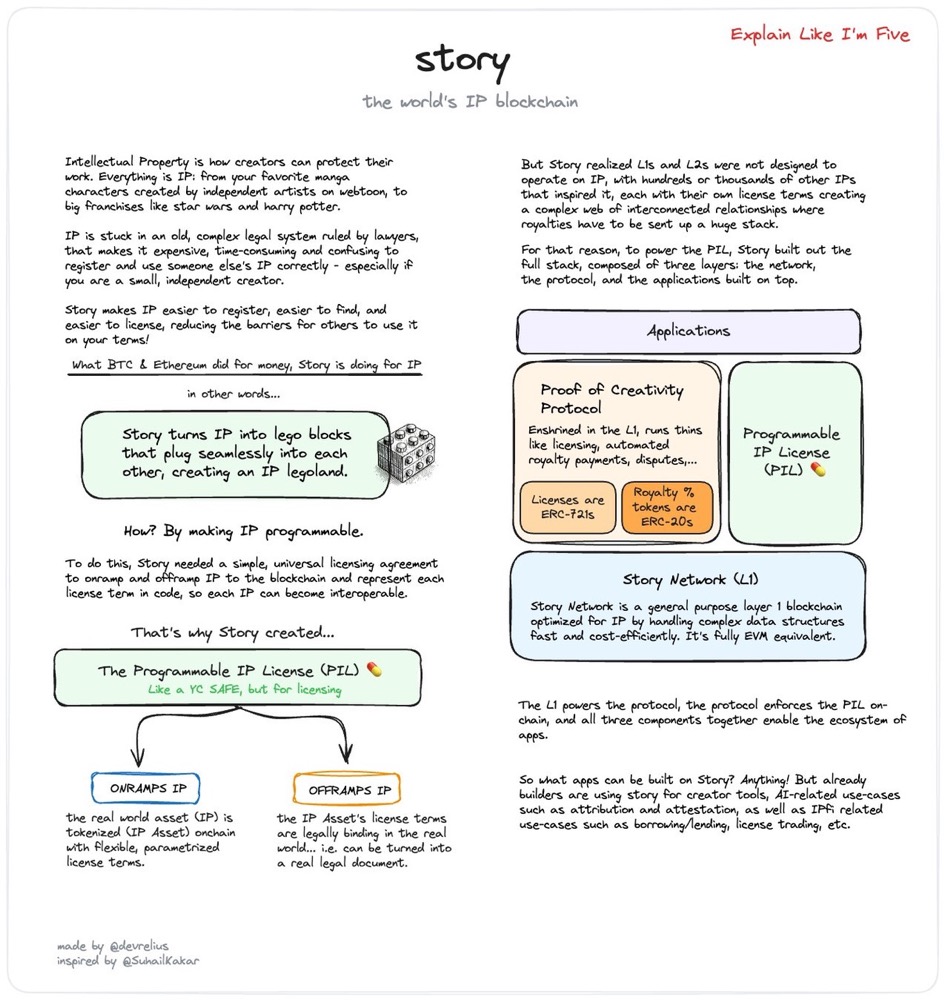
Specifically, the Story Network is an EVM-compatible L1 designed to process complex data structures like IP quickly and cost-effectively. It leverages precompiled primitives to traverse complex data structures within seconds at marginal cost, while using the mature CometBFT consensus stack to ensure fast finality and low transaction fees.
The Proof-of-Creativity Protocol consists of various smart contracts handling modules related to IP licensing, royalties, and disputes. Natively deployed on the Story Network, this protocol allows creators to register their IP as “IP Assets” (IPA). Each IPA comprises an on-chain NFT and an associated IP account, with the latter implemented via ERC-6551 (token-bound accounts).
In addition, Programmable IP Licenses (PIL) aim to create a mapping between on-chain smart contracts and real-world legal terms. This enables creators to migrate tokenized IP into off-chain legal frameworks, embedding specific conditions around how their IP can be remixed, monetized, or used to create derivatives.
As many industry observers have noted, Story’s technical stack isn’t particularly novel or complex. So what exactly enabled it to raise such a staggering amount? Insights from Chris Dixon, partner at a16z, in his investment thesis article may shed some light.
Investing in People
First, consider Story’s team background. According to Chris Dixon, Story’s founding team “possesses deep expertise in both technology and creative domains.” The a16z team was reportedly captivated by CEO and co-founder Seung Yoon Lee’s “visionary thinking and world-class tactical execution” during their first meeting three years ago. Public records from the Berggruen Institute indicate that Lee graduated from Oxford University and became the first Asian president of the Oxford Union. He founded Radish Fiction, a mobile fiction app backed by SoftBank, UTA, and Bertelsmann, which was acquired in 2021 by South Korean tech giant Kakao for $440 million. Following the acquisition, Lee served as Kakao’s Global Strategy Officer, overseeing global investments and M&A activities. He is also a venture partner at Hashed, South Korea’s largest blockchain fund, and a fellow at both the Asia 21 Young Leaders Forum and the Trilateral Commission. In 2016, Lee was named to Forbes Asia’s inaugural 30 Under 30 list and later recognized as an All-Star Alumnus.
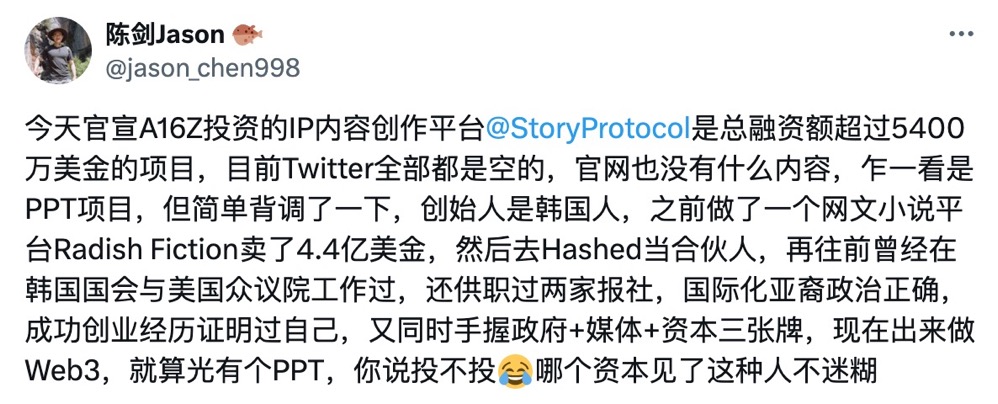
Additionally, according to @jason_chen998, Seung Yoon Lee previously worked in the South Korean National Assembly and the U.S. House of Representatives, and also held positions at two newspapers—effectively holding “three powerful cards: government, media, and capital.”
The other co-founder, Jason Zhao, who currently leads technical development at Story, may not have as high-profile a resume as Lee, but is still impressive. A Stanford graduate in computer science, he formerly worked at DeepMind.
This exemplifies the adage: “Investors bet on people.” Of course, beyond the strong team, a16z’s own investment philosophy likely played a key role in the decision.
Ownership: What Story Values Is Also What a16z Believes In
As a leading voice in Web3 narratives, a16z has published numerous influential perspectives on Web3. From Chris Dixon’s description of Web3 as “readable, writable, ownable,” it’s clear that ownership is central to a16z’s worldview. In his investment article, Dixon notes that for decades, the internet operated under an implicit economic contract between creators and platforms: creators supply content, platforms deliver demand. However, “the rise of generative AI threatens to break this pact,” significantly undermining creators’ interests. Story, aiming to protect creator ownership, thus resonates deeply with Dixon’s beliefs. As Jason Zhao explained when justifying why Story was built as an L1: “The next generation of blockchain infrastructure needs to be built for specific purposes.” For a16z, it’s Story’s vision—not its technical novelty—that matters most.
Other Possible Factors
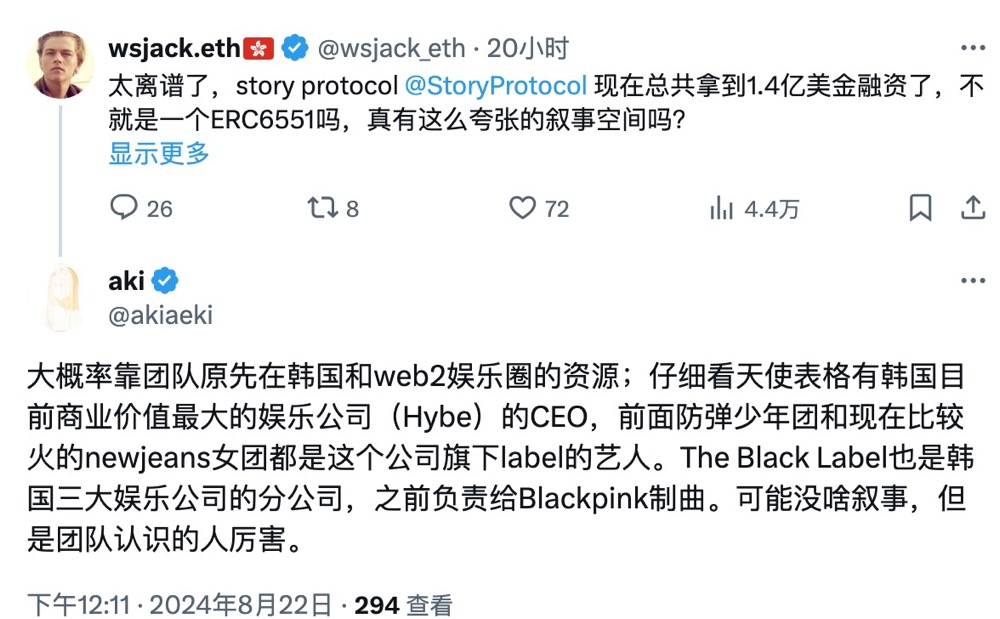
Beyond technical architecture, team strength, and alignment with a16z’s philosophy, other potential factors have been suggested. @akiaeki speculated that Story likely has access to powerful Korean entertainment resources. Considering the global influence of the “Korean Wave” (with all due respect, the Chinese wave reigns supreme), if Story successfully brings major K-pop IPs into crypto, its impact could be substantial.
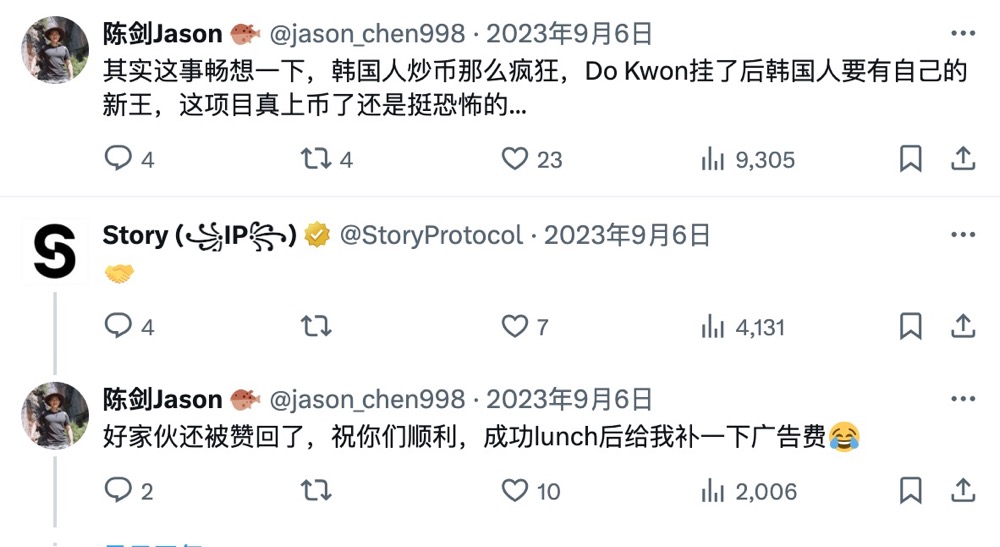
Moreover, as @jason_chen998 speculated during Story’s Series A announcement, South Korea’s historically enthusiastic retail crypto investors—who once rallied behind Do Kwon—may now be looking for a new figurehead.
The Power of IP
It’s common in the crypto space for funding figures to be inflated, so whether Story’s $140 million is “pumped up” remains unverifiable. But given the sheer scale of the IP industry, a $2.25 billion valuation might not be unreasonable—if successful. After all, “one Iron Man can save the entire Marvel universe.” According to data compiled by Wiki&Mili, in 2023, the Pokémon IP alone generated $88 billion in revenue for The Pokémon Company and Nintendo across the top 50 highest-grossing IPs globally.
However, in an interview with Fortune, Jason Zhao stated that Story is unlikely to attract giants like Disney. Instead, the platform targets “Tier 2 IP” creators. “This generation of AI-native creators is similar to early YouTubers—overlooked by traditional brands,” Zhao said. “Like YouTube, which didn’t rely on directors like Spielberg, but on smartphone-wielding individuals uploading videos. Fifteen years later, YouTube gave us MrBeast.”
Whether Story will become the “YouTube” Zhao envisions remains to be seen. Notably, following the funding announcement, the floor price of Story’s NFT commemorating ETHDenver 2024 surged several-fold. In an interview with The Block, Zhao revealed that Story’s mainnet is expected to launch later this year. When asked whether a token would launch alongside the mainnet, Zhao declined to comment.
Join TechFlow official community to stay tuned
Telegram:https://t.me/TechFlowDaily
X (Twitter):https://x.com/TechFlowPost
X (Twitter) EN:https://x.com/BlockFlow_News
 @News_Techub






