Private order flow on Ethereum takes up half the market, as the "fat application" theory gradually comes into effect
TechFlow Selected TechFlow Selected
Private order flow on Ethereum takes up half the market, as the "fat application" theory gradually comes into effect
The privatization of order flow will continue to expand as the commodity value of block space grows, paving the way for large-scale applications.
 Navigating Web3 tides with focused insights
Author: Mason Nystrom
Translation: TechFlow
Update: August 19 – corrected Orderflow data
In the past 30 days, Ethereum has seen over $12 billion in order flow, with nearly half of that coming from private or proprietary applications. Read the full article here.
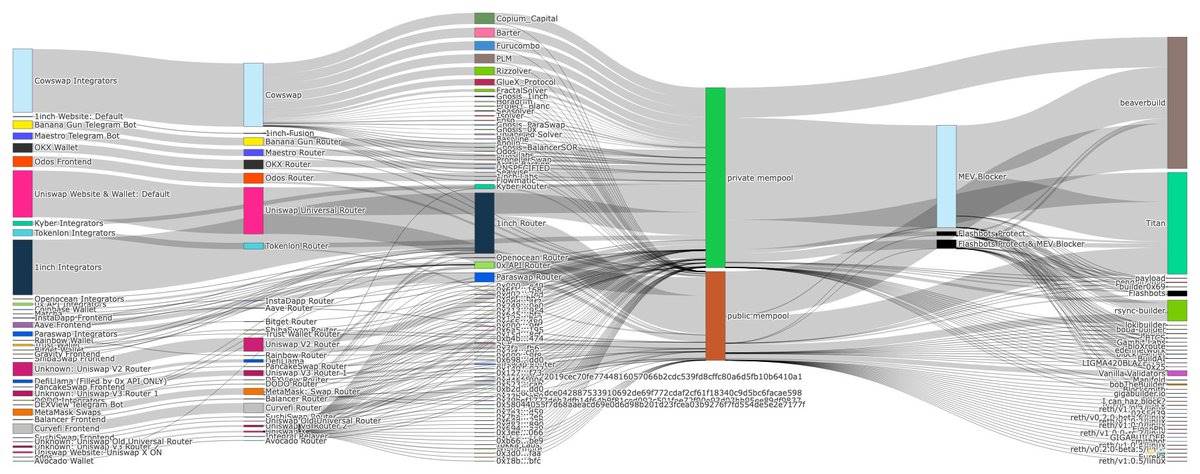
Source: Orderflow.art
The privatization of order flow will continue expanding as blockspace becomes increasingly commoditized, paving the way for large applications.
But how did we get here? And where are we headed?
Short answer: foodcoins. A slightly longer version: The DeFi summer spawned a wave of sophisticated users and retail trading, which led to the emergence of trade aggregators like 1inch—aggregators that offered better price execution through private order routing. Wallets such as MetaMask quickly followed, realizing they could monetize user convenience by adding in-app swap functionality—proving that any app controlling end-user attention (and orders) possesses an extremely valuable business model.
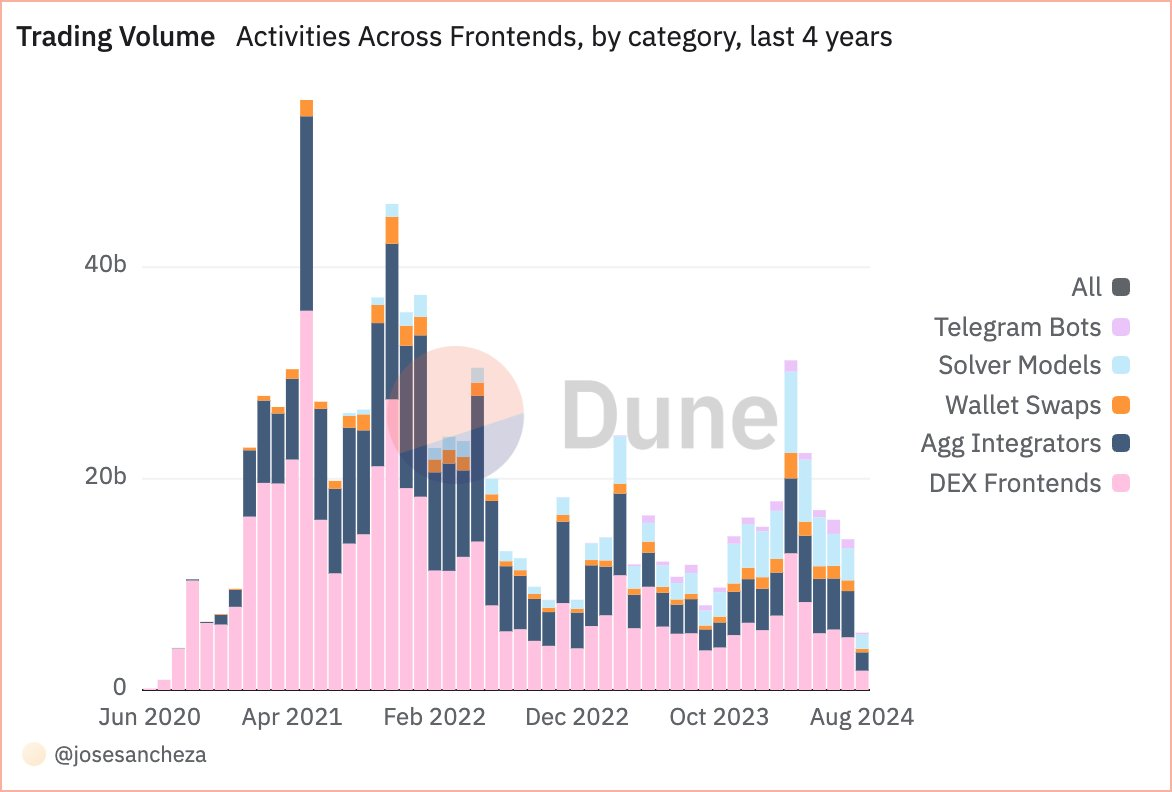
Source: Dune
In the past two years, two additional categories of participants have entered the private order flow space—Telegram bots and solver networks. Telegram bots align with MetaMask’s “convenience fee” model, offering users an easy way to trade long-tail, low-cap meme assets directly within group chats. As of July, Telegram bots accounted for ~17% of trades and 6% of trading volume, most of which flowed through private mempools.
Meanwhile, in the more liquid parts of the market, solver networks such as Cowswap and UniswapX have emerged as core venues for trading highly liquid pairs (e.g., stablecoins and ETH/BTC). Solver networks have transformed the order flow market structure by outsourcing the task of finding optimal routes for a given trade to competitive markets of solvers (market makers).
As a result, we’ve seen an initial bifurcation of trading venues: convenient frontends—including TG bots, wallet swaps, and Uniswap’s interface—are primarily used for long-tail, lower-value trades (under $100k), while aggregators and solver networks are the venues of choice for larger trades, typically involving stablecoins and major assets (ETH/BTC).
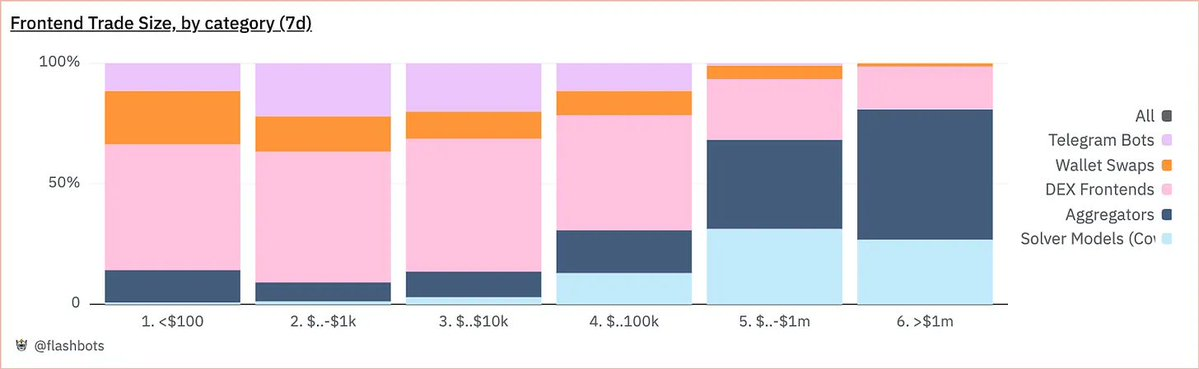
A closer look reveals that the bulk of private order flow comes from aggregators (like 1inch) and frontend tools (TG bots, wallets, and interfaces).
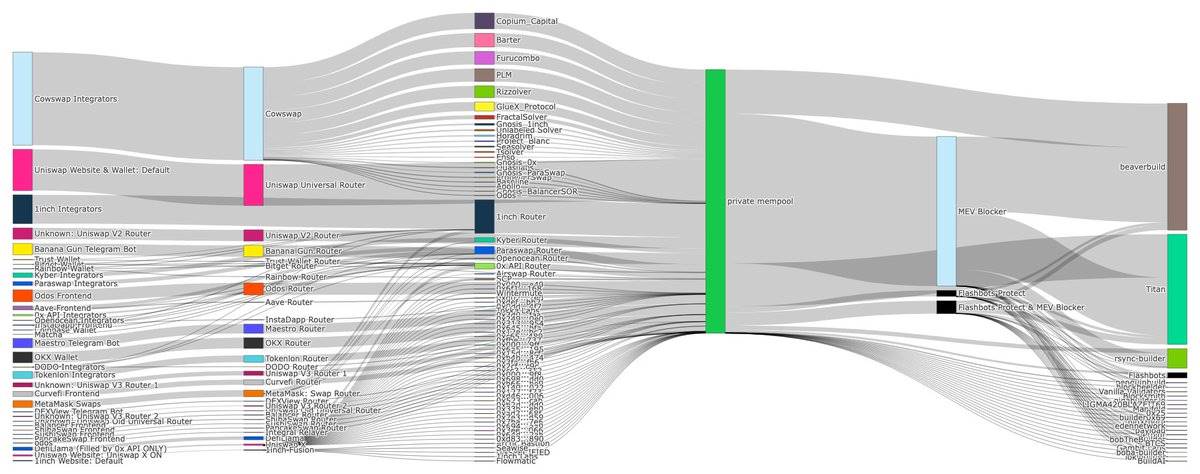
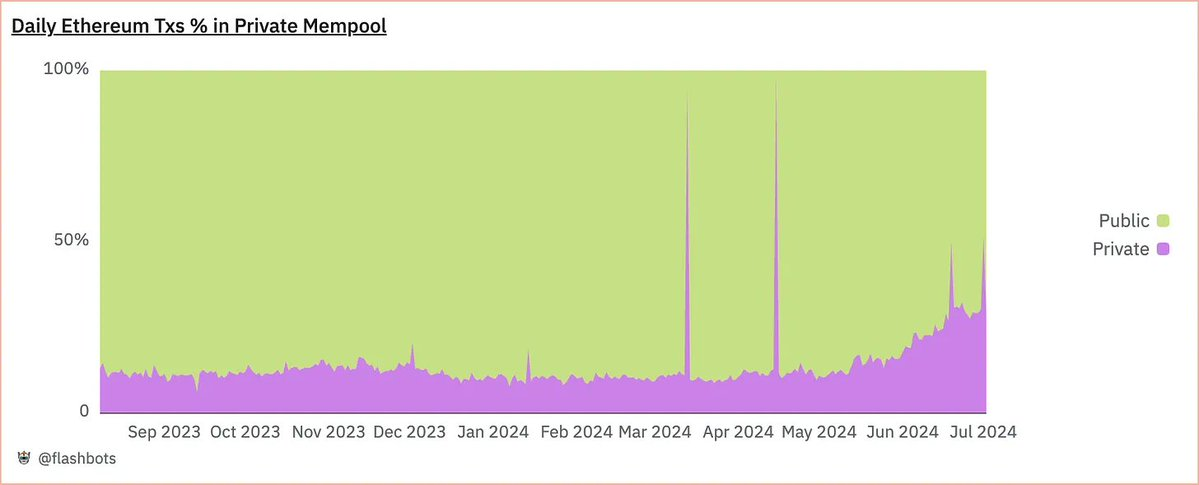
When you consider that only about 30% of Ethereum transactions go through private mempools by count, the concentration of private order flow becomes even more striking—indicating that a small number of transactions contribute disproportionately to private order volume.
Source: Dune
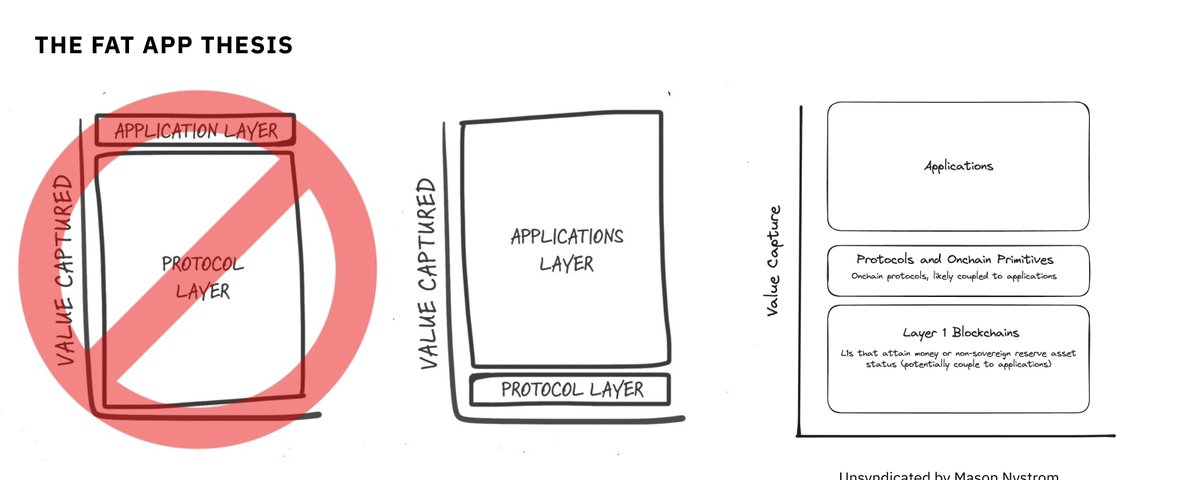
In other words, valuable order flow matters more than sheer volume. The power-law relationship between users and order flow leads to one inevitable conclusion—applications will capture the largest share of overall value. Put differently, the fat app thesis still holds.
Toward Fat Apps
Uniswap’s protocol clearly holds value, but the more compelling story is unfolding at the application layer, as Uniswap strives to become a consumer app—vertically integrating key components of its tech stack and expanding its capabilities across interfaces, mobile wallets, and aggregation layers. For example, Uniswap Labs’ suite—the frontend, wallet, and aggregator UniswapX—generated roughly 16% of the $8 billion in private order flow over the past 30 days, accounting for nearly 18% of total order flow (private and public combined).
In crypto, apps like Worldcoin now account for nearly 50% of activity on the Optimism mainnet, prompting them to launch their own appchain—further underscoring the strength of the fat app thesis and the power of controlling demand (users and transactions).
Even top-tier NFT projects with strong brands, such as Pudgy Penguins, are building their own chains; CEO Luca explained that controlling the blockspace on which distribution relies benefits the accumulation of value for the Pudgy brand and IP.
Looking ahead, apps should focus on creating new types of order flow—whether by launching new assets (like Pump and memecoins), building applications that deliver novel user utility such as identity (e.g., Worldcoin, ENS), or crafting superior consumer experiences that are vertically integrated and enable valuable transactions—such as Farcaster and frames, Solana Blinks, Telegram and TG apps, or on-chain gaming.
Final Thoughts on the Fat App Thesis
It’s worth noting that since the end of the last cycle, the fat app thesis has been a central focus for many in crypto, as the appchain narrative evolved into part of the consensus view.
My current take on the fat app thesis is that we’ll see most value accrue to the application layer of the tech stack, where control over users and order flow places apps in a privileged position. These apps may combine with on-chain protocols and primitives—similar to how UniswapX and the Uniswap protocol work today, Warpcast and Farcaster, or Worldcoin and Worldchain. Ultimately, these protocols—especially those that are maximally on-chain like MakerDAO—can still accumulate significant value. However, due to apps' proximity to users and off-chain components, applications are likely to capture more value, thus forming stronger moats.
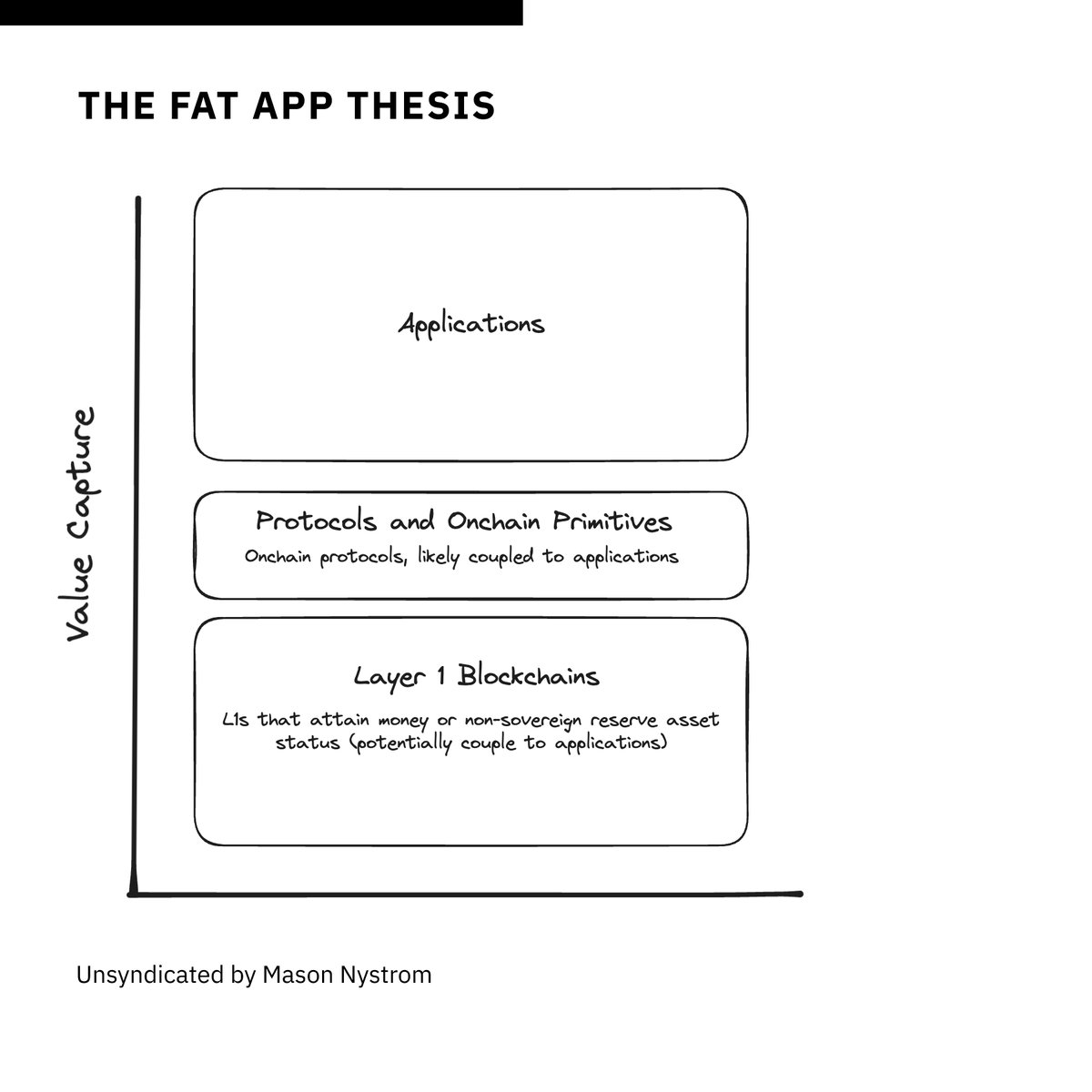
The fat app thesis and value accrual in crypto investing
Finally, I still believe Layer 1 blockchains (such as Bitcoin, Ethereum, Solana) can capture significant value as non-sovereign reserve assets, with their base assets (like ETH) accumulating enormous value. Given enough time, apps may attempt to build their own L1s just as they’ve built their own L2s—but launching a commoditized L2 blockspace is very different from launching an L1 and turning a token into a commodity and collateral asset, so this may remain a distant future.
The key takeaway is that as more consumer apps create and own valuable order flow, the crypto world will reevaluate applications—arriving at the inevitable conclusion: fat apps are unavoidable.
Join TechFlow official community to stay tuned
Telegram:https://t.me/TechFlowDaily
X (Twitter):https://x.com/TechFlowPost
X (Twitter) EN:https://x.com/BlockFlow_News
 @masonnystrom