








Circle's Circle Transaction Lead: Building a New Internet Financial System Through Cryptocurrency
TechFlow Selected TechFlow Selected
Circle's Circle Transaction Lead: Building a New Internet Financial System Through Cryptocurrency
The core idea behind stablecoins is to bring the interoperability, composability, and accessibility of the internet into traditional monetary systems, with USDC leading the way in building a secure and transparent "digital dollar."
 Navigating Web3 tides with focused insights
Author: STANFORD BLOCKCHAIN CLUB
Translation: TechFlow
*Note: This article is from the Stanford Blockchain Review. TechFlow is a partner of the Stanford Blockchain Review and has been exclusively authorized to translate and republish this content.
An interview with Heath Tarbert, Chief Legal Officer and Head of Corporate Affairs at Circle, former Chair of the Commodity Futures Trading Commission (CFTC), and former Assistant Secretary of the U.S. Treasury.
This article is an in-depth exploration of a discussion and ideas from an interview conducted in June 2024 between Heath Tarbert and Jay Yu of the Stanford Blockchain Club. Click here to watch the full video.
Introduction
Today, stablecoins are a critical component of the crypto industry, combining the reliability of the U.S. dollar as a store of value with the tradability and usability of blockchain tokens. USDC, Circle’s flagship product, is one of the most widely adopted stablecoins and ranks as the sixth-largest cryptocurrency by market capitalization.
In this article, we will explore the unique characteristics of USDC as a stablecoin product, its current adoption as a payment method, the regulatory environment facing USDC and other digital assets, and what all of this means for the digital future of the U.S. dollar.
Building Trust and Transparency in Stablecoins
At its core, USDC solves a simple problem: how can you use U.S. dollars to buy digital assets? Before stablecoins existed, the solution was to transfer fiat dollars from traditional banking systems to cryptocurrency exchanges—a process that was often slow, cumbersome, and expensive. USDC addresses this “on-ramping” issue by creating a “digital dollar,” a programmable, tokenized representation of the U.S. dollar backed 1:1 by cash and cash-equivalent assets.
Since its launch in 2018, USDC has grown into one of the leading stablecoins in the crypto industry. Perhaps the key differentiator for USDC compared to other major stablecoins is its emphasis on trust and transparency in issuance. Unlike many other stablecoin issuers that operate overseas and remain unregulated, Circle is a fully U.S.-owned and operated company issuing these “digital dollars.” Each month, USDC’s reserves are independently audited by one of the Big Four accounting firms, and Circle maintains a public dashboard where anyone can view the composition of USDC’s reserves in real time. For example, as of August 8, 2024, Circle’s dashboard reported $34.5 billion worth of USDC in circulation.
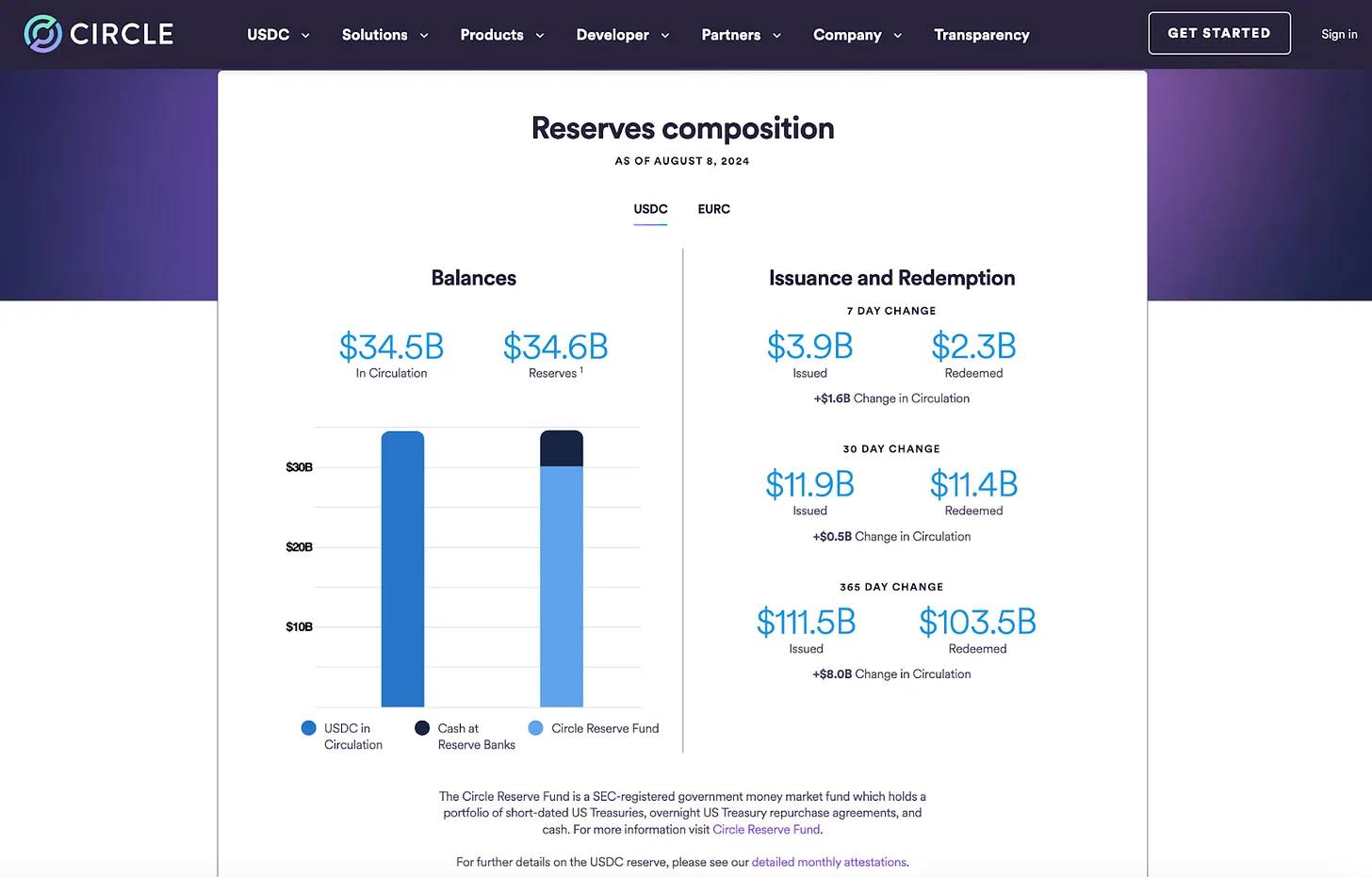
Composition of Circle's reserves, accessed on August 8, 2024
How exactly are USDC tokens issued and redeemed against fiat backing? Direct issuance and redemption of USDC are handled through “Circle Mint,” an application programming interface (API) designed for institutional traders, fintech companies, exchanges, and other enterprises. To receive any amount of USDC, Circle Mint customers initiate a corresponding fiat transfer to Circle’s USDC reserve account via the API, and Circle issues an equivalent amount of USDC to the customer’s Circle Mint account. Similarly, when a Circle Mint customer requests to redeem USDC for fiat currency, Circle sends those USDC tokens to a “burn address,” and after this “burn event,” transfers the equivalent dollar amount to the company’s linked bank account.
The asset management process is also designed to foster trust by leveraging the expertise and transparency of traditional asset managers. Of the current $34.5 billion in USDC reserves, $4.5 billion is held in reserve banks, while the remaining $30.1 billion is invested in the Circle Reserve Fund—an SEC-registered government money market fund managed by BlackRock, offering a 7-day SEC yield of 5.29%.
Fiat-backed stablecoins like USDC stand in stark contrast to the traditional fractional banking system. Dollars in most banks are backed only by the bank’s loan portfolio—assets that are typically less liquid and riskier—whereas every dollar of USDC is backed by an equal amount of highly liquid cash and cash-equivalent dollar assets. In this sense, Circle’s USDC paves the way for the future of the U.S. dollar in the digital realm. By providing a secure, reliable, and innovative infrastructure framework for “digital dollars,” Circle aims to reimagine one of the most important assets in finance.
USDC Adoption: From DeFi to TradFi
Naturally, the true value of a stablecoin lies in its use cases. No matter how well-designed or transparent a product may be, the real test for a stablecoin is its adoption in everyday usage—both within blockchain environments and in traditional payment systems.
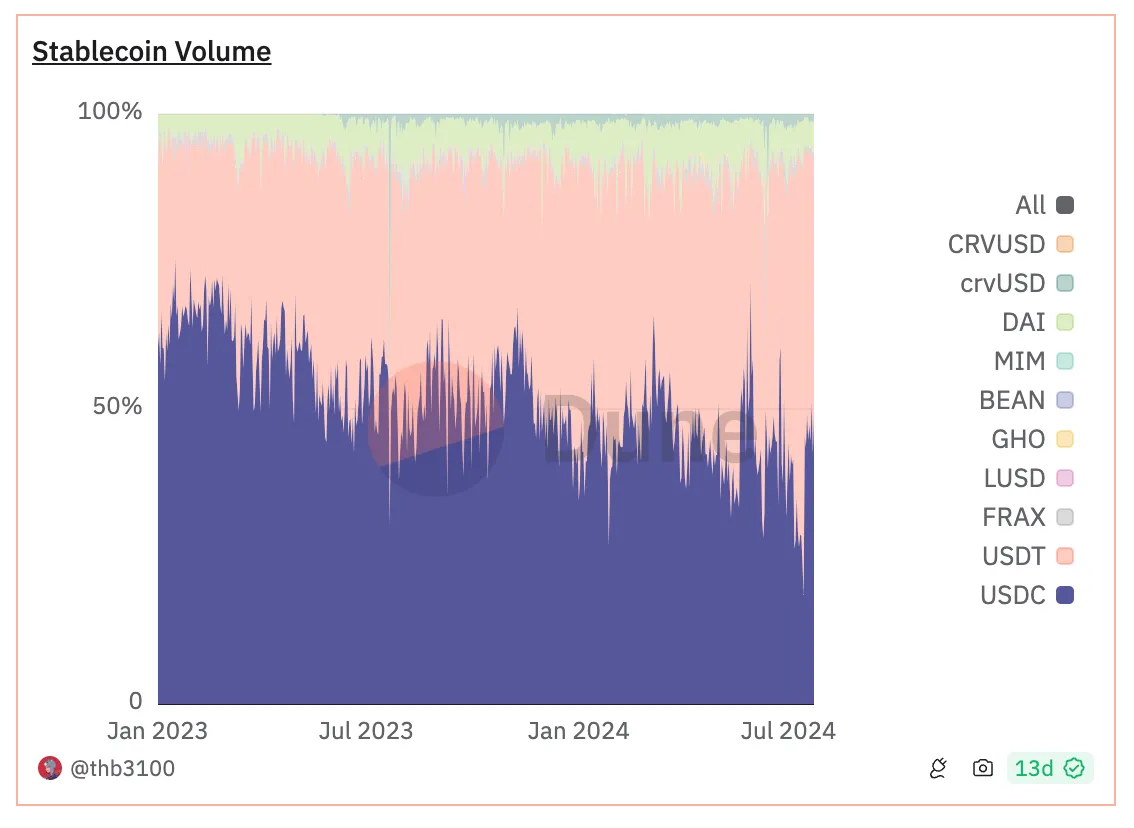
Dune dashboard showing stablecoin transaction volume in DeFi
Circle’s USDC remains the world’s largest regulated digital dollar, natively supported across 16 different blockchains and widely used as the preferred stablecoin in DeFi protocols. The highest transaction volumes occur on Solana and Ethereum, primarily for trading and other activities within the crypto ecosystem. To ensure compatibility across supported blockchains, USDC has developed a native interoperability infrastructure for cross-chain transfers called the Cross-Chain Transfer Protocol (CCTP).
The interoperability mechanism in CCTP closely mirrors the fiat-to-token infrastructure of Circle Mint. Currently, CCTP supports eight different chains: Arbitrum, Avalanche, Base, Ethereum, Noble, OP Mainnet, Polygon PoS, and Solana. Transferring USDC from one chain to another—for example, from Ethereum to Solana—involves three main steps:
-
First, USDC is burned on Ethereum (the source chain).
-
Then, the user obtains a signed attestation from Circle verifying the burn event, serving as a receipt.
-
Circle uses this proof to authorize the minting of USDC on Solana.
One advantage of this burn-and-mint mechanism is that it enables compatibility between blockchains running different virtual machines—such as Ethereum’s EVM and Solana’s SVM—making possible use cases like cross-chain swaps, deposits, and purchases within decentralized finance (DeFi) systems.
But perhaps the most exciting growth area for USDC lies in its adoption beyond crypto trading and DeFi products. Traditionally, money serves three primary functions: (1) a store of value, (2) a unit of account, and (3) a medium of exchange. Adoption of USDC across all three monetary functions in the real world is steadily increasing.
As a “store of value,” USDC has become a natural solution for people in developing countries who lack access to reliable dollar-denominated banking services. In Argentina, where annual inflation exceeds 200%, stablecoins have become a vital tool for wealth preservation. In 2023, 60% of cryptocurrency purchases in Argentina were made using dollar-pegged stablecoins like USDC, and the country ranked 15th globally in cryptocurrency adoption. In December 2023, Circle also announced a partnership with Brazil’s Nubank, giving its 85 million customers access to “digital dollars.”
As a “unit of account,” USDC has made significant progress over the past few years, with Circle conducting extensive pilots with the two largest global payment processors, Visa and Mastercard. Since 2021, for example, Visa has piloted USDC as a settlement mechanism with Crypto.com, and in 2023, Visa announced expanded support for USDC settlements in collaboration with new merchant acquirers Worldpay and Nuvei, utilizing the Solana blockchain. Similarly, in 2021, Mastercard announced it would enable crypto companies to launch branded cards settled in stablecoins like USDC.
As a “medium of exchange,” USDC can now be used at any Visa terminal via the Coinbase Visa Card. Launched in 2020 for U.S. consumers, this debit card allows users to directly spend USDC at any Visa terminal, delivering a fiat-like payment experience while earning crypto rewards.

The Coinbase Visa Card allows customers to spend USDC at any Visa terminal
Another example of USDC as a “medium of exchange” is Singapore-based Grab, a super app serving over 180 million users across Southeast Asia with ride-hailing, food delivery, and grocery services. In September 2023, Grab announced a partnership with Circle to create a web3 wallet supporting USDC payments, along with NFT-based government vouchers and food stamps. Today, consumers can top up their Grab wallets with USDC on both Ethereum and Solana.
Thus, we see growing support and integration of USDC within traditional payment systems, bridging internet-native financial systems with legacy financial services. But how do stablecoin payments compare to existing digital payment systems such as the Automated Clearing House (ACH)?
In many existing systems like ACH, funds and messages move separately through centralized ledgers. If Alice sends a payment to Bob via ACH or credit card, the transaction is first marked as “pending” and may take days to settle. This is because, at the moment of transaction, only a “message” indicating the transfer is sent—the actual movement of funds happens asynchronously, sometimes delayed by several days.
A key advantage of stablecoin payments over these traditional systems is that the message and the funds move simultaneously. When Alice sends a stablecoin payment to Bob, Bob receives the full amount instantly upon confirmation of the transaction—just like a cash payment. In this way, stablecoins represent a technological leap forward over many existing settlement solutions, making them better suited to serve as “digital dollars” in the future.
Legal and Regulatory Perspectives on Stablecoins
Like any emerging technology, stablecoins raise numerous legal and regulatory questions. As stablecoins like USDC enter the mainstream, a key concern is their potential misuse by bad actors for money laundering, terrorist financing, and sanctions evasion. This becomes especially important as connections between traditional finance and stablecoins mature, forming new internet-based financial systems—thus underscoring the need to advance compliance in stablecoin products.
In this article, we’ve emphasized Circle’s efforts to make USDC a regulated, transparent stablecoin issued by a company that prioritizes compliance. As a regulated money transmitter, Circle follows relevant FinCEN guidelines and state money transmission laws. All U.S. users of Circle Mint must comply with anti-money laundering (AML) and know-your-customer (KYC) regulations, such as those under the Patriot Act.
While introducing compliance to prevent abuse of stablecoins like USDC by malicious actors is necessary, regulation must also be nuanced and sophisticated enough to protect the interests of ordinary consumers who wish to use USDC. Creating a regulatory framework that excludes average users—especially those already marginalized within the existing financial system—does not serve U.S. interests.
Currently, the two main agencies attempting to regulate stablecoins in the United States—the Securities and Exchange Commission (SEC) and the Commodity Futures Trading Commission (CFTC)—were established long before the invention of the modern internet, let alone cryptocurrencies and stablecoins. Today’s regulators are working with tools developed over 90 years ago. While certain guidelines remain useful in specific contexts, regulators must exercise particular care in applying existing rules to this emerging industry and in crafting new rules to effectively govern blockchain-based innovations.
Although the blockchain industry can introduce technical innovations—such as decentralized digital identity systems—that help balance end-user privacy needs with regulatory requirements, these alone are insufficient to close the regulatory gap. Congress must act to increase regulatory clarity for stablecoins and digital assets overall. Proposed legislation like the Stablecoin Transparency Act represents a step in the right direction.
In this regard, several regions—including the European Union—are far ahead of the United States. Recently, the EU introduced the Markets in Crypto-Assets Regulation (MiCA), expected to be fully implemented by December 2024. MiCA’s core innovation is its aim to create a new regulatory framework for digital assets, including requirements for stablecoin issuers to hold liquid reserves, restrictions on non-euro-denominated stablecoins, and a unified authorization mechanism for the EU’s 450 million citizens. MiCA marks a significant step toward greater regulatory clarity in stablecoin and digital asset oversight, and Circle’s stablecoin is among the first global stablecoins compliant with MiCA. Given its work toward MiCA compliance, Circle’s products are well-positioned for adoption across the EU as a leading compliant stablecoin.
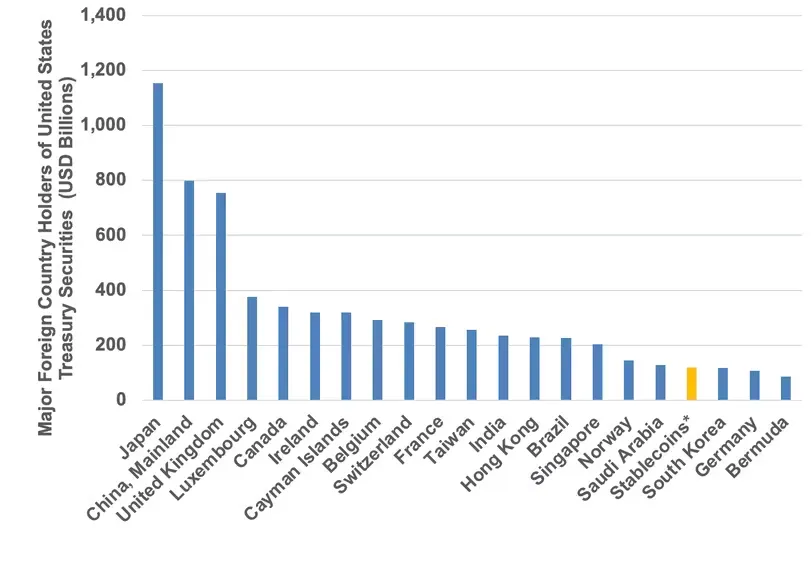
Largest foreign holders of U.S. Treasury securities
Therefore, there is strong motivation for the U.S. Congress to act on stablecoin legislation. Regulated, dollar-denominated stablecoins like USDC can significantly advance U.S. interests in the digital asset space. USDC’s reserve requirements ensure ongoing demand for U.S. Treasuries. As of June 2024, stablecoins ranked as the 18th-largest creditor of U.S. debt, holding more Treasury bills than either South Korea or Germany. As demand for stablecoins and digital assets grows, this figure will only increase. In other words, demand for dollar-denominated stablecoins translates directly into demand for the U.S. dollar and U.S. Treasury securities. Congress must therefore enhance regulatory clarity in the digital asset sector to further strengthen the dollar’s position in the digital age.
Conclusion
Stablecoins like USDC have come a long way since their inception just a few years ago, emerging as one of the most compelling use cases for blockchain technology. The core idea behind stablecoins is to bring the internet’sinteroperability, composability, and accessibility into traditional monetary institutions—and USDC is at the forefront of building a secure and transparent “digital dollar.”
In the coming years, as stablecoin products, adoption, and regulation mature, we can expect millions of businesses and individuals to adopt a new open standard for financial transactions. In this sense, Circle’s mission is to fulfill the internet’s unfinished promise—bringing openness and transparency into the realm of money and ultimately building an internet-native financial system.
Join TechFlow official community to stay tuned
Telegram:https://t.me/TechFlowDaily
X (Twitter):https://x.com/TechFlowPost
X (Twitter) EN:https://x.com/BlockFlow_News
 Stanford Blockchain Club


