Large holders seize opportunity to buy the dip, but Bitcoin still faces correction risks
TechFlow Selected TechFlow Selected
Large holders seize opportunity to buy the dip, but Bitcoin still faces correction risks
Bitcoin whales are seizing the opportunity of the price decline to accumulate more holdings, while small investors are selling in panic as fear sets in.
 Navigating Web3 tides with focused insights
By TechFlow Mary Liu
Financial markets rebounded across the board on Tuesday as investors took advantage of the pullback to buy the dip, lifting both U.S. equities and cryptocurrencies, although prices remain well below pre-selloff levels.
By market close, the S&P 500, Dow Jones Industrial Average, and Nasdaq Composite were all up, gaining 1.04%, 0.76%, and 1.03% respectively. Gold declined 0.63% as safe-haven demand weakened.
Data from TechFlow shows Bitcoin (BTC) climbed from its support level at $54,000 to a high of $57,100 on Tuesday, regaining support at the lower end of its trading range since late February. At the time of writing, Bitcoin was trading at $56,051, up 2.25% over 24 hours.
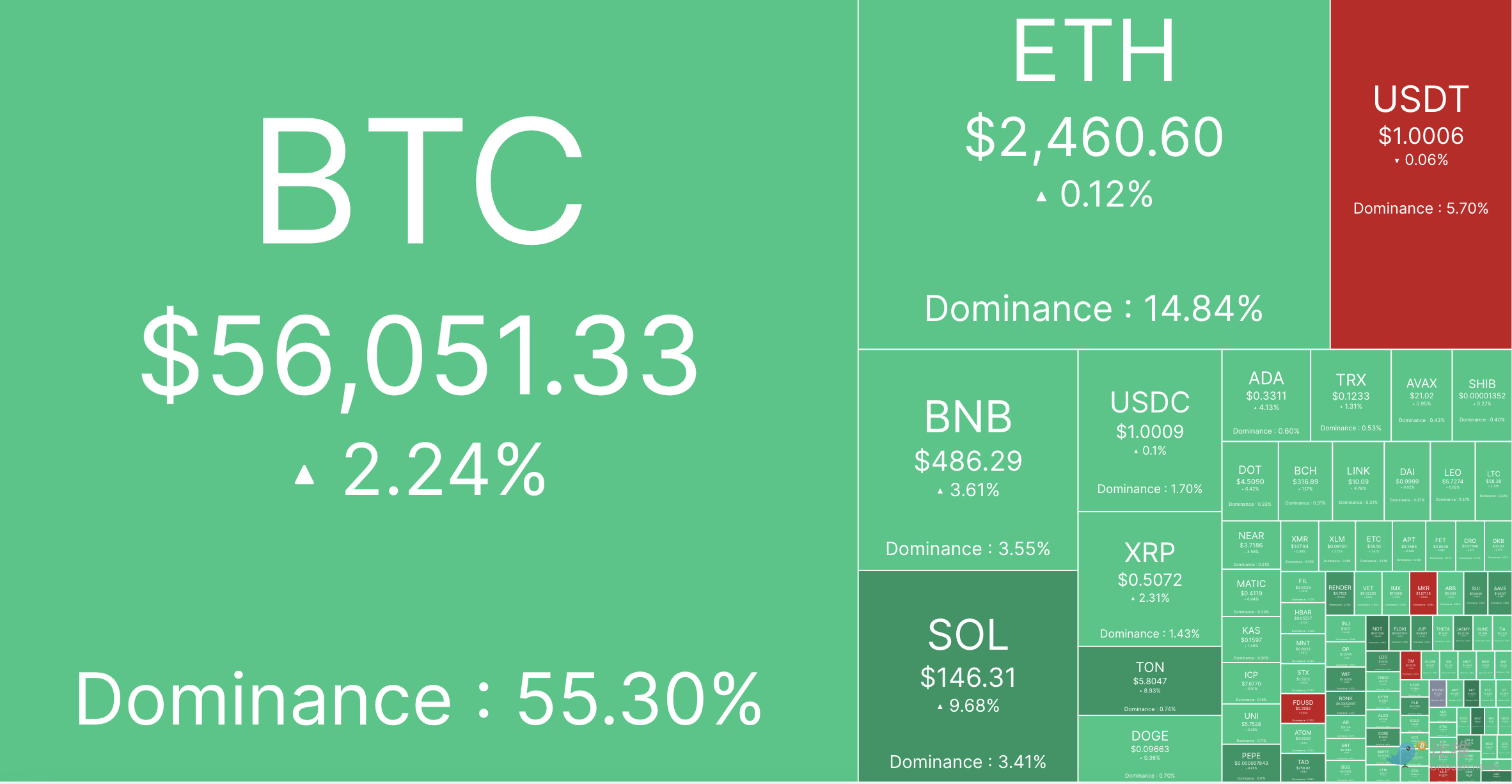
Altcoins saw double-digit recoveries, with all top 200 non-stablecoin tokens by market cap posting gains.
The meme token cat in a dogs world (MEW) led the rally, surging 39.8% to trade at $0.00568, followed by Notcoin (NOT) up 30% and AIOZ Network (AIOZ) rising 27.9%.
The total cryptocurrency market capitalization currently stands at $2 trillion, with Bitcoin’s dominance at 55.9%.
Whales holding 1,000 to 10,000 BTC buying the dip
According to blockchain analytics firm IntoTheBlock, Bitcoin whales—large holders—seized the price decline to accumulate more coins, while smaller investors sold off amid panic.
IntoTheBlock analysts noted that wallets holding between 1,000 and 10,000 BTC—worth approximately $56 million to $560 million at current prices—"have shown confidence during the recent downturn, consistently increasing their holdings as prices fell."
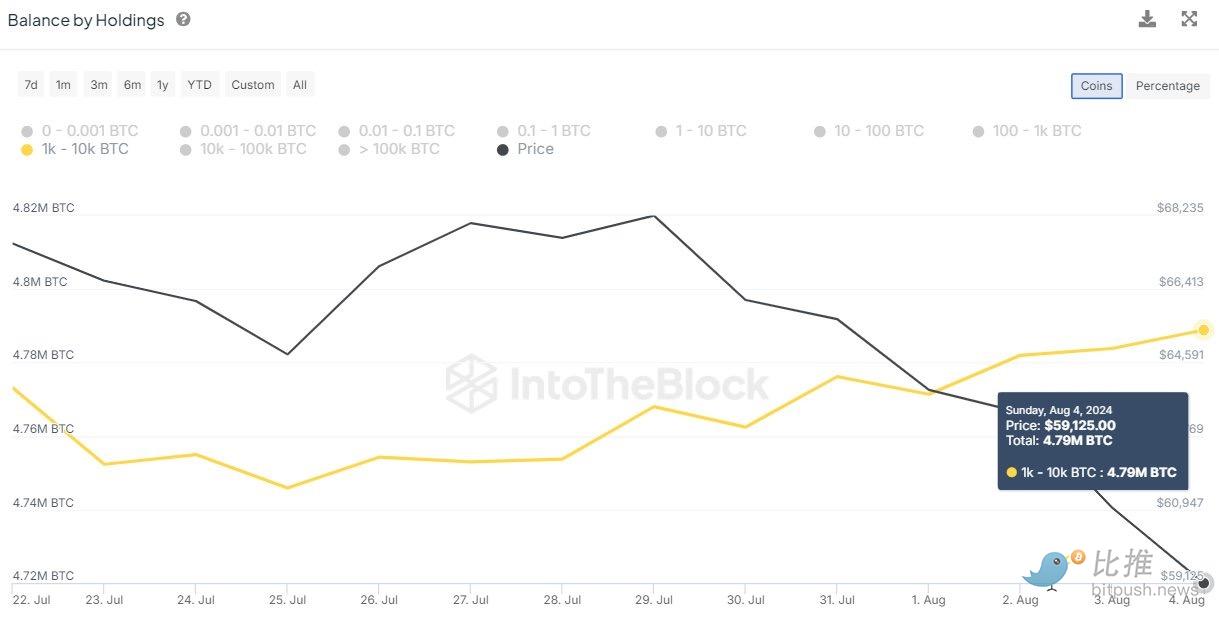
Meanwhile, wallets holding less than 1 BTC "performed weakly, with holdings significantly declining during yesterday's market slump."
Data compiled by Farside Investors showed that U.S. spot Bitcoin ETFs recorded net outflows of $168 million on Monday, with outflows concentrated in Grayscale’s GBTC, Fidelity’s FBTC, and 21Shares/Ark Invest’s ARKB, while inflows into competing products were modest or flat.
Bloomberg senior ETF analyst Eric Balchunas pointed out that the outflows represented just 0.3% of the ETFs’ total assets under management. He also noted that the largest spot BTC ETF—the $18 billion IBIT from BlackRock—did not see any net outflows.
Need to reclaim $59,000 support
Market analyst Bloodgood said on X: "A lot has changed over the past two weeks. If we were previously discussing whether BTC would break above $69,000, now we're focused on whether the $51,000 level can hold. Due to market turmoil, Bitcoin has dropped 30% in the past two weeks."
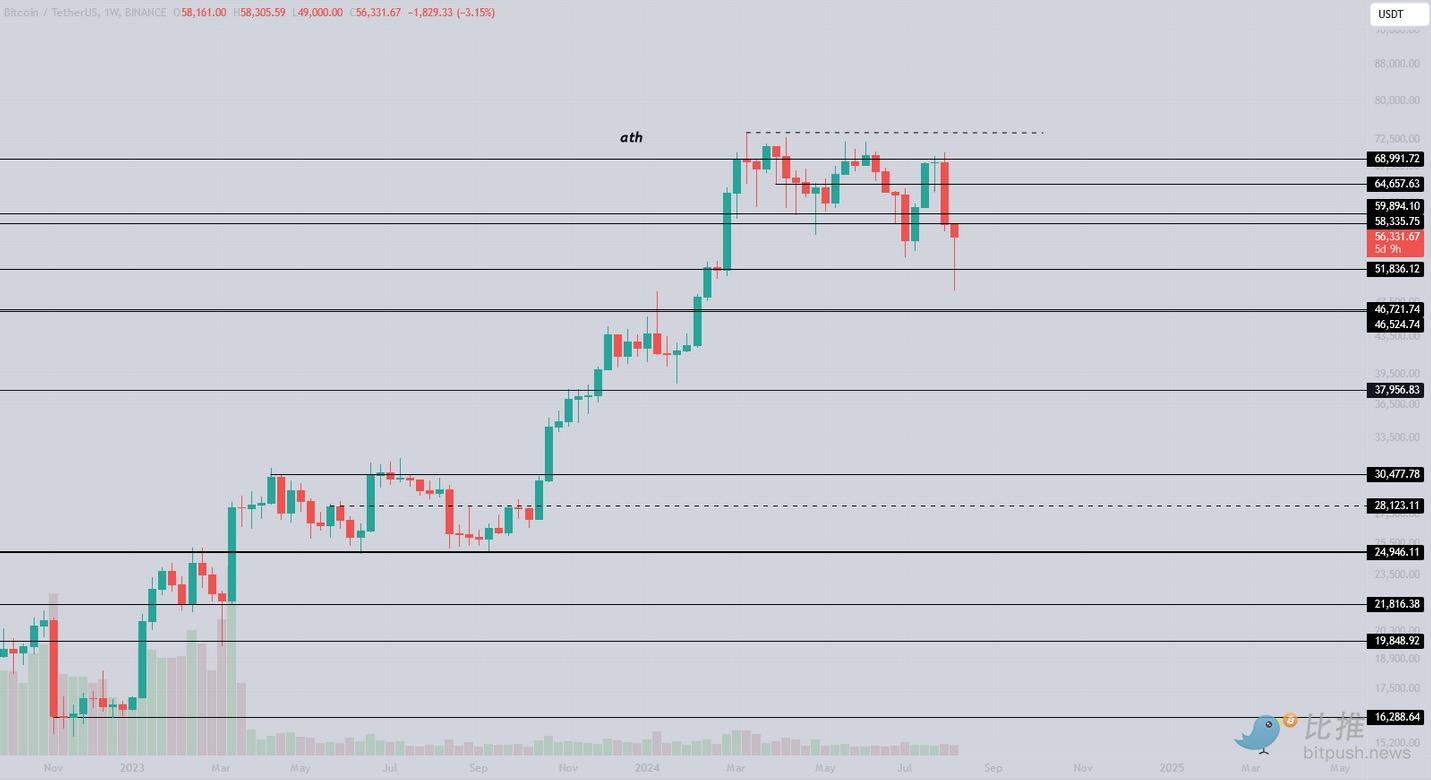
He added: "However, we’re not interested in fundamentals here; we look at the chart. The bottom formed slightly below $50,000, and a bounce is underway. For us to see this rebound continue quickly, we need BTC’s weekly close above the key weekly resistance level of $59,000. Otherwise, we might soon see levels below $50,000."
Bloodgood stated: "Since Bitcoin failed to make a higher high on the weekly chart, we now have three lower highs and three lower lows, indicating that we are still in a downtrend. Unless this changes, I won’t feel comfortable looking for long positions. I will continue waiting until the trend shifts."
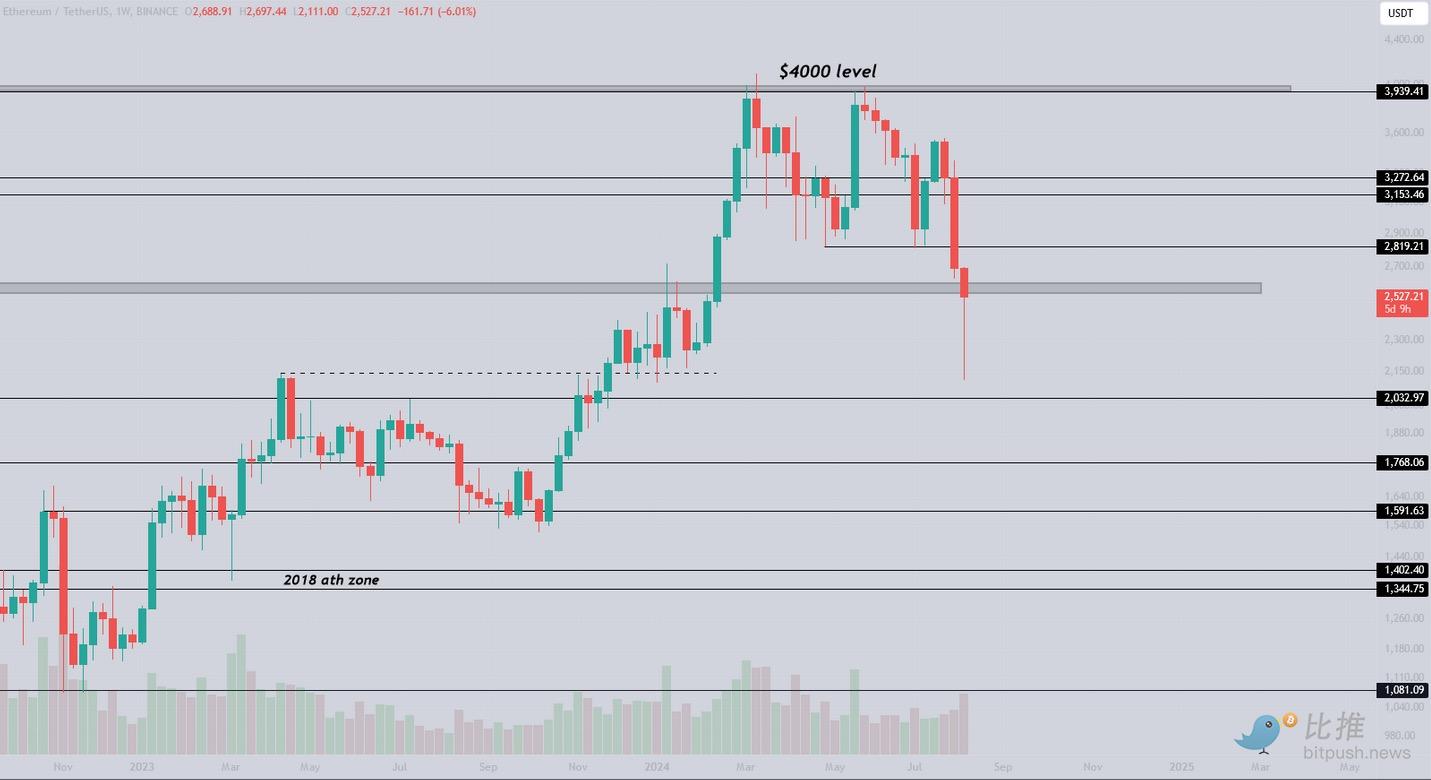
Regarding Ethereum’s outlook, Bloodgood said: "Similar to BTC, ETH needs to reclaim $2,600—a critical level to propel ETH toward $4,000. If this doesn’t happen, we may see it test $2,000. On the other hand, breaking above this level could take ETH to $2,800, then $3,300."
According to Tuesday’s CryptoQuant market report, the BTC Market Value to Realized Value (MVRV) ratio has fallen below its 365-day moving average—a historical signal during previous cycles that often precedes continued price declines. The report noted that the same key support level was breached during the March 2020 COVID-19 crash, the May 2021 downturn, and the start of the bear market in November 2021.
Analysts added: "Investors should monitor these valuation metrics to assess the likelihood of a price rebound or further correction."
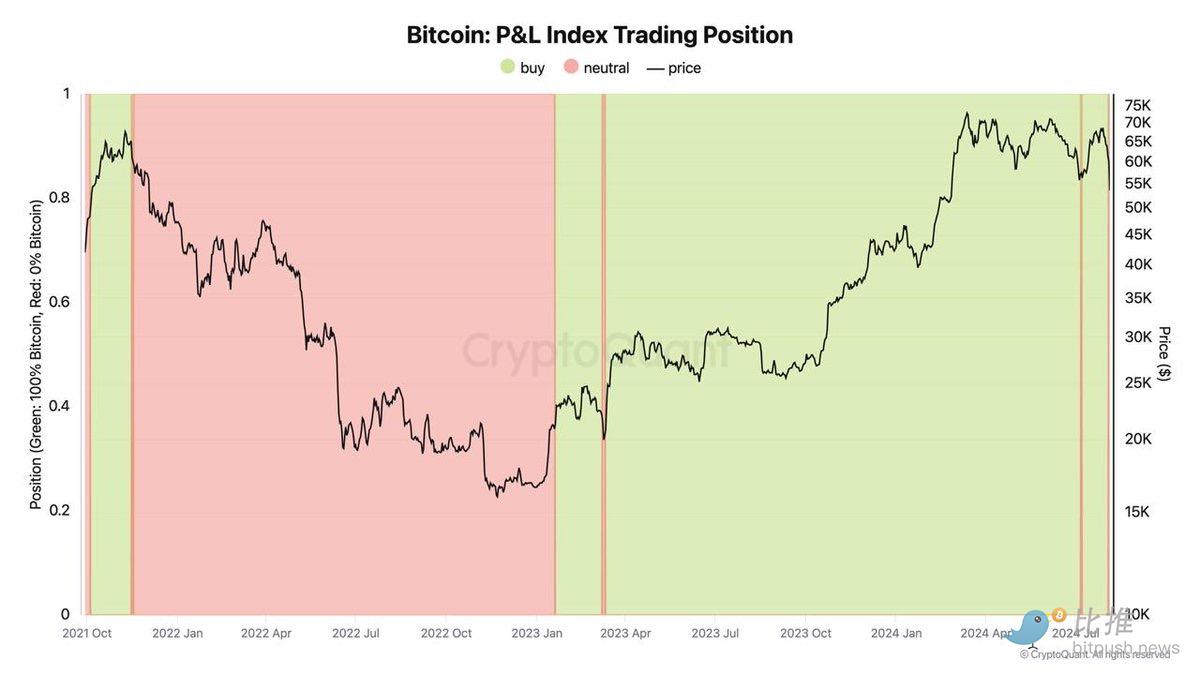
Ki Young Ju, founder and CEO of CryptoQuant, analyzed on X: "As long as Bitcoin can hold above $45,000, there remains a possibility of surpassing its all-time high again within a year. While some indicators now show bearish signals, a rebound is still possible. Therefore, we need to observe whether price can stabilize at this level for one or two weeks. If the consolidation lasts longer, bear market risks increase; if it extends beyond a month, recovery could become difficult."
Join TechFlow official community to stay tuned
Telegram:https://t.me/TechFlowDaily
X (Twitter):https://x.com/TechFlowPost
X (Twitter) EN:https://x.com/BlockFlow_News
 比推 BitpushNews