









Spot Ethereum ETF off to a strong start: over $1 billion in trading volume on first day
TechFlow Selected TechFlow Selected
Spot Ethereum ETF off to a strong start: over $1 billion in trading volume on first day
Among them, Grayscale's Ethereum ETF had the highest trading volume, nearly $458 million, accounting for almost half of the total trading volume.
 Navigating Web3 tides with focused insights
Authors: Li Dan, Zhao Ying
Source: Wall Street Insights
The cryptocurrency market has taken another step forward, with spot Ethereum ETFs attracting strong interest on their first day of trading.
On Tuesday, July 23 local time, spot Ethereum ETFs began trading publicly in the United States. On their debut day, investor enthusiasm was evident—media estimates suggest that the combined trading volume of the first batch of nine Ethereum ETFs exceeded $1 billion.
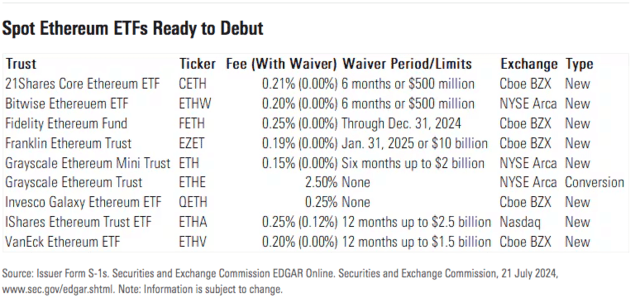
Media noted that compared to the $4.6 billion in trading volume recorded on the first day of spot Bitcoin ETFs in January this year, Ethereum ETFs' volume appears modest. However, for a U.S. market debut, it represents a solid start. Several of these Ethereum ETFs are expected to rank among the top 50 highest first-day trading volumes in U.S. ETF history.
Analysts believe this ETF launch is a positive development for the crypto market, potentially enhancing market stability and reducing volatility.
Spot Ethereum ETFs Draw Strong Interest
Specifically, Grayscale Ethereum Trust, the Ethereum trust ETF offered by Grayscale, saw the highest trading volume at nearly $458 million, accounting for almost half of the total trading volume.
BlackRock’s iShares Ethereum Trust reached a trading volume of $243 million. Compared to Grayscale’s ETF, this figure more closely reflects actual capital inflows.
Fidelity Ethereum Trust, operated by Fidelity, also surpassed $100 million in trading volume. The remaining six funds each raised less than $100 million, with 21Shares’ Ethereum ETF showing the weakest fundraising appeal on its first day.
The total trading volume across these funds reached as high as $1.077 billion, approximately 20% of the trading volume seen on the launch day of spot Bitcoin ETFs in January.
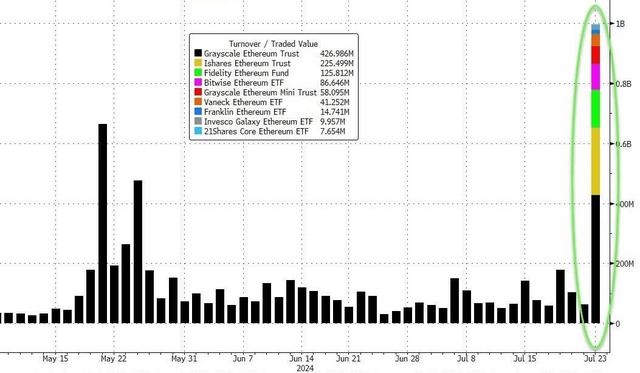
It's worth noting that trading volume reflects transaction scale but does not indicate whether investors are net buyers or sellers. Data on net inflows or outflows for Ethereum ETFs may not be available until Wednesday.
Drew Walsh, Vice President of Research and Operations at Roundhill Financial, commented that Ethereum ETFs and Bitcoin ETFs attract similar investor groups—not native crypto users, but those new to the asset class seeking exposure to cryptocurrencies.
Crypto ETFs Help Enhance Market Stability
Some industry observers are optimistic about the investment outlook brought by the launch of Ethereum ETFs.
Grzegorz Drozdz, market analyst at investment firm Conotoxia Ltd, stated:
While Ethereum ETFs may not attract as much capital inflow as Bitcoin ETFs, they represent an important milestone in the development of the cryptocurrency market.
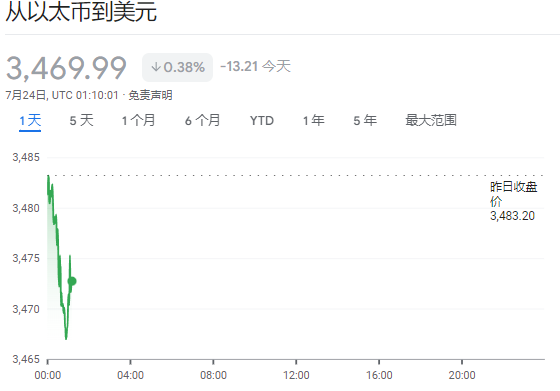
Ethereum is the world’s second-largest cryptocurrency after Bitcoin. Its price declined on Tuesday, dragging down the prices of the new ETFs. Ethereum is currently trading flat at $3,469.
Market participants view the ETF launch as significant for long-standing efforts to classify Ethereum as a commodity rather than a security. Although the U.S. Securities and Exchange Commission (SEC) has not explicitly declared Ethereum a commodity, the new products are defined in filing documents as commodity-based trusts.
Cristiano Ventricelli, Senior Analyst for Digital Assets at Moody’s Ratings, wrote in a report on Tuesday:
This listing enhances the “legitimacy” of cryptocurrencies in the U.S. market, and adds that crypto ETFs will help improve market stability and reduce volatility.
Meanwhile, some analysts point out that when the U.S. SEC approved exchange-related plans in May, paving the way for Ethereum ETFs, industry insiders suggested the launch could sharply increase demand, leading to tighter Ethereum supply. Under tight supply conditions, Ethereum’s price could become more sensitive to capital inflows. Moreover, staked Ether cannot be used to meet new ETF demand, further tightening supply and potentially driving up Ethereum’s price. Therefore, the launch of Ethereum ETFs may signal a key “turning point” ahead of a potential surge in cryptocurrency prices.
Last month, Matt Hougan, Chief Investment Officer at Bitwise, predicted that spot Ethereum ETFs would attract $15 billion in net inflows within the first 18 months of launch. On Monday, media reported that research firm Steno Research forecasts spot Ethereum ETFs could draw between $15 billion and $20 billion in inflows during their first year—comparable to the amount attracted by spot Bitcoin ETFs within just seven months.
According to Wintermute, current analyst expectations for capital inflows into Ethereum ETFs over the next year range from $4.8 billion to $6.4 billion. Wintermute’s own analysts expect inflows to fall below this range, estimating between $3.2 billion and $4 billion.
Christopher Jensen, Head of Digital Asset Research at Franklin Templeton, said investor adoption of Ethereum ETFs may be faster than that of Bitcoin ETFs, as many investors already have experience with Bitcoin ETFs. He estimates total capital flows into spot Ethereum ETFs could reach around 30% of those seen in spot Bitcoin ETFs.
Join TechFlow official community to stay tuned
Telegram:https://t.me/TechFlowDaily
X (Twitter):https://x.com/TechFlowPost
X (Twitter) EN:https://x.com/BlockFlow_News






