








Japan Plans to Launch Spot Crypto ETFs: A Comprehensive Analysis of Market Status, Regulatory Shift, and Implementation Impact
TechFlow Selected TechFlow Selected
Japan Plans to Launch Spot Crypto ETFs: A Comprehensive Analysis of Market Status, Regulatory Shift, and Implementation Impact
Using Japan’s proposed push for cryptocurrency spot ETF trading as a starting point, this article outlines and discusses the evolving regulatory trends reflected in consultation documents and recent developments.
 Navigating Web3 tides with focused insights
By FinTax
1 Introduction
Over the past year, spot cryptocurrency ETFs have launched sequentially across multiple markets, forging a more direct link between crypto assets and the traditional financial system. According to Japanese media reports, the Financial Services Agency (FSA) plans to amend the Enforcement Ordinance of the Investment Trusts and Investment Corporations Act (“Investment Trusts Act,” referred to hereafter as the “Investment Trusts Act”) to include crypto assets within the scope of “specific assets” eligible for investment by investment trusts. The FSA expects to submit the relevant bill to the Diet as early as 2026. If ultimately approved by the Diet, spot crypto ETFs could begin trading in Japan as early as 2028, with projected assets under management reaching several trillion yen and spurring securities firms, exchanges, and other market participants to roll out complementary services. However, as early as April last year, in its Discussion Paper on the Examination of the Regulatory Systems Related to Cryptoassets (hereinafter the “Discussion Paper”), the FSA explicitly stated that ETFs primarily invested in crypto assets are currently infeasible under the existing legal framework. Now, as regulatory deliberations continue, new signals regarding the FSA’s policy direction are emerging.
What regulatory trends does the FSA’s shifting stance reflect in Japan today? What hurdles remain before Japan can launch spot crypto ETF trading—and how will market opportunities and compliance requirements evolve in tandem? This article takes Japan’s proposed push for spot crypto ETF trading as its entry point to first introduce the fundamental mechanics of spot crypto ETFs and their key distinctions from futures-based and other products; then outline the evolving regulatory trends reflected in the Discussion Paper and recent developments; and finally analyze how this policy evolution may impact Japan’s crypto market ecosystem, financial institutions’ business strategies, and investor risk identification and protection.
2 What Is a Spot Crypto ETF: Concepts and Types
2.1 Core Concept
ETP (Exchange Traded Product) is an umbrella term for exchange-traded products, while ETF (Exchange Traded Fund) is the dominant type structured as a fund. Across jurisdictions, the legal form of spot crypto products may not always be labeled “ETF,” but because their trading experience and investor recognition closely resemble those of ETFs, the market widely refers to them as “spot crypto ETFs.” A spot crypto ETF generally holds actual crypto assets as its underlying, achieving exposure via spot holdings. While such products enhance trading and holding convenience, they do not eliminate risks including price volatility, fraud, and market manipulation. As investors shift from self-custodied wallets to exchange-listed products, their risk profile changes—yet price volatility remains the most immediate variable.
Understanding a spot crypto ETF requires viewing it as a complete chain.
First, the underlying asset and valuation: Products typically calculate net asset value (NAV) based on spot market prices or designated indices. NAV calculation frequency, pricing sources, and handling mechanisms during extreme market conditions affect tracking accuracy and investor experience.
Second, custody: Underlying assets of spot crypto ETFs must reside within a compliant custody framework. Private key management, cold storage ratios, access controls, and audit arrangements constitute core risk controls—typically overseen by regulated custodians.
Third, creation/redemption and the Authorized Participant (AP) mechanism: APs arbitrage between primary-market creations/redemptions and secondary-market trading, helping converge premiums/discounts and influencing liquidity performance. During heightened volatility, however, premiums/discounts and trading friction tend to amplify.
Fourth, transaction costs: Trading spot crypto ETFs involves bid-ask spreads, market impact costs, and tax treatment variations across jurisdictions.
2.2 Types: Spot, Futures, and Others
In investment practice, crypto-related exchange-traded products are commonly categorized by their primary underlying instruments. The two most prevalent types are spot-holding ETFs and futures-based ETFs. Spot Bitcoin and Ethereum ETFs typically hold the crypto assets directly to track their price performance, whereas futures-based ETFs achieve exposure through futures contracts referencing those assets.
A spot ETF is an open-ended fund—or similar exchange-traded product—listed on an exchange and created/redeemed via an authorized participant mechanism. To track the price performance of a specific underlying, it primarily holds and custodies the underlying’s spot assets, calculating NAV based on the fair value of those held assets. Spot ETFs may hold either a single asset or a multi-asset basket. Single-asset spot ETFs hold one crypto asset (e.g., BTC or ETH), while multi-asset spot basket ETFs hold multiple crypto assets per index or portfolio rules—diversifying exposure to individual assets. Spot ETFs suit investors seeking crypto price exposure within traditional securities accounts who prefer not to manage wallets or private keys themselves—though underlying price volatility still directly impacts the product’s NAV.
Futures-based ETFs use crypto asset futures contracts as their primary underlying instrument. These ETFs issue publicly tradable securities granting investors exposure to Bitcoin futures price movements. Due to contract expirations and rollover mechanics, investors must also monitor basis risk arising from futures rollovers. Prior to spot product approvals, the U.S. market already hosted ProShares’ Bitcoin Strategy ETF.
Beyond classification by underlying instrument (spot-holding vs. futures-based), crypto-related exchange-traded products may also be distinguished by tracking objective (single-asset vs. index/basket-based) or underlying asset category (crypto-native vs. crypto-industry equity themes). Leveraged, inverse, and certain strategy-based products involve more complex return objectives and rebalancing mechanisms—often resetting daily and exhibiting stronger path dependency, thereby narrowing their suitable investor base.
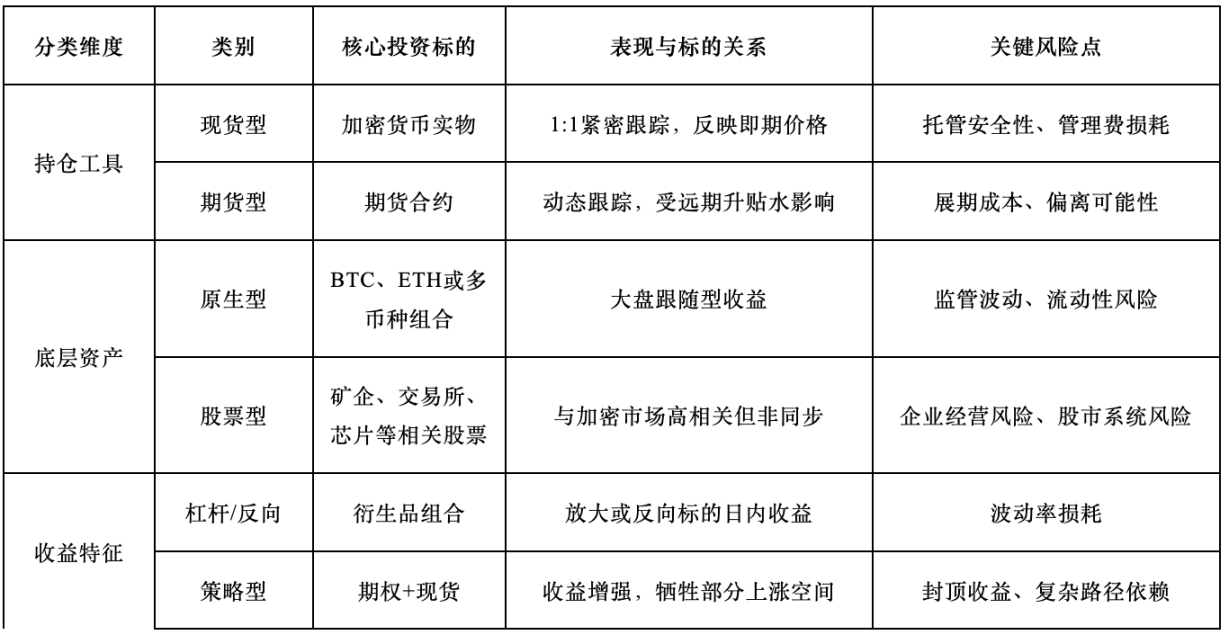
Table 1: Dimensions for Classifying ETF Products
3 From Rejection to Promotion: Japan’s Regulatory Shift on Crypto Assets
3.1 Dual Influence of Market Structure and International Competition
The FSA’s current positive signals toward spot crypto ETFs starkly contrast its earlier cautious and conservative stance—a near 180-degree reversal driven both by structural shifts in Japan’s domestic crypto market and international competitive pressures.
Domestically, Japan’s prior crypto regulation focused largely on payment functionality, covering exchange compliance, client asset management, and price volatility monitoring. Since 2025, Japan has initiated a series of policy and regulatory updates aimed at formally integrating crypto assets into the mainstream financial system. Legally, on December 10 last year, the FSA proposed transferring crypto asset regulation from the Payment Services Act (PSA) to the Financial Instruments and Exchange Act (FIEA), reclassifying crypto assets as financial instruments and aligning their legal status closer to securities. On taxation, Japan released its 2026 tax reform blueprint late last year, proposing to shift crypto asset income taxation from progressive rates up to 55% to a flat 20% separate tax regime. Collectively, these existing and prospective policy adjustments lay the institutional foundation for crypto asset financialization—creating ample space for spot crypto ETFs to take root.
Second, international competition and regulatory benchmarking have served as catalysts. Following the U.S. mainstream adoption of spot Bitcoin products, institutional allocation and the compliant service ecosystem rapidly matured. For Japan, this is not merely a matter of investor product choice—it implicates financial center competitiveness and capital market attractiveness. Prolonged absence from the compliant product landscape risks capital and service capability leakage abroad, while depriving domestic financial institutions of opportunities to accumulate experience within a regulatorily controlled environment.
Lastly, the FSA’s earlier position on spot crypto ETFs in its Discussion Paper did not amount to outright rejection, but rather emphasized their current infeasibility under the prevailing regulatory regime. Significant room remains for adjustment as market conditions and regulatory architecture evolve. Indeed, the Discussion Paper acknowledged crypto assets’ strong de facto investment attributes and stressed the necessity of developing matched regulatory tools. Accordingly, it proposed a two-tiered classification framework:
- Tier 1: Financing crypto assets—primarily tokens issued for project fundraising or utility purposes. Regulatory focus centers on issuer disclosure obligations, requiring clear articulation of fund usage and project progress;
- Tier 2: Non-financing crypto assets—such as BTC and ETH—which lack a single issuing entity. Regulatory emphasis shifts to fairness and integrity in trading venues.
3.2 Comparative Regulatory Pathways for Spot Crypto ETFs Abroad
Globally, the U.S., EU, and UK represent three distinct regulatory pathways for spot crypto ETFs: The U.S. integrated spot products into mainstream markets while strengthening rules, disclosures, and market surveillance; the EU prioritized framework-first harmonization to minimize regulatory arbitrage; and the UK long emphasized retail protection—first restricting high-risk product access, then cautiously recalibrating boundaries under stricter promotion standards and enhanced risk disclosures. Weighing these differing approaches, Japan may adopt a middle course balancing openness and constraint: introducing compliant products while reinforcing disclosure standards, suitability assessments, and anti-fraud requirements to elevate regulatory oversight and investor protection.
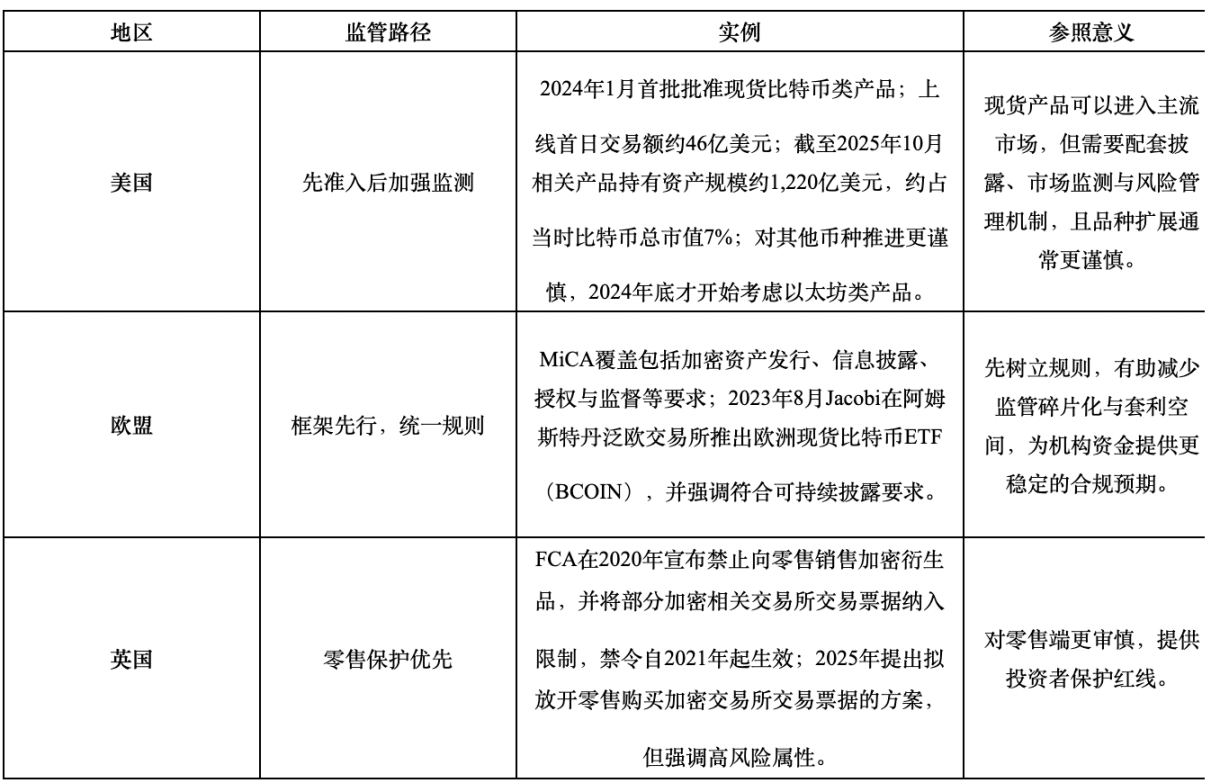
Table 2: Global Jurisdictional Comparison of Spot Crypto ETF Regulation
4 Impact Forecast of Spot Crypto ETF Implementation in Japan
4.1 Current State of the Japanese Market
Japan’s crypto market has expanded significantly in recent years. As of July 2025, domestic crypto trading accounts numbered approximately 13.2 million—fewer than securities accounts, yet still exhibiting growth potential. Holdings of crypto assets by Japanese investors peaked at roughly ¥5 trillion in July 2025, declining slightly to ¥4.9 trillion by September amid market volatility, but maintaining an overall upward trajectory. This reflects rising investor appetite for risk assets amid persistent mismatches between inflation and income growth. Concurrently, consultation and complaint volumes have risen. FSA data shows 1,304 crypto-related consultations and complaints in Q4 2024—exceeding prior quarterly levels. Regulators thus face dual pressure: providing legitimate participation channels while continuously safeguarding investor interests and financial stability.
4.2 Impact Forecast: Domestic Market and Investors
Should spot crypto ETFs gain approval in Japan, the most immediate impact would be a migration of crypto investment inflows. Under this scenario, some funds previously transacted directly on exchanges may shift toward products accessible via securities accounts—potentially pressuring domestic exchanges with reduced retail trading volume and diminished asset retention.
For traditional financial institutions, the potential launch of spot crypto ETFs represents both a business innovation opportunity and a stress test for compliance and reputational risk. Given crypto assets’ pronounced price volatility, any rapid market correction post-launch would trigger intense scrutiny over adequacy of risk disclosures, sales process compliance, and alignment between product features and client risk tolerance. Given the FSA’s sustained focus on fraudulent solicitation and operational security in regulatory discussions, internal control capabilities will become a critical threshold for institutions seeking to advance such products under any future准入 framework.
For investors, global asset managers, family offices, and hedge funds seeking Asian allocation opportunities will closely monitor Japan’s spot crypto ETF developments. Should Japan permit spot crypto ETF listings, it would effectively add a new, regulatorily accepted gateway within a mature capital market—facilitating optimized asset allocation: products could be traded via securities accounts, periodic reporting and disclosures would adhere to standardized norms, custody would be entrusted to regulated entities, and internal compliance approvals would proceed more smoothly.
Join TechFlow official community to stay tuned
Telegram:https://t.me/TechFlowDaily
X (Twitter):https://x.com/TechFlowPost
X (Twitter) EN:https://x.com/BlockFlow_News
 TaxDAO






