








10x Research: Post-ETF Era, Where Will ETH Price Go?
TechFlow Selected TechFlow Selected
10x Research: Post-ETF Era, Where Will ETH Price Go?
"We tend to go long on BTC and short ETH."
 Navigating Web3 tides with focused insights
Author: 10x Research
Translation: Azuma, Odaily Planet Daily
Editor's Note: In the early hours of July 23, Beijing time, the U.S. Securities and Exchange Commission (SEC) officially approved spot Ethereum ETFs, allowing multiple funds to begin trading on Tuesday. However, perhaps because the market had already priced in the approval, ETH’s price showed no significant movement following the SEC announcement. At the time of writing, ETH was trading at 3,442.62 USDT, down 1.3% over the past 24 hours.
Currently, one of the market’s primary concerns is undoubtedly the future trajectory of ETH’s price—especially whether inflows from the newly launched ETFs will provide a boost once trading begins tomorrow. Could we see a classic “sell the news” scenario unfold? To address these questions, the market-obsessed research firm 10x Research has released another analysis on ETH’s near-term outlook.
Below is the full translation of 10x Research’s original analysis, brought to you by Odaily Planet Daily.
Let’s first review the approval journey of the spot Ethereum ETF.
On May 20, the SEC unexpectedly requested exchanges to update their Form 19b-4 filings, marking substantial progress in the Ethereum ETF application process. The market responded by raising the probability of approval from 25% to 75%.
On May 23, the SEC formally approved the Form 19b-4 for spot Ethereum ETFs, resolving the biggest hurdle ahead of launch.
In the seven days that followed, Ethereum futures open interest surged from $8.8 billion to $13 billion, and ETH’s price jumped from $3,065 to a short-term high of $3,959.
This morning, the SEC completed final approval for spot Ethereum ETFs, authorizing them to begin trading tomorrow. We’ve seen similar milestone events before—the launch of Bitcoin futures in December 2017, Coinbase’s IPO in April 2021, the debut of Bitcoin futures ETFs in October 2021, and the January 2024 launch of spot Bitcoin ETFs—and each was followed by a short-term correction.
Now, traders are constantly asking us whether ETH will follow a similar path…
Although ETH briefly reached $3,959 at the end of May, it also fell below $3,000 in early July. This alone suggests traders lack confidence in sustained upward momentum. Even though ETH has recovered to around $3,500 ahead of the ETF launch, we suspect many will take profits immediately after—or even before—the launch.
Furthermore, marketing efforts surrounding spot Ethereum ETFs have been relatively muted, which could directly dampen retail and institutional interest. BlackRock CEO Larry Fink recently made televised appearances, but he only promoted Bitcoin—not Ethereum. This signals that, at least initially, BlackRock’s client base may show limited appetite for ETH.
At the time of the spot Bitcoin ETF launch, annualized funding rates in the futures market approached 15%, peaking at 70% in February—drawing significant arbitrage flows. Traders bought ETF shares while hedging with futures, capturing risk-free returns. This buying activity reinforced bullish sentiment around BTC.
Currently, annualized Ethereum futures funding rates stand at just 7–9%. This offers little appeal to arbitrageurs, especially considering a capital cost floor of at least 5% (the federal funds rate). Compared to Bitcoin ETFs in February, spot Ethereum ETFs are unlikely to attract substantial arbitrage inflows, weakening overall optimism toward ETH.
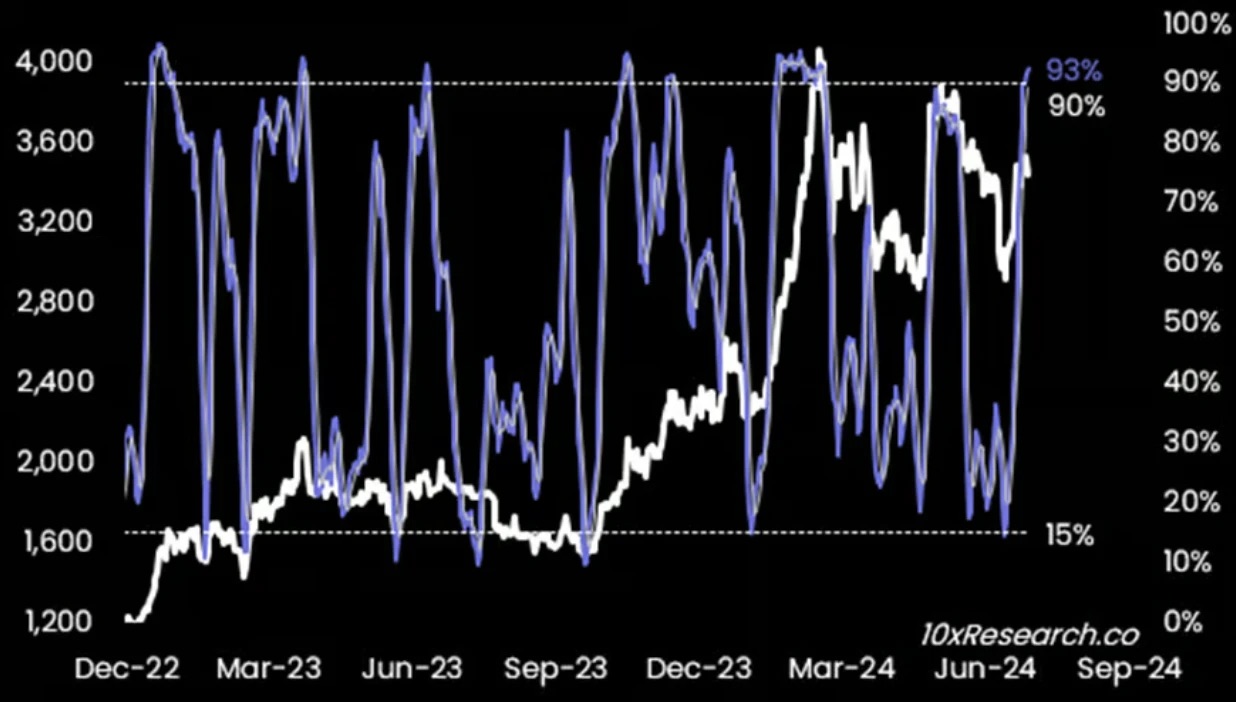
Note: Ethereum Stochastics indicator (above 90% indicates overbought conditions).
From a technical perspective, ETH’s Stochastics indicator is nearing overbought territory, suggesting a favorable opportunity to short. We would place a stop-loss at the recent high of 3,560.
Alternatively, we prefer pairing long BTC positions with short ETH hedges rather than outright shorting ETH. Traders could also consider selling Ethereum put options while buying Bitcoin call options. However, options remain expensive—implied volatility for contracts expiring September 27 stands at 65%, while 30-day realized volatility is only 50%, indicating a significant implied volatility premium.
In terms of market chatter, Solana has clearly drawn more attention than Ethereum this cycle. The Solana ecosystem has become a hotspot for meme tokens, while Ethereum missed out due to high gas fees. Numerous metrics support Solana’s greater热度—Solana currently has 14.2 million active addresses, compared to Ethereum’s 7.5 million…
Ethereum’s market dominance peaked at 18.4% just a month ago but has since dropped to 17.0%. Lack of market interest is also evident in persistently low gas prices. Although the Dencun upgrade in March 2024 significantly reduced network fees, transaction volumes have stagnated, and active address counts remain similar to levels seen three years ago—indicating minimal growth in the Ethereum network.
In a zero-interest trade finance environment, Ethereum’s staking yield advantage was a key driver behind the DeFi Summer of 2020–2021. Today, however, Ethereum’s staking yield has fallen to just 3.12%, with Coinbase offering only 2.91%. While ETFs do not currently include staking, the opportunity cost remains a critical factor behind weak ETH demand this cycle.
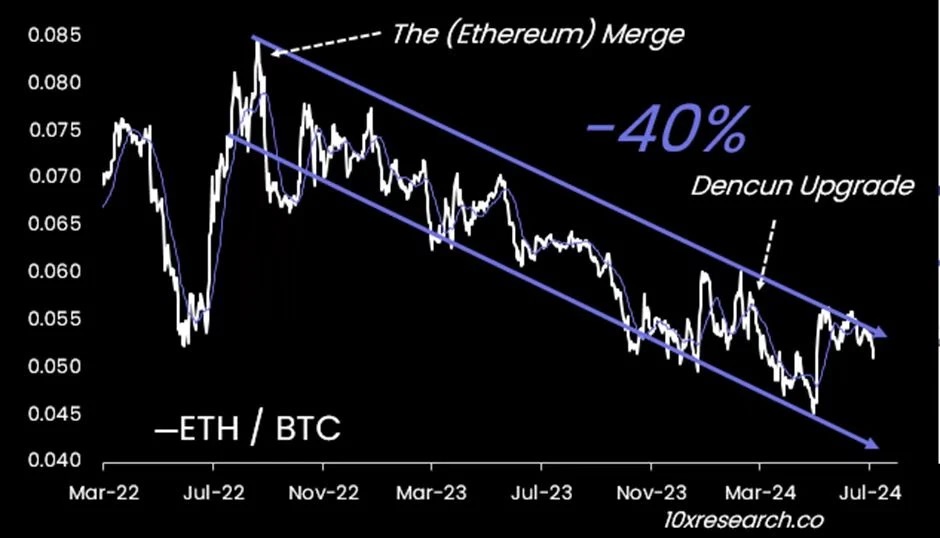
Compared to BTC, ETH’s beta (price sensitivity to market moves) is also weakening. Since the start of this bull run, ETH has underperformed consistently. Measured from October 2022, ETH has lagged BTC by 40%.
Considering all these factors—limited marketing by ETF issuers, traders likely closing long positions upon news confirmation, and potential outflows from Grayscale’s trust—there are solid grounds for bearish sentiment on ETH, at least in the near term.
Join TechFlow official community to stay tuned
Telegram:https://t.me/TechFlowDaily
X (Twitter):https://x.com/TechFlowPost
X (Twitter) EN:https://x.com/BlockFlow_News






