JD.com, Yuan Coin, and Zha打入局, Who Will Emerge as the Winner in Hong Kong's Stablecoin Sandbox?
TechFlow Selected TechFlow Selected
JD.com, Yuan Coin, and Zha打入局, Who Will Emerge as the Winner in Hong Kong's Stablecoin Sandbox?
The Financial Services and the Treasury Bureau and the Monetary Authority are fully advancing the drafting of legislation, with the aim of submitting the bill to the Legislative Council for deliberation before the end of the year.
 Navigating Web3 tides with focused insights
By Bo Wen, White Dew Salon
On July 18, 2024, the Hong Kong Monetary Authority (HKMA) released the list of participants in its stablecoin sandbox. JD.com, OSL Group (Yuanbi), and Standard Chartered have become official participants. These three institutions will now collaborate with regulators to test their operational plans and engage in two-way communication regarding proposed regulatory requirements, aiming to establish a purpose-driven and risk-based regulatory regime. It was also emphasized that during the initial phase, the "sandbox" trials will not involve public funds, nor will they raise capital from or offer any related products to the public under the name of the sandbox.
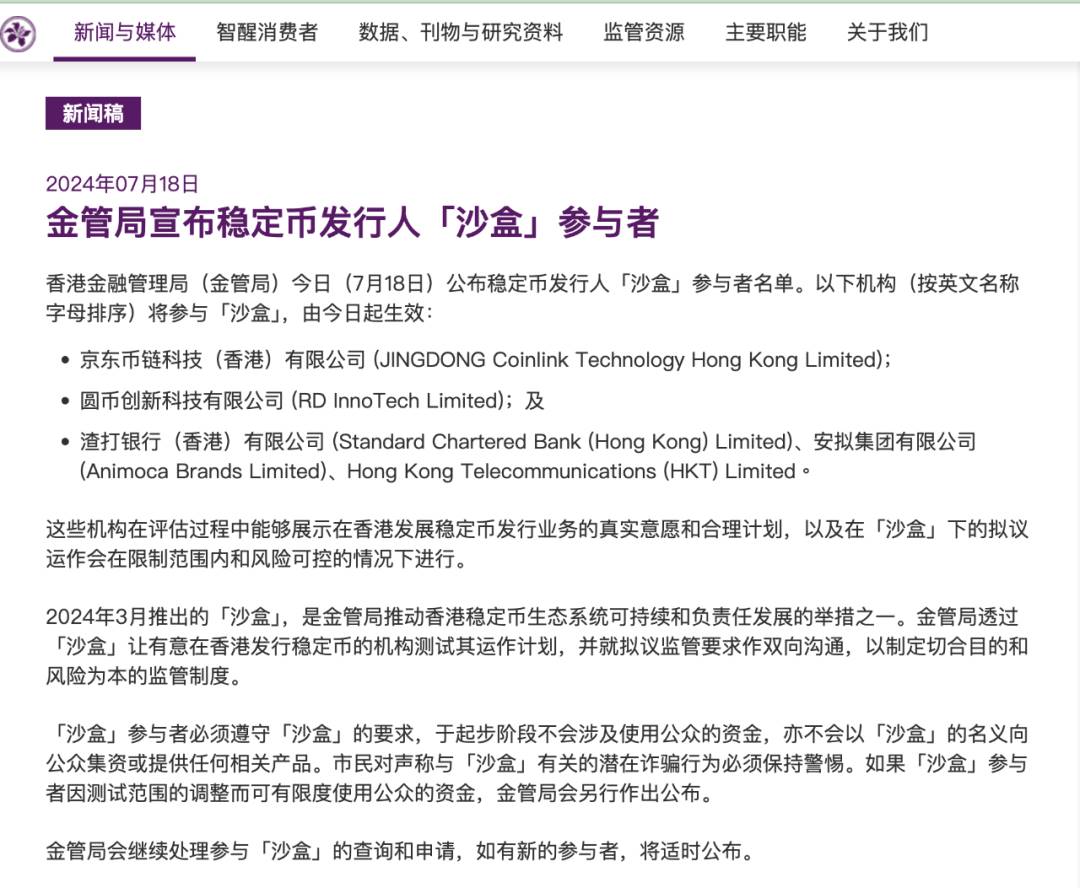
The Financial Services and the Treasury Bureau and the HKMA stated that on July 17, both parties issued a consultation conclusion on legislative proposals for regulating stablecoin issuers in Hong Kong, and are now fully advancing the drafting of relevant legislation, with hopes to submit the bill to the Legislative Council for review before year-end.
Requirements for Entering the Sandbox
The HKMA stated that the purpose of establishing the sandbox is to test the business processes of stablecoin issuers and evaluate how they can operate compliantly and sustainably within Hong Kong’s stablecoin sector. Therefore, applicants must present detailed and feasible business and sandbox plans.
A key requirement is that applicants must propose specific use cases and clearly explain how their stablecoin operations can practically address pain points in economic activities, bringing tangible benefits and new opportunities to Hong Kong's economy and financial ecosystem. At the same time, applicants must demonstrate how their business networks, supply chains, or major partners will drive long-term demand for the stablecoin, achieving sustainable growth. In addition, applicants must specifically outline how they intend to use the sandbox to demonstrate robust and compliant processes for issuing, distributing, and redeeming stablecoins, explaining how their operations meet regulatory expectations—including reserve management and custody, as well as controls over credit, liquidity, technology, operational risks, anti-money laundering (AML), and other areas.
Given the practical needs for effective sandbox operation, entry criteria are stringent, and only applicants who fully satisfy the above conditions will be admitted. Prior to the completion of legislation and the enactment of new laws, the HKMA will continue accepting inquiries and applications for the sandbox.
Whether individual entities—including existing stablecoin issuers—choose to apply depends on multiple factors, such as their business plans post-regulation implementation and whether there is a need at this stage to test stablecoin issuance processes within a limited scope. It should be emphasized that participation in the sandbox is not a prerequisite for future applications for a stablecoin issuer license. Even institutions already in the sandbox will still need to submit formal applications separately once the regulatory framework is established.
Stablecoin Use Cases
The HKMA noted that advancing digital finance involves adopting emerging technologies to overcome limitations inherent in traditional financial models, better serving businesses and individuals in economic activities by improving efficiency, reducing costs, and enhancing user experience.
The three initial sandbox participants have proposed primary use cases including payments, supply chain management, and capital markets applications. Currently, fund transfers in these areas often involve financial institutions, payment service providers, and settlement systems across different time zones. These intermediaries or financial infrastructures do not operate 24/7, and are associated with high fees and inefficiencies.
Stablecoins can serve as transaction mediums to reduce costs and transaction times, while leveraging their programmability to enable various innovative solutions, automating and intelligentizing financial services. Beyond facilitating smoother capital flows, they allow more precise management of transaction-related risks. In addition to the above applications, sandbox participants have also suggested other use cases such as Web3, gaming, and virtual asset trading.
Risk Management and Compliance Measures
All sandbox operations and testing will take place within restricted scopes and controlled-risk environments. Participating institutions will test stablecoin issuance workflows across different scenarios, placing particular emphasis on operational and technological risks.
Throughout the process, regulators will observe how participants adhere to proposed regulatory standards, such as ensuring reserves consist of high-quality, highly liquid assets; whether stablecoin redemptions are smooth and completed within reasonable timeframes; the robustness of wallet and private key management; and the implementation of measures protecting stablecoin holders and complying with AML requirements. In addition to meeting sandbox criteria and local laws, if use cases involve cross-border payments, participating institutions must ensure both themselves and overseas partners strictly comply with applicable laws and regulations in respective jurisdictions throughout testing. Depending on participant proposals, progress, and risk levels, the HKMA may adjust the design scenarios and application scope of sandbox testing accordingly.
Since the launch of the stablecoin issuer sandbox announcement in March, the HKMA has received dozens of inquiries from institutions. Which among JD.com, OSL Group, and Standard Chartered has the most promising proposal? Will more institutions join? Many uncertainties remain.
JD Blockchain Technology
JD Blockchain Technology Co., Ltd. was officially registered in March 2024, focusing on digital currency payment systems and blockchain infrastructure development.
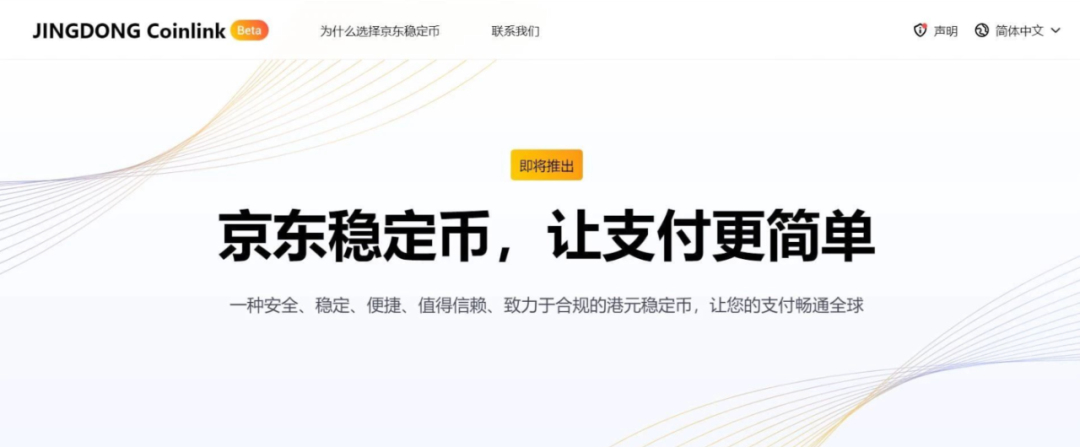
According to LinkedIn, CEO Liu Peng currently serves as Vice President of JD Technology, with extensive experience in fintech, having previously worked at Tencent, Huawei, Ant Group, and JD.com. JD Blockchain Technology has already obtained Type 1 (Securities Trading), Type 4 (Advising on Securities), and Type 9 (Asset Management) licenses from the Securities and Futures Commission (SFC) of Hong Kong.
OSL Group (Yuanbi)
OSL Group specializes in DeFi, digital payments, and fintech, developing and operating various decentralized finance applications offering users services such as decentralized exchanges, lending, and yield farming. The company currently operates two core businesses: the “O Wallet” supporting digital fiat payments and a “Hong Kong Dollar Stablecoin.”
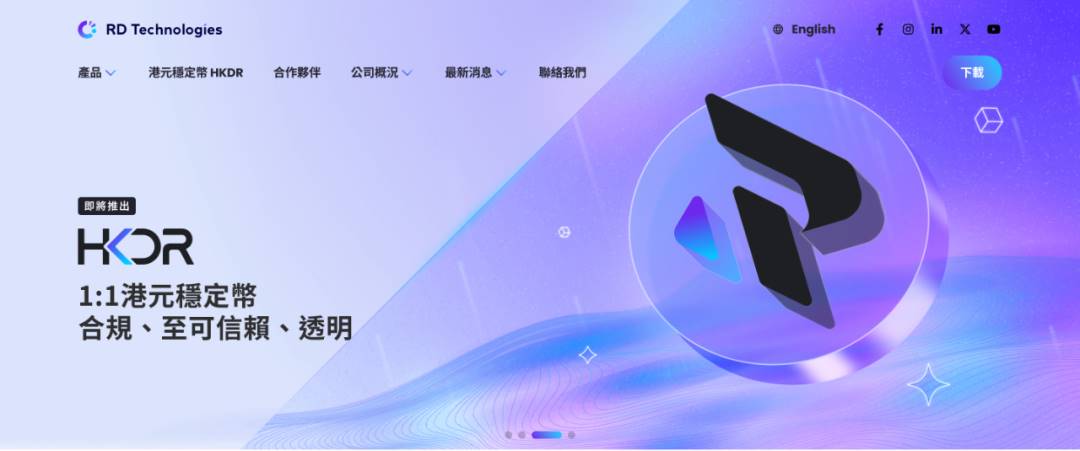
The team combines traditional financial expertise with mainland Chinese connections. Founded by former HKMA Chief Executive Norman Chan, who also serves as Chairman of the Board, the board includes six other members: Ou Yaping (Chairman of ZhongAn Online), Xu Wei (CEO of ZhongAn International), Xiao Feng (Chairman of HashKey Group), Feng Bo (Managing Partner of Dragonfly Capital), Zheng Tuo (Non-Executive Director of Bocci Environmental Protection), and Yu Fan Yun.
Commenting on being selected for the stablecoin sandbox, OSL Group CEO Rita Liu said: “The real-world implementation of a Hong Kong dollar stablecoin requires time for mutual understanding between regulators and the market. We need more dialogue with regulators. Blockchain itself offers many advantages—its transparency and traceability are particularly helpful in combating crime and money laundering, which is exactly what regulators value.”
“There's a shared belief among industry players that within five years, the market could reach $3 trillion. Stablecoins can bring significant volumes from traditional financial markets into Web3. If OSL Group can successfully bridge Web2 and Web3, it will unlock enormous market potential.”
Standard Chartered Bank
Standard Chartered Bank (Hong Kong) Limited, Animoca Brands Limited, and HKT have jointly launched strategic initiatives in the virtual asset and stablecoin sectors.
Standard Chartered Bank (Hong Kong) is setting up spot trading desks for Bitcoin and Ethereum, making it one of the first global banks to enter direct cryptocurrency trading. Additionally, through its subsidiary Zodia Custody, the bank has launched crypto custody services in Hong Kong, primarily targeting institutional investors. In blockchain applications, Standard Chartered (Hong Kong) successfully completed its first pilot transaction across blockchain platforms, linking Hong Kong’s eTradeConnect with the People's Bank of China’s Trade Finance Platform (PBCTFP).
Animoca Brands Limited, headquartered in Hong Kong, focuses on blockchain gaming and digital entertainment. The company reported booking revenue of $90 million in the quarter, up 72% from $52 million in the same period of 2023. Of this, $65 million came from digital asset advisory services, including token consulting, trading, and blockchain node operations.
HKT Limited is one of Hong Kong’s largest integrated telecommunications service providers, founded in 1925.
Regarding this collaboration, Animoca Brands stated: “HKT will actively explore, via the sandbox, how innovations in stablecoins can support local and cross-border payments, delivering greater benefits to consumers and merchants; Standard Chartered Bank (Hong Kong) will actively participate in the stablecoin issuer sandbox to examine the most effective ways to support the thriving development of Hong Kong’s digital asset ecosystem, gaining deeper insights into the evolution of the stablecoin market and the opportunities and risks it presents; Animoca Brands remains committed to promoting widespread adoption of digital assets and applying blockchain technologies to real-world assets and traditional economies.”
Unlike central bank digital currencies such as the digital Hong Kong dollar, stablecoins are designed for use by financial institutions globally and represent an important tool for private-sector financial activity. By prioritizing stablecoin issuance and gradually building a comprehensive regulatory framework, Hong Kong is taking a crucial step toward establishing financial infrastructure centered on virtual assets. However, Hong Kong’s current regulatory environment is extremely strict and costly, posing significant challenges for institutions seeking practical implementation. Whether this stablecoin sandbox can effectively balance regulatory safeguards with institutional friendliness to drive market advancement will be another critical point to watch.
Join TechFlow official community to stay tuned
Telegram:https://t.me/TechFlowDaily
X (Twitter):https://x.com/TechFlowPost
X (Twitter) EN:https://x.com/BlockFlow_News