Base’s Growth Dilemma: Everything Is Done Right—Yet Users Still Leave
TechFlow Selected TechFlow Selected
Base’s Growth Dilemma: Everything Is Done Right—Yet Users Still Leave
Even with a potential user base of 100 million, if there’s nothing compelling enough to retain users, the platform will ultimately be left deserted.
 Navigating Web3 tides with focused insights
By: Thejaswini M A
Translated by: Chopper, Foresight News
A few days ago, I read about a concept in Japanese philosophy: basho. Roughly translated as “place” or “locus,” the philosopher Kitarō Nishida imbued it with far more than mere geographical location—it signifies a context, a field wherein things come into being as themselves. In other words: people do not merely happen to appear somewhere; they are shaped by the place they inhabit. Today, I’ll use this framework to interpret Base.
Last month, its number of active addresses fell to an 18-month low. Reflecting on this phenomenon, I realized: Base built only a *location*, never cultivating the conditions for things to grow and take shape.
When Coinbase launched Base in 2023, the crypto-native community experienced something rare: faith. Many believed it would finally solve Ethereum’s oldest problem—infrastructure everywhere, yet no real users. With 100 million users and unparalleled distribution power, Coinbase held a unique advantage. The door opened—and users were already waiting outside.
For a while, that confidence appeared justified. Base grew faster than any previous Layer 2. In October 2025, its total value locked (TVL) reached $5.6 billion, and its fee revenue surpassed all other L2s. Then, in September 2025, Base confirmed its token launch—seemingly heralding an experiment destined for success. Yes, a *place* was becoming a basho.
Then, the users left.
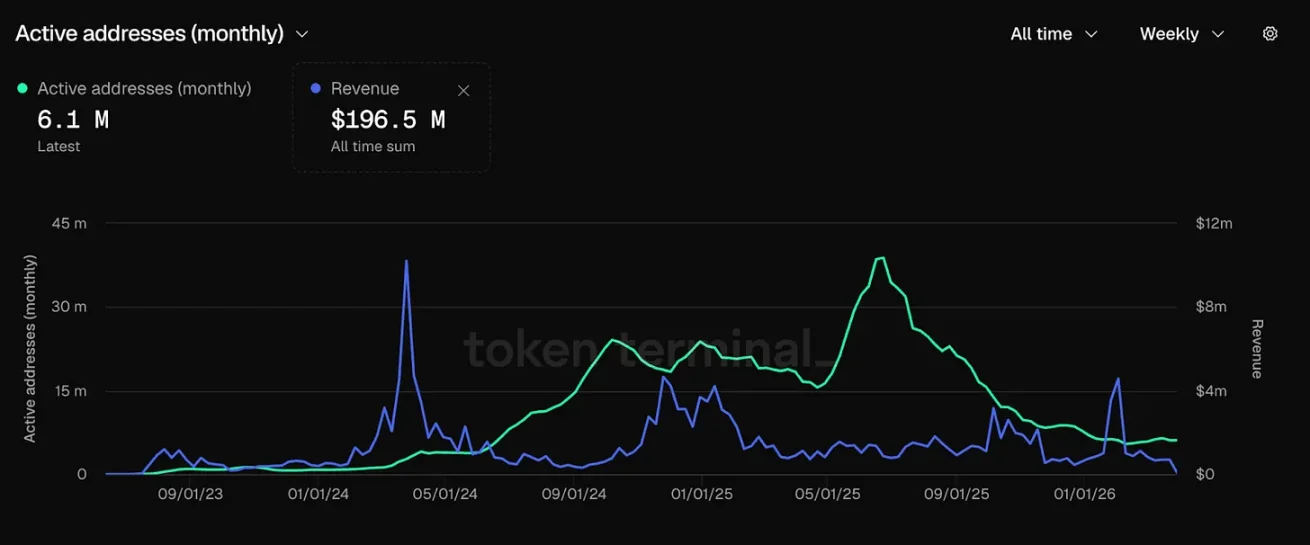
The data makes it starkly clear: Base’s active addresses have regressed to levels last seen in July 2024. The token launch expectation perfectly satisfied the “airdrop hunters”: collect the final payout—and exit.
Base’s 2025 bet on the creator economy also failed. Its core is the Zora protocol, which defaults to tokenizing content. By year-end, 6.52 million creator and content tokens had been minted on Base via Zora—but only 17,800 remained consistently active throughout the year, just 0.3%. The remaining 99.7% were abandoned.
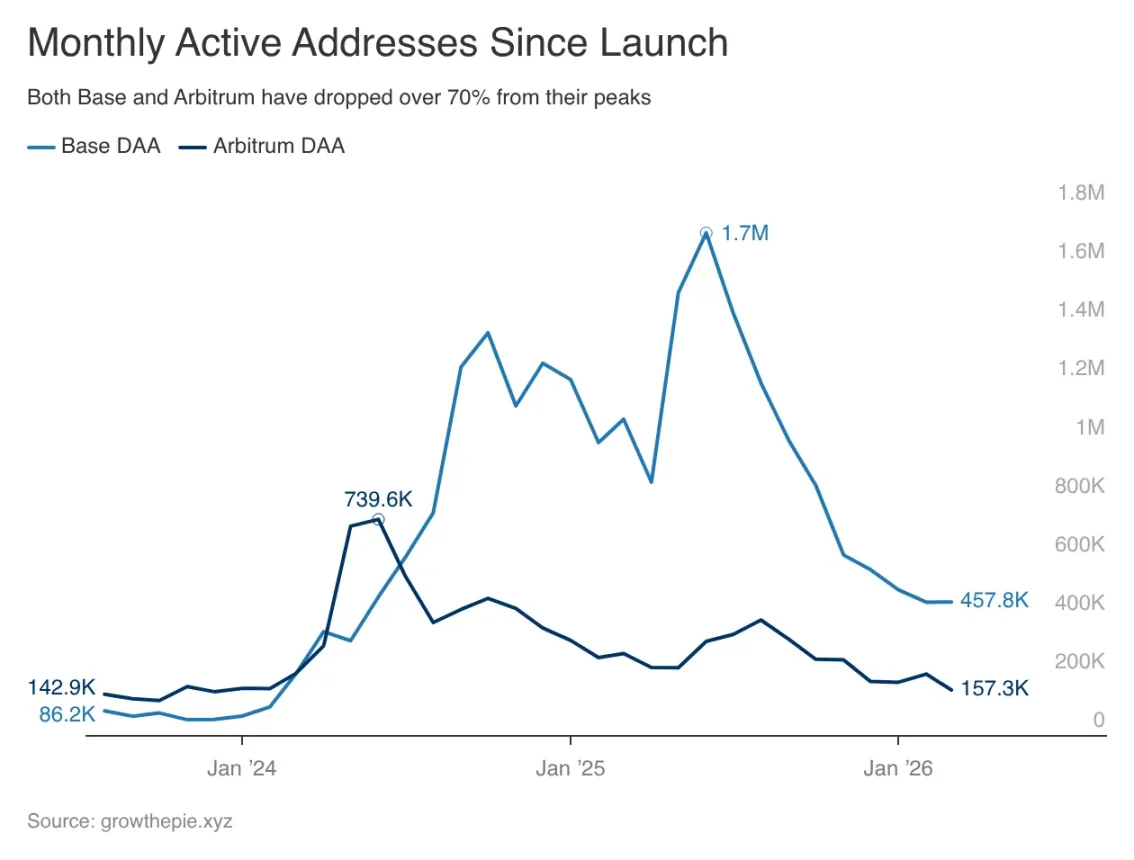
Base’s daily active addresses peaked at 1.72 million in June 2025. By March 2026, they had plummeted to just 458,000—a 73% drop from the high. Within six months of Brian Armstrong’s September 2025 announcement that Base was considering a token launch, active addresses fell by 54%, signaling a full exodus of speculative capital.
Sociologist Ray Oldenburg studied what draws people back to a place repeatedly—even without compensation. He called them “third places”: bars, barbershops, city squares. They are not efficient production spaces, yet they offer reasons to return that lie beyond incentives. Crucially: the desire to return cannot be engineered—it must emerge organically from possibilities sustained over time by the place itself. The crypto industry designs places to extract from users—and then wonders why no one stays.
This is a *location without a basho*: people pass through, take what they need, and leave—because leaving costs nothing. No identity forms here. No capability develops that can’t be replicated elsewhere within three weeks. Nothing makes departure feel like loss. Does this chain host uniquely irreplaceable relationships? We’ve never built anything with that question in mind, have we?
You cannot build a basho with financial incentives. Incentives may draw people in—but they won’t make them want to stay. The longing to remain must arise from possibilities nurtured over time by the place itself. Nishida called this “the logic of place”—how relational fields shape the phenomena that emerge within them. Crypto designed places for extraction—and unsurprisingly, only extraction emerged.
Brian Armstrong has publicly stated that the Base App is now focused on becoming Coinbase’s self-custodial, on-chain trading interface.
That original vision—social stickiness, on-chain identities worth protecting, a social and creator-first platform—has vanished. Data-wise, it’s a rational decision. But it also admits: that vision never truly took root. Base has a location—and now focuses solely on serving its existing users, because that’s all it can offer.
One Chain, One Narrative
Base is the most visible microcosm of the entire L2 paradigm.
Since June 2025, usage across mid- and small-sized L2s has collectively declined by 61%. Most chains outside the top three have become “zombie chains”: active enough to avoid shutdown, yet too cold to matter. The ratio of L2 daily active addresses to L1 has dropped from 15× in mid-2024 to just 10–11× today. Most new L2s collapse immediately after their incentive cycles end. The entire L2 ecosystem is cooling—not just Base.
The rollup-centric roadmap was once a theory of user adoption: lower participation cost → user influx → ecosystem formation → compounding growth. This year, the Ethereum Foundation released a 38-page vision document outlining Ethereum’s future. Yet the largest L2 has hit bottom in activity—and abandoned the OP Stack; the second-largest L2 has stalled in growth.
Lowering entry barriers does not equate to creating conditions for things to coalesce. The industry solved the “getting in” problem—and then assumed “belonging” would follow automatically. It doesn’t. Belonging isn’t a feature you ship.
Farcaster is the closest thing crypto has produced to a genuine basho. A specific group of people cultivated a distinct culture there: developers share work, debate Ethereum, form impressions of each other over months. That takes time—and competitors can’t replicate it with higher rewards. Friend.tech tried the same with incentives: topped charts in one week, vanished in one month. Same mechanics—no culture. The difference lies not in product design, but in whether people stayed long enough for something real to crystallize.
What Keeps People Around?
Chains retaining users through bear markets don’t do so with richer incentives.
Arbitrum’s daily active addresses peaked at 740,000 in June 2024—and now stand at 157,000, down 79%. Both chains are declining—but their underlying logics differ entirely.
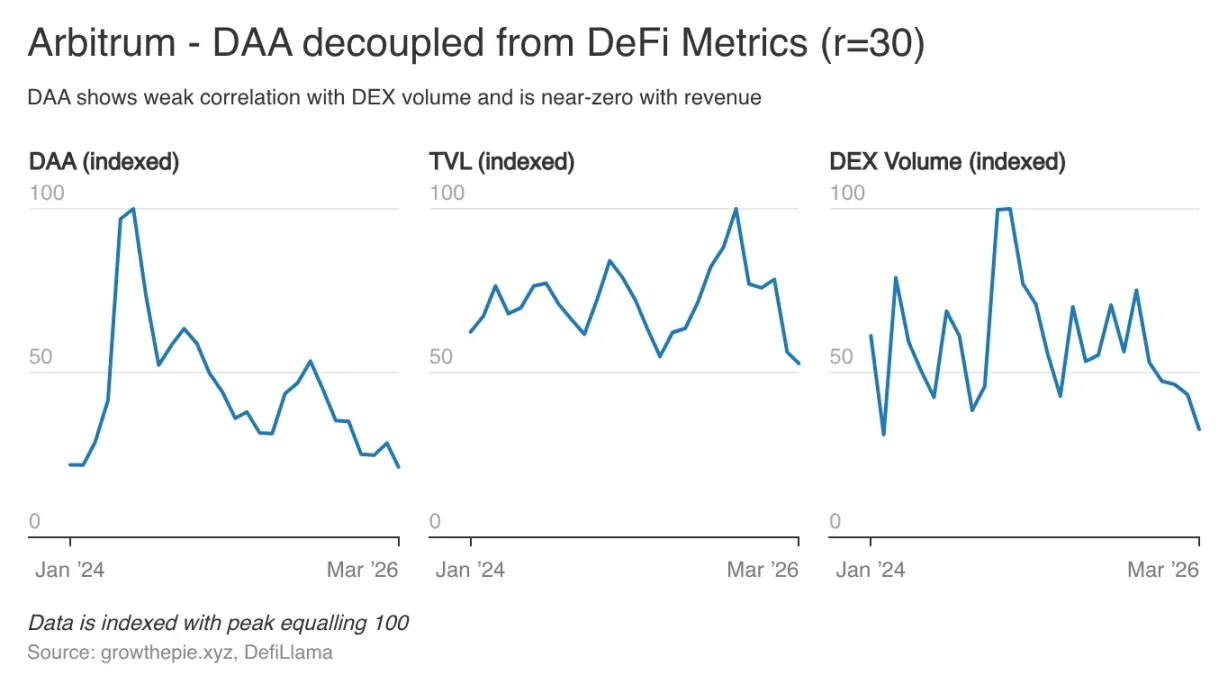
Base users came for trading—and left when volume dropped. Arbitrum users, however, are largely indifferent to fee levels: correlation between user count and fee revenue is nearly zero. Base attracts tourists; Arbitrum—somehow—keeps users.
Hyperliquid endures because its trading experience is unique, and its community forged an identity found nowhere else. Token incentives are almost irrelevant—being *in* it has become part of users’ behavior and identity. Things shape users; users, in turn, shape things.
The crypto industry remains obsessed with optimizing “how to get people here”—while “how to cultivate a context” is only remembered *after* metrics crash, never considered at the outset of chain design.
I believe Base possessed the strongest distribution capacity in history—and could have tackled this problem better than any chain.
Today, it’s a trading app. A reasonable product direction—yet one already delivered by over 40 others. Trading apps cannot generate a basho; they generate only transactions: users enter when they need to trade, and exit once done.
To become a truly successful application requires building *ongoing connection*. Users must develop relationships *between* visits—so the next visit feels like returning home, not simply arriving.
Armstrong’s pivot reflects lessons learned from Base’s own data. Social layers, creator economies, on-chain identities—these were meant to shift Base from “used” to “inhabited.” But they demand patience—and systems don’t reward patience.
The Ethereum ecosystem needs Base to be more than a trading venue. The foundational premise of the entire L2 narrative is that chains can become infrastructure around which people build lives. If the L2 with the strongest distribution capability in crypto history settles for being merely a faster Coinbase, that narrative collapses entirely.
Nishida argued that the deepest basho is where the boundary between self and place begins to dissolve. You cannot fully separate “who you are” from “where you are shaped.” This sounds abstract—but applied to a public chain, it means: a user cannot imagine their financial life outside that chain; a developer’s entire toolset is built upon that ecosystem; their identity barely exists elsewhere.
To my knowledge, nothing like this has ever been built on any L2. It may be fundamentally impossible to build under incentive schemes.
Even with 100 million potential users, if there’s nothing worth staying for—you’ll still end up with empty rooms. Base understands that now.
Join TechFlow official community to stay tuned
Telegram:https://t.me/TechFlowDaily
X (Twitter):https://x.com/TechFlowPost
X (Twitter) EN:https://x.com/BlockFlow_News