The Moatless Dilemma: Why Optimism Can’t Retain Base
TechFlow Selected TechFlow Selected
The Moatless Dilemma: Why Optimism Can’t Retain Base
Optimism has won the standards battle, but the victory did not bring a way to secure its gains.
 Navigating Web3 tides with focused insights
By: Thejaswini M A
Translated by: Luffy, Foresight News
The Optimism story could have had a triumphant ending.
In that version, the OP Stack becomes Ethereum’s default scaling infrastructure; dozens of well-funded chains join the Superchain; revenue flows back to the Collective; interoperability features launch smoothly; and the entire ecosystem compounds continuously—appearing, from afar, like an entirely new kind of internet: owned by no one, governed and sustained by all.
That version isn’t pure fantasy. For a time, it genuinely looked like it was about to happen. The problem is this: everything Optimism did to make that vision possible also made it impossible to protect.
The OP Stack was released under the MIT open-source license. This decision matters more than almost any other Optimism has made—and its implications must be stated clearly: MIT is currently the most permissive general-purpose open-source license. Anyone can take the code, build upon it, modify it, commercialize it, or even fork it wholesale—no royalties, no revenue-sharing obligations, no conditions whatsoever—not even a “thank you” required.
Optimism chose this deliberately. The logic is simple: if you want to become the default framework, you must eliminate every reason not to adopt it. Reduce the cost of adoption to zero. Make the protocol frictionless. Enable any team, company, or exchange with development budget to launch an OP Stack chain instantly—permissionlessly, without signing any documents.
It worked. By mid-2025, the OP Stack processed 69.9% of all L2 transaction fees, and 34 chains were live on mainnet. Coinbase, Uniswap, Kraken, Sony, and Worldcoin all use it. When people talk about Ethereum scaling, they usually mean something built atop Optimism’s codebase.
Optimism won the standards war.
Then the largest chain it helped build announced it no longer needed the relationship.
On February 18, 2026, Coinbase published a blog post with carefully worded, friendly phrasing—the kind of tone companies use when announcing major news without wanting to sound jarring. Base would unify its codebase, accelerate development cycles, and reduce coordination overhead. Gratitude was expressed; collaboration praised.
The market reacted instantly: OP token price plunged 28% within 48 hours; sell volume surged 157%. Within days, the token had fallen 89.8% from its year-ago level, trading at just $0.12 at time of writing—down from a March 2024 high of $4.85. OP Labs CEO Jing Wang wrote on X: “This is a short-term hit to on-chain revenue.”
To understand why, you must grasp what the Superchain is truly selling.
The OP Stack is free—and the protocol guarantees that permanence irrevocably. So why would any chain voluntarily share revenue with the Optimism Collective? Optimism’s answer is interoperability. By joining the Superchain, your chain stops being just another chain—it becomes part of a unified network where liquidity and users flow freely across all member chains, and building on one chain equals building across them all—delivering a 1+1>2 effect.
That is its value proposition: pay 2.5% of gross revenue—or 15% of net profit—in exchange for access to something no single chain could build alone.
But interoperability never launched.
Optimism had originally targeted native interoperability on mainnet for early 2025—but it never arrived. A long-standing governance representative stated: “Despite years of technical development, unfortunately, this has not been realized.”
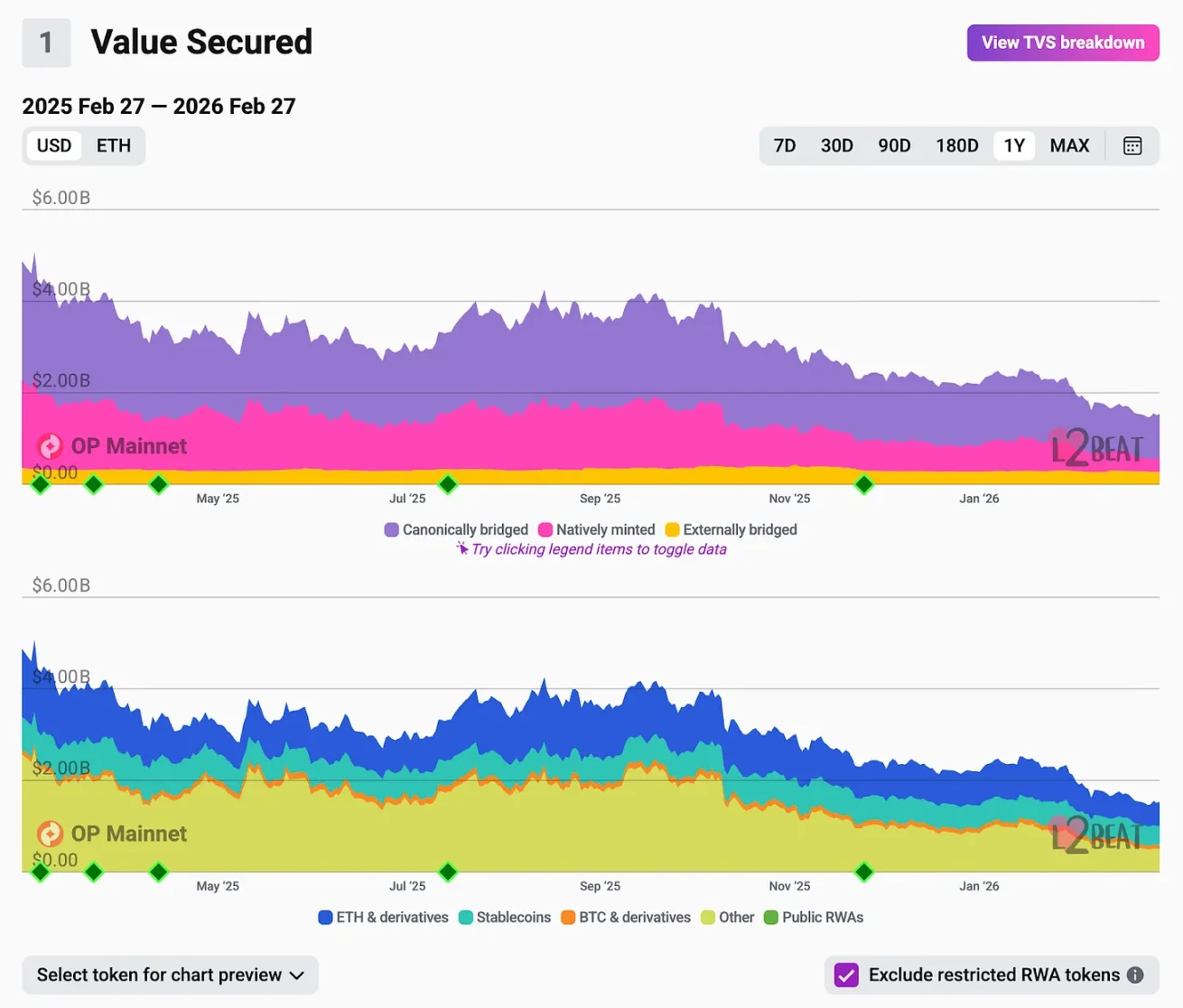
Members are paying their “tax,” yet the product that tax was meant to fund remains theoretical. What the Superchain actually delivers is only shared branding, shared governance costs, and a revenue obligation. And the thing that would make that obligation worthwhile remains perpetually “just around the corner.” Meanwhile, Base keeps growing.
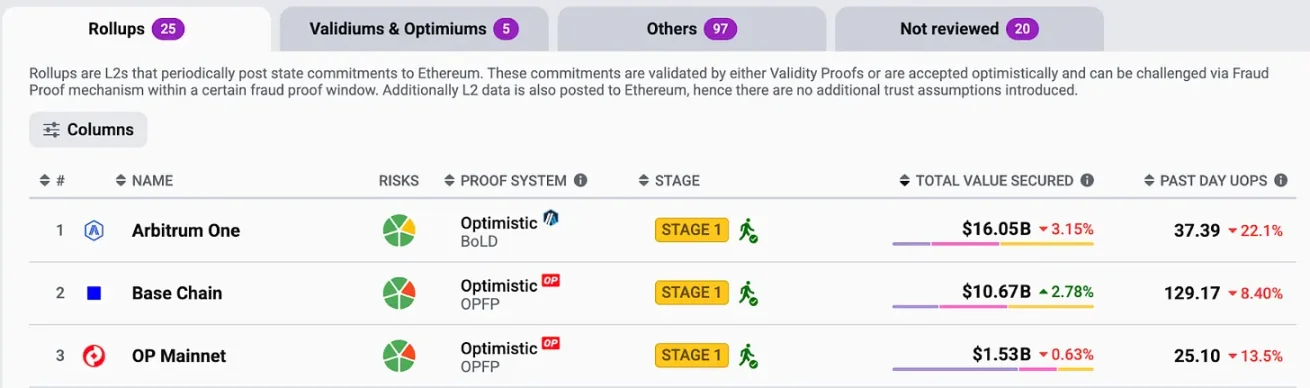
By January 2026, Base contributed 96.5% of all gas fees flowing into the Optimism Collective—nearly the entirety. Base’s transaction volume was roughly four times that of OP Mainnet; its DEX volume, ~144x; its gas fee generation, 80x. During the partnership period, the Collective received approximately 14,000 ETH in total—of which Base contributed 8,387 ETH, with its monthly revenue share steadily approaching 100%.
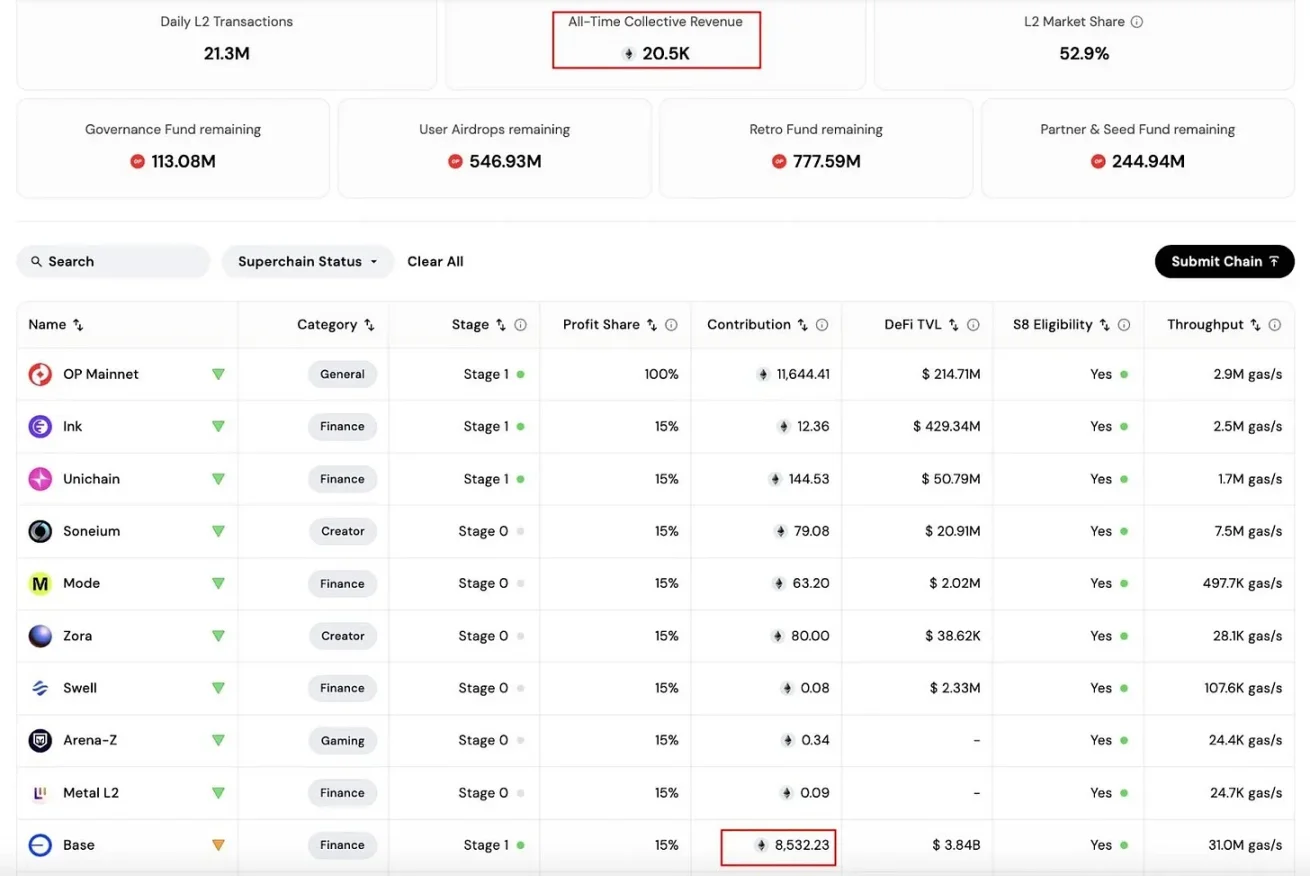
The other 33 Superchain members, while listed, are economically insignificant. In H1 2025, the second-most active member—World Chain—accounted for just 11.5% of Superchain compute volume; OP Mainnet itself, 11.4%; Ink, Soneium, and Unichain combined accounted for less than 13%.
Beyond name alone, the Superchain has effectively become a single-chain ecosystem. The alliance exists on paper—but economically, it is entirely Base.
In any alliance, once a certain scale is reached, the strongest participant inevitably asks the obvious question: What, exactly, am I getting out of this?
This same logic plays out in nearly every successful open-source story. MongoDB built a widely adopted database, open-sourced it—and watched helplessly as AWS built a profitable managed service atop it, paying nothing. AWS controlled distribution; MongoDB set the standard. Value flowed to the entity controlling users—not the one writing the code. MongoDB eventually changed its license; AWS forked its codebase into OpenSearch.
Elastic and Redis followed identical cycles. Details differ, but the structure is identical: infrastructure creators set the standard; distribution-powerhouse giants adopt it; those giants capture the value; and ultimately, they internalize the stack and depart.
Optimism is the crypto version of this story.
Arbitrum saw the pattern—and chose differently. Its Orbit chains, designed as counterparts to the Superchain, use the Business Source License, with revenue-sharing enforced via contractual obligation—not goodwill. When your largest partner can walk away without legal consequence, the alliance’s survival depends entirely on their willingness to stay. Arbitrum refused to build an ecosystem on that assumption.
Base’s official rationale for leaving is technical: unifying the codebase enables faster development—shifting upgrade cadence from three major releases per year to six; independent control over the security council means no external body can delay or block network decisions; reduced dependencies mean Base can keep pace with Ethereum’s own upgrade rhythm—without waiting for governance processes outside its control.
Coordinating across multiple codebases *is* slower than owning the full stack.
But there’s another reason, too obvious to spell out. Morgan Stanley estimates Base’s token could deliver ~$34 billion in equity value to Coinbase—and raised its target price to $404. As long as Base continues paying 15% of net profits to an external protocol’s Collective, designing a Base token with reliable value capture is structurally difficult. Leaving the Superchain isn’t a side effect—it’s a prerequisite. Both motives point in the same direction—and Base acted accordingly.
Optimism hasn’t been left with nothing—but it must honestly confront what has already changed.
OP Mainnet still holds $1.5 billion in TVL. On the very day Base announced its departure, ether.fi announced it would migrate its on-chain credit card product to OP Mainnet—bringing 70,000 active cards, 300,000 accounts, and over $160 million in TVL. Just weeks earlier, the Collective had approved a buyback program allocating 50% of sequencer revenue to monthly OP repurchases.
The ether.fi partnership gives OP Mainnet a clearer use case in consumer payments. But ether.fi’s annualized fee contribution is only ~$13 million—while Base’s profit alone reached $55 million in 2025. The revenue base underpinning the buyback program has evaporated. Token unlocks for investors and contributors continue at ~$32 million per month.
Transitioning to enterprise services may be the right move. OP Labs has raised over $175 million, boasts top-tier engineering talent, and there is genuine institutional demand for managed OP Stack deployments—organizations that want to launch a chain but lack in-house operational capacity. Jing Wang frames it as “Databricks for blockchain infrastructure”—a fitting analogy. It’s a services business—and it can work.
But a services business is fundamentally different from a network generating compounding protocol revenue through an alliance. OP’s token valuation was priced for the latter. The market grasped this within 12 hours of the blog post.
Zoom out. What happened on February 18 wasn’t just about Optimism.
For most of 2024, over 50 L2 networks competed for users and liquidity. By end-2025, Base, Arbitrum, and Optimism together handled nearly 90% of L2 transactions—with Base alone accounting for over 60%. Small rollups saw activity decline 61% since June. The Dencun upgrade slashed fees by 90%, compressing industry-wide margins. Base was the only L2 profitable in 2025.
The chains that survive—and will define this layer over the coming years—are not necessarily the most technically sophisticated. They’re the ones with structural reasons for user retention. Exchange-native chains (Base, Ink, Mantle) inherit distribution power from their parent companies’ existing user bases—every Coinbase user wanting to go onchain is just one click away from Base. DeFi-native chains like Arbitrum and Hyperliquid hold their ground thanks to liquidity depth that cannot easily be rebuilt elsewhere.
Technology can be forked. The OP Stack proves that better than anything. What cannot be forked is Coinbase’s relationship with its 100 million users—or the tens of billions in open positions on Arbitrum. That’s where durable value resides—and it has almost nothing to do with which license you choose for your codebase.
Optimism’s decision to release the OP Stack under a permissive open-source license was the right one. It delivered the broadest adoption of any L2 framework—making Optimism the infrastructure standard for an entire generation of Ethereum scaling. Without that decision, Base might have been built on alternative tech—or might never have existed at all.
But the very decision that made all this possible also made exit costless. When Base grew large enough—possessing its own users, its own token roadmap, and its own rationale for pursuing full infrastructure sovereignty—there was no contractual constraint in the protocol, and no interoperability promise strong enough to justify staying.
Optimism won the standards war. It just didn’t win the value-capture war. The $0.12 token price is the market’s final verdict on that value.
Join TechFlow official community to stay tuned
Telegram:https://t.me/TechFlowDaily
X (Twitter):https://x.com/TechFlowPost
X (Twitter) EN:https://x.com/BlockFlow_News