








Elon Musk Posts a Job Ad for SpaceX—After Reading the Comments, I Had an Epiphany
TechFlow Selected TechFlow Selected
Elon Musk Posts a Job Ad for SpaceX—After Reading the Comments, I Had an Epiphany
A thousand words on a resume are no match for a single product.
 Navigating Web3 tides with focused insights
Author: Kuli, TechFlow
On May 20, after U.S. market close (Eastern Time), SpaceX filed its prospectus with the SEC, valuing the company at $1.75 trillion, with plans to list on the Nasdaq in June.
This will almost certainly be the largest IPO in history—Saudi Aramco’s six-year-old fundraising record of $29 billion is likely to be broken.
Less than a day after filing the prospectus, on the afternoon of May 21, Elon Musk posted a job listing on X.
The post stated that SpaceX is hiring world-class engineers and physicists—and having zero experience in AI is perfectly fine, because smart people learn quickly. The application process is absurdly simple:
Send an email listing three points proving your extraordinary ability.
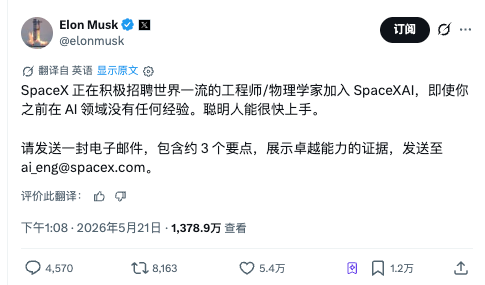
Musk also added that having built “something extremely complex that actually works” would be a strong plus. He personally reviews emails that pass initial screening. At the time of writing, this post had already garnered over 13 million views and 4,500 replies.
Musk’s hiring approach looks refreshingly bold: degrees, previous employers, or ten years of experience don’t matter—only whether you possess “extraordinary ability.” But upon closer reflection, you’ll realize this is actually a far more rigorous filter than conventional hiring.
So tell us: Is it easy or difficult to summarize your exceptional qualities in just three points?
A conventional resume runs at least one page long—listing past job titles and achievements, alma mater, technical tools mastered, awards won… all packed together to look impressively full—but not a single line may directly prove your “extraordinariness.”
Scroll through the comments, and you’ll find most people simply can’t do it.
Resumes Are About “Performance Efficiency”
I skimmed through the comment section and quickly grasped the pattern.
Of those 4,500 replies, the tone is probably what you’d expect: most are jokes or tongue-in-cheek quips. The top-voted reply comes from a user named Greg, who posted a so-called “resume”—absurd on its face:
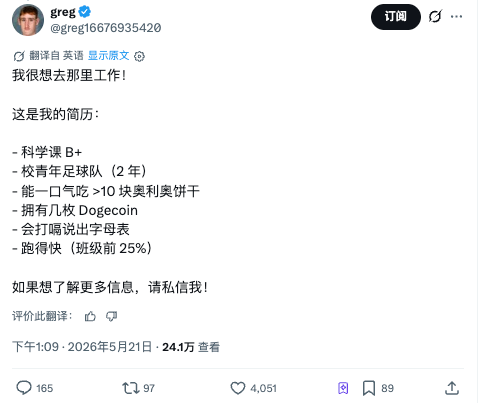
Self-deprecating humor is fun, and the reply is clearly a joke—but it’s also a mirror. Think about it: haven’t many of the resumes I’ve submitted looked essentially the same?
Swap out the content—replace it with “GPA 3.8 in Computer Science from a top university,” “two years on varsity basketball,” “proficient in Python and Java,” “self-studied CFA Level I,” “top 50 in university sports meet…”
The format is identical; the logic is identical—just less outrageous content. But fundamentally, it’s still an undifferentiated list of everything you have.
From Musk’s perspective, your level of Python proficiency isn’t meaningfully different from your ability to recite the alphabet while hiccuping.
The comment section isn’t filled only with jokers. Some users earnestly attached their diplomas; others forwarded Ivy League acceptance letters for their children; some even uploaded passport photos requesting work visas; others listed publications and conference talks…
Clearly, these people are genuinely interested in joining SpaceX.
Yet zoom out, and their actions mirror the absurd joke-post above: listing credentials, stacking experiences, indiscriminately enumerating any potentially impressive item—hoping to collectively construct an impression of “I’m outstanding.”
Musk asks: What complex, useful thing have you actually built? Your average interviewer may not hold such high standards—but they still want stronger relevance in your resume.
Plainly put, a resume is a performance—and performances must be efficient. Often, what resonates most efficiently isn’t a long-winded essay.
A Product Is a Better Resume
There’s another highly upvoted comment in the thread—one I believe perfectly satisfies Musk’s request: “Use three points to demonstrate your excellence.”
Yet this person used only one point—and just one word:
codex.
Clicking into his profile, I found that Tibo (full name Thibault Sottiaux) is Engineering Lead at OpenAI, currently heading the Codex team. Codex is among the world’s most powerful AI coding tools—and something developers worldwide use daily.
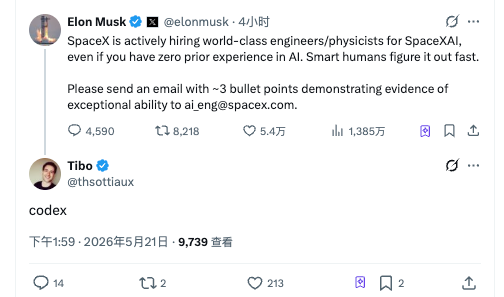
A product name alone serves as the entire resume.
The more you need to explain who you are, the less likely you are to be the person Musk seeks. Those who’ve truly built things carry proof in their names—and the product itself becomes the point. You might object: “He’s the head of an OpenAI project—he’s elite, so he can afford to reply with just one word. Ordinary people don’t have that confidence.”
Flip the perspective: Tibo could reply this way because he holds something tangible, proven, and self-explanatory—something that speaks for him entirely.
Of course, elitism is undesirable—but most of us aren’t elites either. Yet sometimes, all we need is to “productize” ourselves—to present our work in a more efficient, demonstrable way.
Push this idea further, and it becomes clear this has nothing to do with seniority.
If you spend a weekend building a small tool using vibe coding—and persistently share it, and people actually use it—that’s a product. If you publish an industry research article on social media that others cite—that’s also a product.
These are obviously much smaller in scale than Codex—but they share one crucial trait: they’re things you built, visible to others, and require no self-explanation.
In the AI era, every piece of work you publish online, every output you create, every result others can link to—it’s all, in a sense, a living resume. It speaks for you.
You don’t need to reach Codex’s scale—but you do need at least one thing others can point to.
So those attachments in your resume? They might themselves be better resumes.
But Is This Hiring Real?
The story has one final twist.
Some commenters, after reading Musk’s post, carefully drafted and sent emails to the address [email protected]—only to receive bounce-backs stating the address doesn’t exist…
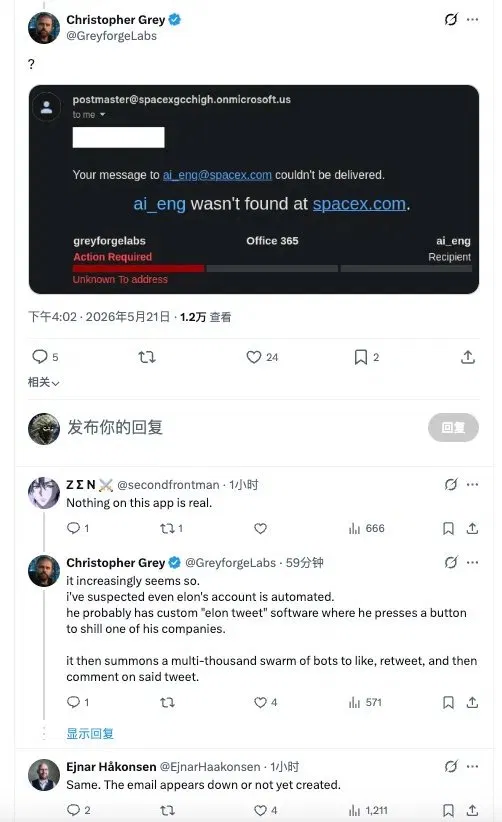
Some suspect Musk’s account auto-posted the message before the hiring email was even set up; others believe the timing—right before IPO—is purely for hype, projecting an image of talent acquisition and team expansion.
Investors will certainly see Musk’s post. Whether the hiring is genuine can be set aside for now—the posture conveyed—“SpaceX is aggressively recruiting top global talent”—is unmistakable.
So is this job posting real recruitment—or just part of the IPO roadshow?
Possibly, the distinction isn’t that sharp. In Musk’s world, a single tweet can simultaneously serve as a job ad, an investor relations statement, and a brand advertisement. You see three bullet points; investors see “this company can attract the world’s best talent.”
Reading the post and scrolling through the comments delivers a kind of epiphany: the joke replies, the one-word Codex self-verification, the bounced emails—all are players on the same stage.
Some come to perform; some come to prove themselves; some discover the stage set is made of paper…
In an age of scarce attention and cheap content output, finding your place and demonstrating your value remains a lifelong endeavor.
Join TechFlow official community to stay tuned
Telegram:https://t.me/TechFlowDaily
X (Twitter):https://x.com/TechFlowPost
X (Twitter) EN:https://x.com/BlockFlow_News
 深潮TechFlow











