SpaceX Secretly Files for IPO, Aiming for Record-Breaking $1.75 Trillion Valuation; Aerospace Stocks Surge During Trading
TechFlow Selected TechFlow Selected
SpaceX Secretly Files for IPO, Aiming for Record-Breaking $1.75 Trillion Valuation; Aerospace Stocks Surge During Trading
If successfully completed, it will break Saudi Aramco’s IPO record of $29 billion.
 Navigating Web3 tides with focused insights
Author: TechFlow
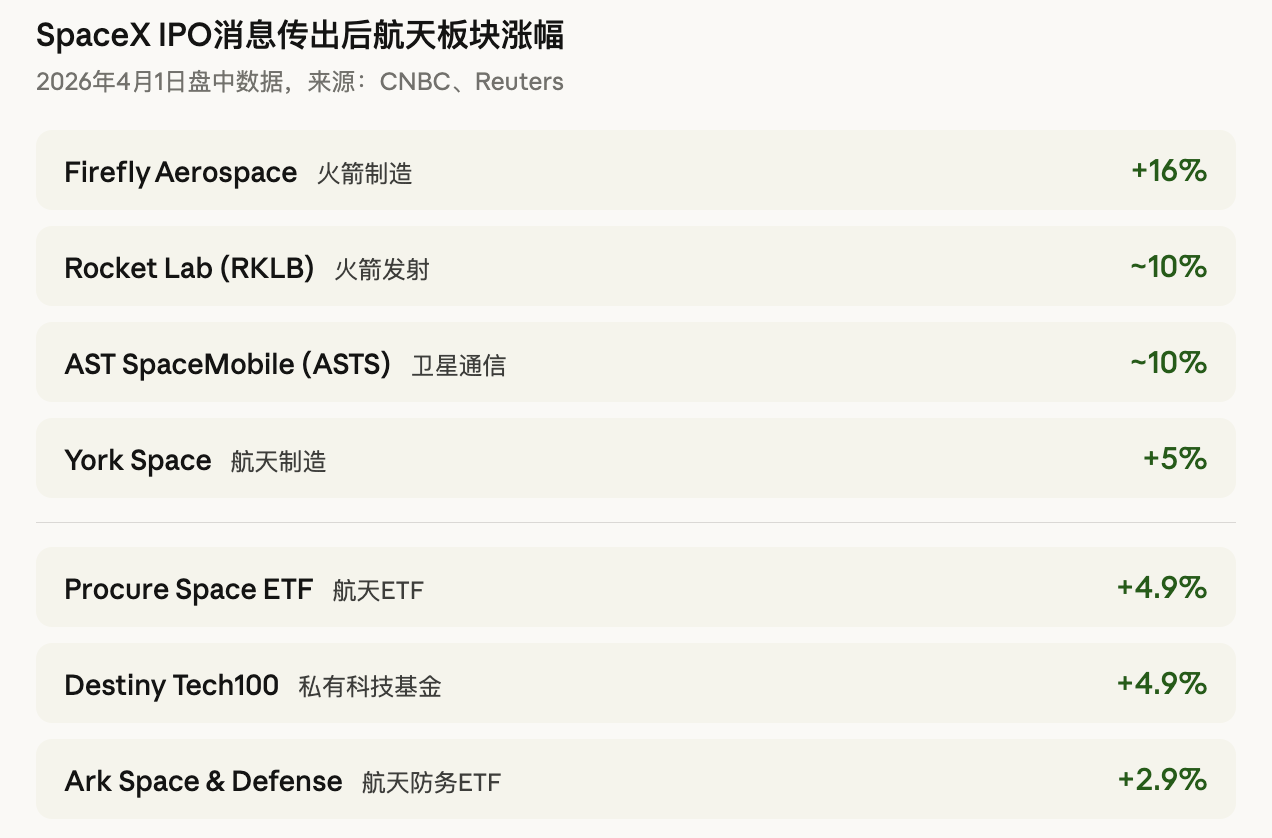
TechFlow Insight: On April 1, SpaceX secretly filed its IPO registration documents with the U.S. Securities and Exchange Commission (SEC), targeting a valuation of $1.75 trillion and aiming to raise up to $75 billion. If successful, this would shatter Saudi Aramco’s record-setting $29 billion IPO in 2019. Following the news, aerospace stocks surged across the board—Rocket Lab and Intuitive Machines rose nearly 10%, while ETFs tracking the aerospace sector climbed as much as 5%.
Yet market debate is equally intense: In February, SpaceX completed an all-stock merger with xAI—the AI company founded by Elon Musk—that reported annual losses exceeding $6 billion. Moreover, Nasdaq’s newly introduced “tailor-made” rule—allowing newly listed companies to be added to its index just 15 days after listing—has raised concerns about passive funds being forced into buying the stock.
Content below:
Elon Musk’s aerospace empire has officially begun its countdown to going public.
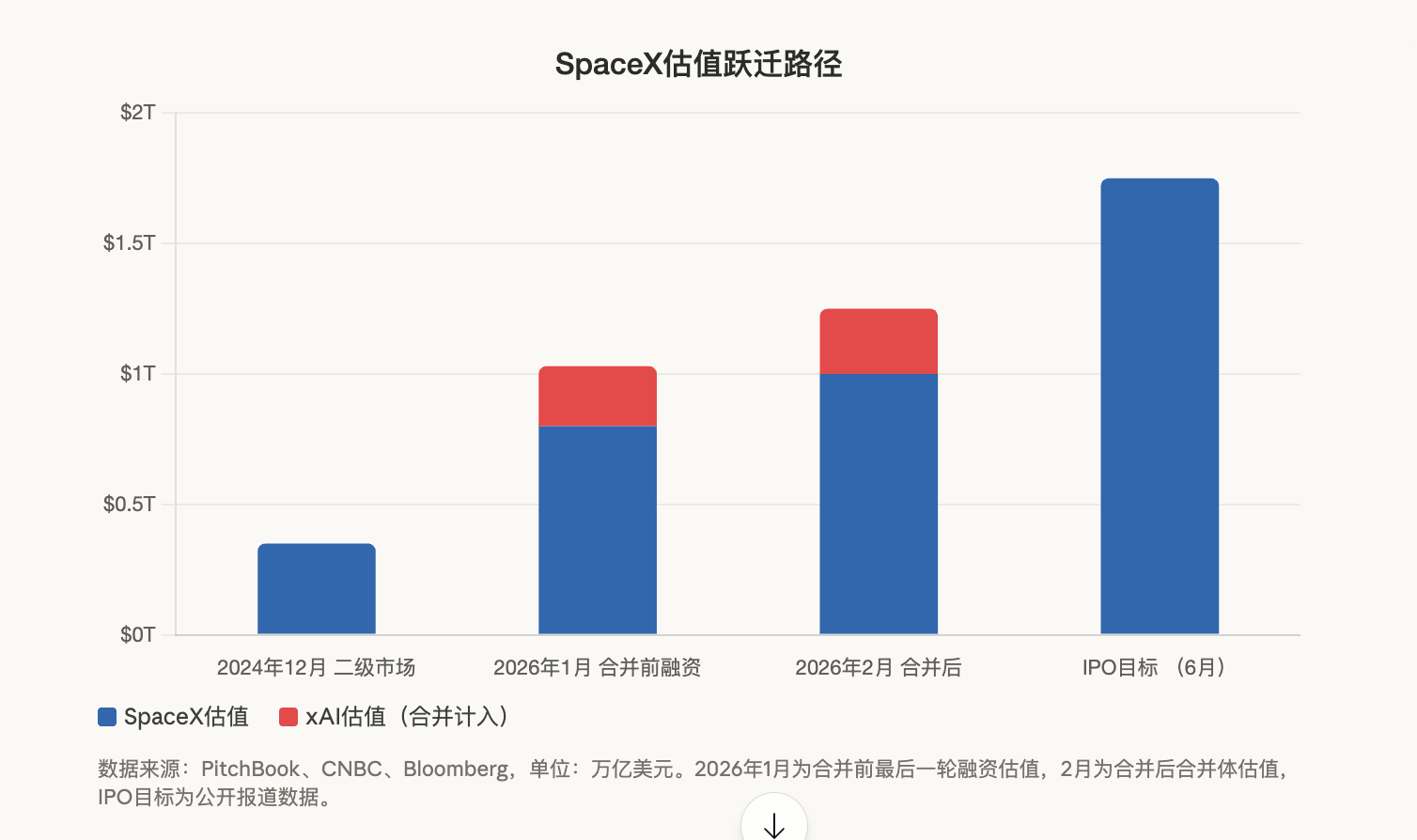
According to multiple media outlets—including Bloomberg, CNBC, and Reuters—on April 1, SpaceX secretly submitted a draft IPO registration document to the U.S. Securities and Exchange Commission (SEC), targeting a valuation exceeding $1.75 trillion and planning to list on the Nasdaq in June. Codenamed “Project Apex,” this offering is expected to raise as much as $75 billion—more than 2.5 times Saudi Aramco’s $29 billion IPO in 2019—and could become the largest IPO in capital markets history.
SpaceX has assembled an unusually large underwriting syndicate of 21 banks, with Goldman Sachs, Morgan Stanley, JPMorgan Chase, Bank of America, and Citigroup serving as lead underwriters. According to Reuters, Musk is considering allocating up to 30% of the IPO shares to retail investors.
$1.75 Trillion Valuation Anchored on Starlink; xAI Merger Boosts Combined Scale
SpaceX’s $1.75 trillion valuation target rests primarily on its satellite internet business, Starlink. According to data from Teslarati and Spaceflight Now, Starlink had 9.2 million users by the end of 2025 and surpassed 10 million users in February 2026. Its full-year 2025 revenue exceeded $10 billion, and analysts project that figure could reach $24 billion in 2026.
In February, SpaceX completed an all-stock merger with xAI, Musk’s AI company. At the time of the deal, SpaceX was valued at approximately $1 trillion and xAI at around $250 billion, resulting in a combined entity valued at roughly $1.25 trillion. Bloomberg Intelligence estimates the merged company’s 2026 revenue will approach $20 billion, with xAI contributing less than $1 billion.
The $500 billion premium—from the $1.25 trillion post-merger valuation to the $1.75 trillion IPO target—reflects market optimism about the fusion of space and AI. Yet skepticism remains strong. According to Benzinga, citing anonymous sources, xAI was burning approximately $1 billion per month at the time of filing, and all 11 co-founders had already departed. A user on Hacker News bluntly stated: “xAI’s annual net loss is about $6 billion, while SpaceX’s best years yield roughly $8 billion in net profit—meaning retail investors are effectively forced to absorb a massively unprofitable AI company.”
Nasdaq’s “Tailor-Made” Rule: 15-Day Fast Track to Index Inclusion
Behind SpaceX’s listing process lies a Nasdaq rule change that has sparked widespread controversy.
As reported by Bloomberg on March 30, Nasdaq announced it will implement a new rule effective May 1: Newly listed companies ranked among the top 40 by market capitalization in the Nasdaq-100 Index will be eligible for inclusion just 15 trading days after listing—down from the previous minimum waiting period of three months. Nasdaq has also eliminated the 10% minimum free-float requirement and now permits unlisted shares to be included in total market cap calculations.
According to Rio Times, SpaceX reportedly made “fast-track inclusion into the Nasdaq-100 post-listing” one of its conditions for choosing Nasdaq over the New York Stock Exchange. Index inclusion means ETFs and index funds tracking the benchmark—including Invesco QQQ alone, which manages over $300 billion in assets—will be compelled to buy shares of the newly added stock. Globally, more than $30 trillion in assets are linked to major U.S. equity indices currently adjusting their rules.
Ross Gerber of Gerber Kawasaki Wealth Management criticized the practice, calling it “highly unusual” for a company to demand index inclusion from day one of its IPO—effectively using passive funds to prop up its stock price. Hedge funds can precisely anticipate institutional buying surges during the 15-day window and front-run them for profit. Prominent investor Michael Burry calculated on X: If SpaceX lists at a $1.75 trillion valuation and issues only 5% of its shares, the publicly traded portion would amount to roughly $87.5 billion—but Nasdaq’s 5x weighting multiplier would cause index funds to allocate weights as if SpaceX were a $437.5 billion company.
Aerospace Stocks Rally Broadly, but Geopolitical Risks Loom Over Listing Window
On the day the news broke, aerospace stocks surged broadly. According to CNBC, AST SpaceMobile and Rocket Lab rose nearly 10%, rocket manufacturer Firefly Aerospace—which went public last August—jumped 16%, and York Space—which listed in January—rose 5%. According to Reuters, ETFs tracking the aerospace sector strengthened concurrently: Ark Space & Defense Innovation rose 2.9%, Procure Space rose 4.9%, and Destiny Tech100—a fund investing in pre-IPO tech giants—rose 4.9%.
Peter Andersen, founder of Andersen Capital Management, noted that large IPOs often drive industry-wide repricing—a common phenomenon where investors interpret an IPO as a positive signal for the entire sector. Matthew Tuttle, CEO of Tuttle Capital Management, said outright that retail investors will rush to chase SpaceX’s first-day trading, but he cautioned that SpaceX has remained private far longer than most public companies, meaning much of its value appreciation has already been captured by private investors—leaving uncertain upside for public-market investors.
Reena Aggarwal, Professor of Finance at Georgetown University and an IPO expert, pointed out that even with strong fundamentals and robust investor interest, IPOs can still fail amid adverse market conditions. Currently, the U.S.-Iran conflict and surging oil prices have triggered Nasdaq’s largest weekly decline in nearly a year, pushing market volatility to elevated levels. She expressed hope that geopolitical tensions ease before June. Polymarket data shows a 63% probability that SpaceX completes its listing before June 30—a 10-percentage-point increase following the announcement.
Three AI Giants Set for IPOs Amid 2026’s Super IPO Cycle
SpaceX is not alone. According to Bloomberg, it is expected to be the first of three mega-IPOs scheduled for this year, with OpenAI and Anthropic also preparing for public listings later in 2026.
As analyzed by Gizmodo, the combined valuation of these three firms approaches $3 trillion. If they list in close succession and gain rapid index inclusion via the fast track, they could place immense pressure on market liquidity. SpaceX’s IPO is not merely a milestone for the aerospace industry—it is also a bellwether for whether the AI investment boom can sustain momentum. NVIDIA’s March GTC conference triggered only modest stock movement, signaling waning enthusiasm for AI-themed investments. The market’s reception of these three IPOs will largely determine the next phase of AI-related trading activity.
Join TechFlow official community to stay tuned
Telegram:https://t.me/TechFlowDaily
X (Twitter):https://x.com/TechFlowPost
X (Twitter) EN:https://x.com/BlockFlow_News
 深潮TechFlow