








a16z on Project Launch Strategy: Driving Decentralized Communities with Attention and Tokens
TechFlow Selected TechFlow Selected
a16z on Project Launch Strategy: Driving Decentralized Communities with Attention and Tokens
Web3 has transformed the entire approach to launching new networks, with tokens providing an alternative solution to the traditional cold-start problem.
 Navigating Web3 tides with focused insights
Author: Maggie Hsu
Translation: TechFlow
Every company faces some form of a "cold start problem": How do you begin from nothing? How do you acquire customers? How do you create network effects—making your product or service more valuable as more people use it—thereby incentivizing even more users to join?
In short, how do you “go to market” and convince potential customers to spend their money, time, and attention on your product or service?
In the Web2 era, most companies—the era defined by large centralized products/services like Amazon, eBay, Facebook, and Twitter, where the vast majority of value flows to the platform itself rather than its users—responded by heavily investing in sales and marketing teams as part of a traditional go-to-market (GTM) strategy focused on lead generation, customer acquisition, and retention. But in recent years, a new model for building organizations has emerged. Instead of centralized control—where a top-down leadership team makes all decisions about the product or service, even while using consumer data and free, user-generated content—this new model leverages decentralized technology and brings users into the role of owners through digital primitives called Tokens.
This new model, known as Web3, fundamentally reshapes the entire GTM concept for these novel types of companies. While some traditional customer acquisition frameworks still apply, the introduction of Tokens and new organizational structures such as decentralized autonomous organizations (DAOs) demands multiple approaches to market outreach. Since Web3 remains new to many—but with massive building activity happening in this space—in this article, I will share some new frameworks for thinking about GTM in this context, along with where different types of organizations might sit within the ecosystem. I’ll also offer builders hoping to craft their own Web3 GTM strategies some tips and tactics as the space continues to evolve.
The Catalyst for New Market Actions: Tokens
The concept of a customer acquisition funnel is central to marketing and familiar to most businesses: from awareness and lead generation at the top of the funnel to conversion and retention at the bottom. Traditional Web2 go-to-market strategies thus address the cold start problem through this highly linear lens of customer acquisition, covering areas such as pricing, marketing, partnerships, sales channel mapping, and sales team optimization. Success metrics include time to close leads, website click-through rates, and revenue per customer.
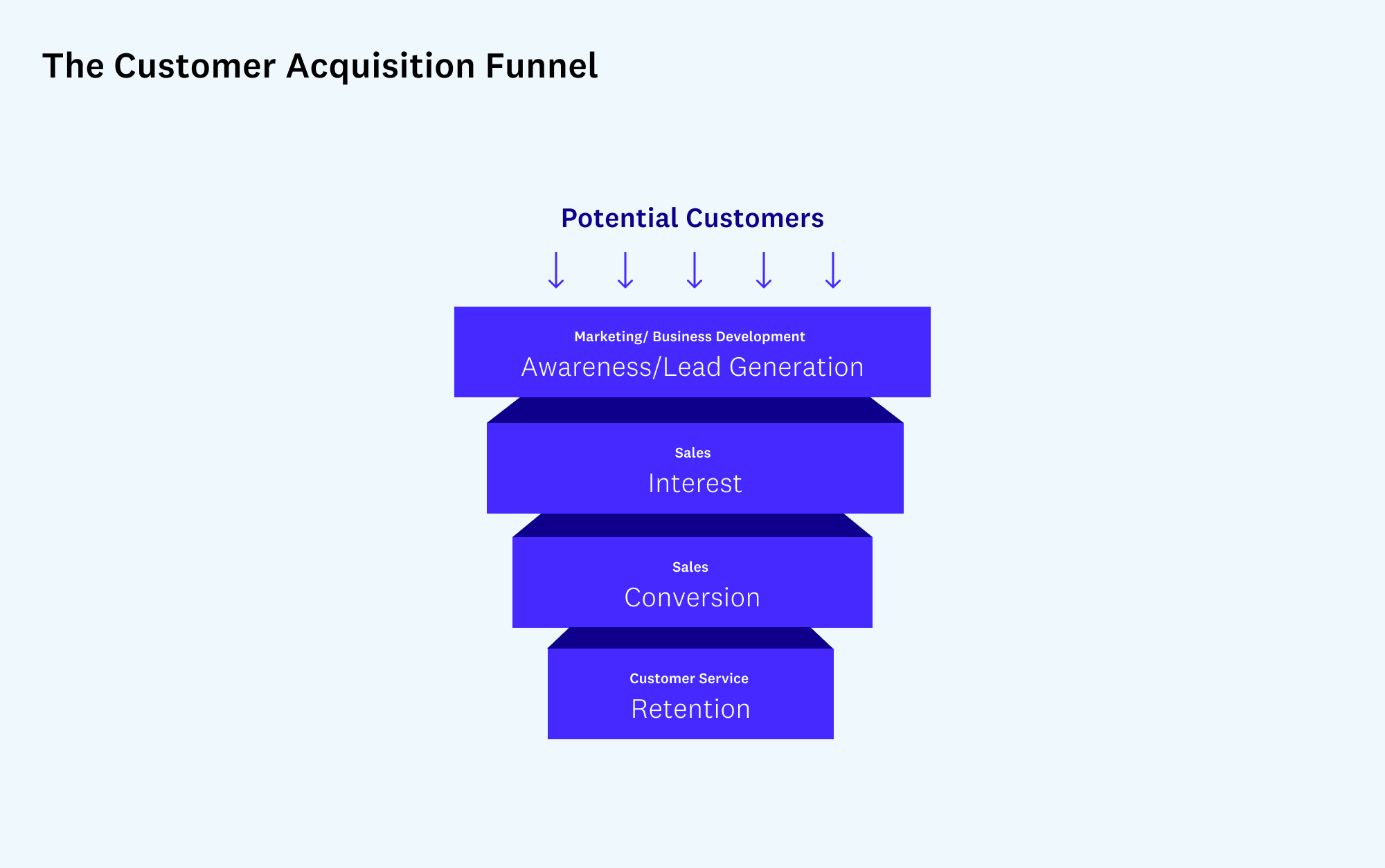
Web3 changes the entire approach to launching new networks because Tokens offer an alternative solution to the traditional cold start problem. Instead of spending capital on conventional marketing to attract leads, core development teams can use Tokens to attract early users who can be rewarded for their early contributions, even before network effects are visible or just beginning. These early users not only become evangelists who bring others into the network (who similarly hope to be rewarded for their contributions), but they effectively become more powerful in Web3 than traditional business development or salespeople in Web2.
For example, the lending protocol Compound [full disclosure: we are investors in some of the organizations discussed here] used Tokens to incentivize early lenders, offering additional rewards in the form of COMP Tokens to participate in—or “bootstrap liquidity” for—the protocol via a liquidity mining program. Any user of the protocol, whether borrower or lender, could earn COMP Tokens. After launching in 2020, Compound’s total value locked (TVL) surged from around $100 million to approximately $600 million. Notably, while Token incentives attract users, that alone isn’t enough to make them “sticky”—more on that later. While traditional companies do incentivize employees with equity, they rarely financially reward customers in lasting ways (beyond discounts or referral bonuses).
In summary: In Web2, the primary GTM stakeholders are customers, typically acquired through sales and marketing efforts. In Web3, an organization’s GTM stakeholders include not only customers/users but also developers, investors, and partners. As a result, many Web3 companies find community roles far more critical than sales and marketing roles.
The Web3 Go-To-Market Matrix
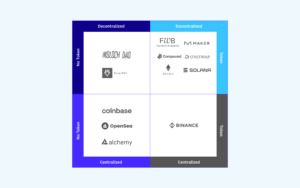
For Web3 organizations, go-to-market (GTM) strategy depends on their position in the following matrix based on organizational structure (centralized vs. decentralized) and economic incentives (no Token vs. Token):
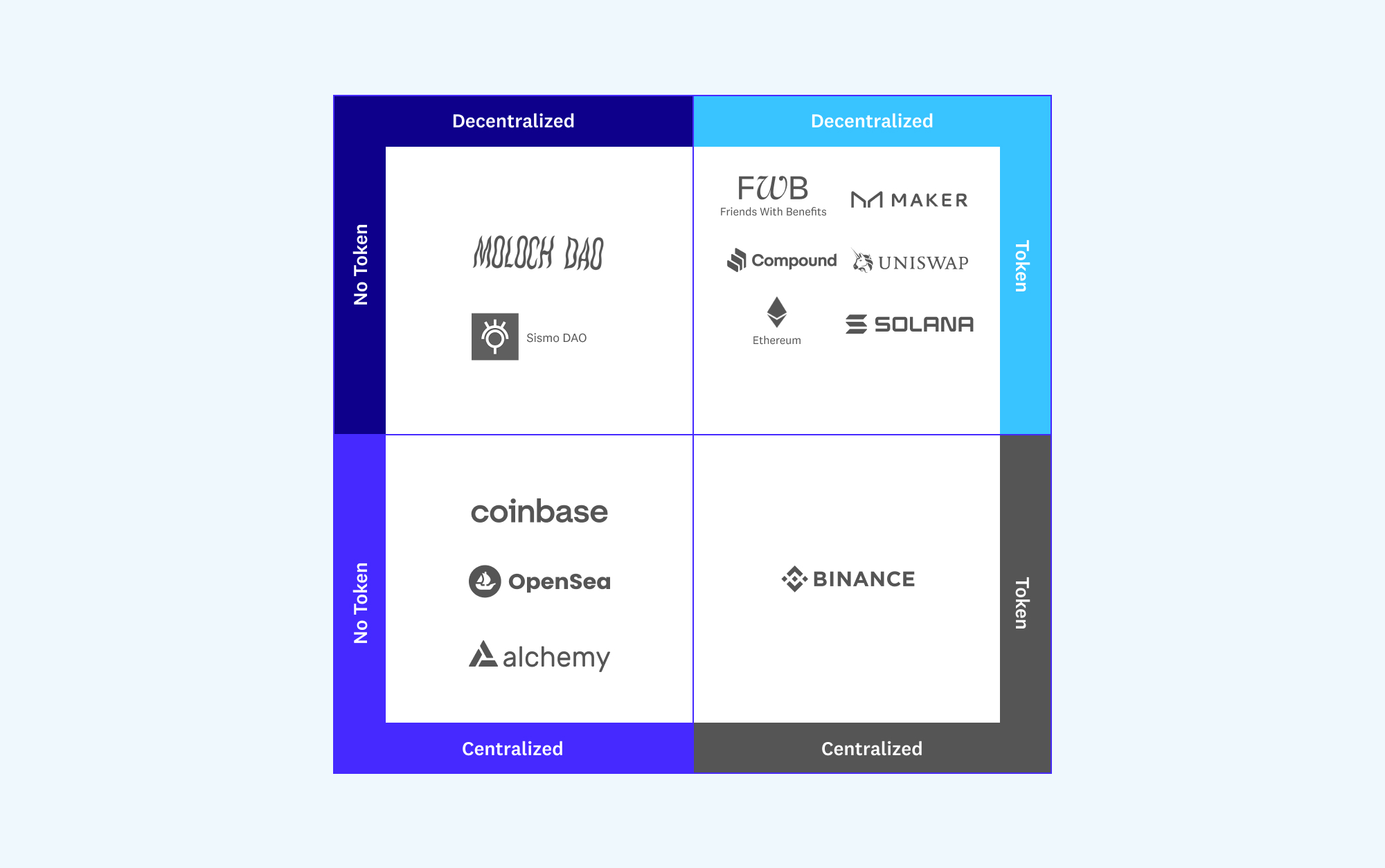
Marketing differs across each quadrant, ranging from traditional Web2-style strategies to emerging and experimental ones. Here, I’ll focus primarily on the upper-right quadrant (decentralized teams with Tokens) and contrast it with the lower-left (centralized teams without Tokens) to illustrate the differences between Web3 and Web2 GTM approaches.
Decentralized with Tokens
Let’s first examine the upper-right quadrant. This includes organizations, networks, and protocols with unique Web3 operating models that require novel go-to-market strategies.
Organizations in this quadrant follow a decentralized model (though they often begin with a core development team or operators) and use tokenomics to attract new members, reward contributors, and align incentives among participants. (For a deeper discussion on Web3 business models and the apparent paradox of capturing value, check out talks from a16z Crypto Startup School.)
The fundamental difference between Web3 organizations in this quadrant and those using more traditional GTM models lies in one key question: What is the product? While Web2 companies—and those in the lower-left quadrant—typically must start with a compelling product to attract customers (“come for the tool, stay for the network”), Web3 companies approach go-to-market through a dual lens of purpose and community.
Having a strong product and solid technical foundation remains important, but it doesn’t have to come first.
What these organizations need instead is a clear purpose—a reason for being. What unique problem are they trying to solve? It’s not simply about a white paper or a founding team raising funds. It means cultivating a strong community—not merely “community-led” or “community-first,” but community-owned—that blurs the lines between owners, shareholders, and users. Long-term success in Web3 hinges on a clear mission, an actively engaged high-quality community, and the right organizational governance aligned with that mission and community.
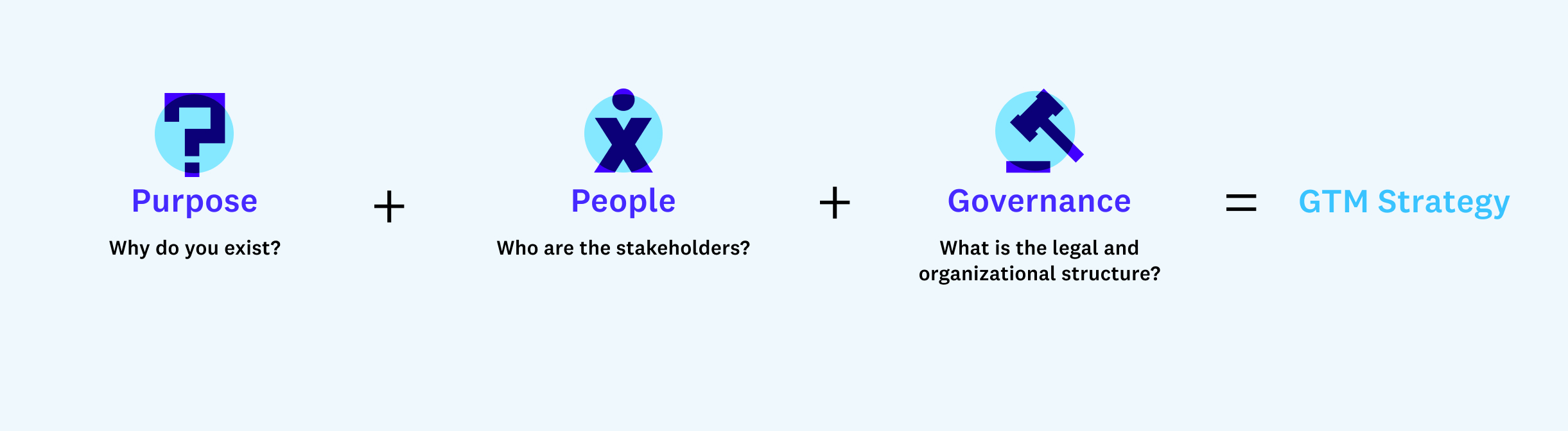
Now let’s dive into two major categories of go-to-market actions for Web3 organizations in the upper-right quadrant: (1) decentralized applications; (2) Layer 1 blockchains, Layer 2 scaling solutions, and other protocols.
Go-to-Market for Decentralized Applications
“Decentralized applications” cover use cases such as decentralized finance (DeFi), non-fungible tokens (NFTs), social networks, and gaming.
Decentralized Finance (DeFi) DAOs
A major category of decentralized applications is decentralized finance (DeFi), such as decentralized exchanges (e.g., Uniswap or dYdX) or stablecoins (e.g., MakerDAO’s Dai). While their go-to-market actions may resemble standard, non-decentralized apps, the way value accrues differs due to structural and tokenomic distinctions.
Many DeFi projects follow a path where the protocol is initially developed by a centralized team. After launch, the team typically seeks to decentralize the protocol to enhance security and delegate operational management to a decentralized group of Token holders. This decentralization is usually achieved by simultaneously issuing a governance Token, launching a decentralized governance framework (often a DAO), and transferring control of the protocol to the DAO.
This decentralization process can take various forms. For instance, many DAOs operate purely in the digital realm without any legal entity, while others use multisig wallets acting on the DAO’s instructions. In some cases, nonprofit foundations are established to oversee the protocol’s future development per the DAO’s direction. In nearly all cases, the original development team continues operating as one of many contributors within the ecosystem, building complementary or ancillary products and services. (This whitepaper provides further details on DAO legal frameworks, from tax and entity formation to operational considerations.)
Here are two popular DeFi examples:
-
MakerDAO launched as a DAO in March 2015, established a foundation in June 2018, and dissolved that foundation in July 2021. MakerDAO issues a stablecoin called Dai, designed to allow users to transact with a stable unit of value quickly, cheaply, borderlessly, and transparently—whether purchasing goods and services or interacting with other DeFi applications. It also has a governance Token, MKR. The DAO approves various governance changes and certain parameters of protocol operations, including the collateral ratio the protocol uses to mint DAI.
-
The Uniswap protocol was launched by a centralized company but is now owned and governed by the Uniswap DAO, controlled by UNI Token holders. Uniswap Labs, the creator of the protocol, operates one interface of the Uniswap protocol and is one of many developers contributing to the ecosystem.
So what does go-to-market look like here? Take Dai, the algorithmic stablecoin issued and governed by MakerDAO. A key goal for most algorithmic stablecoin issuers (like MakerDAO) is increasing adoption of their stablecoin across the financial ecosystem. Thus, go-to-market actions involve: 1) listing on cryptocurrency exchanges for retail and institutional trading; 2) integration into wallets and applications; and 3) acceptance as payment for goods or services. Today, there are over 400 Dai markets, it’s integrated into hundreds of projects, and accepted as a payment method via major commercial solutions like Coinbase Commerce.
How did they achieve this? Initially, MakerDAO accomplished much of this through a more traditional business development team that drove early partnerships and integrations. However, as it became more decentralized, the business development function transitioned to a Growth Core Unit, a sub-community of Maker Token holders, often referred to as a SubDAO. Additionally, because MakerDAO is decentralized, its protocol operations are trustless and permissionless—anyone can use the protocol to generate or purchase Dai. And since Dai’s code is open-source, developers can self-serve integrate it into their applications. Over time, as the protocol became more self-service—with better developer documentation and more integration guides—other projects were able to build on it at scale.
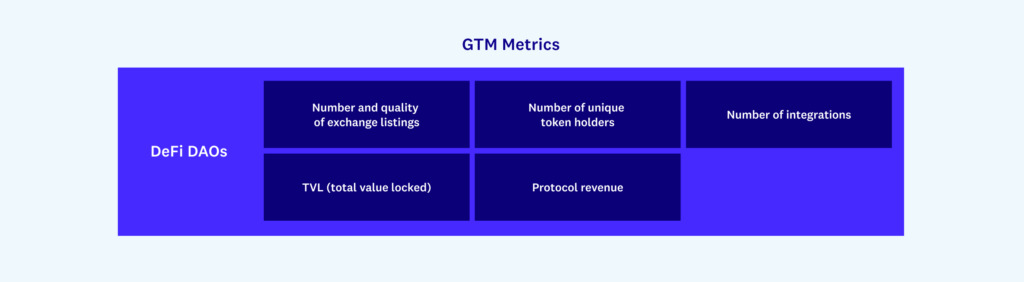
DeFi DAO Go-to-Market Metrics: As new go-to-market strategies emerge in Web3, so do new ways of measuring success. For DeFi applications, a classic metric is total value locked (TVL), mentioned earlier. TVL represents all assets used in the protocol or network for transactions, staking, and lending.
However, TVL is not an ideal measure of long-term organizational health and sustainability. While new DeFi protocols can copy open-source code, offer high yields, and attract significant inflows and TVL, this isn’t necessarily sticky—traders often leave when the next project appears.
Therefore, more critical metrics include the number of unique Token holders; frequency and sentiment of community engagement; and developer activity. Additionally, because protocols are composable—programmable to interact with and build upon each other—another key metric is integrations. The number and type of integrations track how widely the protocol is used across other applications such as wallets, exchanges, and products.
Social, Cultural, and Art DAOs
For social, cultural, and art DAOs, the essence of go-to-market (GTM) lies in building a community around a specific purpose—sometimes starting from a text chat among friends—and growing organically by finding others who share the same beliefs. But isn’t this just “a group chat” or similar to traditional crowdfunding on Kickstarter?
Not quite. While organizers of traditional Web2 crowdfunding projects also have clear goals, they typically must plan top-down exactly how to achieve them. Project initiators usually specify how funds will be spent, product roadmaps, and timelines. In contrast, the Web3 model prioritizes the goal first, while the execution—including fund usage, product roadmap, and timeline—is often determined later.
For example, ConstitutionDAO aimed to purchase a copy of the U.S. Constitution; Krause House aims to buy an NBA team and pioneer fan-governed ownership; LinksDAO aims to create a virtual country club for golf enthusiasts; PleasrDAO collects, displays, and creatively adds to or shares back NFTs representing culturally significant ideas and movements.
Take ConstitutionDAO: it raised $47 million from a community of strangers united around this goal, all within weeks, starting solely with a clear purpose and fundraising for it. At the time, ConstitutionDAO had nothing else—no detailed roadmap, execution plan, or even a Token (which was created after the failed bid). Contributors were deeply aligned with the cause and motivated by community spirit, spreading the word and even creating a meme of scrolling emojis on Twitter.
Friends with Benefits is a Token-gated social DAO that began as a Discord server for Web3 creatives requiring a minimum purchase of $FWB Token (representing membership). Beyond the Token requirement, prospective members must also submit a written application. The community grew, connected across Discord channels, hosted real-world events, and eventually realized one product they could build was a Token-gated event app. FWB gives creators real stakes in the community, and the DAO framework enables this decentralized social group to coordinate at scale—allocating budgets, completing projects from content publishing to event production.
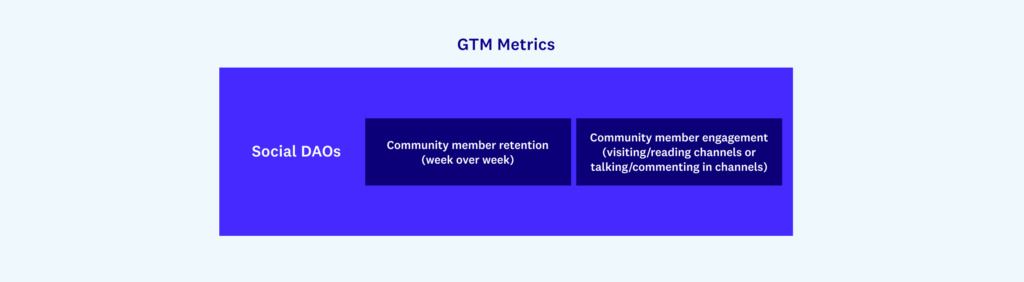
Social DAO Go-to-Market Metrics: One key indicator of a DAO’s health is high-quality community engagement, measurable through its primary communication and governance platforms. For example, a DAO can track Discord channel activity; member activation and retention; attendance at community calls; governance participation (who votes on what, and how often); and actual work completed (number of compensated contributors).
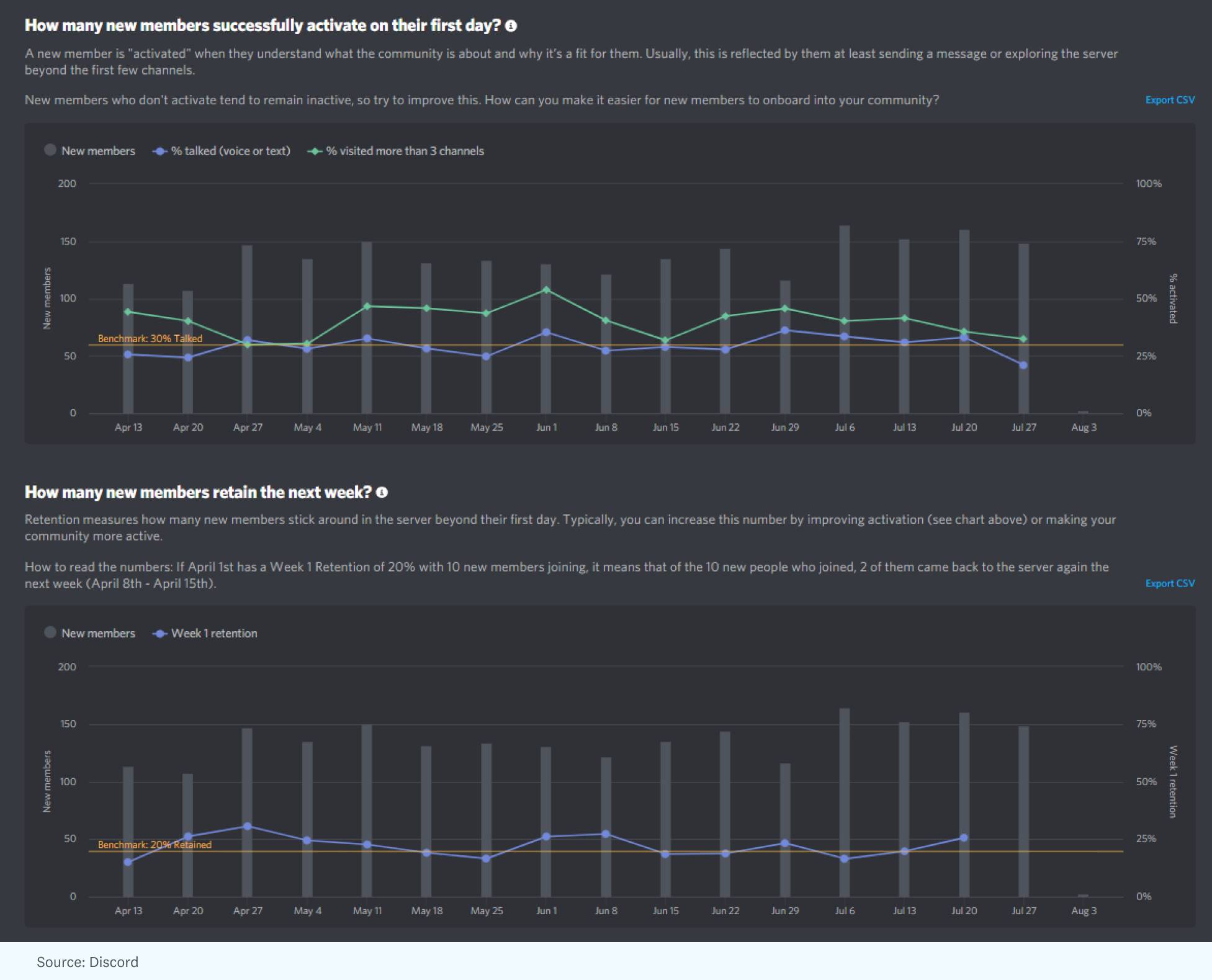
Other possible metrics include the number of new relationships formed or measures of trust built among DAO community members. While some tools and frameworks exist, social DAO metrics remain emergent, so we’ll see more tools evolve as the field matures.
Gaming DAOs
Today, most Web3 games—whether play-to-earn, play-to-mint, move-to-earn, or otherwise—are visually and mechanically very similar to popular Web2 games—but with two key differences:
-
Use of in-game assets native to open, global blockchain platforms instead of closed, controlled economies in traditional pay-to-win or free-to-play games;
-
Players can become true stakeholders with a voice in game governance.
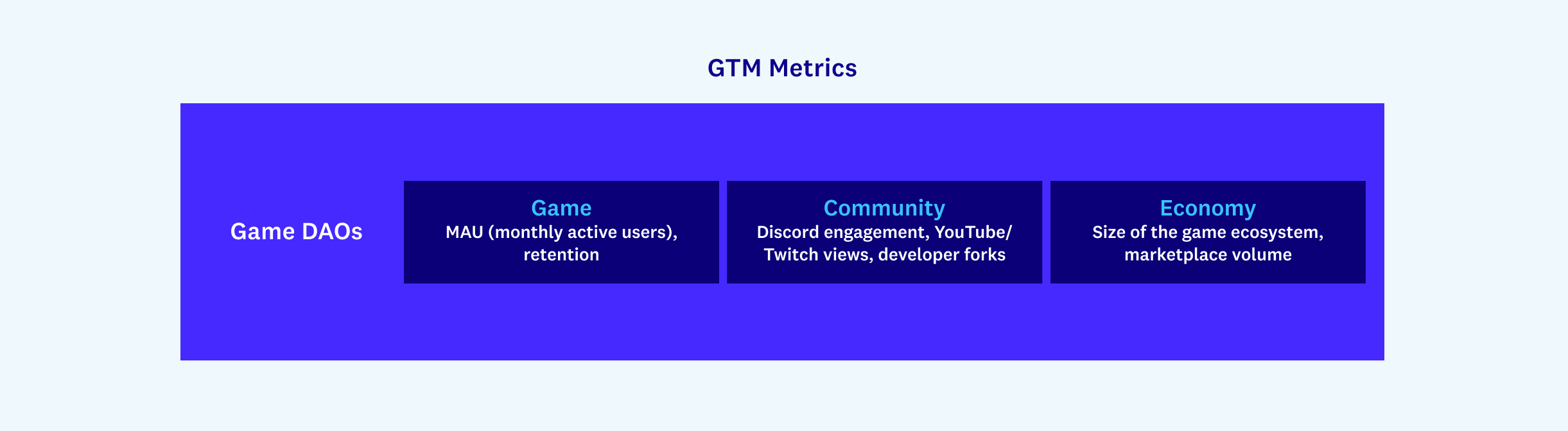
In Web3 gaming, go-to-market (GTM) strategies are built through platform distribution, player referrals, and partnerships with guilds. Guilds like Yield Guild Games (YGG) enable new players to start playing by borrowing game assets they couldn't otherwise afford. Guilds evaluate which games to support based on three factors: game quality, strength of community, and robustness and fairness of the game economy. Game, community, and economic health must all be sustained together.
While blockchain-based game developers may have a smaller ownership percentage and/or revenue cut, by incentivizing players as owners, developers help grow the overall economy for everyone.
But unlike Web2, purpose and community dominate. For example, Loot, a “content-first, gameplay-later” game, exemplifies a purpose- and community-driven GTM over product-driven. Loot consists of a series of NFTs—each called a Loot bag—containing unique combinations of adventuring gear (e.g., dragonhide belt, gloves of rage, amulet of enlightenment). Loot essentially provides a prompt—or primitive building block—upon which games, projects, and worlds can be built. The Loot community has already created everything from analytics tools to derivative art, music collections, domains, quests, and more games—all inspired by their Loot bags.
The key insight is that Loot’s growth didn’t stem from an existing product attracting users, but from the idea and lore it represented—an open, composable network welcoming creativity and rewarding users with Tokens. The community builds the products—not the network building products to attract a community. Thus, a key metric may be the number of derivatives, which could be more valuable here than traditional metrics.
Go-to-Market for Layer 1 Blockchains and Other Protocols
In Web3, Layer 1 refers to foundational blockchains. Avalanche, Celo, Ethereum, and Solana are all examples of Layer 1 blockchains. These blockchains are open-source, so anyone can build on, copy, modify, or integrate with them. Their growth comes from the number of applications built atop them.
Layer 2 refers to any technology running on top of an existing Layer 1 to help solve scalability challenges. One type of Layer 2 solution is rollups. Layer 2 rollups do this by batching transactions off-chain and then posting the data back to the Layer 1 network via a bridge. There are two main types of Layer 2 rollups. First, optimistic rollups “optimistically” assume transactions are honest rather than fraudulent, using fraud proofs. Second, zk rollups use “zero-knowledge” proofs to verify the same thing. Most of these Layer 2 solutions are currently being developed for Ethereum and don’t yet have their own Tokens, but we include them here because their go-to-market success metrics resemble those of other networks in this category.
Additionally, protocols can be built on other L1s or L2s—for example, the Uniswap protocol supports Ethereum (L1), Optimism (L2), and Polygon (L2).
Growth for Layer 1 blockchains, Layer 2 scaling solutions, and other protocols can come from forking—when a network is copied and modified. For example, the Layer 1 blockchain Ethereum was forked by Celo. The Layer 2 scaling solution Optimism was forked by Nahmii and Metis. Uniswap was forked to create SushiSwap. While this may seem negative at first, the number of forks a network has can actually be a sign of success—it shows others want to replicate it.
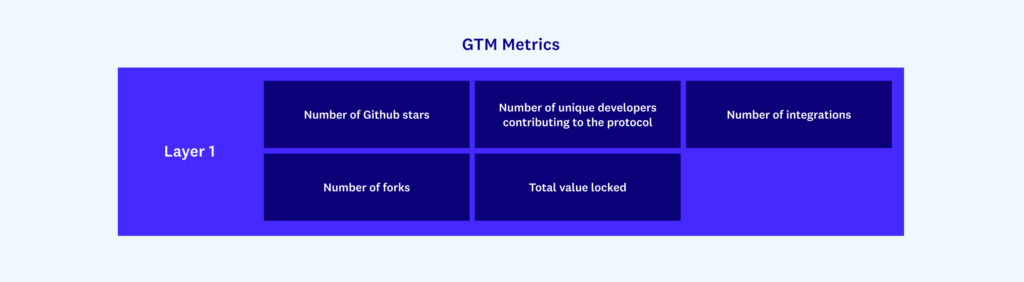
These examples and mental models focus on the upper-right quadrant—decentralized networks with Tokens—which represent the most advanced current examples of Web3. However, depending on the type of organization, there are still many hybrids combining Web2 GTM strategies with emerging Web3 models. Builders crafting their go-to-market strategies should understand the full range of available methods. So now let’s turn to a hybrid model that blends both Web2 and Web3 GTM strategies.
Centralized Without Tokens: The Web2-Web3 Hybrid Model
Many companies in the lower-left quadrant (centralized teams without Tokens) provide users with gateways and interfaces to access Web3 infrastructure and protocols.
In this quadrant, Web2 and Web3 go-to-market (GTM) strategies overlap significantly, especially in the SaaS and marketplace sectors.
Software-as-a-Service (SaaS)
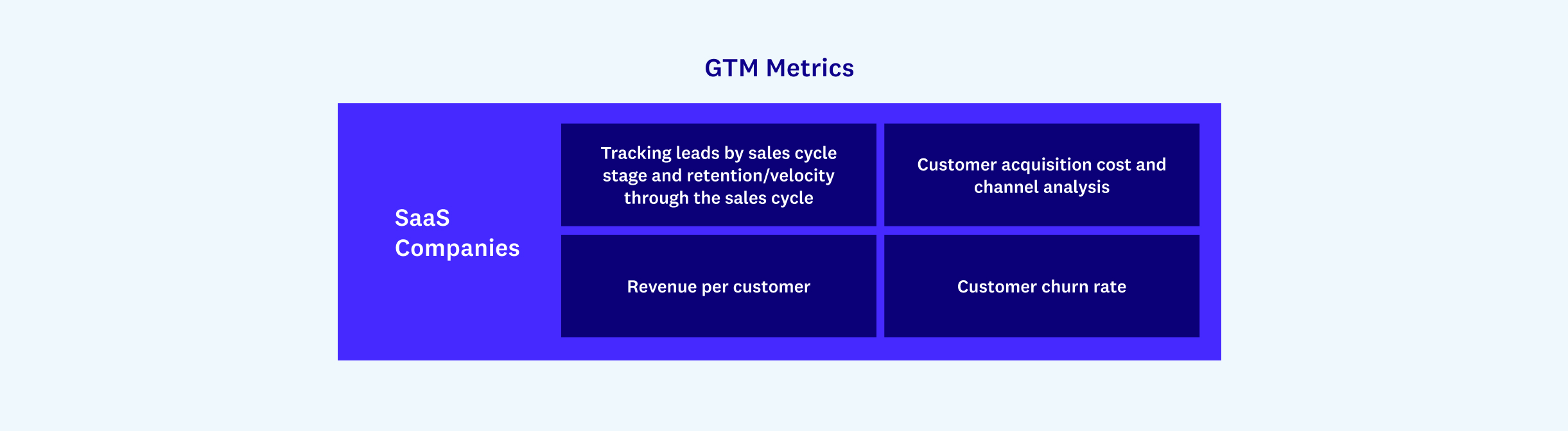
Some companies in this quadrant follow traditional SaaS business models, such as Alchemy, which offers node-as-a-service. These companies provide on-demand infrastructure through tiered subscription fees based on storage needs, whether nodes are dedicated or shared, and monthly request volume.
SaaS business models typically require traditional Web2 GTM actions and incentives. Customer acquisition combines product-led and channel-led strategies:
Product-led acquisition focuses on letting users try the product directly. For example, Alchemy’s Supernode is an Ethereum API for any organization building on Ethereum but不愿 managing its own infrastructure. In this case, customers can try Supernode via a free tier or freemium model, then refer the product to other potential users.
By contrast, channel-led acquisition focuses on segmenting different customer types (e.g., public vs. private sector clients) and deploying sales teams to engage them. For example, a company might have a sales team focused on public-sector clients (such as government and education) with deep understanding of their needs.
This article provides an overview to explain differences between Web2 and Web3 GTM strategies, but note that developer-focused outreach and developer relations—including documentation, events, and education—are also crucial here.
Marketplaces and Exchanges
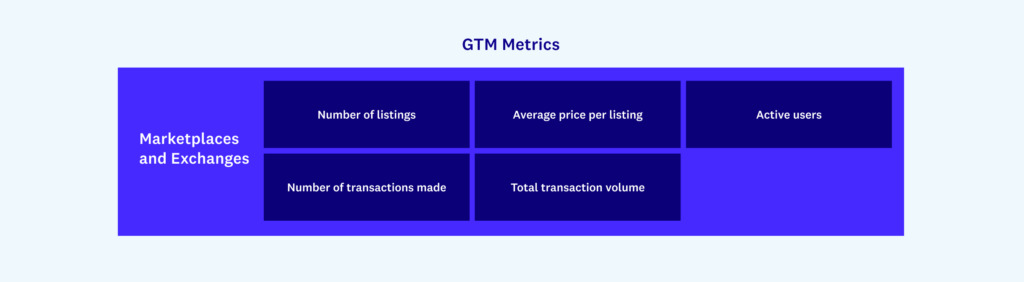
Other companies in this quadrant rely on relatively familiar consumer models such as marketplaces and exchanges—for example, the peer-to-peer NFT marketplace OpenSea and the cryptocurrency exchange Coinbase. These businesses generate revenue through transaction fees (usually a percentage of transaction value)—similar to classic Web2 marketplaces like eBay and Amazon’s business model.
For these companies, revenue growth comes from increasing listings, average dollar value per listing, and number of platform users—all leading to higher transaction volume and benefits for users in diversity, market liquidity, etc.
A key GTM action is expanding channel distribution by partnering with other platforms to showcase items. This resembles Amazon’s affiliate program, where bloggers link to favorite products and earn commissions on purchases made through their links. But unlike Web2, Web3 structures allow not only affiliate fees but also royalties to be distributed to creators. For example, OpenSea offers a traditional affiliate sales channel through its white-label program—purchases via referral links earn affiliates a cut of sales—but it also enables royalties, allowing creators to earn a percentage from any secondary sale. (This Web3 feature is uniquely enabled by crypto, as smart contracts can pre-code royalty percentages and blockchains can track provenance.)
Because creators now have the opportunity to continue earning from their work in secondary markets—a value stream previously unseen and unclaimable in Web2 systems—they’re incentivized to keep promoting the marketplace. Creators become evangelists.
GTM Strategies
Now that I’ve outlined key mental models and illustrative use cases, let’s explore some specific go-to-market (GTM) strategies common among Web3 organizations. These strategies are foundational elements—not a complete playbook—but can still help newcomers understand the range of options available.
Airdrops
An airdrop refers to a project distributing Tokens to reward users for certain behaviors, such as testing a network or protocol. Tokens can be sent to all existing addresses on a blockchain network or targeted to specific key influencers. Typically, airdrops are used to address cold start problems, drive early adoption, reward or incentivize early users, and more.
In 2020, Uniswap airdropped 400 UNI Tokens to every user who had ever used the platform. In September 2021, dYdX airdropped DYDX to users. More recently, ENS conducted an airdrop to anyone holding an ENS domain (.eth decentralized domain names). The airdrop occurred in November 2021, but anyone who held an ENS domain before October 31, 2021, was eligible (until May 2022) to claim $ENS Tokens, which grant governance rights over the ENS protocol.
In the non-fungible token (NFT) space, airdrops by NFT projects are also becoming increasingly popular to broaden access. A notable recent example came from Bored Ape Yacht Club (BAYC), a collection of 10,000 unique NFTs. On August 28, 2021, BAYC created the Mutant Ape Yacht Club (MAYC). Each BAYC Token holder received a mutant serum enabling them to mint one of 10,000 “mutant” apes, with another 10,000 new mutant apes available for new entrants. With different serum types, each usable only once, and a single Bored Ape unable to use multiple serums of the same tier, the serum introduced a new scarcity model.
The purpose of creating MAYC was to “reward our ape holders with a brand new NFT”—a “mutated” version of their ape—while also allowing new entrants to join the BAYC ecosystem at a lower membership tier. This maintains accessibility to the broader community without diluting the uniqueness of the original set or making original owners feel their contributions were devalued. (Another approach to accessibility is NFT fractionalization, where one NFT has multiple owners.) The floor price of MAYC—its lowest listed price—has always remained below BAYC’s, but owners enjoy essentially the same benefits.
These airdrops reward NFT holders or network and protocol users (like the ENS airdrop), but airdrops can also serve as proactive GTM actions to generate visibility and encourage exploration. Because blockchain data is public, new projects can airdrop to all wallets that used a specific marketplace or hold a particular Token.
Regardless, projects should clearly articulate their overall Token allocation, segmentation, and plans before conducting an airdrop. There are numerous examples of airdrops used for malicious purposes and failed airdrops. Moreover, in the U.S., Token airdrops may be considered securities offerings, so projects should consult legal counsel before any such activity.
Developer Grants
Developer grants are funds provided from a protocol’s treasury to individuals or teams who improve the protocol in some way. This can serve as an effective go-to-market (GTM) mechanism for decentralized autonomous organizations (DAOs), as developer activity is a critical component of protocol success. Projects and protocols with developer grant programs include Celo, Chainlink, Compound, Ethereum, and Uniswap.
Grants aren’t limited to protocol development—they can also fund bug bount
Join TechFlow official community to stay tuned
Telegram:https://t.me/TechFlowDaily
X (Twitter):https://x.com/TechFlowPost
X (Twitter) EN:https://x.com/BlockFlow_News
 a16z
a16z






