









US Spot Ethereum ETF Launch Imminent: Jump In Early or Wait and See?
TechFlow Selected TechFlow Selected
US Spot Ethereum ETF Launch Imminent: Jump In Early or Wait and See?
Will Ethereum ETFs be successfully launched, and when can they start trading?
 Navigating Web3 tides with focused insights
Author: imToken
For reader convenience, some common terms are abbreviated below:
-
Ethereum Spot ETF: abbreviated as "Ethereum ETF" below
-
Bitcoin Spot ETF: abbreviated as "Bitcoin ETF" below
-
U.S. Securities and Exchange Commission: abbreviated as "U.S. SEC" below
After eight asset management firms planning to launch Ethereum ETFs in the U.S. securities market finally submitted their S-1 filings to the U.S. SEC in June 2024, questions about whether these Ethereum ETFs will successfully launch—and when they might begin trading—have remained at the forefront of industry attention. Amid fluctuating predictions and frequent ETH market volatility driven by related news, why do Ethereum ETFs generate such strong market sentiment? Should we respond with optimistic anticipation and early positioning, or maintain cautious observation?
Through ETFs, digital assets are integrating into mainstream financial markets
This may be one of the most significant market implications of launching crypto asset ETFs.
"You're witnessing the emergence of a new asset class," said Matthew Hougan, Chief Investment Officer at Bitwise Asset Management, in an interview with U.S. media CNBC on July 8, 2024.
Bitwise is among the firms planning to issue Ethereum ETFs in the U.S. securities market. Hougan believes that crypto asset ETFs represent an ongoing evolution, and the successful launch and trading performance of Bitcoin ETFs in January 2024 serve as strong indicators of future developments.
Data from FactSet shows that U.S. Bitcoin ETFs have already captured the top two spots in 2024's U.S. ETF inflows rankings.
Similarly, there are high expectations for the capital-attracting potential of Ethereum ETFs in the U.S. securities market. However, industry experts generally believe that Ethereum ETFs are likely to attract less capital than Bitcoin ETFs.
Still, as previously noted in an article published on Bankless.com, even in their initial years, Ethereum ETFs could see inflows reaching several billion dollars—a strong start by any ETF standard.
Matthew Hougan of Bitwise expressed more optimistic expectations: "If Ethereum ETFs achieve $5 billion, $10 billion, or even $15 billion in assets within the first two years, that would be a huge success."
Currently, beyond Bitcoin and Ethereum-based assets having launched ETFs, rumors have been circulating since early July 2024 about the imminent launch of a Solana Spot ETF in the U.S. securities market.
On July 8, 2024, the Chicago Board Options Exchange (Cboe) filed a 19b-4 application with the U.S. SEC, confirming plans by asset managers VanEck and 21Shares to list and trade a Solana Spot ETF. The U.S. SEC has 240 days (until approximately March 2025) to respond to this filing.
Why did Bitcoin ETFs launch smoothly in the U.S., while Ethereum ETFs face uncertainty?
The main reason is regulatory controversy.
Within the U.S. financial regulatory environment, there remains ongoing debate over whether Ethereum’s native token ETH qualifies as a commodity or an unregistered security. This classification dispute stems from jurisdictional competition—if ETH is deemed a “digital commodity,” it falls under the oversight of the U.S. Commodity Futures Trading Commission (CFTC); however, if ETH staking rewards are considered analogous to traditional investment contracts, then ETH may be classified as a security subject to U.S. SEC regulation.
In the U.S., issuing securities requires registration with the U.S. SEC. If ETH is classified as a security, all related offerings—including ETFs—must comply with registration requirements. Failure to register, without qualifying for an exemption, could expose Ethereum ETF issuers to enforcement actions or sanctions for offering unregistered securities.
In contrast, Bitcoin’s BTC does not involve on-chain staking and thus avoids such regulatory complexities, resulting in clearer asset classification and smoother approval processes.
Notably, the U.S. SEC has so far refrained from commenting officially on either the classification of ETH or the potential approval of Ethereum ETFs, issuing no formal statements.

What impact would an Ethereum ETF have on Ethereum?
To minimize compliance risks, all initial asset managers planning to launch Ethereum ETFs in the U.S. securities market have explicitly stated in their filings that the ETH held in their ETFs will not participate in on-chain staking.
Ethereum staking began with the Merge on September 15, 2022, marking Ethereum’s transition from a Proof-of-Work (PoW) to a Proof-of-Stake (PoS) consensus mechanism. For Ethereum 2.0, staking is essential—not only for network security but also for supporting ETH’s market value growth.
On one hand, larger staked ETH volumes mean more validators securing the network, significantly increasing the cost and difficulty of attacks, thereby enhancing transaction and smart contract security. On the other hand, since the Merge, Ethereum’s net ETH supply has decreased—gas fees burned exceed newly issued ETH—creating deflationary pressure that could support long-term value appreciation.
However, due to Bitcoin’s rapid market surge in 2024 and the smooth approval of Bitcoin ETFs, Ethereum’s position in the blockchain asset landscape has faced challenges. Regarding the impact of Ethereum ETFs on Ethereum itself, most industry observers focus on ETH valuation, predicting that ETF approval could trigger a notable rebound in ETH’s price, potentially surpassing its previous all-time high of $4,867.60 set in November 2021.
Zach Pandl, Managing Director of Research at Grayscale Investments, told the media: "Less than 30% of the total ETH supply is currently staked, and around 10% is locked in smart contracts. This limited availability may reduce the pool of ETH accessible to ETFs, and under such supply-demand dynamics, ETH’s market value could rise."
Media reports also suggest that due to tighter ETH supply and lower liquidity compared to BTC, capital inflows into Ethereum ETFs could exert a stronger upward pressure on ETH’s price.
This may explain why many eagerly anticipate a swift approval of U.S.-listed Ethereum ETFs.
As of the end of June 2024, data compiled by Morningstar Direct and cited by media indicate that U.S. Bitcoin ETFs have attracted nearly $38 billion in inflows. Within two months of their launch, Bitcoin’s price surged from over $40,000 to a peak of $73,803.25. In comparison, while ETH has seen gains in 2024, it has yet to approach its prior highs.
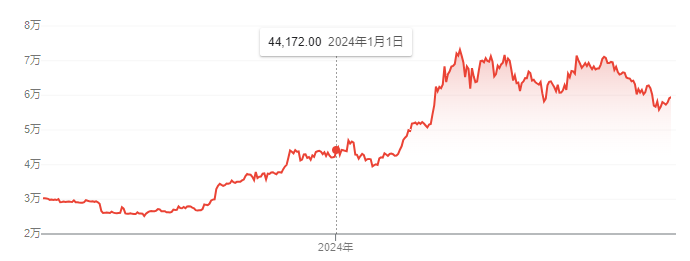
△ BTC Market Cap Trend from January 1 – July 14, 2024
Market Cap Unit: USD, Source: Google
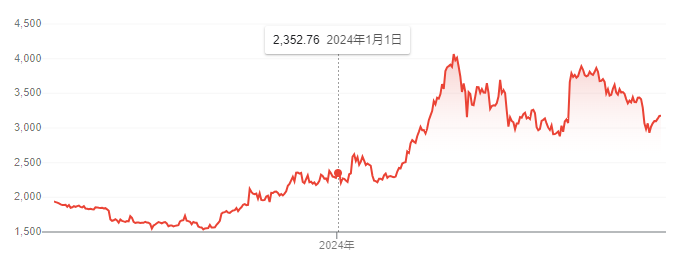
△ ETH Market Cap Trend from January 1 – July 14, 2024
Market Cap Unit: USD, Source: Google
Rising ETH valuations remain a hopeful prospect. However, given the typically massive scale of traditional finance ETFs and the structure of U.S. Ethereum ETFs—which hold large quantities of ETH without participating in staking—could this pose risks to Ethereum’s network security?
Additionally, if staking rewards fall short of ETF returns, might reward-seeking participants abandon staking altogether? Could large-scale non-staking holdings by asset managers distort ETH’s pricing mechanism or even enable manipulation? Would this exacerbate centralization? And could it undermine Ethereum’s original vision of becoming a “world computer”?
These concerns are not hypothetical. Given the global influence and capital-drawing power of the U.S. securities market, the launch of U.S. Ethereum ETFs presents a double-edged sword for Ethereum’s future development and core mission.

If U.S. Ethereum ETFs are rejected, what alternatives should we watch?
Beyond the U.S., markets such as the UK, Hong Kong, and Australia have already joined the ranks of jurisdictions offering Bitcoin ETFs. The trend of digital assets integrating into mainstream financial markets continues to strengthen.
On April 15, 2024, both Harvest Fund International Asset Management and CSOP Asset Management announced they had received preliminary approval from the Hong Kong Securities and Futures Commission (SFC) to list the first Bitcoin and Ethereum ETFs on the Hong Kong Stock Exchange (HKEX). Thanks to Hong Kong’s clear regulatory framework—which designates digital assets as non-securities under SFC oversight—these ETFs avoid the regulatory uncertainties facing U.S. applicants and eliminate compliance risks associated with issuing unregistered securities.
On April 30, 2024, HKEX officially began trading Bitcoin and Ethereum ETFs. Notably, Hong Kong-listed ETFs also support in-kind subscriptions.
On May 24, 2024, Yahoo Finance reported, citing Bloomberg News and anonymous sources, that the Hong Kong SFC is considering allowing Ethereum ETFs to participate in staking. According to the sources, the SFC is currently in discussions with crypto ETF issuers regarding participation in staking via licensed platforms. These discussions are ongoing, with no definitive timeline for a decision. The SFC has declined to comment on the matter.
Join TechFlow official community to stay tuned
Telegram:https://t.me/TechFlowDaily
X (Twitter):https://x.com/TechFlowPost
X (Twitter) EN:https://x.com/BlockFlow_News
 @imTokenOfficial






