








Opinion: The TON foundation cannot possibly build an EVM Layer 2
TechFlow Selected TechFlow Selected
Opinion: The TON foundation cannot possibly build an EVM Layer 2
The TON ecosystem has almost no demand for Layer 2 solutions—TVM is the only first-class citizen.
 Navigating Web3 tides with focused insights
By Jaleel Ga Liu, BlockBeats
Recently, there have been rumors claiming "TON is launching an EVM L2," but I believe this is impossible—at least for now.
Before diving into the analysis, let's briefly review TON’s core technical features (scroll down three lines to skip the technical part).
First, it must be clarified that smart contracts on the TON blockchain run on the TON Virtual Machine (TVM), which is entirely incompatible with the Ethereum Virtual Machine (EVM).
Second, the programming language used for smart contracts on TON is FunC—a language specifically designed for the TON blockchain. Unlike traditional programming languages, FunC emphasizes decentralized technologies based on asynchronous paradigms.
Additionally, TON employs dynamic sharding technology, automatically scaling the blockchain into more shard chains according to network load. TON’s architecture consists of one masterchain and multiple workchains, with workchains further divided into shards—each capable of processing a portion of transactions.
Why It’s Impossible for TON Officially to Build an EVM L2?
Judging from token price performance this year, TON has seen the most significant growth among major public blockchains, far outpacing others.
If you had purchased TON on January 1, 2024, you would have already achieved over a 3x return by holding it until now. Currently, TON has surpassed Dogecoin in market capitalization, rising to ninth place globally.
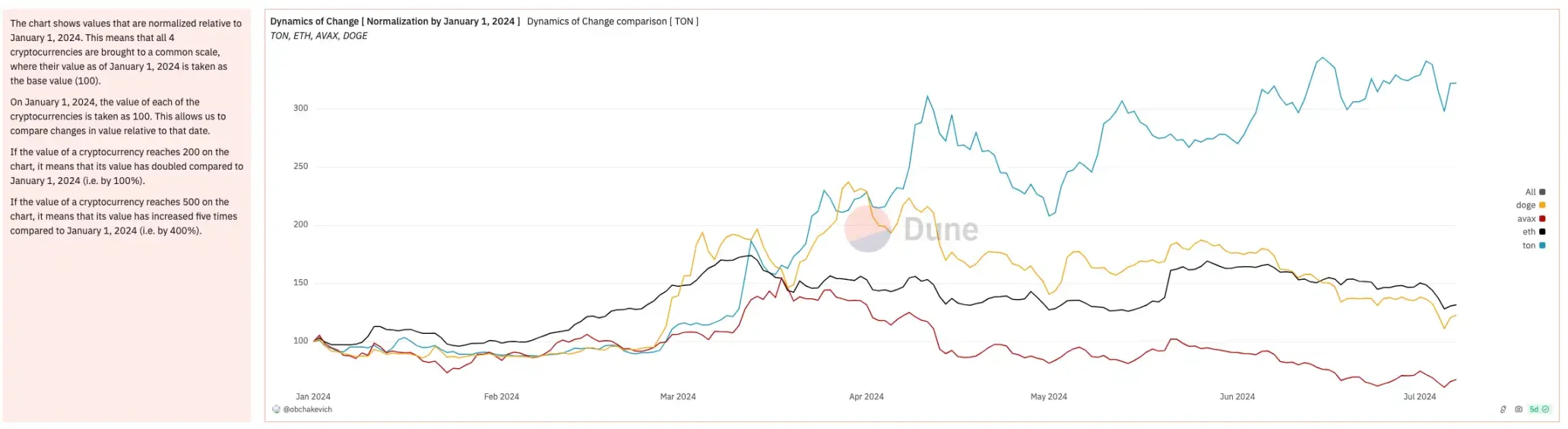
Alongside its rising price, TON’s ecosystem metrics have also grown—but clearly not to a level where a Layer 2 solution is necessary.
Once Bridges Are Built, Villagers Leave
TON does not want its TVL to flow out from TON to EVM chains. Analyzing current TVL and liquidity data makes this clear.
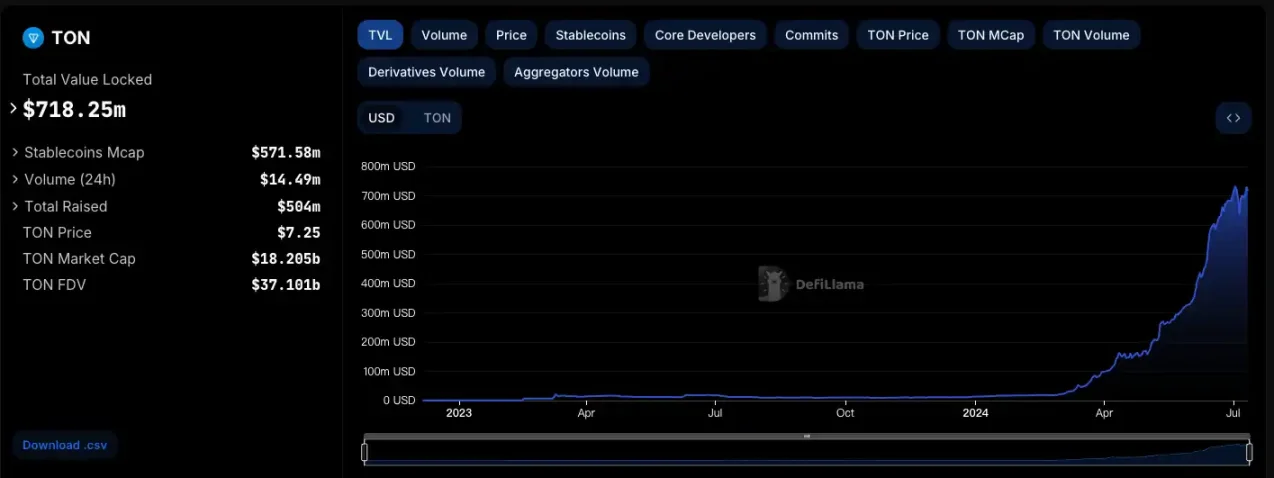
In terms of TVL growth, prior to this year, TON’s TVL hovered around $10 million. However, in the first seven months of 2024, it has risen sharply—nearly 70-fold.
According to DefiLlama, TON’s current Total Value Locked (TVL) stands at $718 million, with stablecoins accounting for $571 million. This indicates TON already has a solid base of DeFi capital, though still modest compared to top-tier blockchains.
In contrast, Ethereum’s DeFi ecosystem is vastly larger, with a current TVL of approximately $54.2 billion—about 80 times that of TON.
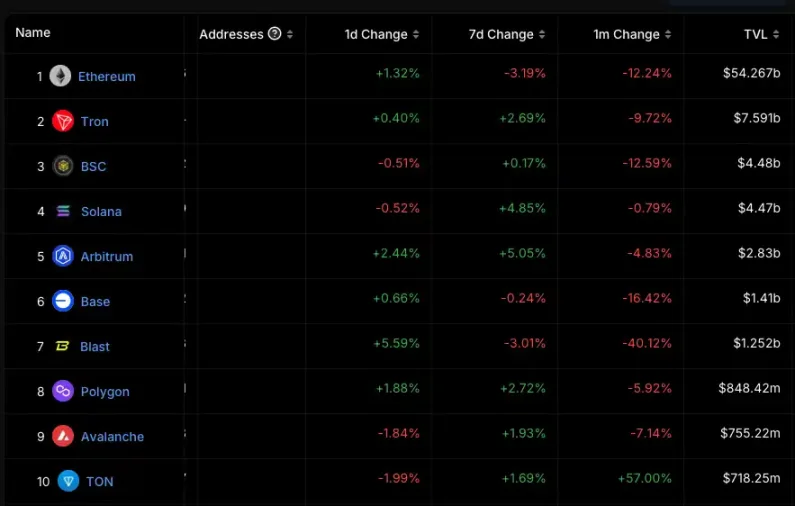
However, from a certain perspective, high TVL was never TON’s original design goal.
"Fewer than 10% of TON’s native users participate in DeFi. Unlike most L1s, many projects on TON—such as mini-games—are off-chain operations settled on-chain," said vivi, research lead at the TON Foundation.
Therefore, TVL isn’t crucial here—or rather, boosting TVL isn’t the game TON excels at.
Moreover, TON struggles to retain liquidity. The total amount transferred from Ethereum to TON is $18.95 million, while transfers from TON back to Ethereum amount to $16.1 million.
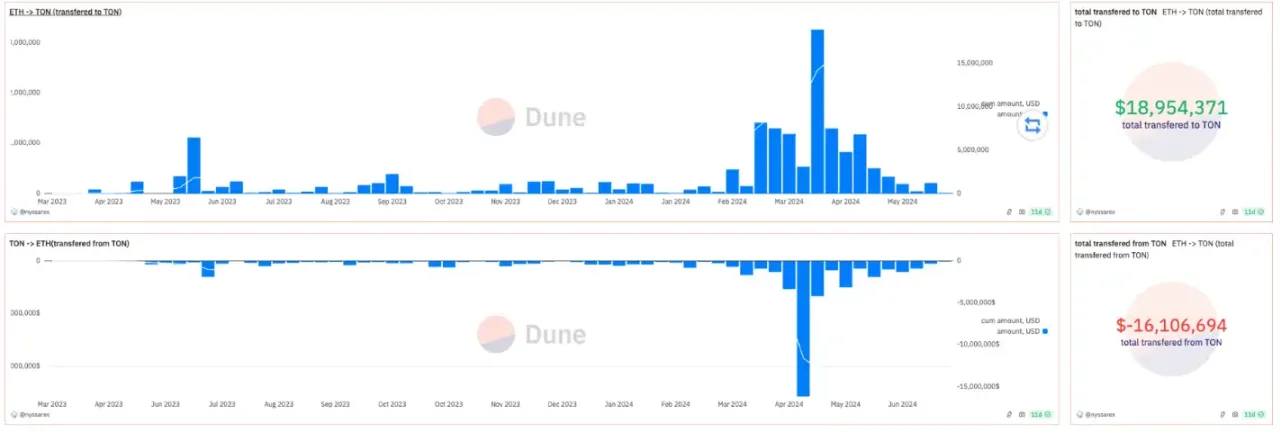
Looking at inflows and outflows of liquidity, if EVM compatibility were ever implemented, TON doesn’t appear to have a strong advantage in attracting long-term liquidity from Ethereum.
With over 800 million active Telegram users, Telegram’s user base represents a massive opportunity—a “windfall fortune”—giving TON a natural edge in user growth. For TON, achieving EVM compatibility would essentially mean working for Ethereum.
No Sports Cars? Why Build Highways?
Over the past two months, leading DEXs on TON—including STON.fi and DeDust—have seen their TVL grow nearly 20-fold.
While the growth multiplier sounds impressive, the absolute numbers remain limited.
The total trading volume on TON-based DEXs is $405 million, with buy/sell volume at $10.76 million, and daily transaction count hovering around 200.
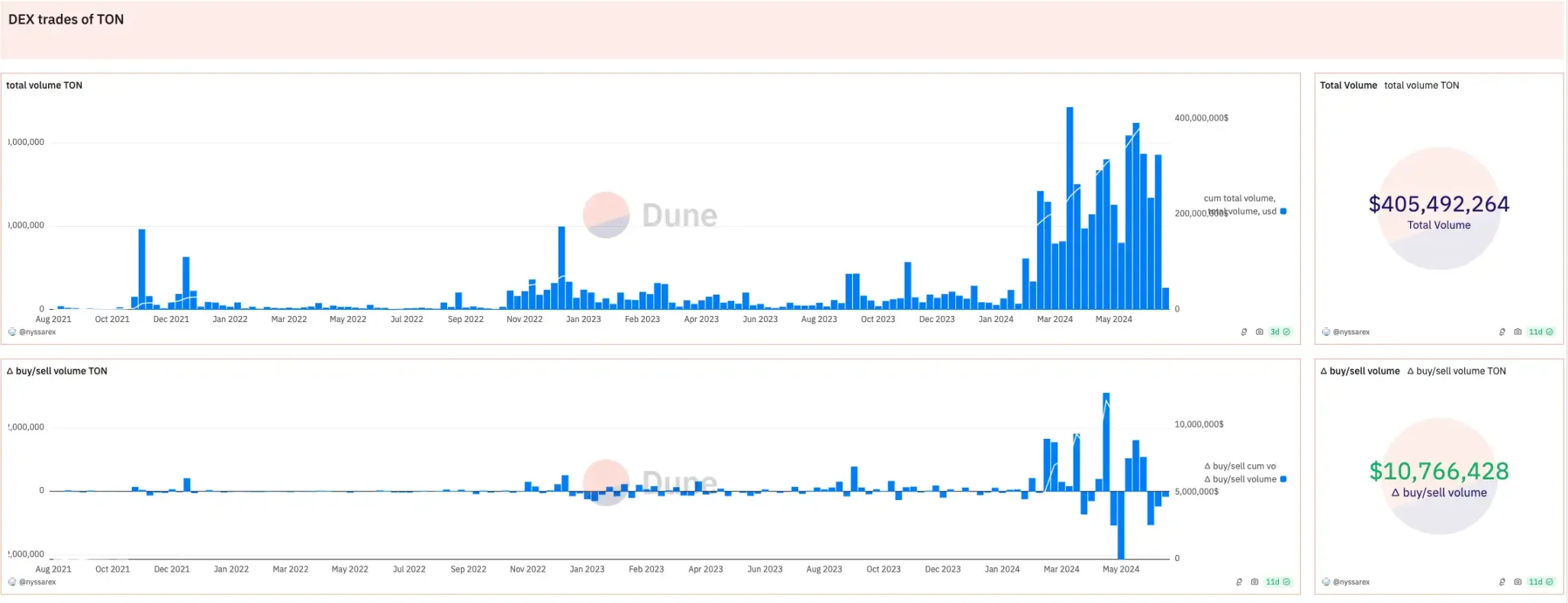
A key catalyst behind the rapid growth in TON’s DeFi data has been its partnership with Tether, expanding USDT on TON and enabling payments within Telegram—again reinforcing the point made earlier: unlike most L1s, most TON projects operate off-chain with on-chain settlement.
Although several DEXs and staking platforms are operating on TON, their number is limited, and there are no mature lending protocols or CDP (Collateralized Debt Position) systems yet.
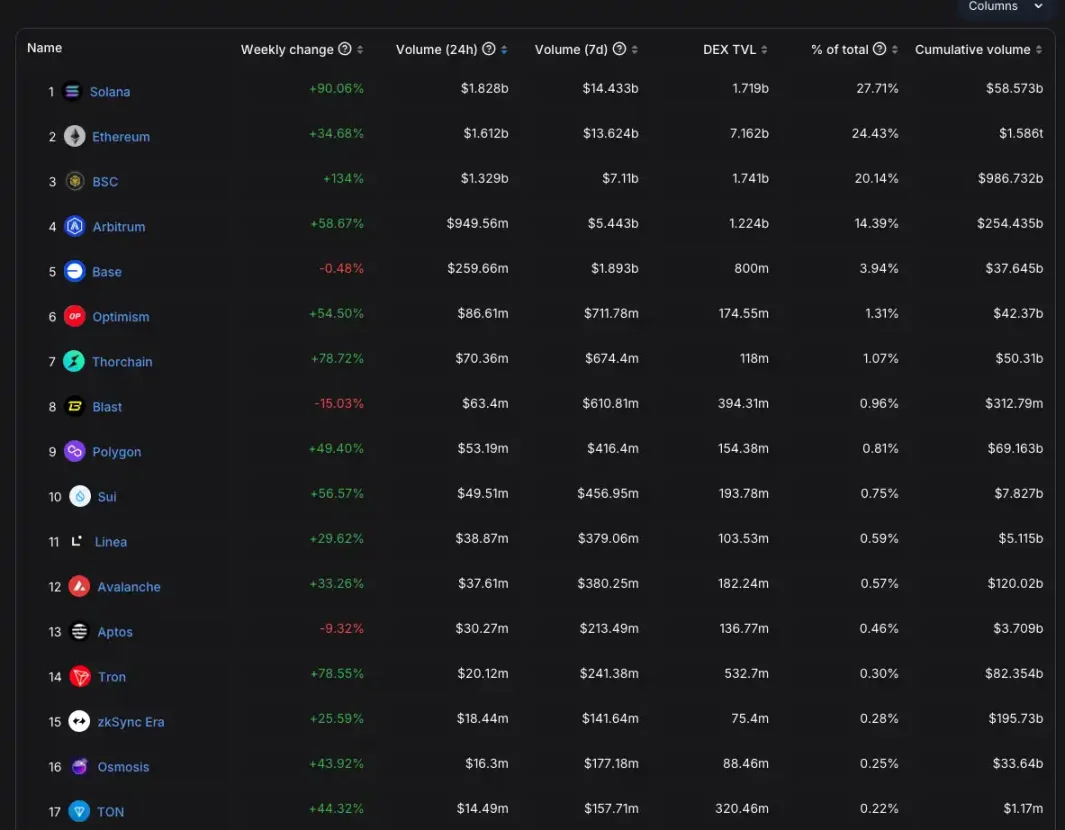
When compared to transaction volume data from other blockchains, the gap becomes even clearer. DeFi applications within the TON ecosystem are still in early development and far from maturity.
In a widely circulated group chat screenshot recently, vivi bluntly stated: "Given that TON’s mainnet only has 2 DEXs, 1 lending protocol, and 0 CDPs, we will naturally prioritize promoting our own TVM first."
Meanwhile, we all know that speed and low cost are TON’s standout features. In 2023, TON set a Guinness World Record for transaction processing speed, reaching 104,715 transactions per second.
Transaction costs are also minimal: the average fee for sending any amount of TON is 0.0055 TON; sending any amount of custom JetTON tokens costs 0.037 TON on average; minting one NFT averages 0.08 TON; storing 1MB of data on TON for one year costs 6.01 TON.
At this stage, TON has almost no need for a Layer 2 because its Layer 1 is already fast and cheap enough.
So Where Did the Rumor Come From?
Where did this rumor about TON building a Layer 2 originate? I traced it back to CoinDesk, which initially reported it incorrectly—and has since issued a correction.

In fact, the project planning to build a Layer 2 on TON is a third-party initiative called TAC—unaffiliated with the official TON team.
The TAC project plans to leverage Polygon’s Chain Development Kit (CDK)—a customizable toolkit allowing developers to create their own Layer 2 blockchains using Polygon’s zero-knowledge technology—alongside Polygon’s AggLayer, an interoperability layer designed to address blockchain fragmentation.
Polygon, zero-knowledge, Layer 2—it sounds like everything is covered, but I don’t believe this aligns with what TON currently needs.
TVM Is the Only First-Class Citizen
As team members clarify that the official TON team is not developing an EVM L2, another keyword emerges: TVM.
For example, Anthony Tsivarev, Ecosystem Development Director at the TON Foundation, said: "Have you heard about a Layer 2 on TON built on Polygon’s stack? Some might think it’s an official TON version, but it’s not. It’s independently developed by a third-party team on TON. We believe in TVM!"
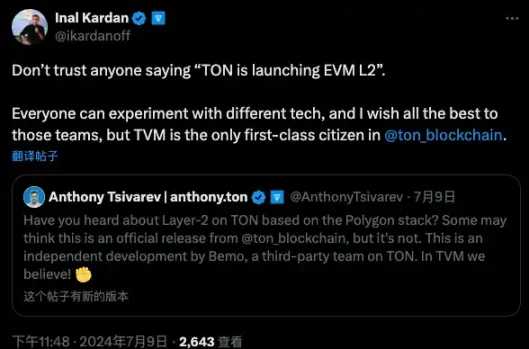
Inal Kardan, TON’s gaming lead, put it even more directly: TVM is the only first-class citizen on TON.
Looking back at the whitepaper, TON officially emphasized in its blockchain development strategy that TVM (Threaded Virtual Machine) is its top priority.
For TON, all future advancements in decentralized technology will ultimately be based on asynchronous paradigms. As a core component of the TON blockchain, TVM is designed to execute smart contracts efficiently and securely. Unlike EVM, TVM emphasizes asynchronous patterns, enabling it to handle more complex decentralized applications (DApps).
For instance, TONNEL Network leverages recent TVM updates to enable complex computations and proof verification, allowing zero-knowledge proofs to be implemented directly within smart contracts—enhancing on-chain privacy. By deploying private transactions and ZkNFT standards via TVM, TONNEL Network further demonstrates TVM’s pivotal role in the TON ecosystem.
Since the official TON team won’t build an EVM L2, could it happen in the future? The TON whitepaper includes a passage that largely clarifies this:
-Is there a need for L2 on the TON?
-At any transaction cost, there will always be applications that cannot sustain such a fee but can function at a much lower cost. Similarly, regardless of the latency achieved, there will always be applications that require even lower latency. Therefore, it is conceivable that there might eventually be a need for L2 solutions on the TON platform to cater to these specific requirements.
(Regardless of transaction costs, there will always be applications unable to afford them but able to operate at much lower costs. Likewise, no matter how low the latency, some applications will demand even faster speeds. Thus, it’s conceivable that TON may eventually require L2 solutions to meet these specific needs.)
In my view, a TON L2 could exist—but it’s unnecessary. TON can simply use its sharding technology to create a new workchain instead.
The only possible reason TON might pursue EVM compatibility in the future is developer accessibility. On TON, running smart contracts requires using FunC—a specially created programming language. For most developers who learned Solidity, adopting FunC means having to "re-adjust" their mindset.
Simply put, development is difficult—which explains why there are so few DeFi products in the TON ecosystem today. "People are building TON L2s mainly because 99% of developers can't build on the main chain," vivi said frankly.
However, the TON team may offer alternative solutions—such as the TVM SDK, which has begun supporting multiple programming languages.
That’s precisely why I believe the official TON team will not build an EVM L2—at least not now.
Join TechFlow official community to stay tuned
Telegram:https://t.me/TechFlowDaily
X (Twitter):https://x.com/TechFlowPost
X (Twitter) EN:https://x.com/BlockFlow_News
 BlockBeats






