








What’s Grayscale’s secret to attracting capital? Despite high fees and over $18.6 billion in outflows, it remains second in Bitcoin spot ETFs
TechFlow Selected TechFlow Selected
What’s Grayscale’s secret to attracting capital? Despite high fees and over $18.6 billion in outflows, it remains second in Bitcoin spot ETFs
This article will examine the underlying reasons for the deep capital entrenchment in Grayscale's GBTC from perspectives such as return on investment, liquidity, bid-ask spreads, and taxation.
 Navigating Web3 tides with focused insights
Author: Nancy, PANews
As market size continues to grow, capital flows into spot Bitcoin ETFs have become a key indicator for market observers, with strong inflows providing a significant boost to the industry. Among these ETFs, although Grayscale has faced ongoing controversy due to continuous fund outflows, GBTC still maintains a leading advantage in assets under management (AUM), despite its fees being significantly higher than those of its peers.
This article by PANews analyzes the reasons behind GBTC's deep capital retention from perspectives including return on investment, liquidity, bid-ask spreads, and taxation. It should be noted that as fee-waiver periods for ETFs such as FBTC, ARKB, BITB, BTCO, and EXBC approach, they may impact competitive market shares.
GBTC Net Outflows Exceed $18.6 Billion; Grayscale Plans ETF Split to Alleviate Fee Pressure
Since converting to a spot ETF in January 2024, Grayscale’s GBTC has consistently experienced fund outflows. According to SoSoValue data, as of July 11, GBTC’s historical net outflows reached $18.66 billion—nearly equivalent to BlackRock’s total net inflows.
In addition to investor profit-taking, fees are another major reason behind the large outflows. While issuers such as BlackRock, Fidelity, and Bitwise charge management fees at or below 0.25%, GBTC’s fee stands at 1.5%. Even before the U.S. SEC approved spot Bitcoin ETFs, the other 10 ETFs reduced their fees to attract investors, but GBTC did not adjust its pricing.
For cost-conscious investors, GBTC is clearly unattractive. In response, Grayscale CEO Michael Sonnenshein explained that given the fund’s scale, liquidity, and strong performance over the past decade, GBTC’s fees are justified. Dan McArdle, co-founder of Messari, speculated: “The simplest explanation might be the most likely. For instance, Grayscale may have considered all factors and realized that maintaining high fees allows them to earn more money. They’ve likely calculated precisely how much percentage of funds will flow out versus how much will remain invested for years under such high fees.”
To counter competitive pressure on fees, Grayscale has applied for a “mini” version of GBTC with a reduced fee of just 0.15%. Grayscale plans to allocate over 63,000 bitcoins to this Mini Fund, approximately 10% of GBTC’s current assets. To retain existing investors, the mini GBTC will allow automatic transfers into the new fund without triggering capital gains taxes.
Beyond Bitcoin spot ETFs, spot Ethereum ETFs—including one from Grayscale—are also expected to launch soon. Bloomberg ETF analyst Eric Balchunas predicts the SEC could approve them by July 18. However, Grayscale has not yet disclosed fees in its filings for the spot Ethereum ETF or the revised S-1 for its Ethereum Mini Trust. Industry estimates suggest management fees cover fund operating costs such as marketing, salaries, and custody services. Most Bitcoin spot ETF issuers have chosen fees between 0.19% and 0.3%, and Ethereum ETF issuers are likely to follow a similar range.
Backed by 671 Public Companies; These Factors May Drive Holdings
Despite months of fund outflows, GBTC’s market scale remains substantial compared to competitors. SoSoValue data shows that as of July 11, GBTC’s net asset value was still $15.65 billion, accounting for about 30.9% of total spot Bitcoin ETF assets—second only to financial heavyweight BlackRock.
According to PANews’ analysis, among the top five spot Bitcoin ETFs, GBTC leads with 671 institutional holders—far surpassing others. Fintel data reveals that public companies holding GBTC include asset management giant SIG, Horizon Kinetics Asset Management, Wall Street powerhouse Morgan Stanley, and top hedge fund Millennium Management. Collectively, these institutions hold over 7,735 GBTC shares, currently valued at nearly $3.94 billion.
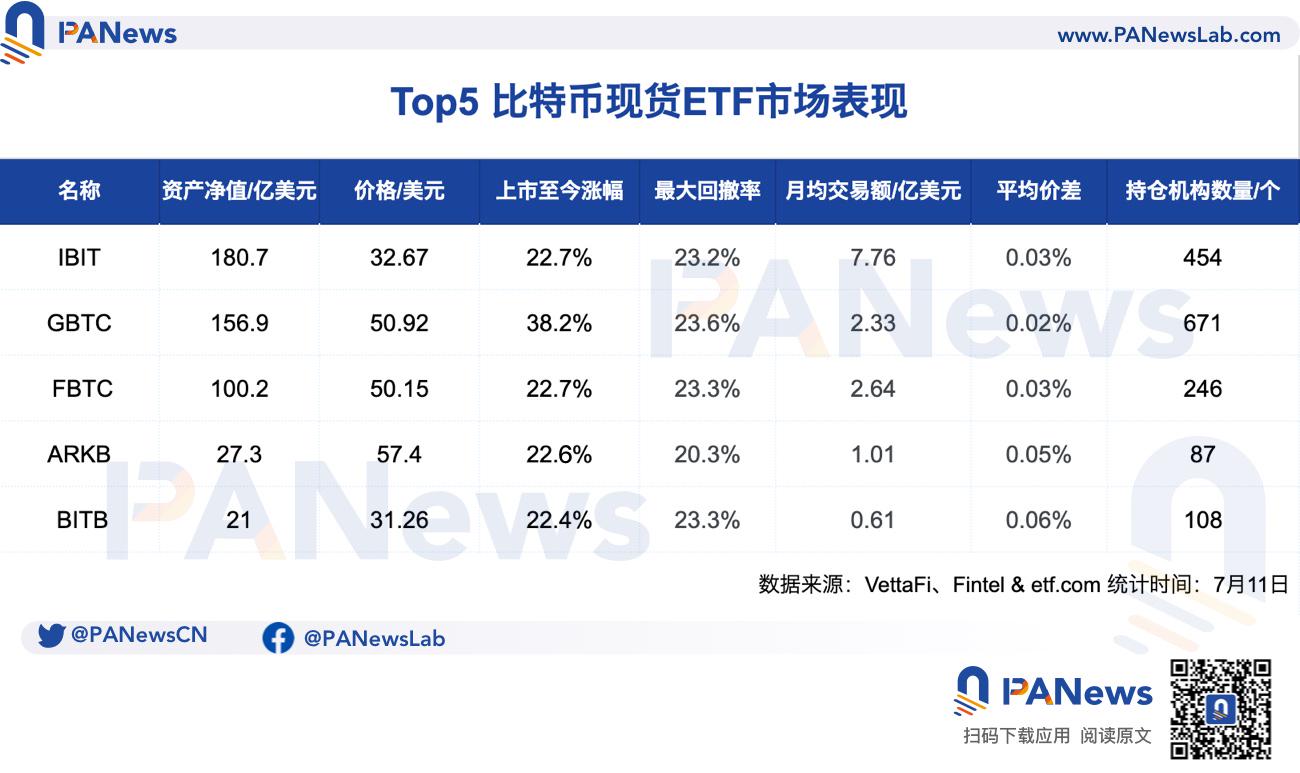
Below, PANews compares the market performance of the top five spot Bitcoin ETFs to explore Grayscale GBTC’s multiple advantages in the ETF race.
User Base from First-Mover Advantage
Compared to other spot Bitcoin ETF issuers, Grayscale’s GBTC debuted as early as 2013—giving it over a decade of first-mover advantage and a deeply established user base. During this period, it attracted arbitrageurs through significant premiums (peaking above 43%) and regained investor trust as its prior steep discounts (exceeding 48%) eventually narrowed. Moreover, early holders achieved exceptional returns. Google Finance shows that as of July 11, GBTC’s price has surged 9,325.9% since inception.
Return on Investment and Downside Resilience
Returns and risk management are key considerations for investors. Since their launch on January 11, 2024, the average return among the top five spot Bitcoin ETFs has been 25.7%, with GBTC leading at 38.2%—outperforming IBIT, FBTC, and ARKB. The average maximum drawdown across these ETFs was 22.7%, indicating no significant difference in downside resilience.
Liquidity and Demand Performance
Liquidity is closely related to product scale—higher liquidity improves trading convenience and reduces transaction costs, while larger circulating market caps result in smaller price impacts from trades. VettaFi data shows the top five spot Bitcoin ETFs averaged $287 million in monthly trading volume, with IBIT, FBTC, and GBTC above average. Although GBTC ranks third with $233 million, BlackRock and Fidelity—the top two—benefit from strong reputations and extensive resources in traditional finance, making their Bitcoin ETFs more trusted by mainstream investors. Additionally, bid-ask spread serves as an indicator of supply-demand balance. The average spread among these ETFs is 0.04%, with BlackRock leading at 0.02%, lower than its peers.
Potential Tax Implications
While spot Bitcoin ETFs offer investors a more convenient and secure investment vehicle, they are subject to capital gains tax, with rates depending on holding periods. This means GBTC holders must weigh fees against potential capital gains tax liabilities.
Previously, Shehan Chandrasekera, Head of Tax Strategy at CoinTracker, explained that selling Bitcoin ETF holdings held for less than one year triggers short-term capital gains taxed as ordinary income—ranging from 10% to 37% based on total taxable income and filing status. Selling holdings after more than 12 months incurs long-term capital gains tax, which could be 0%, 15%, or 20%. If income exceeds certain thresholds, an additional 3.8% tax may also apply.
Join TechFlow official community to stay tuned
Telegram:https://t.me/TechFlowDaily
X (Twitter):https://x.com/TechFlowPost
X (Twitter) EN:https://x.com/BlockFlow_News
 PANews






