









Opinion: L2 is the savior of users, but the plunderer of L1
TechFlow Selected TechFlow Selected
Opinion: L2 is the savior of users, but the plunderer of L1
When more people start using L2, it could be a win-win for both Ethereum and users.
 Navigating Web3 tides with focused insights
Author: Decentralised.Co
Translation: TechFlow
Are L2s Extracting Value from L1?
L2s use L1 for settlement while offering users cheaper transaction services. They act as intermediaries between L1 and users, capturing value through fees (including MEV). But are they paying enough for the valuable block space on L1? Let's analyze the impact of L2s on Ethereum through four charts.
1. How do L2s benefit the Ethereum ecosystem?
Setting aside L2 tokens themselves, let’s examine their contribution to the broader Ethereum ecosystem. One way to measure this is by assessing how much L2 tokens have boosted ETH's market capitalization.
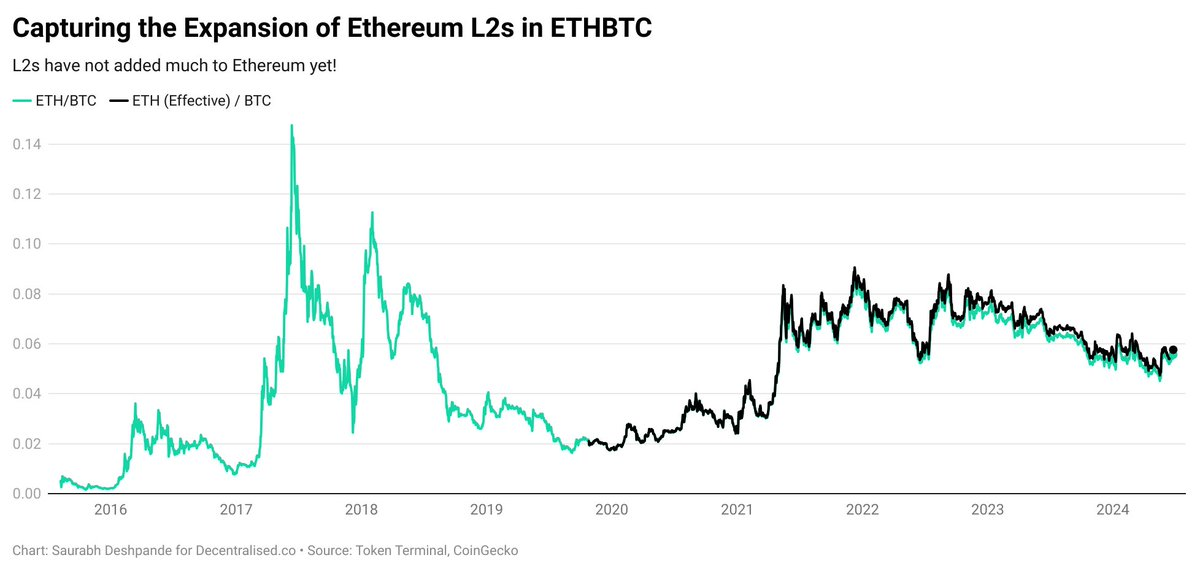
For comparison, I use the ETH/BTC ratio as a benchmark reflecting Ethereum's ecosystem trend relative to Bitcoin.
To capture the full value of Ethereum, I add the market caps of the top 10 L2 tokens to ETH, treating it as "effective ETH" or the total value of the entire Ethereum ecosystem.
Currently, the top 10 L2s have almost no impact on the ETH/BTC ratio. With Bitcoin's market dominance exceeding 50%, the chart below shows that L2s have not significantly lifted the (effective) ETH/BTC ratio (see the black line versus the green line).
2. Where is value being captured?
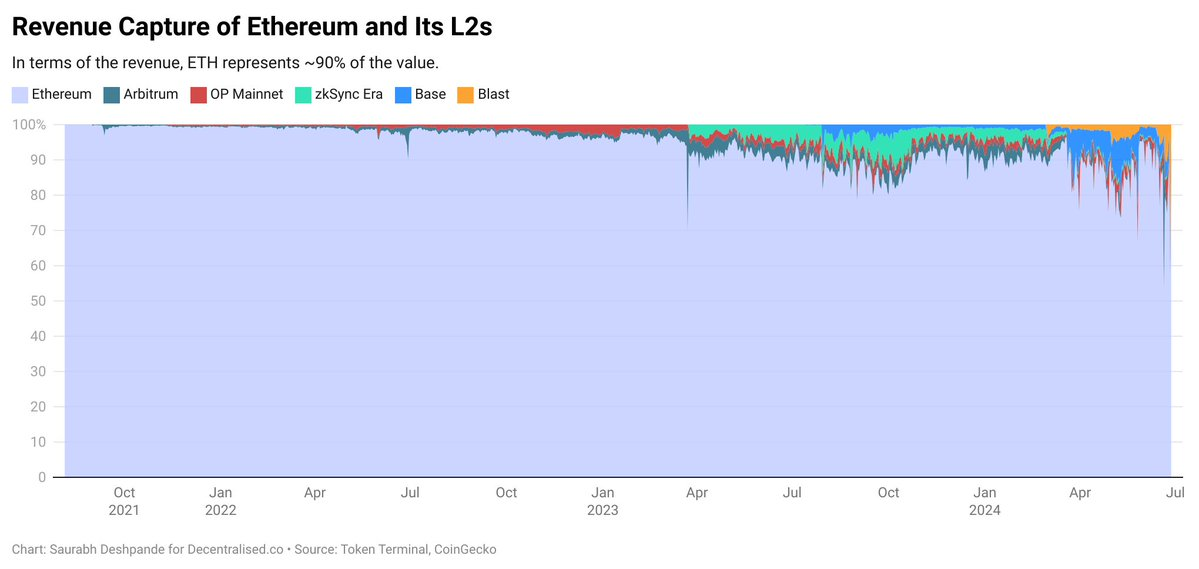
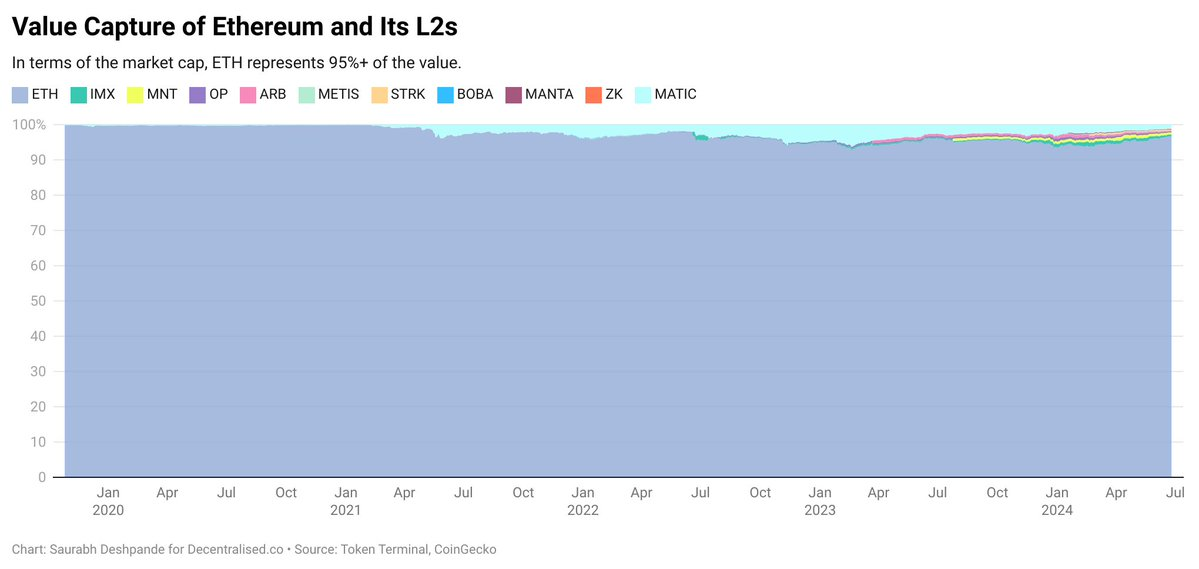
Simply put, value capture can be measured by two metrics: revenue and market cap. If value is being generated, it should reflect in price.
a. Where is revenue being captured? Ethereum consistently captures around 90% of the total revenue generated within the Ethereum ecosystem. In Q2 2024, Base has been the leading revenue-generating L2, followed by Blast.
b. In terms of market cap, ETH still accounts for over 95% of the combined market cap of the top 10 L2s.
3. How much revenue do L2s pass back to Ethereum?
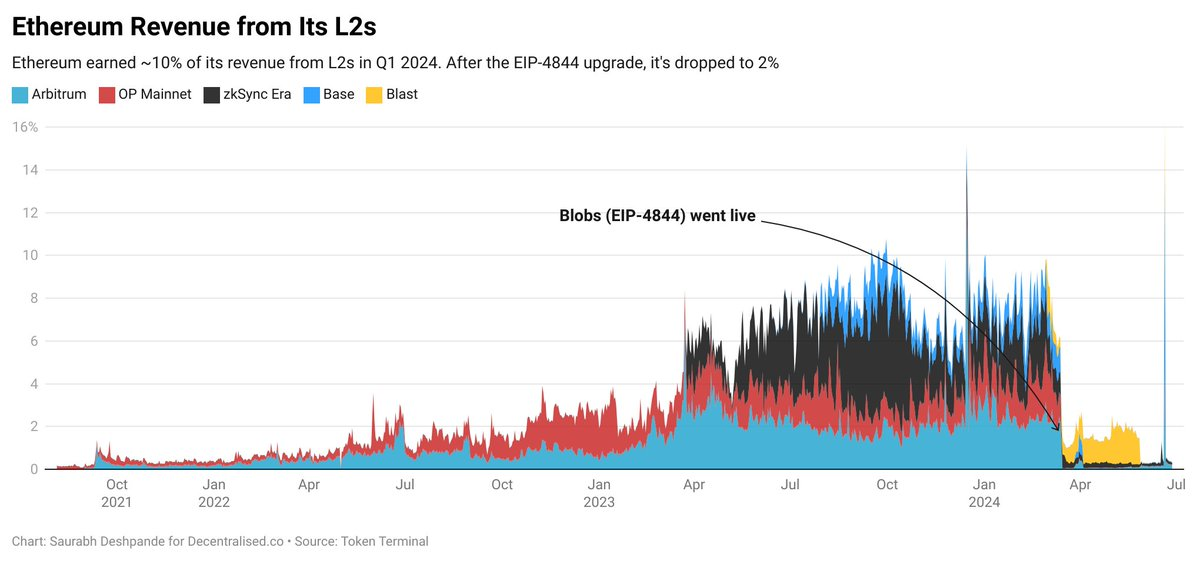
L2s incur costs when storing data on Ethereum—this is their operational cost. This cost needs to be balanced. If too high, operating L2s becomes difficult; if too low, Ethereum earns little despite providing critical settlement services.
Ethereum's 4844 upgrade (also known as Proto-Danksharding) reduced L2 operational costs. The lower data storage costs caused L2s' revenue contribution to Ethereum to drop from about 10% to roughly 2%. While this may seem like a setback, it prepares L2s for more users by lowering transaction costs.
So far, blobs appear to be a bad idea from Ethereum's perspective. But what's the end goal? Scalability.
In one week during 2024, Ethereum supported 7.1 million transactions with $10.6 million in revenue—about $1.50 per transaction. Meanwhile, five L2s (Arbitrum, Base, Blast, Optimism, and Polygon) processed over 70 million transactions at a cost of $2.75 million—just $0.03 per transaction.
We could debate the quality of these transactions—whether they're bot transactions or their intrinsic value—but the fact remains: Ethereum cannot support this volume of transactions.
Overall, building L2s and reducing their transaction costs by providing cheaper data storage options on L1 benefits users but is less favorable for Ethereum (L1). However, if most users choose to transact on L2s, more data gets pushed to L1. As L2s push more data and compete for L1 block space, base fees on L1 rise, increasing Ethereum's revenue. Thus, when more people start using L2s, it could become a win-win for both Ethereum and users.
Join TechFlow official community to stay tuned
Telegram:https://t.me/TechFlowDaily
X (Twitter):https://x.com/TechFlowPost
X (Twitter) EN:https://x.com/BlockFlow_News
 @Decentralisedco






