








How Web3 Can Attract Hundreds of Millions of Users: Exploring Morph's Consumer-Centric L2 Growth Solution
TechFlow Selected TechFlow Selected
How Web3 Can Attract Hundreds of Millions of Users: Exploring Morph's Consumer-Centric L2 Growth Solution
From OGs and whales to the general public, Morph has unveiled a new formula for Web3 to reach hundreds of millions of users.
 Navigating Web3 tides with focused insights
Over the past five years, what has been the most successful crypto financial product globally?
The most popular answer isn’t DeFi innovations like Uniswap that ignited the DeFi Summer, nor digital art pieces like CryptoPunks that sparked the NFT craze. Instead, it’s something we’ve long taken for granted—stablecoins.
Indeed, beyond high-stakes DeFi and NFT games, stablecoins aimed at everyday users have become the most widespread use case in crypto finance—just the TRC20 version alone boasts over 40 million on-chain addresses. This has truly transformed blockchain and crypto economies from niche pursuits into mass-market phenomena, significantly expanding and deepening the user base of the crypto economy.
At the same time, this reflects the general public's strong demand for "Web3 consumer products." Web3 was never meant to be a playground for whales. Recognizing this, Morph decisively abandoned strategies centered around crypto OGs and chain whales. Instead, it clearly positioned itself as a “consumer-grade L2,” choosing to build with a “consumer-first” approach, focusing on the majority—ordinary users and developers:
Imagine if Morph could attract existing Web3 users exhausted by high-barrier financial games through consumer-facing applications such as payments, gaming, SocialFi, and entertainment—and simultaneously bring traditional Web2 players with massive capital and traffic into Web3. Could this become a breakthrough point for mass Web3 adoption?
Web3 May Be on the Brink of a 'Consumer DApp' Boom
Change begins subtly. Against the unprecedented shifts in TraFi and regulation in 2024, consumer-focused L2s like Morph may offer a fresh alternative for the general public weary of "VC coins" and whale-dominated games.
It’s worth noting that both regulatory and financial macro-environments have recently turned favorable. On May 22, the Financial Innovation and Technology for the 21st Century Act (FIT21) passed the House of Representatives by a landslide vote of 279 to 136. Then, on May 24, the U.S. Securities and Exchange Commission (SEC) officially approved eight spot Ethereum ETF filings via Form 19b-4.
This signals a softening stance from U.S. regulators. Institutions already exposed to spot Bitcoin ETFs may now diversify further into Ethereum investments. But this raises an old problem:
With Layer 2s proliferating and on-chain rewards becoming increasingly inaccessible, whether using DeFi or NFTs or participating in testnets and airdrops for potential gains, the system is growing ever more favorable to whales, leaving average users with fewer opportunities to share in Web3 and project growth benefits.
So even if Ethereum-based ecosystems see a flood of new capital, how can a strategy focused only on OGs handle this massive influx of new users and funds?
In many ways, each additional whale-centric financial game or airdrop that ignores ordinary users drives more people away from Web3. Without new users, the ecosystem will eventually stall. The solution must be to start from broader fundamental needs—just like stablecoin payments—and attract far more mainstream users.
This echoes the story of Pinduoduo, once dismissed as promoting “downgraded consumption.” In reality, it leveraged the highways of internet, manufacturing, and logistics to reach the grassroots masses—the overlooked yet dominant majority—miraculously overturning Alibaba and JD.com’s first-mover advantages and achieving an “impossible reversal.”
A single spark can start a prairie fire. There was no real consumption downgrade—only a new traffic-growth strategy rooted in reaching the masses. Today’s Web3 needs exactly this kind of “going down to the grassroots” approach and a renewed focus on mainstream users—a network that connects new users and capital through consumer scenarios stands to capture the biggest rewards.
Recall how Axie Infinity rose rapidly in 2021 by tapping into Southeast Asia’s ordinary population—anyone with just a smartphone could play-to-earn. With good strategy and ample time, earnings could surpass several times the average monthly salary. In short, the crypto and Web3 world isn’t just about financial use cases.
In this context, Morph’s unique positioning as a “consumer-grade L2” aligns perfectly with this incremental need. Especially after the Dencun upgrade drastically reduced L2 fees, gas friction across the Ethereum ecosystem has hit historic lows—removing the core barrier to thriving consumer-grade DApps:
-
On one hand, consumer-grade use cases span a wide range, offering numerous expansion points for the ecosystem—from entertainment and leisure fulfilling emotional needs to on-chain assets meeting material ones. Morph can cover these through continuous ecosystem development;
-
On the other hand, the target user market is vast. At a time when blockchain seeks mainstream breakout, providing low-barrier, seamless experiences can make Morph a gateway for billions of Web2 users entering Web3;
While most native on-chain applications like DeFi and NFTs are still striving to break out, acquire initial traffic, and retain users, Morph has chosen an almost opposite path:
Targeting the massive grassroots Web2 internet users—and even partnering with leading Web2 companies—Morph uses consumer applications and real-world scenarios to directly bridge tens of billions of existing Web2 users and traditional capital into Web3’s new user base and “New Money.”
Morph: A Consumer-Centric Incremental Solution for L2
To stretch an analogy, Morph somewhat follows a “surrounding the cities from the countryside” strategy—starting from ordinary users’ real needs, capturing this growing segment, and using consumer apps as the ideal entry point for traffic breakthroughs:
By enabling everyone to access Web3 services and enjoy consumer-level on-chain use cases, Morph provides users with on-chain services covering wallets, payments, social, gaming, and entertainment—gradually building a broad consumer-grade L2 ecosystem centered on billions of internet users.
Thus, interpreting Morph merely as a “consumer-grade L2 in the Web3 world” might be too narrow. Fundamentally, it aims to serve a much broader market with low barriers, combining Web3 with everyday scenarios and average consumers—bringing more new users into Web3 through democratization.
Yet “consumer applications” remain largely uncharted territory in Web3. What truly qualifies as a blockchain- and token-economics-integrated consumer app or consumer-grade DApp? How do we attract enough users into Web3 and keep them engaged?
We might glimpse early signs of this vision in Morph’s recent multi-phase “Morph Zoo” initiative targeted at community users:
Currently, ten interactive DApps are available on the official site. Besides cross-chain bridges, liquidity protocols, lending protocols, and NFT marketplaces, there are also consumer and DePIN-type DApps such as RapcHAIN and PingPong. (See Morph’s New Take Inside the L2 Fortress: How Can Users and Developers Share Ecosystem Growth Benefits?)
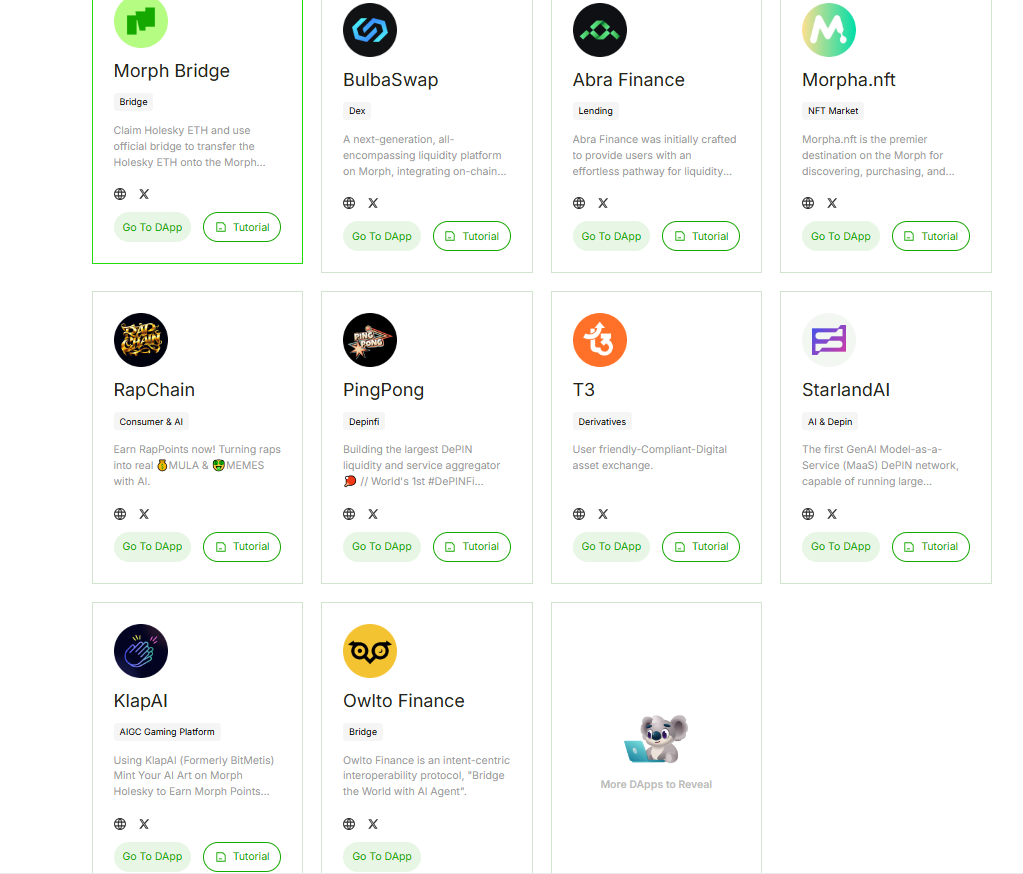
RapChain
RapChain is an entertainment and interactive platform integrating blockchain, AI, memes, and rap, allowing players to create unique meme-rap works and earn rewards through gameplay and competitions. Any user can spend a small amount of ETH to use AI technology to auto-generate a draft of a meme rap and choose different virtual MCs for performance.
It also features a FOMO3D-inspired game mechanic: users’ rap creations are added to a chain of entries from other participants. Players must create and join the chain within a time limit, aiming to extend their chain length. Winners receive ETH rewards, and the creator of the longest chain earns an extra bonus.
As the game progresses, the cost of creating raps gradually increases, requiring players to strategically decide when to join the chain.
The reason complex entertainment DApps like RapChain choose Morph highlights Morph’s friendliness toward consumer-grade DApps—enabling innovation through advanced tech without burdening users with complexity.
Especially with AI-generated content (AIGC), intellectual property (IP), and NFTs involved, users don’t need to worry about backend operations—they simply enjoy creating and sharing novel content.
PingPong
PingPong is a new solution simplifying DePIN mining, aiming to combine crypto tokenomics with greater on-chain financial possibilities for DePIN, thus building an on-chain financial market around computing power resources.
Users simply create an account, download, and launch the app to begin mining. PingPong’s algorithm automatically optimizes resource allocation for maximum returns. It integrates multiple DePIN networks into one platform, eliminating the need to manage separate systems.
As you may have noticed, these are consumer applications with established or potentially large user bases and underlying needs. Their choice of Morph is straightforward—integrating with Morph allows traditional Web2 consumer products to enter the Web3 space at minimal cost, delivering consumer-grade DApp experiences and gaining incremental advantages through richer on-chain scenarios.
Likewise, this represents Morph’s exclusive competitive edge over other blockchains/L2s in partnering with mainstream Web2 companies—not limited to purely on-chain scenarios, but drawing growth from mature Web2 products and use cases.
In a way, this is one of Morph’s key focuses in pushing “consumer-grade DApps,” connecting new users/traffic with on-chain services, and positioning itself to capture the largest incremental benefits while delivering consumer-grade Web3 experiences worldwide.
A New Paradigm for Mass Adoption of Ethereum and L2?
“Usefulness” is the highest praise a public chain can receive—and may become Morph’s irreplicable competitive advantage in the future.
The market is beginning to recognize that the underlying logic of Web3 competition is increasingly tied to Web2—unlike most current Web3 apps actively seeking breakout, the collision between native Web2 products and Web3 may already be bringing massive Web2 user bases passively into the Web3 world.
Just as stablecoins enabled millions of Web2—or even “Web0”—users, especially the unbanked, to access convenient, near-zero-cost global instant payments, they were also potentially converted into new Web3 users, capturing this incremental value.
Therefore, consumer applications hold profound historical significance for the entire Web3 industry and may represent a paradigm shift in product thinking—building a low-barrier Web3 environment targeting new users and mimicking traditional Web2 app experiences, returning to a user-centric product model to capture the broadest foundational value.
For Morph, helping projects like RapChain enter Web3 is a key milestone in its mass adoption strategy, potentially making it the critical network bridging new users/traffic with on-chain services:
If Morph successfully brings RapChain and similar high-DAU Web2 projects into Web3 and leads further replications, it would validate the correctness and replicability of this incremental Web3 strategy.
In short, a consumer-driven approach may be the key gateway for Web3 to reach hundreds of millions of users, breaking the current growth bottleneck by bringing native Web2 users into Web3—repeating Axie Infinity’s incremental miracle through a different logic.
Throughout this process, Morph’s positioning as a “consumer-grade L2” gives it the potential to attract massive new users and achieve mass adoption:
-
First, Morph benefits from strategic partnerships with top exchanges like Bitget and MEXC, and leading wallets like Bitget Wallet and Trust Wallet, giving DApps access to vast user pools and direct global reach;
-
Second, as the first Ethereum L2 to implement a decentralized sequencer design at the foundational level, Morph redistributes sequencer profits (or control rights) back to on-chain projects and DApp developers, giving the L2 ecosystem genuine “self-growth” properties (see Decentralized Sequencer’s Debut: Understanding Morph’s Self-Incentivizing Ecosystem Flywheel);
Recently, beyond its testnet, Morph launched a community-driven co-construction initiative, rolling out a series of support programs for nurturing early consumer ecosystems, focusing on the development of diverse consumer-grade DApps (see Morph Idea Hub).
This program welcomes DApps across all consumer scenarios/use cases and offers end-to-end support across funding, development, and marketing:
-
In funding, Morph provides ample capital for promising emerging consumer projects;
-
In development, Morph’s developer community offers technical guidance and solutions;
-
In marketing, leveraging rich experience and extensive resources, Morph can tailor promotion strategies to boost DApps’ visibility and influence;
Simply put, Morph’s current focus is to catalyze a surge of innovative consumer-grade DApps through comprehensive support.
If “Web3 in 2022 was like Web2 in 2002,” then today’s cool market may be the perfect time to build—and the key lies in bridging traditional capital and the vast Web2 user base.
Whoever captures the institutional giants of the Web2 world and their billions of users will win this race. Morph, through its focus on consumer applications and developers, is well-positioned to lead—more and more users are expected to join the Web3 ecosystem via Morph, achieving the goal of mass adoption.
Conclusion
Objectively speaking, even though the cryptocurrency industry in 2024 is beginning to penetrate unprecedented areas like traditional finance and politics, Web3 as a whole is still on the eve of mass user adoption.
For Web3 builders, the most urgent need is to expand the scope of Web3 use cases and open the door to new Web3 users.
We cannot yet know whether the recently approved spot Bitcoin ETF, or the potential approval of spot Ethereum ETFs, marks the turning point for Web3’s traffic breakthrough. Only in hindsight might we fully grasp how seemingly mundane moments can profoundly shape the future.
But truly historic moments often sprout quietly—this is the unknown of the Web3 era, and also its charm and opportunity.
This challenge is full of uncertainty—but it’s precisely where solutions like Morph’s “consumer-first” approach find their appeal and potential.
Join TechFlow official community to stay tuned
Telegram:https://t.me/TechFlowDaily
X (Twitter):https://x.com/TechFlowPost
X (Twitter) EN:https://x.com/BlockFlow_News
 @MorphLayer






