Interview with Cysic Co-founder: ZK DePIN Computing Network Launches Testnet, Aims for Mass Adoption by 2025
TechFlow Selected TechFlow Selected
Interview with Cysic Co-founder: ZK DePIN Computing Network Launches Testnet, Aims for Mass Adoption by 2025
As a leading project in the ZK hardware acceleration space, Cysic's key focuses can be summarized in three aspects: efficiency, universality, and decentralization.
 Navigating Web3 tides with focused insights
Written by: TechFlow
Having fallen deep into the dazzling and surreal rabbit hole of Web3 for some time, the public seems to have habitually overlooked one key point: at its core, we live in a world supported by hardware. Whether it’s VR devices enabling the metaverse, CPU and GPU consumption behind AI, or even the ZK赛道 (ZK field) — which Vitalik Buterin views as “Ethereum’s future” — none of these can escape reliance on physical infrastructure.
Although ZK boasts rigorous mathematical logic and clear advantages in security, privacy, and scalability, there remains an inefficiency in ZK proof generation. With no breakthroughs currently possible at the algorithmic level, ZK hardware acceleration has become the most direct and effective solution to empower ZK development. When attending the Hong Kong Web3 Festival this past April, Vitalik also mentioned that ZK hardware acceleration could elevate Ethereum's efficiency and security to entirely new levels.
As growing attention turns toward the potential of ZK hardware acceleration, Cysic—a leading project in this space—is set to launch its testnet in mid-July, drawing widespread interest. For this testnet rollout, Cysic will roll out a series of community incentive programs in phases. Currently, users are invited via a whitelist mechanism to become validators, participate in network testing, and earn corresponding rewards; later stages will open up certain prover roles to the broader community.
As one of the earliest front-runners in the ZK hardware acceleration space, Cysic has previously raised $6 million in seed funding and $12 million in Pre-A financing, attracting top-tier VCs such as Polychain Capital, Hashkey Capital, OKX Ventures, and ABCDE, along with support from angel investors including DAO5 partner George Lambeth (the first investor in Celestia) and former Binance Labs executive director Ken Li.
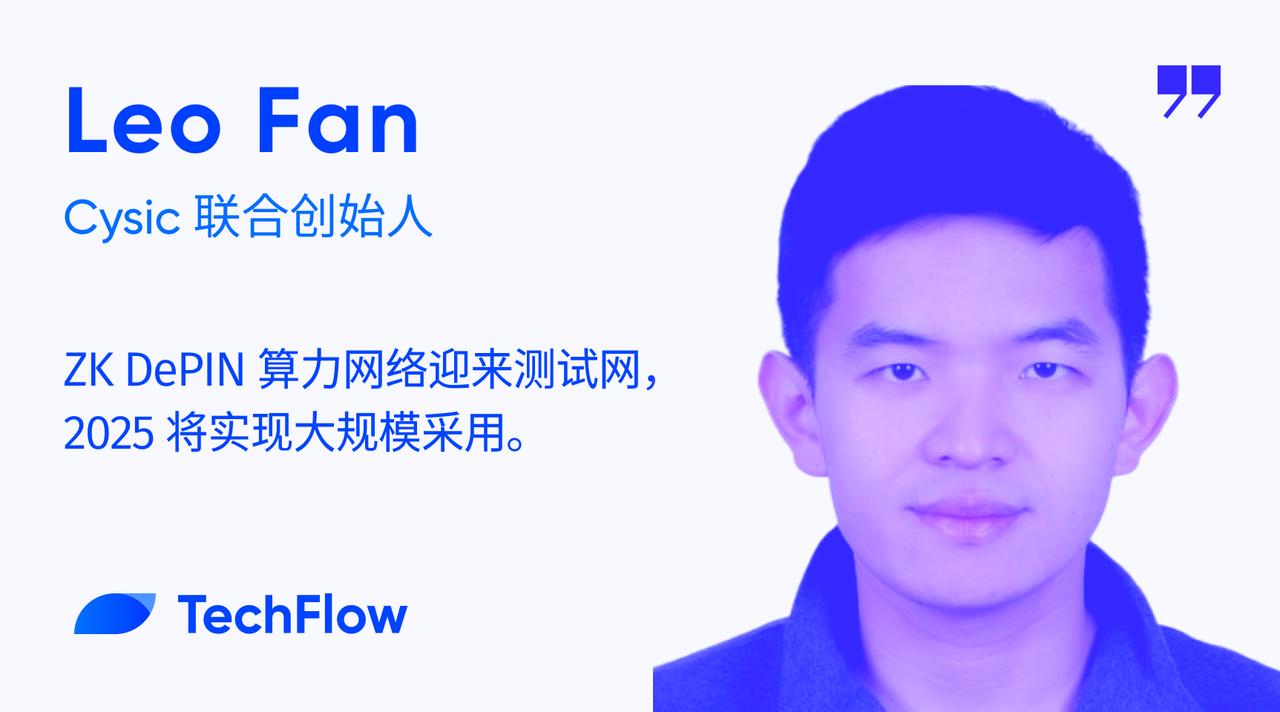
On the occasion of the upcoming testnet launch, we sat down with Leo Fan, Co-founder of Cysic, for an in-depth conversation about Cysic’s insights into the ZK and hardware acceleration landscape, the project’s competitive advantages and technical rationale, and prospects for large-scale adoption of ZK technology. During our discussion, Leo Fan stated: ZK hardware acceleration will greatly empower Ethereum, the crypto industry, and even the real world—and with the advancement of ZKVM and the imminent delivery of Cysic’s ASIC hardware, we have strong reasons to believe that ZK technology will achieve true mass adoption by 2025.
In this article, let’s explore Cysic’s past, present, and future, and dive into Co-founder Leo Fan’s perspectives, thoughts, and reflections on the ZK hardware acceleration sector.
Key Takeaways
-
With the mid-July testnet launch approaching, a series of incentive activities are being prepared: Cysic will invite users through a whitelist mechanism to serve as validators, participate in testing, and win rewards. Later in the testnet phase, we’ll also open certain prover roles to the community. For enterprise (B2B) users, Cysic aims to provide ZK projects with efficient, low-cost, and instant ZK services. Professional miners can also connect to the Cysic network to achieve more efficient utilization of their hardware. For individual (C2C) users, even ordinary laptops can join the Cysic network as validators.
-
As a leading project in the ZK hardware acceleration space, Cysic’s focus can be summarized in three aspects: Efficiency—achieving real-time proof generation through proprietary chip design; Universality—providing acceleration services for nearly all types of ZK algorithms on the market; and Decentralization—building a ZK DePIN Network to deliver decentralized services to the industry.
-
The strength of ZK lies in eliminating the need to trust individuals—instead relying on mathematical logic to establish trust. Additionally, compared to other scaling solutions, Ethereum’s architecture is more conducive to ZK integration, and ZK’s rigorous mathematics offers stronger guarantees for Ethereum’s security and fairness.
-
At Cysic, project teams retain the autonomy to choose suitable provers based on their needs, further enhancing decentralization.
-
In terms of both cost-performance and performance-per-watt metrics, ASIC significantly outperforms other options. However, due to risks like tape-out failures during ASIC design and manufacturing—which can lead to high costs—most remain cautious about ASIC development.
-
Cysic adopts a dual-token economic model: The Native Token serves purposes such as gas fees and rewarding ecosystem contributors, while the veToken enables governance participation in network compute resource allocation decisions.
-
With advancements in ZKVM and the delivery of Cysic’s ASIC hardware, ZK technology may achieve true mass adoption by 2025.
The Fastest ZK Hardware Acceleration Service in the Industry – Cysic Testnet Is Coming Soon
TechFlow: Could you please introduce yourself first?
Leo Fan:
Hello everyone, I’m Leo Fan, Co-founder of Cysic.
Let me start with my academic background, primarily focused on cryptography and computer security: I completed my undergraduate studies at Sichuan University’s Mathematics Honors Program, pursued my master’s degree at the State Key Laboratory of Information Security in Beijing from 2010 to 2014, and then went on to earn my Ph.D. in Cryptography and Information Security from Cornell University in 2019.
Now, regarding my professional journey: During my graduate studies in Beijing, I was introduced to Bitcoin and participated in early Bitcoin mining. While pursuing my doctorate, I interned at companies like IBM and Yahoo. After graduation, I joined the U.S. National Institute of Standards and Technology (NIST), working on cryptographic standardization. Then I moved to Algorand—a Layer 1 project founded by Turing Award winner and MIT professor Silvio Micali, the inventor of ZK technology—where I led the design and implementation of Algorand State Proofs, bringing trustless interoperability to the Algorand ecosystem.
By 2022, I realized that ZK proof generation took far too long. Initially, I tried optimizing at the algorithm and software levels, but results were underwhelming. That’s when I began considering hardware-based acceleration for proofs, which ultimately led to the creation of Cysic—with the goal of achieving real-time ZK proof generation through hardware acceleration.
TechFlow: Cysic’s testnet is scheduled to launch in mid-July. From both B2B and C2C perspectives, how can projects, users, or developers currently engage with the Cysic ecosystem?
Leo Fan:
From a B2B perspective, Cysic aims to provide ZK projects with efficient, low-cost, and instant ZK services. We’ve launched an Early Access Program (EAP), offering enterprise-grade end-to-end hardware acceleration solutions to ZK projects with compute demands. Cysic supports a wide range of verification systems including Halo2, STARK, Groth16, Plonky2, ZAMA, GKR, and RapidSnark. Our powerful network is backed by over 10,000 GPU cards, ensuring unparalleled performance and reliability. So far, 16 projects—including Scroll, Light Protocol, Risc Zero, Inference Labs, Ion Protocol, Aerius Labs, and TalusNetworkEAP—have joined the EAP program, and early participants will enjoy various future ecosystem benefits.
Additionally, “B2B” here can also refer to professional miners who own large quantities of GPUs. Beyond joining AI-focused DePIN networks, they can also plug into the Cysic network in the future. Once connected, their GPUs will stay near full utilization—meaning hardware achieves much higher efficiency. In the later stages of the testnet, we will open prover roles to the community, allowing users meeting certain hardware criteria to apply as provers, contribute to mainnet readiness, and earn testnet rewards.
From a C2C user perspective—referring perhaps to less technical users who don’t own high-end hardware—they can still contribute to the ZK ecosystem and earn rewards by connecting their regular laptops to the Cysic network as validators. The Cysic testnet launches in mid-July, and related incentive campaigns are already being prepared: We’ll use a whitelist mechanism to invite users to become validators, participate in network testing, and receive corresponding rewards.
TechFlow: If you had to describe what Cysic is doing using only three words, what would they be?
Leo Fan:
We believe that once the efficiency bottleneck is overcome, ZK technology will see mass adoption not just within crypto, but across Web2 and the real world. Cysic aims to enable real-time ZK proof generation by providing full-stack hardware acceleration—including FPGA, GPU, and ASIC—and building the Cysic Network, a ZK DePIN network that connects ZK projects, compute providers, and community validators, ultimately delivering an efficient, cost-effective, and decentralized compute + validation infrastructure to the entire industry. In short, Cysic will play an indispensable role in accelerating the arrival of mass-scale ZK adoption.
To answer your question directly, I’d summarize Cysic’s current work in three words:
Efficiency: Cysic aims to achieve real-time proof generation through self-developed chips. While we’re currently still delivering ZK acceleration via GPU, we’re already the fastest in the entire industry. As the project progresses and ASIC rolls out, we’ll become even faster.
Universality: There are many different algorithms within the ZK domain, each with unique characteristics. Cysic aims to offer ZK acceleration services compatible with all major algorithms, broadening our service scope and usability.
Decentralization: Cysic is currently building the Cysic Network—a ZK DePIN network—where we aim to deliver services through decentralized provers and verifiers. Participants contribute to the ZK ecosystem and are rewarded accordingly.
TechFlow: Current ZK hardware acceleration solutions include CPU, GPU, FPGA, and ASIC. What are the differences between them? Which approach does Cysic favor for ZK hardware acceleration?
Leo Fan:
Cysic actually has strong credibility on this topic. There’s a competition in the ZK space called ZPrize. We missed the first edition, but this year we served as designers and judges for one of its tracks.
Across the entire ZK and hardware domain, three key metrics stand out:
First is Performance Per Dollar (cost-effectiveness): How much compute power do you get per dollar spent on hardware? Here, CPU lags significantly behind, so our discussion focuses on GPU, FPGA, and ASIC. In terms of cost-effectiveness: ASIC > GPU > FPGA—especially when ASIC volume scales sufficiently, which ZK demand now supports.
Second is Performance Per Watt (energy efficiency): The energy consumed running the hardware. Again, ASIC leads by a wide margin, with GPU slightly outperforming FPGA.
Third is Go-to-Market Time: We know ASIC requires chip design, and tape-out—the process of sending mask designs to foundries for fabrication—carries significant risk. Any error during tape-out can incur massive costs, making most teams cautious about ASIC development.
In the short term, Cysic follows a similar path: from late last year through early 2025, we’ll continue providing acceleration via GPU. However, our ASIC is expected to arrive in Q2–Q3 next year, after which we’ll shift primarily to ASIC-based services. This transition is inevitable. Cysic is committed to real-time ZK proof generation. For mainstream ZK circuits, we aim to reduce proof times to 1–5 seconds—and only ASIC can make that possible.
TechFlow: How does Cysic achieve real-time proof generation? What changes or innovations might this bring to ZK, Ethereum, and the broader crypto industry?
Leo Fan:
I believe this will drive tremendous innovation. Let’s take ZK combined with machine learning (ML) as an example. Running an ML circuit with ZK today is extremely time-consuming: Executing GPT-2 without ZK takes about one second, but proving a GPT-2 circuit with ZK—even with the fastest existing methods—takes several minutes; with CPU alone, it could take hours. Such delays make for a completely unusable user experience.
Cysic’s ASIC chips will enable real-time ZK proof generation, unlocking seamless integration between ZK and ML technologies and dramatically improving user experience. Of course, given the tight convergence between crypto and AI today, this example is particularly relevant in the crypto-native context.
Moreover, I believe ZK acceleration will profoundly empower Ethereum and the wider crypto ecosystem. The biggest change is reducing processes that previously took tens of minutes down to just seconds. More L2 transactions and cross-chain swaps can be confirmed faster—and these confirmations rely on mathematical logic rather than optimistic assumptions like OP’s “innocent until proven guilty” model. This represents a major leap forward for the crypto industry.
Achieving Real-Time ZK Proof Generation Decentrally: Dual-Token Model Powers the ZK DePIN Network
TechFlow: In previous solutions, high efficiency and decentralization have often been difficult to balance. Yet Cysic achieves real-time proof generation while maintaining decentralized provers and verifiers. Can you briefly explain how Cysic accomplishes this? How does Cysic’s PoC consensus further enhance decentralization?
Leo Fan:
As mentioned earlier, the Cysic Network—a ZK DePIN network—features two key roles: provers and verifiers.
Verifiers validate proofs generated by provers. Achieving decentralization among verifiers is relatively easy, since even smartphones, laptops, or tablets can verify a ZK proof. The hardware requirements are minimal, and verification typically takes less than one second.
Decentralizing provers is more challenging initially—during the GPU era—because delivering a good user experience (i.e., fast proof generation) requires high-end hardware, creating a barrier to entry for many. However, this will greatly improve once Cysic’s hardware ships. Compared to current mainstream GPU acceleration, Cysic’s hardware can boost ZK performance up to tenfold at a lower price point, enabling users to reach professional miner-level capabilities at affordable cost.
From a software standpoint, Cysic is building a ZK DePIN network and has designed a Proof-of-Compute (PoC) mechanism tailored specifically to ZK DePIN use cases. PoC resembles a hybrid of Proof-of-Stake and Proof-of-Work. For each epoch—approximately 100 blocks—a group of nodes is selected based on their compute capacity, and then block proposers are chosen according to their staking weight. This ensures network stability while further enhancing decentralization.
TechFlow: We noticed Cysic employs a dual-token model combining utility and governance tokens. Could you explain the advantages of this design and how Cysic uses it to enable effective ecosystem governance and incentives?
Leo Fan:
The dual-token model consists of a Native Token and a veToken.
The Native Token is used for gas fees and rewarding ecosystem contributors. To participate in governance—such as deciding network compute allocation—users must stake Cysic tokens to gain voting rights.
There are many ZK projects, each using different algorithms, so efficiently scheduling compute resources across the Cysic network becomes critical. Optimal scheduling leads to higher returns for the network and better outcomes for participants. Voting rights grant influence over compute allocation—for instance, allocating more resources to a rapidly growing project. This mechanism not only helps capture value across the ZK ecosystem but also promotes broader circulation of Cysic’s token within the ZK space.
TechFlow: The hardware demands of ZK acceleration naturally evoke associations with the DePIN sector. How does Cysic extend its ecosystem development within DePIN?
Leo Fan:
We aim to attract more hardware into the Cysic network. Importantly, the hardware in the Cysic Network isn’t idling—it actively generates proofs and performs verifications, creating real value through actual services. This is a key difference from many AI or DePIN projects. Currently, during internal testing, hundreds of servers in the Cysic network are fully utilized at all times.
Furthermore, the Cysic network also reaches traditional users. Thanks to ZK’s strengths in privacy-preserving computation, we plan to deliver superior services to conventional users through our DePIN network.
TechFlow: At both last year’s EDCON in Montenegro and this year’s Hong Kong Web3 Festival, Ethereum co-founder Vitalik Buterin clearly expressed his view that “ZK is Ethereum’s future.” Why does Vitalik hold ZK in such high regard? In your opinion, what advantages does ZK offer over other scaling solutions, and how does it empower Ethereum?
Leo Fan:
I think there are two main reasons:
First, ZK doesn’t require trusting individuals. Unlike OP’s “innocent until proven guilty” model, ZK establishes trust through rigorous mathematical logic. ZK technology has evolved over three to four decades, and cryptographic systems based on mathematical assumptions are becoming increasingly robust. Therefore, placing trust in math is fundamentally safer than trusting people.
Second, compared to other scaling approaches, Ethereum’s architecture is more ZK-friendly. Once a ZK proof is generated, it can be verified quickly on Ethereum—and that single proof can represent an entire L2 block containing, say, 1,000 transactions. Thus, verifying one ZK proof equates to confirming 1,000 transactions. Without requiring extensive changes to Ethereum’s base layer, ZK emerges as a superior scaling solution.
Finally, on how ZK empowers Ethereum: I believe ZK’s rapid development has already significantly shortened Ethereum’s settlement times via L2s. Second, ZK bridges enhance efficiency while avoiding many security vulnerabilities. Additionally, ZK improves how Ethereum itself generates blocks. Through modules like Verifiable Delay Functions (VDFs), ZK uses rigorous mathematical functions to generate randomness, accompanied by ZK proofs verifying correct computation—greatly enhancing Ethereum’s security and fairness.
TechFlow: Regarding ZK’s current inefficiency, Vitalik has highlighted three potential solutions: 1) Parallelization and aggregation trees; 2) Using SNARK algos and hashing to improve efficiency; 3) ZK hardware acceleration via ASIC. As a project focused on ZK hardware acceleration, how do you see ZK hardware’s advantages over the other two directions?
Leo Fan:
Actually, the first solution—parallelization and aggregation trees—and the third—ZK hardware acceleration—are complementary. Parallelization and aggregation either involve Parallel EVM or proof batching and aggregation, and hardware acceleration can speed up these processes as well.
The second solution involves using SNARK algorithms and hashing to boost efficiency. SNARK (Succinct Non-Interactive Arguments of Knowledge) is essentially ZK—we accelerate SNARKs. Many SNARK implementations contain tunable parameters; setting them too aggressively can compromise security. The advantage of ZK hardware acceleration is that it speeds things up without undermining the foundational security.
ZKVM Advancements and Cysic’s Proprietary Hardware Rollout—ZK Mass Adoption May Arrive by 2025
TechFlow: Recently, ZK momentum has reached Solana. The privacy protocol Light Protocol introduced a new primitive for Solana called ZK Compression, aiming to enable native ZK computation on Solana and reduce token and account management costs by orders of magnitude. What’s your take on ZK Compression? How might it create opportunities or challenges for Cysic’s ZK hardware acceleration space?
Leo Fan:
ZK compression is a recently emerging ZK technique on Solana. It leverages ZK’s succinctness to compress state data and reduce overhead. The same concept is already applied in ZK-L2s and ZK bridges. For Cysic, the underlying technology is identical to what we’re developing—just applied in a new environment (Solana). Our existing tech stack is fully capable of supporting it.
TechFlow: How long do you think it will take before ZK technology achieves true mass adoption in real-world applications? What are the key catalysts?
Leo Fan:
I believe mass adoption of ZK could happen as early as next year—not limited to crypto, but truly integrated into real-world applications. Two major catalysts will drive this:
First, on the software side: Cysic closely follows ZKVM development. ZKVM allows developers to write code in familiar languages like Rust or Go instead of manually crafting complex ZK circuits. The ZKVM then compiles this into ZK circuits, drastically speeding up development and lowering the barrier to entry. Cysic will continue advancing software solutions in this area.
Second, Cysic’s self-developed hardware will ship next year, dramatically boosting ZK proof generation speed and serving as a pivotal force in driving mass ZK adoption.
TechFlow: Could you share some of Cysic’s recent major milestones and what the team’s priorities will be in the second half of 2024?
Leo Fan:
Over the past year, Cysic has achieved multiple breakthroughs: By the end of 2023, the team finalized the direction for ZK chip design. Previously, our work focused on accelerating specific high-weight modules. But by year-end, we committed to a ZKVM-based ZK chip architecture—giving our hardware product far greater flexibility. We’re launching two products:
ZK Air will be a consumer-facing product—a lightweight, portable ZK DePIN device roughly the size of a MacBook charger, connectable via USB-C to phones or computers for efficient ZK proof generation. ZK Air delivers compute power exceeding top-tier consumer GPUs, rivaling 10 RTX 4090s.
ZK Pro maximizes ZK proof production speed, enabling real-time ZK computation, designed similarly to traditional mining rigs. ZK Pro is ideal for large-scale ZK applications like zkRollups and zkML. In performance, ZK Pro sees massive gains over Air—officially disclosed specs claim compute power equivalent to 50 NVIDIA RTX 4090 GPUs.
Additionally, on the GPU front, we’ve developed proprietary general-purpose code that significantly outperforms CPU-based solutions and is nearly twice as fast as existing open-source alternatives. Until ASICs arrive, we aim to provide the industry with superior ZK hardware acceleration via GPU and other means.
Looking ahead to 2024, Cysic’s testnet will launch in mid-July, with mainnet expected in Q3. Most development work is complete, and we’re now conducting ongoing stress tests and performance evaluations.
Another major focus will be finalizing the hardware design based on ZKVM, aiming to deliver tangible, community-accessible performance benchmarks.
Join TechFlow official community to stay tuned
Telegram:https://t.me/TechFlowDaily
X (Twitter):https://x.com/TechFlowPost
X (Twitter) EN:https://x.com/BlockFlow_News
 深潮TechFlow