Pay to claim ZRO: This round of airdrops has introduced a new twist on Pay-to-Earn
TechFlow Selected TechFlow Selected
Pay to claim ZRO: This round of airdrops has introduced a new twist on Pay-to-Earn
LayerZero's pay-to-claim ZRO is the first, but certainly won't be the last.
 Navigating Web3 tides with focused insights
By TechFlow
Good news: ZRO airdrop claims are now live.
Bad news: you have to pay to claim it.
Earlier, the market criticized LayerZero for distributing too few tokens, with many users expressing frustration after extensive interactions only to receive underwhelming allocations—prompting widespread feelings of receiving an "insulting airdrop."
Now, that insult seems to have come twice.
On the evening of June 20, LayerZero announced that ZRO tokens can now be claimed—but this claim isn't free:
Users must donate $0.10 worth of USDC, USDT, or native ETH per ZRO token to claim their allocation.
LayerZero has branded this mechanism as Proof-of-Donation, a novel claiming method designed to collectively fund Protocol Guild—a developer collective on Ethereum—with up to $18.5 million in donations.
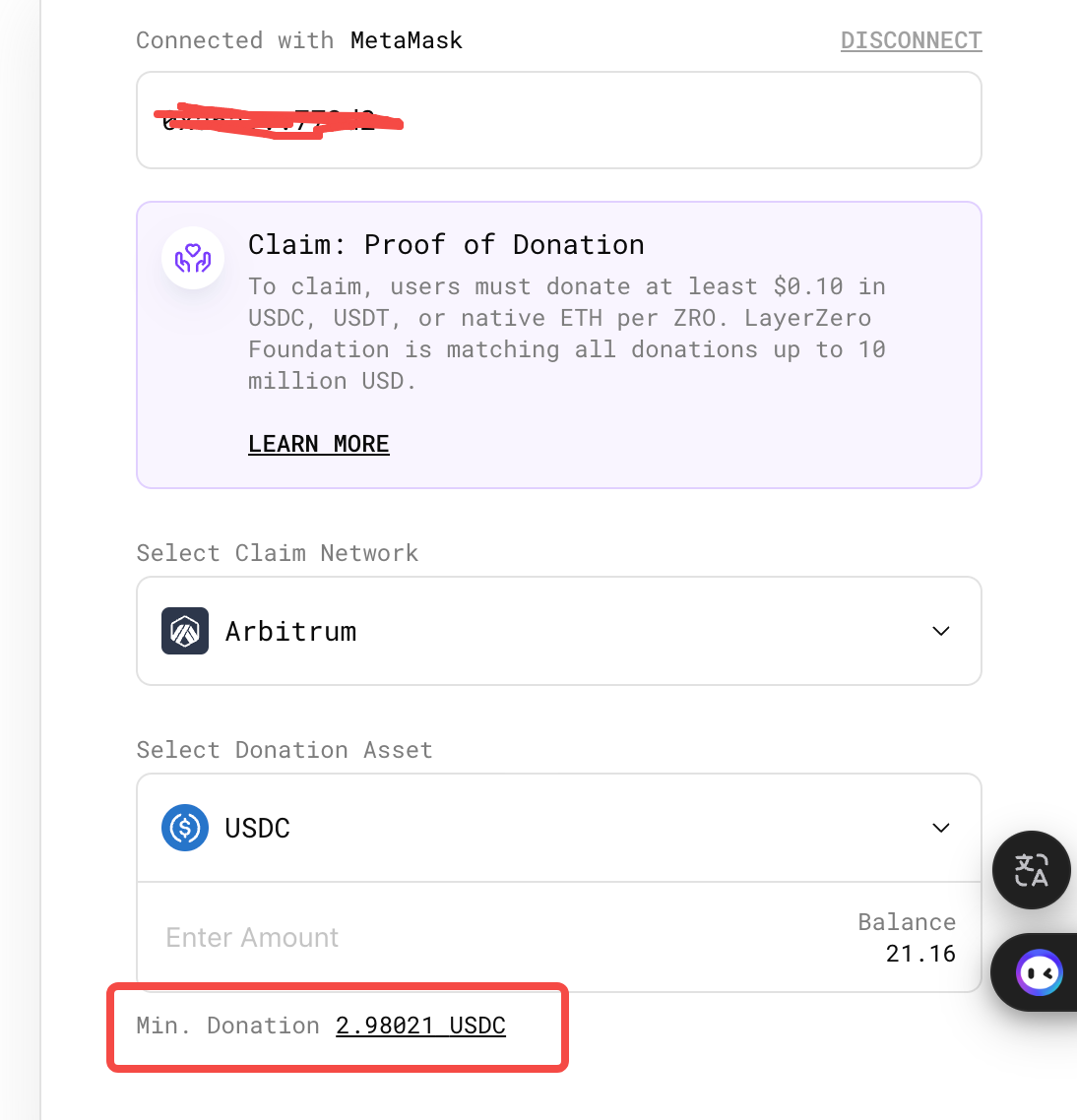
Regardless of donation transparency or actual use, from the user's perspective, this rule translates plainly to:
Want your airdrop? Pay first.
This is unprecedented in crypto airdrop history.
You've seen scams like pool rug-pulls, hollow whitepapers, and "sorry we failed" exit schemes—but openly extracting payment directly from your airdrop? That’s unheard of.
Thus, Airdrop-to-Earn becomes Pay-to-Earn.
Forced Donations, Stark Contrast
What makes this even more emotionally jarring is the “historical recap” section displayed on the official LayerZero page before claiming ZRO.
Before claiming ZERO, the site presents a personalized review similar to those annual retrospectives used by Chinese tech companies, proudly stating things like “You first used omnichain on X date” or “You’ve interacted X times,” evoking nostalgic memories of hard work and hopeful anticipation.
There's nothing wrong with the recap itself, but juxtaposed against the final donation requirement, it feels heartbreaking.
It’s as if saying, all your past efforts now translate into a higher financial burden when claiming.
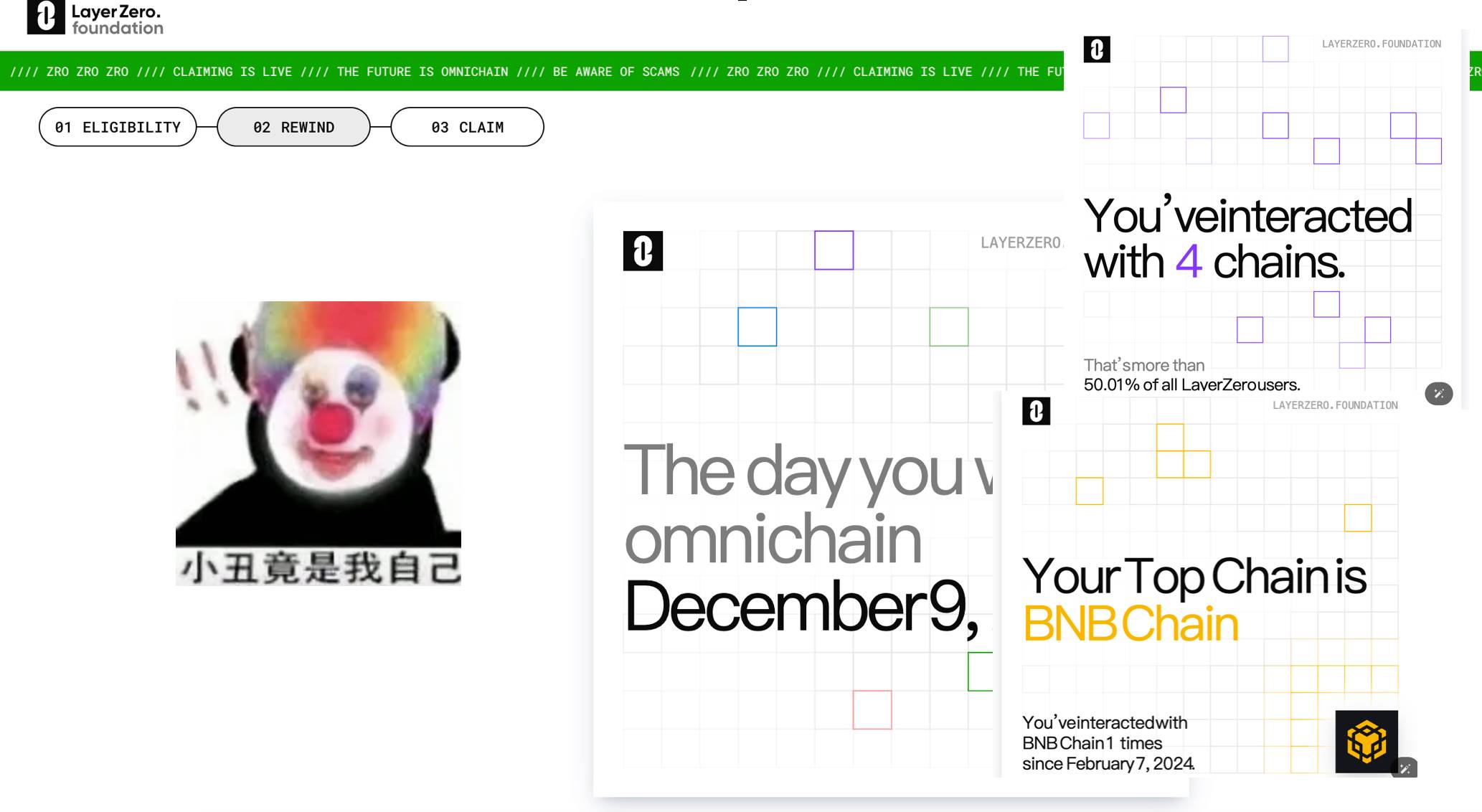
Bulk farming? Premium accounts? Multi-chain setups?
No problem—the joke’s on you.
Until the last moment, you never know what restrictions await on the claiming page. Based on industry norms, you might expect unfair distribution rules—after all, pleasing everyone is impossible.
But a pay-to-claim design? Unimaginable—until now. Though perhaps the team planned it all along, just kept quiet until the end, maximizing your sunk costs.
Here, smart contract-enforced rules become the bane of every farmer’s existence. Sorry, no changes allowed—the contract is immutable. Want your tokens? Then donate.
It’s not that donating is bad or that users lack goodwill—it’s the forced, seemingly malicious design that creates psychological dissonance, turning “donate” into “steal.”
Airdrop Tax: Robbing Rich and Poor Alike
If we abstract this donation button further, we can interpret it as an “airdrop tax.”
The project rewards you for your interactions, but how much you get is entirely at their discretion. And legally, there’s nothing stopping them from taxing part of that reward for other purposes.
They hold the knife; we’re the fish. Getting an airdrop is already generous—what’s wrong with a little tax?
From the project’s standpoint, this may seem reasonable—or even shrewd. But from the average user’s view, the project has clearly overestimated its own importance.
For large holders and bulk farmers, paying per-ZRO means significantly higher total payments. But small holders aren’t spared either—at $0.10 per token, it’s equal opportunity taxation: robbing both rich and poor.
Some users have even reported on Twitter that their actual donation cost exceeds $0.10 per token—clearly amounting to robbery.
Combined with skyrocketing gas fees during the airdrop period, small claimers are left with a sense of partial gain—like they were played.
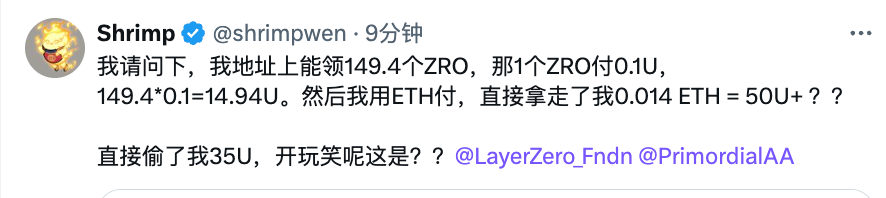
Will you still blindly farm multiple accounts going forward? Professional airdrop hunters will now need to meticulously calculate ROI and minimize costs—after all, nobody knows how high the “donation tax rate” might go next time.
Farming has shifted from golden-age windfalls to intense competition and self-cannibalization.
Users compete—more people join, if you don’t interact, someone else will. Projects compete—giving less and less, even adding tax mechanisms.
As the saying goes: the future is already here—it’s just unevenly distributed.
LayerZero’s pay-to-claim ZRO is the first, but certainly won’t be the last.
Future projects may adopt milder tax rates, craftier justifications, grander narratives—to quietly skim part of your earned airdrop. As market participants and rule-takers, you may have no choice.
Want to collectively boycott by refusing interaction? In a decentralized ecosystem driven by diverse motives, that’s nearly impossible.
Lower your expectations. Spend within means. There’s no such thing as a free lunch—and soon, perhaps, no such thing as a free airdrop.
Join TechFlow official community to stay tuned
Telegram:https://t.me/TechFlowDaily
X (Twitter):https://x.com/TechFlowPost
X (Twitter) EN:https://x.com/BlockFlow_News
 深潮TechFlow