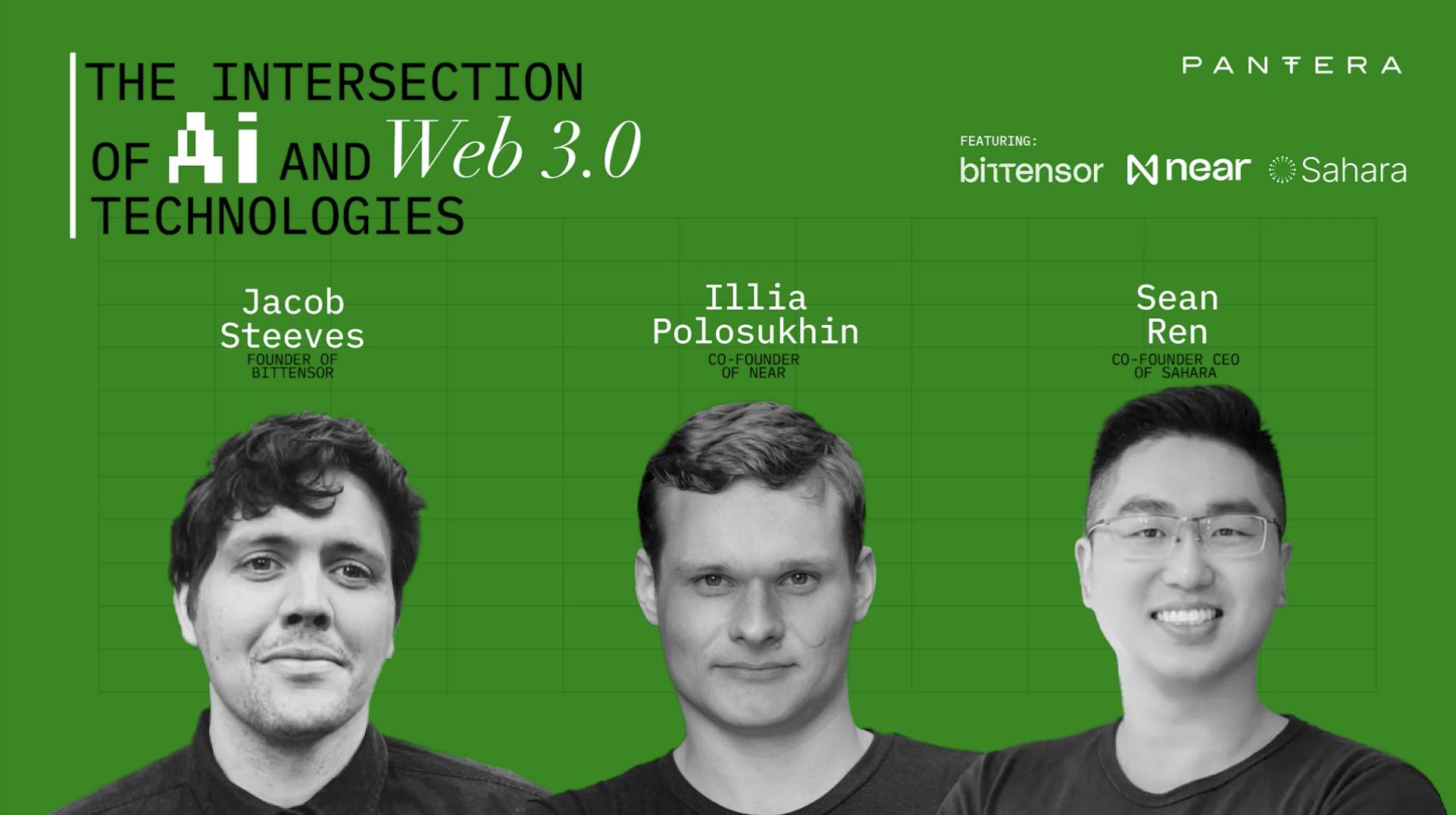
Podcast Notes | Conversing with the Founders of Bittensor, Near, and Sahara: How Different Projects Integrate with AI
TechFlow Selected TechFlow Selected
Podcast Notes | Conversing with the Founders of Bittensor, Near, and Sahara: How Different Projects Integrate with AI
The topic of this discussion is the integration of AI and Web3, exploring how these two fields can mutually promote each other and address current challenges.
 Navigating Web3 tides with focused insights
Compiled & Translated: TechFlow
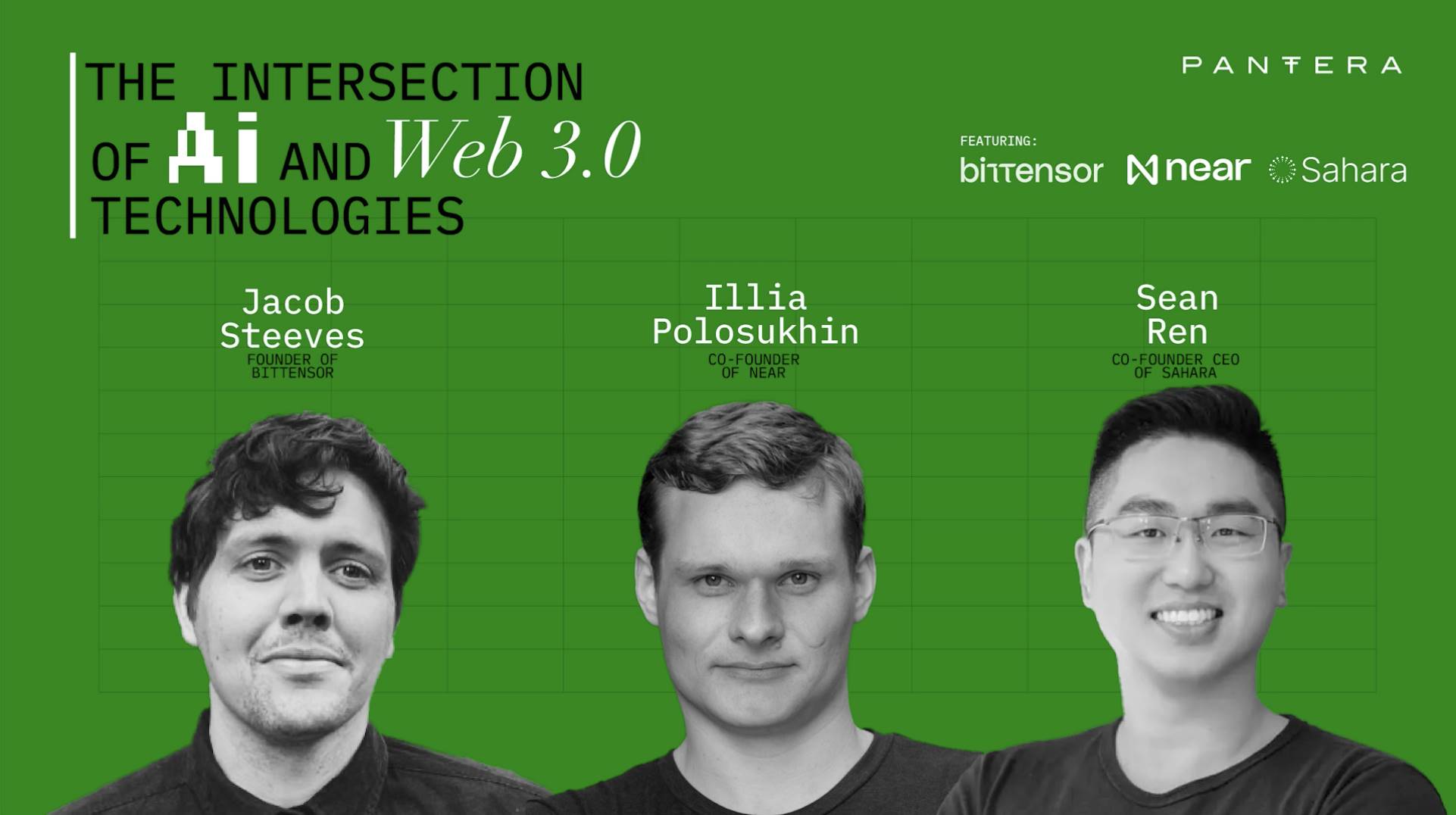
Host: Matt Stephenson, Head of Research at Pantera
Guests:
-
Jacob Steeves, Founder of Bittensor. Bittensor is a mining network with a built-in token-based incentive mechanism, creating a pure market for artificial intelligence.
-
Illia Polosukhin, Co-founder of NEAR Protocol. NEAR is a chain-abstracted stack enabling builders to create applications scalable to billions of users across all blockchains.
-
Sean Ren, Co-founder of Sahara. Sahara is a permissionless, high-performance blockchain designed to securely deploy personalized autonomous AI with privacy and provenance.
Podcast Source: Pantera
Original Title: The Intersection of AI and Web3.0 Technologies
Discussion on three pioneering projects exploring the intersection of artificial intelligence and Web3.0 technologies.
Summary of Discussion
-
The discussion focused on the convergence of artificial intelligence (AI) and Web3, exploring how these two fields can mutually reinforce each other and address current challenges. Hosted by Matt Stephenson, Head of Research at Pantera, participants included Ilia Polosukhin, Co-founder and CEO of NEAR Protocol, Jacob (also known as Const), core developer of Bittensor, and Sean Ren, CEO and Co-founder of Sahara.
-
Jacob shared Bittensor’s efforts in building a decentralized AI market, enhancing AI model quality and data privacy through market mechanisms and decentralized consensus. He emphasized that proper incentive structures and efficient resource allocation are key to the success of decentralized AI systems.
-
Ilia spoke from NEAR Protocol's vision, stressing the importance of building a decentralized internet and introduced how Near AI advances the next-generation internet through automated programming and decentralized infrastructure. He highlighted that ensuring user data security and privacy is fundamental to this vision.
-
Sean approached the topic from user privacy and data sovereignty, introducing Sahara’s creation of a decentralized blockchain platform specifically designed for AI, prioritizing user asset sovereignty and security. He emphasized that future AI development requires a multi-layered infrastructure to ensure users can enjoy AI capabilities without sacrificing privacy or data control.
Bittensor: Decentralized AI Market and Incentive Mechanisms
-
Jacob introduced Bittensor’s decentralized network, where anyone can join and contribute computing resources and data. This decentralized approach enables a global AI marketplace, allowing broad participation and benefit-sharing.
-
Jacob emphasized the critical role of proper incentives in decentralized AI systems. Well-designed incentives effectively tackle issues around data privacy and computational resource allocation in both AI and crypto. He noted that Bittensor has attracted numerous teams and talents via market-driven incentives, fostering innovation within the network—an approach more efficient than traditional centralized organizations.
-
On security and privacy in decentralized AI systems, Jacob discussed using decentralized consensus mechanisms to ensure system reliability. By combining market dynamics with decentralized consensus, Bittensor enhances AI model quality and protects data privacy, preventing single points of failure and malicious attacks, thus maintaining system stability and security.
-
Jacob also explained how Bittensor handles large-scale data and computation demands through its decentralized computing network, ensuring efficient allocation and utilization of resources for optimal performance and reliability.
NEAR Protocol: Building a Decentralized Internet and Automated Programming
-
Ilia discussed NEAR Protocol’s vision: leveraging decentralized infrastructure and AI to build a next-generation internet offering greater security, privacy, and user sovereignty.
-
Ilia described NEAR’s goal of creating a trustless decentralized internet, providing foundational infrastructure such as payments, identity, provenance, and smart contracts. This allows users to access high-quality AI applications without compromising their privacy, ensuring data safety and confidentiality. Achieving this requires not only advanced technology but also transparency and verifiability to strengthen user trust.
-
NEAR began as an AI project before transitioning into blockchain. Ilia emphasized how integrating AI and blockchain can produce more useful AI applications and accelerate the development of a decentralized internet.
-
Ilia mentioned the relaunch of Near AI, aiming to teach machines how to program—transforming software development. The revival of Near AI is a crucial step toward fulfilling NEAR Protocol’s vision, using automated programming and decentralized infrastructure to enable computers to write code based on natural language requests, delivering a more efficient and verifiable software environment.
-
Ilia stressed the use of advanced cryptographic techniques and strict access controls to safeguard the security and privacy of decentralized AI systems. Additionally, continuous security audits and monitoring are necessary to promptly identify and fix potential vulnerabilities.
-
Ilia pointed out that decentralized solutions must compete with centralized ones in terms of user experience, AI model quality, and dataset value—key benchmarks for assessing the practical viability of decentralized AI projects.
Sahara: A Decentralized Solution for User Privacy and Data Sovereignty
-
Sean noted that as AI models become more capable, they increasingly impact people’s jobs and monetization opportunities—such as replacing simple design, text editing, or translation tasks. This raises concerns about user privacy and data sovereignty.
-
Sean emphasized that when users leverage AI features, they often upload personal data—including health records, financial reports, and chat histories—which may then be used to train even more powerful AI models, further displacing human roles. Thus, protecting user privacy and data ownership becomes essential.
-
Sahara starts from user asset sovereignty and security, striving to build a high-performance decentralized infrastructure—a blockchain platform purpose-built for AI—enabling users to enjoy AI functionalities without sacrificing privacy, while guaranteeing safety, fairness, and accessibility for all.
-
Sean mentioned that Sahara’s high-performance decentralized infrastructure is designed to protect user data privacy and security while offering elastic computing resources to meet sudden computational demands. This ensures the system remains efficient and stable under heavy loads.
-
Sean believes that future AI development requires a multi-layered infrastructure to support user privacy and data sovereignty. Beyond technological advancement, this includes ensuring system transparency and verifiability to build user trust. Sahara’s multi-layer architecture includes execution, computation, and data layers—dedicated respectively to private user data storage, AI model training and inference, and data management and exchange. This layered design not only ensures efficient and stable operation but also strengthens user confidence and sense of security. Sahara’s vision is to drive a fairer, safer, and more accessible AI ecosystem through technological innovation.
Join TechFlow official community to stay tuned
Telegram:https://t.me/TechFlowDaily
X (Twitter):https://x.com/TechFlowPost
X (Twitter) EN:https://x.com/BlockFlow_News
 深潮TechFlow