








5 Questions About UXLINK's User Data
TechFlow Selected TechFlow Selected
5 Questions About UXLINK's User Data
UXLINK's registered users surpass 10 million.
 Navigating Web3 tides with focused insights
Today, UXLINK announced over 10 million registered users, becoming the first product in the Web3 SocialFi category to reach the tens of millions user scale. Regarding these figures, we reached out to the technical lead of the UXLINK community for clarification:
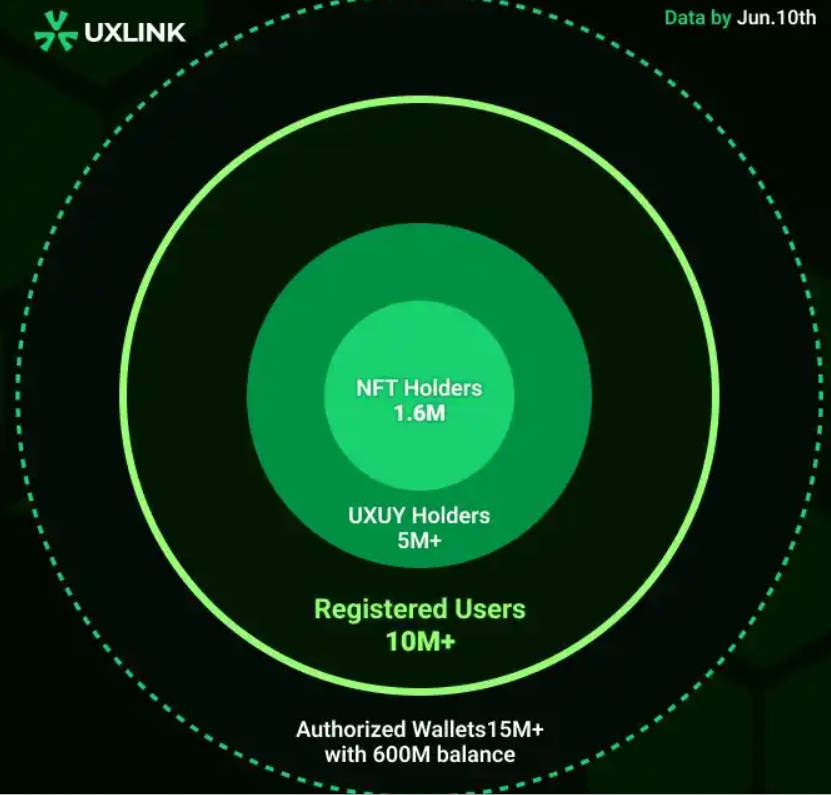
Image source: UXLINK
1. Most blockchain projects use unique wallet addresses as a metric. Why does UXLINK introduce "registered users"? How is it different from unique wallet addresses?
This approach primarily addresses two issues:
(1) There are too many invalid or fake Sybil wallet addresses in crypto, which are meaningless and pollute data.
(2) We are a social platform that emphasizes the concept of “people” / accounts. Only when people connect with people does it become social. One individual can have multiple wallets for different purposes.
Therefore, we use the term “registered users,” which requires passing three verification steps:
(1) 100% invitation-based access through Link-to-Earn — new users must be invited by someone within the UXLINK network (a friend or partner) and register using an invite code.
(2) Human interaction required to prove the user is not a bot.
(3) Active usage of UXLINK products.
Only those meeting all criteria count as registered users. Hence, registered users are fewer than unique wallet addresses. Currently, UXLINK has surpassed 10 million registered users, with 15 million connected authorized wallet addresses. Each user may own multiple wallets.
Does every user have a wallet? Yes. For users coming from Web2 without a wallet, we provide an MPC wallet. Even if this wallet holds no assets initially, contributing users are still valued. Facilitating social mass adoption is our mission. In fact, 100% of users within the UXLINK network are Web3 users.
Is every wallet associated with a user? Not necessarily. We employ anti-Sybil measures such as social verification, diversified tasks, access validation, and third-party reputation systems to filter out millions of invalid or fake Sybil wallets. However, we cannot block them all completely without risking misidentification of genuine users.
Does every user have a social account? Not necessarily. We fully respect user privacy. Some users may only have a wallet, or they may have linked a social account initially but later disconnected it. We continue serving them regardless.
2. What is the concept of UXUY Holders? Is it equivalent to the number of token holders?
Firstly, UXUY is a chain-based Proof-of-Work (POW) points system on UXLINK, used to record and incentivize community growth and engagement. It is non-transferable. All UXUY is generated via the LINK2EARN formula — there was no pre-minting or allocation; all points come from community-driven POW “mining.” Key terms: POW, on-chain, non-transferable.
To qualify as a UXUY Holder, one must meet three conditions:
1. Be a registered user with a wallet.
2. Contribute specific POW actions defined by the community and earn UXUY points.
3. Claim UXUY on-chain. If not claimed, they do not count as holders.
Thus, UXUY Holders are active contributors and Web3 users — potential future governance token holders. Currently, there are 5 million UXUY Holders.
Will the number of UXUY Holders increase? Yes. As long as community contributions continue, the number will grow until reaching 30 million registered users, at which point all UXUY will be mined out. By then, we expect a strong network effect to have formed.
Can the number decrease? Yes. If some holders convert their UXUY into other assets — such as NFTs or governance tokens — the count will drop accordingly.
3. How many holders does UXLINK have? What are the criteria?
The NFT holder metric uses three dimensions: community contribution level, on-chain interaction frequency, and wallet asset value.
Before TGE (Token Generation Event), our method is: once UXUY holders reach certain milestones, they can exchange UXUY for tiered NFTs. These NFTs serve as airdrop eligibility proof. Prior to TGE, users will receive $UXLINK based on their NFT tier and quantity. Another round of Sybil resistance will also occur at that time.
Simply put, pre-TGE: NFT Holders = Token Holders.
Post-TGE, the holder count will include all legitimate holders of $UXLINK, whether through purchase or continued community contribution.
Currently, we have 1.6 million holders. This number will fluctuate as liquidity is released.
4. Given the large number of registered users and holders, will you conduct Sybil mitigation?
Absolutely. Sybil accounts are common in Web3. The main goal of Sybil mitigation is to protect the interests of authentic, high-quality community members. We implement a three-step process:
Step 1: Filter out fake requests using bot detection and access compliance checks. These are blocked at the system entry point — they are neither counted as registered users nor generate UXUY through Link-to-Earn. This step eliminates most Sybils, though we avoid being overly strict to prevent false positives against real users.
Step 2: After entering the UXLINK network and generating UXUY, we apply further filtering based on contribution levels and activity. For example, if a user remains inactive for six months or fails to successfully claim UXUY, unclaimed UXUY will be recycled back into the community to reward active contributors. This redistribution ensures incentives go only to those creating real value.
Step 3: Before TGE, the community will conduct another round of Sybil removal. The exact method will be disclosed by the community, and reclaimed UXUY will be redistributed to benefit quality users.
These three steps ensure community quality, fairness, and efficiency.
5. Many media outlets compare UXLINK to NOTCOIN, claiming UXLINK has better on-chain data. What’s your take?
UXLINK and NOTCOIN belong to different domains — one is a social platform and infrastructure, the other a game. They do share some similarities, including a shared mission of mass adoption and large user bases. From my perspective, NOTCOIN has a larger total user base, while UXLINK demonstrates stronger on-chain metrics and higher user stickiness. For instance, UXLINK has higher ratios of daily active users (DAU), weekly active users (WAU), DAU/WAU, and WAU/MAU compared to NOT. Over 50% of UXLINK's total registered users are monthly active on-chain. Additionally, UXLINK’s holder count significantly exceeds NOT’s pre-TGE numbers.
I believe this stems from three key factors:
(1) Social products involve deeper user interactions than games. Users engage in SBT/SocialGraph features, group participation, invitations, learning check-ins, and also participate in asset-related activities like SWAP, Airdrops, and Pre-Market trading. In contrast, NOTCOIN interactions are more limited to Tap-to-Earn, which are relatively shallow. Depth varies by category — neither is inherently superior.
(2) User retention is closely tied to real-world social relationships and our network of over 100,000 groups, which foster trust and drive higher user retention.
(3) Overall, this also relates to UXLINK’s rigorous registered user screening mentioned earlier. Through multiple layers of Sybil prevention and removal, although the total registered user count may appear smaller, the quality is significantly enhanced.
Both UXLINK and NOTCOIN are excellent products that provide effective models for transitioning from Web2 to Web3 and from off-chain to on-chain. We have much to learn from NOTCOIN and look forward to potential collaboration.
Finally, as the technical lead, how do you view UXLINK’s future product development and direction?
Returning to our core mission: building trust through real-life social connections, while serving both end-users via a social platform and developers via foundational infrastructure. Going forward, we aim to collaborate with ecosystem partners to build a social layer for asset creation, circulation, and distribution. This will allow users to securely, simply, and trustfully use various applications without complex cross-chain operations, and enable them to monetize their social assets. For developers, we’ll offer modular products and APIs leveraging our protocols, social graphs, and data to dramatically improve development efficiency and growth quality.
Join TechFlow official community to stay tuned
Telegram:https://t.me/TechFlowDaily
X (Twitter):https://x.com/TechFlowPost
X (Twitter) EN:https://x.com/BlockFlow_News
 BlockBeats






