Understanding the Web3 Social Beast: UXLINK
TechFlow Selected TechFlow Selected
Understanding the Web3 Social Beast: UXLINK
UXLINK provides comprehensive tools for user socialization through its core functionalities at the levels of entry, identity, and groups.
 Navigating Web3 tides with focused insights
Author: Wilson Lee, Core Contributor of Biteye
Editor: Crush, Core Contributor of Biteye
Community: @BiteyeCN
* Approximately 3,500 words, estimated reading time: 5 minutes
If one were to ask which Web3 social project has drawn the most attention recently, the answer would undoubtedly be UXLINK—the social behemoth.
UXLINK leverages users’ existing social networks to rapidly grow and establish a Web3 social platform rooted in real-life relationships. By offering immersive social experiences and token incentives, it retains users and drives further expansion, quickly building a substantial user base.
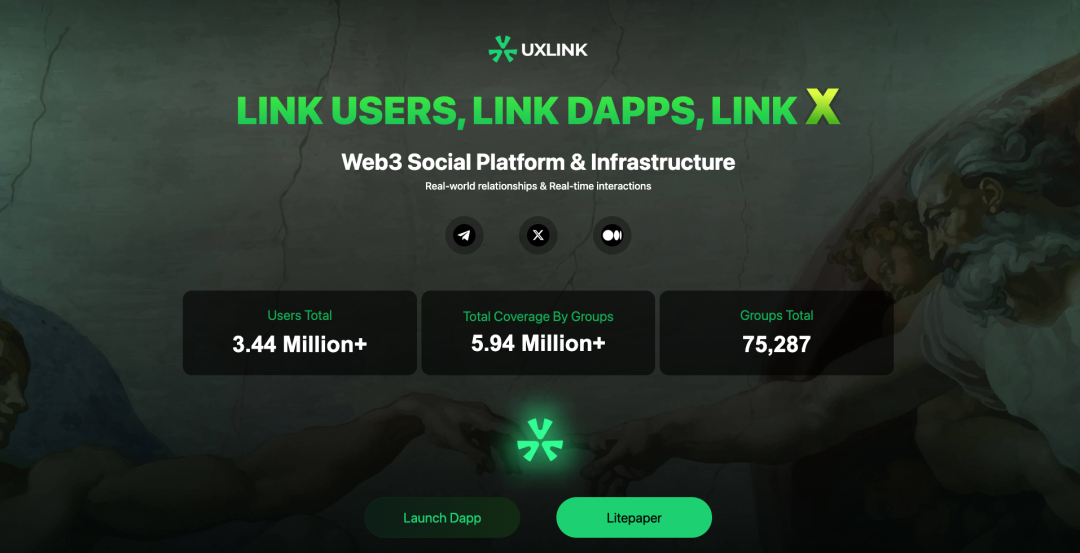
Since its launch in April 2023, UXLINK has attracted 3.4 million registered users, created over 75,000 chat groups, and reached 5.9 million users through these groups. This demonstrates the team’s deep understanding of Web3 social dynamics.
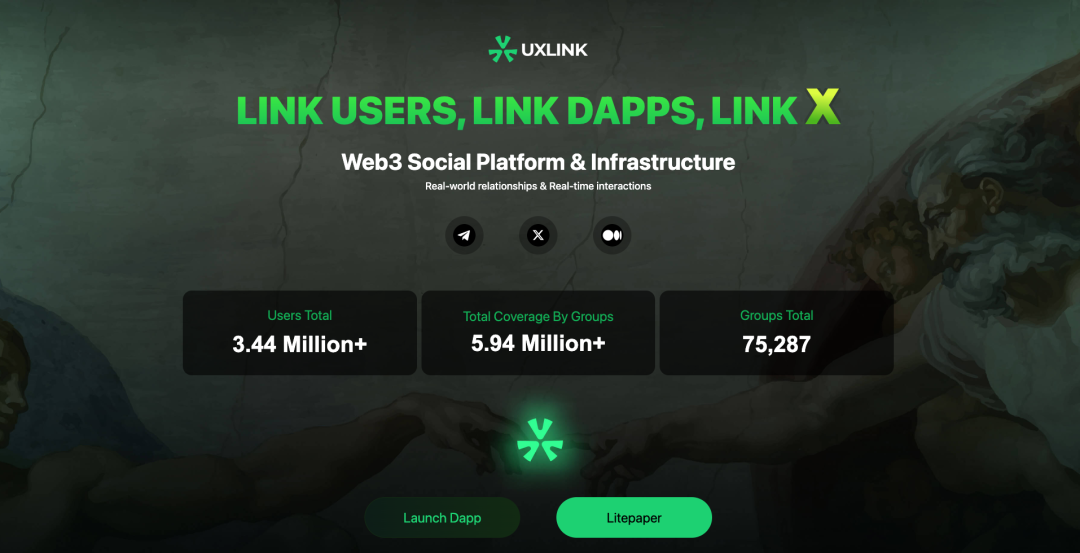
(Source: https://www.uxlink.io/)
01 The Key Variable in Current Web3 Social: Real-Life Social Relationships
Humans cannot exist outside of social relationships. As information technology advances, communication and socializing have become deeply digitalized—from instant messaging to sharing life updates, our social connections are now embedded within digital environments.
In this transformation of social paradigms, we’ve witnessed the rise of killer applications like Facebook and WeChat.
Much of their success stems from network effects: the value of a platform increases as more people use it. This is especially evident in social platforms, where users naturally gravitate toward where their friends and family are—creating a phenomenon known as "real-life network viral growth." When one user joins, their close contacts follow, rapidly expanding the user base.
Web3 is considered the next generation of the internet, emphasizing decentralization, blockchain technology, and asset ownership—enabling users to truly own their digital assets and enjoy deeper digital experiences.
While current Web3 users are largely focused on investment and speculation, as technologies mature and use cases expand, mainstream adoption is expected to accelerate. Given its powerful network effects, social may well be the first domain to produce a killer application and platform for the Web3 era.
Several Web3 social platforms have already gained significant recognition, such as Lens Protocol, Farcaster, and friend.tech.
Lens emphasizes data ownership and portability in social media, allowing users to control their data and move freely across apps; Farcaster prioritizes decentralization and privacy with encrypted messaging, enabling unrestricted communication beyond platform control;
Friend.tech focuses on social assetization, using NFTs to tokenize influence. While these platforms represent notable innovations, their early-stage lack of emphasis on real-life social networks may have limited rapid growth and user retention.
In the Web1 and Web2 eras, the greatest products were all based on real-life social interactions—email, Facebook, WeChat. Could the dominant Web3 platform follow the same pattern?
The core activity in Web3 is transactions, which inherently require trust. Web2 social platforms have already established relationship-building and trust mechanisms.
Web3 social enhances this by adding ownership and asset layers, delivering deeper digital experiences. Therefore, in the current context of relatively small Web3 user bases, building directly upon real-life relationships is key to achieving mass adoption.
02 Product and Services: Growth, Retention, and Ecosystem
The entire UXLINK system can be divided into three layers: Dapp layer, protocol layer, and infrastructure layer.
Dapp Layer: User Growth and Engagement
The Dapp layer delivers core features and services to users, including access points, identity, and group functionalities.
-
Access Layer: Includes MPC and account abstraction wallets, providing users with seamless, frictionless entry into Web3. Upon launching the app, users are automatically registered with an Arbitrum-based wallet, eliminating the need to manage private keys or seed phrases—greatly improving conversion rates.
-
Identity: Includes DID/Profile (SBT). Users can create Web3 accounts via familiar social apps like Telegram or WhatsApp, obtaining a Web3 identity (DID) linked to their off-chain identity. UXLink also employs zero-knowledge proofs to help users build self-sovereign identities (SSI) and maintain private social graphs.
-
Groups: The core practical use case of UXLINK. Users can create chat groups based on their social graph and grow them virally while earning rewards. They can also own and share their social relationship data—minting group IDs to turn social connections into assets, enabling true ownership. Future plans include AI assistant features to further enhance the social experience. Currently, UXLINK builds groups as Telegram plugins, avoiding reinventing the wheel and letting users participate via a familiar interface—minimizing switching costs.
The socialized "exchange"—a combination of DEX and group functions—is not yet fully developed but already includes basic swap functionality. The concept resembles early-stage Pinduoduo: users complete transactions within social interactions, increasing both trust and engagement.
Growth Application: The LINK TO EARN engine serves both UXLINK’s user and data acquisition needs and supports third-party Dapps in growing their own user bases.
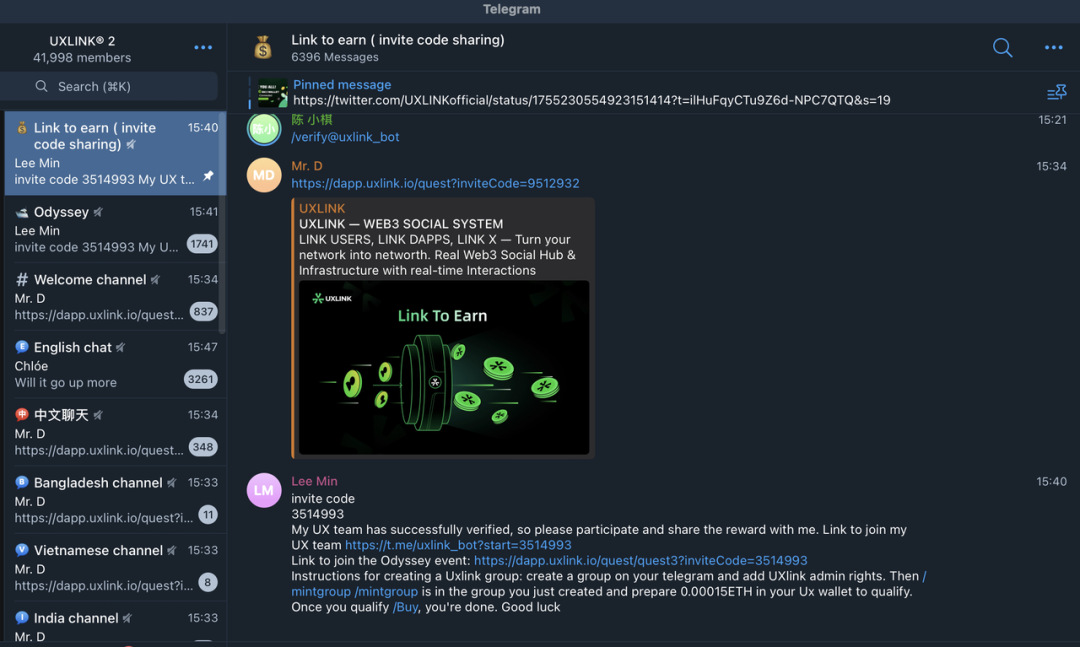
Overall, UXLINK provides comprehensive tools for social interaction at the levels of access, identity, and groups. It uses Proof of Link (PoL) to incentivize users to invite friends, driving growth. Combined with familiar social features, relationship building, and monetization, new users can enter Web3 with minimal friction and enjoy a friendly social experience—accelerating Web3 mass adoption.
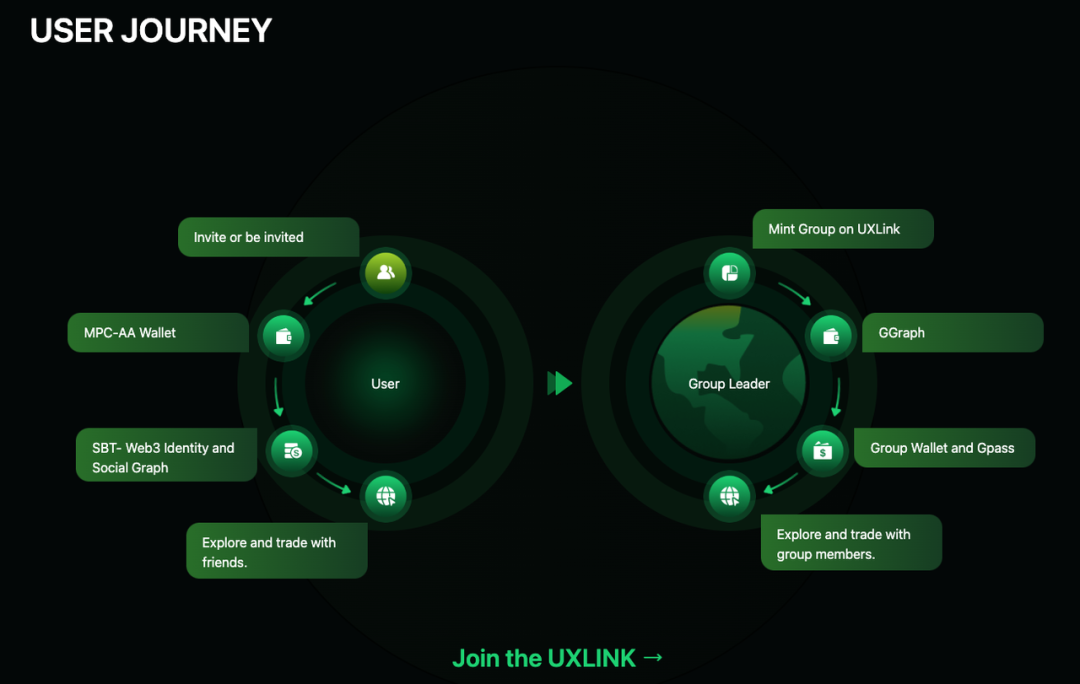
(Source: https://www.uxlink.io/)
Protocol Layer: Data Monetization, Empowering the Ecosystem, Achieving Commercial Closure
The protocol layer centers on data generated from the Dapp layer, primarily serving developers. Since UXLINK's growth relies on viral spread through real-life relationships, the Dapp layer accumulates vast amounts of social relationship data. The value of such data is self-evident—platforms like Pinduoduo and LinkedIn exemplify effective utilization of real-life social graphs.
UXLINK offers robust APIs for Web3 developers, enabling efficient access to user social data for analysis and creation of tangible commercial value. Revenue from this will be shared between users and UXLINK, giving real value to user-generated data and completing the commercial loop.
Infrastructure Layer: Further Ecosystem Development
UXLINK employs a scalable hybrid on-chain/off-chain technical architecture (EVM + IPFS + Hubs) to support mass adoption scenarios. Identity and relationship data are stored on-chain (currently on Arbitrum), while complex business data is processed off-chain—supporting applications built on the UXLINK Protocol. Additionally, UXLINK provides decentralized storage and centralized data indexing services across EVM chains (including Ethereum Mainnet, Arbitrum L2, BNB Chain, Polygon, and Base Chain).
As the user base grows and the ecosystem expands, UXLINK may consider developing its own dedicated social chain to strengthen internal synergies and unlock greater potential.
This outlines UXLINK’s product logic. Unlike other sectors, in social, the application and infrastructure layers co-evolve and mutually reinforce each other—potentially becoming either a super app or foundational infrastructure for other domains like gaming and DeFi.
03 Economic Model and Value Capture
UXLINK adopts a dual-token model consisting of the utility token $UXUY and the governance token $UXLINK.
Utility Token $UXUY: Primarily used to incentivize community growth and engagement.
Earning: Users earn $UXUY by inviting friends and contributing to the ecosystem. $UXUY is stored in EVM-compatible wallets, with earlier adopters receiving larger allocations. As UXLINK’s user base grows, the rate of $UXUY earnings decreases exponentially, underscoring its scarcity. UXLINK refers to this mechanism as PoL (Proof of Link).
Burn Mechanism: $UXUY can be used to pay service fees (for interactions within the ecosystem). UXLINK also enables users to pay commissions using $UXUY. Of these fees, 3%–15% will be burned, with the exact percentage determined by community governance.
Governance Token $UXLINK: Used for governance and capturing value generated by UXLINK products.
1. Supply: $UXLINK has a fixed total supply of 1 billion tokens.
2. Release: $UXLINK tokens will be released following listing.
-
Community Allocation: $UXLINK tokens will be airdropped to active users, builders, and partners. Notably, there is no vesting period after airdrop, ensuring immediate access.
-
Partnership Allocation: Initially subject to a 3-month lock-up, followed by a 2-year linear quarterly release—12.5% per quarter over 8 quarters—to encourage long-term involvement.
-
Team Allocation: After a 6-month lock-up, the team’s $UXLINK tokens will be released linearly over 2 years—12.5% per quarter for 8 quarters—aligning with the project’s long-term success.
-
Treasury Allocation: Flexible release schedule.
We can expect $UXUY to play a vital role in ecosystem growth and viral expansion—providing genuine incentives for users while delivering core Web3 experiences to newcomers.
The burn mechanism ensures that even as the user base grows, $UXUY maintains a healthy circulation level. Meanwhile, $UXLINK will capture value amid UXLINK’s rapid growth.
(Source: https://docs.uxlink.io/uxuy-labs-api/whitepaper/white-paper)
04 Conclusion and Outlook
Mass adoption remains one of the central challenges for Web3 today. Over the past few years, numerous social projects, low-barrier wallets, and DID initiatives have worked to eliminate obstacles for traditional users entering Web3.
Recently, with the SEC approving BTC ETFs, Web3 has re-entered the spotlight for mainstream audiences. Applications that enable seamless entry and deep engagement with Web3 stand a strong chance of thriving in this cycle. By anchoring on real-life social connections as its foundational logic—and leveraging low-barrier infrastructure and broader Web3 breakout trends—UXLINK is well-positioned for success in this wave.
From its roadmap, we clearly see the team’s vision and confidence in driving Web3 mass adoption. We look forward to UXLINK’s future developments.
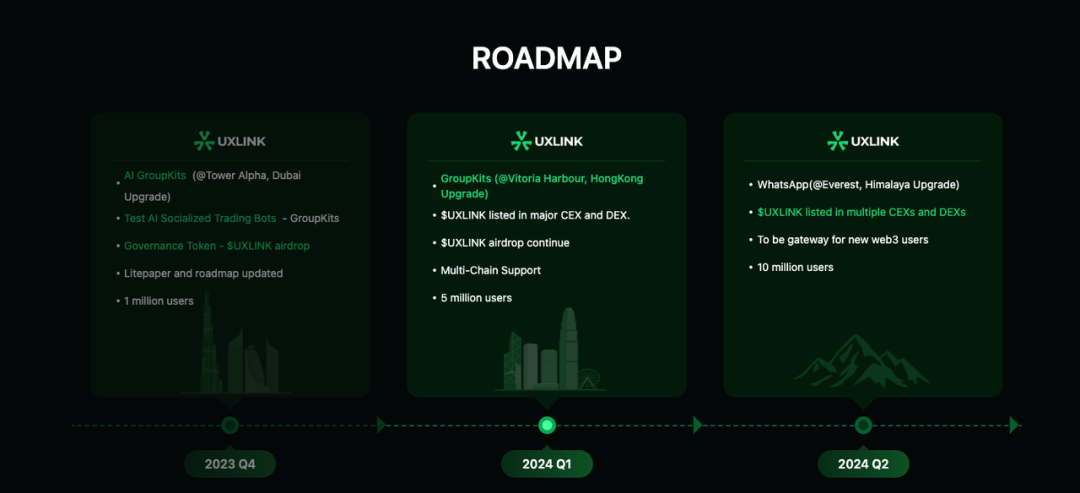
(Source: https://www.uxlink.io/)
Join TechFlow official community to stay tuned
Telegram:https://t.me/TechFlowDaily
X (Twitter):https://x.com/TechFlowPost
X (Twitter) EN:https://x.com/BlockFlow_News
 @BiteyeCN