








How Does UXLINK Break Through the Web3 Social Ceiling via "Holding the Two Extremes and Applying the Mean"?
TechFlow Selected TechFlow Selected
How Does UXLINK Break Through the Web3 Social Ceiling via "Holding the Two Extremes and Applying the Mean"?
UXLINK adopts the narrative thread and product concept of "holding the two extremes and applying the mean," offering greater scalability and infinite potential.
 Navigating Web3 tides with focused insights
Author: Yinghao
Preface
SevenX Ventures is proud to participate in investing in UXLINK, a globally leading group-based Web3 social platform.
We believe that UXLINK starts from the first principles of social interaction and finds an elegant balance at the intersection of the essential laws of generalized social behavior and the core tenets of Web3.
Jon, Founding Partner at SevenX Ventures, said: "By deeply understanding the real needs and pain points of Web3 users and projects, leveraging the powerful network effect amplification through trusted relationships among acquaintances, combined with Web3’s intrinsic incentive mechanisms and wealth effects, UXLINK has become the fastest-growing, highest-quality user-acquiring, and strongest monetizing group-based Web3 social platform. At the same time, with openness, permissionlessness, and modularity as its core principles, UXLINK provides developers and projects with an easy-to-use development environment, enabling deep, high-stickiness connections between projects and their target audiences—further solidifying network depth and expanding network boundaries. From this perspective, we believe UXLINK will cultivate asset issuance and trading capabilities through socialization, becoming a key hub connecting Web3 infrastructure and application scenarios."
UXLINK's Narrative, Product, and Achievements
Achievements
Through its innovative "Link to Earn" mechanism based on trusted referrals among acquaintances and the disruptive concept of "Web3-ized groups," UXLINK introduces new ways of user connection and organizational forms, establishing a unique protocol and data layer that deliver distinct value to Web3 developers. To date, UXLINK has over 5.7 million registered users, more than 100,000 groups, over 1 million daily active users (DAU) on its DApp, and over 300,000 DAU on-chain. Additionally, UXLINK’s first-season airdrop is underway, aiming to cover the top 10% of high-quality users—over 550,000 individuals.
Narrative and Product
UXLINK aims to lead an integrated social ecosystem encompassing Web3 traffic entry, socialized exchanges, and foundational infrastructure.
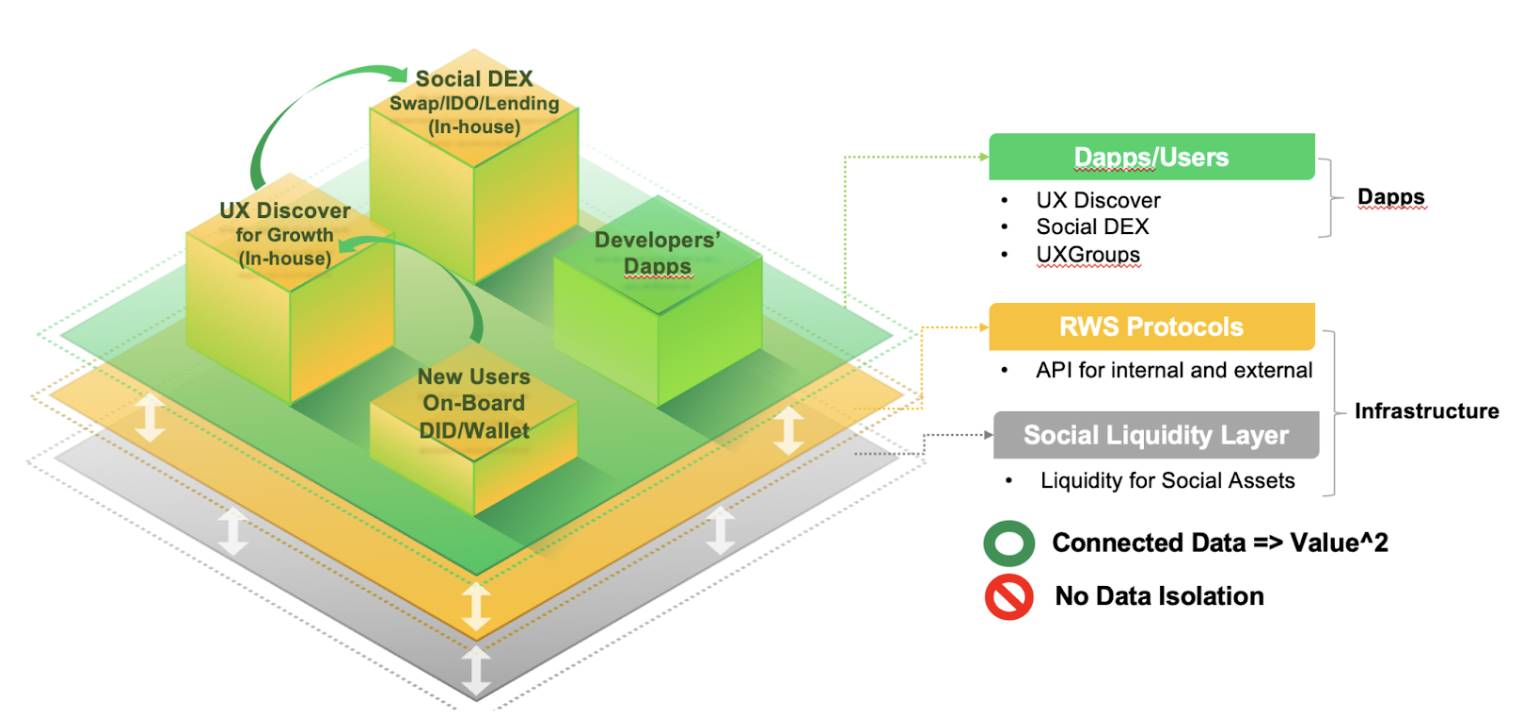
Product Vision Diagram
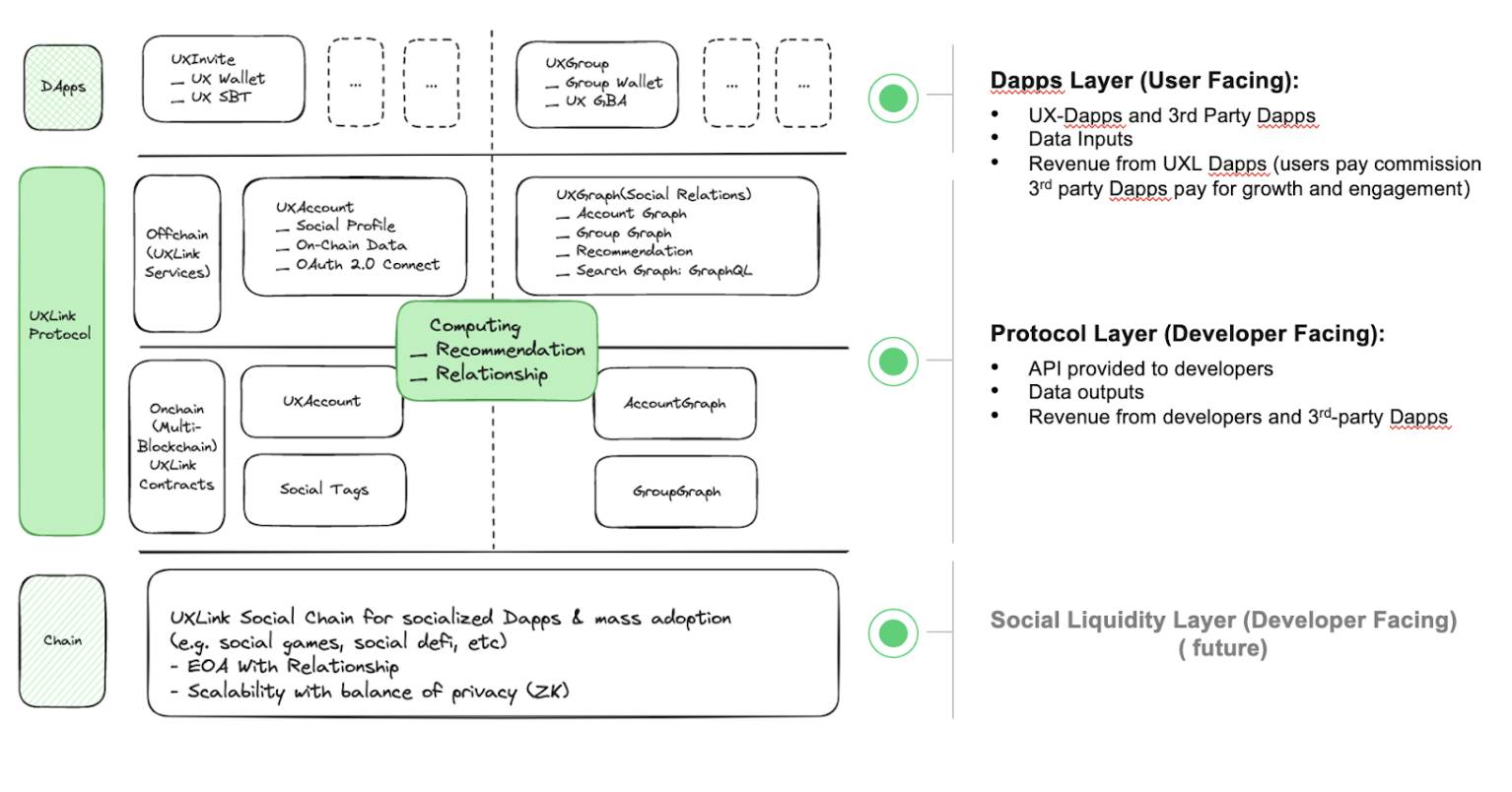
Product Architecture Diagram
UXLINK's product consists of three layers:
First Layer: Application Layer
Includes two main applications—UX Discover and Social DEX—that enable users to socially discover, participate in, and invest in suitable crypto projects and assets within group contexts. It also supports third-party developers in building various applications.
Second Layer: Protocol Layer
Comprises social protocols built upon real-world social relationships, allowing users true ownership of their social connections and data while empowering developers. Just as developers build mini-programs on WeChat or Facebook Marketplace on Facebook, they can leverage these social relationships to drive high-quality growth and personalized user services such as AI algorithms, recommendations, and group formation. This social data effectively addresses the widespread data silo problem in Web3.
Third Layer: Social Liquidity Layer
In planning: A lower-level infrastructure that empowers user sovereignty by enabling social relationships and data to be tokenized and fluidly transferred. It will allow users and developers to securely move their social assets across different public chains and DApps.
Both the second and third layers can serve as unique and effective infrastructures for developers.
The Essence of UXLINK, in Our Eyes
Authentic Social Interaction
UXLINK represents a migration and deepening of authentic social relationships and scenarios, innovatively enhanced by the core principles of Web3.
UXLINK emphasizes relationships among acquaintances—a simulation of real-world social dynamics. In reality, although one-way relationships exist (e.g., fandom or following), they do not constitute genuine “social relationships.” True social interactions are inherently bidirectional, where subjects form connections through some form of mutual engagement—be it communication, collaboration, or shared work.
Acquaintance-based socializing is the most important form of authentic social interaction. Most human interactions throughout life occur with acquaintances because these relationships are underpinned by direct or indirect trust—essential for behaviors like recommendations and transactions. Moreover, acquaintance networks naturally evolve from one-to-one to many-to-many and group formats, forming multi-dimensional structures that lay the foundation for network effects.
In other contexts—such as stranger-based socializing or social media—non-acquaintance relationships can transition into acquaintance ones. Stranger interactions thus act as levers to expand the reach of acquaintance networks. The “group” context provided by UXLINK is particularly well-suited for facilitating this transformation.
The core metric behind successful social products lies in frequency and density. Examining global social apps’ DAU/MAU ratios reveals leaders like WhatsApp, Facebook, and Instagram—all centered around acquaintance-based networks. The more acquaintances involved, the higher the usage frequency, even enabling high-frequency use cases to drive low-frequency ones.
With these insights, when evaluating what kind of social product could succeed, UXLINK presents two compelling paths. First, digitizing real-world social behaviors by replicating them online with specialized interaction models and organizational forms. On this front, Telegram remains functionally a subset of WeChat (which includes Moments and video channels), though both share similar group functionalities. Second, creating entirely new scenarios—like matchmaking or puzzle games—where UXLINK answers by providing all necessary environments for engaging with Web3.
Trust Network
At its core, based on authentic social interaction, UXLINK functions fundamentally as a data-generating machine.
By mining and migrating real-world social relationships, UXLINK generates several types of data: acquaintance-acquaintance, acquaintance-stranger; person-group, person-network, person-project, person-asset, as well as higher-order data with complex interdependencies built atop these metadata. In the first stage, data emerges from these network nodes as raw metadata. In the second stage, this metadata gains self-replicating capabilities—data that grows autonomously.
In an open-ended social network, user experience is largely determined by data—what entities they interact with, what information they receive, which assets get recommended or distributed. User-generated feedback further refines the data model. Thus, UXLINK’s data engine maximizes core user experiences within existing scenarios.
On top of vast, high-quality datasets, UXLINK’s network evolves from an acquaintance network into a trust network.
In asset-heavy and financial contexts, users place significant value on trust within their relational networks. Trust brings security, which encourages continued engagement and sustained interaction with the network: earning once, twice, thrice—and eventually developing strong loyalty toward UXLINK. Within its acquaintance network, UXLINK cultivates endogenous “confidence,” continuously raising the threshold of trust, ultimately fostering immense user loyalty.
Once established as a trust network, UXLINK offers users and developers a high-confidence selection mechanism. Its primary role is bridging users with diverse project teams employing varied token incentive models. Users fear being “scammed” or “reverse farmed” by projects, while projects worry about attracting fake or low-quality users. While acknowledging that many current token economies carry strong Ponzi-like attributes, UXLINK decouples and couples trust networks with Ponzi economics—using high-confidence networks to absorb speculative dynamics and create maximum mutual trust between users and projects.
Assets and Finance
Following this bull market, one clear takeaway is that Web3’s core impact lies in the seamless integration of assets and finance—subtly permeating everyday use—and catalyzing fragmented speculation, gaming, and profit-seeking behaviors. In short: assets and finance are battlegrounds for Web3 applications. Every app must deeply consider how it integrates assets, finance, and users.
On the asset side, UXLINK’s potential unfolds across three levels.
First, revitalizing transaction activity for existing assets. For the first time in Web3, large-scale acquaintance-based relationships have been established—this is a “new relationship.” Combined with UXLINK’s full toolkit (e.g., UX Growth) and its transformation of native Telegram environments (e.g., Social DEX), UXLINK leverages three key drivers—new relationships, new scenarios, new tools—to fully activate trading of existing assets, increasing turnover rates.
Second, issuing and circulating new assets. The surge of numerous projects elevates assets on two fronts: quantity and diversity. This bull run introduced a wide array of new assets—not only novel narratives and trends but also inscriptions, runes, image tokens, and other emerging standards. As a network rooted in Telegram, UXLINK seamlessly accommodates new asset issuance, enabling projects to drive operations across different lifecycle stages via tokenization. Through new assets, new distribution channels, and new operational strategies, UXLINK accelerates asset velocity.
Third, inclusivity toward all asset types. As noted above, UXLINK imposes no restrictions on asset categories. Its trading scenarios extend beyond immediate contexts, supporting tokens, NFTs, points, and other asset forms—lowering barriers to asset access.
On the financial side, beyond asset trading, “earning through actions” represents another critical dimension. When users interact with various entities within the UXLINK ecosystem, these interactions can be seen not just as “engagement” but as “contributions”—users contribute their social connections, attention, trust, and data. UXLINK’s core innovation lies in financializing these contributions, ensuring users—not platforms—are the primary beneficiaries.
Notably, once asset and financial attributes are solidified, scale economies act as a lever to amplify them. Network effects inherently drive scale economies. The asset efficiency generated by UXLINK’s acquaintance network significantly surpasses that of marketplaces or even centralized exchanges. We look forward to this vision becoming reality.
Connector
True to its name, UXLINK acts as a super connector, serving as a hub between two closed loops.
The first is the small loop: user-product-developer. UXLINK effectively links these three elements through its product stack, meeting fundamental needs of users and developers alike, fostering a healthy ecosystem of user-centric products.
The second is the larger loop: infrastructure-traffic-application. Through its three-layer structure—Layer/chain, Protocol, DApp/application—combined with an invisible trust network, UXLINK holds the potential to bridge Web3’s two major camps: infrastructure and applications, closing the loop through traffic.
In today’s somewhat fragmented Web3 landscape, we hope UXLINK becomes the industry’s adhesive and connector through these dual-loop integrations.
UXLINK’s Advantages and Potential
S-Class Team and First Principles Thinking
UXLINK exemplifies an S-class founder leading an S-class team. With years of internet entrepreneurship experience, the team possesses exceptional expertise in product R&D, growth, operations, and fundraising, having managed social products with over 100 million users. After embracing Web3, the team demonstrated remarkable iteration speed—quickly mastering Web3 concepts, technical frameworks, and token economics—while avoiding blind imitation, carving out a unique positioning and entry point for UXLINK. Furthermore, the team consistently demonstrates strong execution and resource integration capabilities, delivering products rapidly, launching large-scale campaigns, and securing extensive partnerships—all rooted in rich frontline entrepreneurial experience.
Another strength of the UXLINK team is their commitment to first principles and independent thinking. When designing each product feature, they start with actual user needs, then thoughtfully integrate Web3 elements—avoiding PMF gaps caused by fabricated demands.
Establishment of Core Resources and Monopoly Potential
Acquaintance-based social networks are core resources in any new paradigm of internet applications—and represent an area ripe for reinvention in Web3.
People feel uneasy after five minutes without checking WeChat; Web3 practitioners grow anxious if they don’t scroll through Telegram for half an hour. Mobile internet has raised our tolerance threshold for disconnection from acquaintance networks to the extreme—any brief separation triggers severe withdrawal symptoms. Once formed, individuals cannot freely choose whether to join or leave such networks—exclusion means being left behind. This is the objective monopoly of acquaintance networks.
As the first Web3 social product deeply focused on acquaintance relationships, UXLINK is rapidly constructing such a network and has achieved initial leadership. If UXLINK becomes the builder of Web3’s acquaintance network, it holds the potential to monopolize this core resource.
This objective monopoly will extend further into scenario definition power and resource pricing power: the dominant use cases on this network will be shaped by UXLINK; all commercial flows within it will be priced accordingly, as suppliers, demanders, and users grow increasingly dependent and sticky to this network.
Moreover, early-mover advantages confer a degree of cognitive and behavioral monopoly over users. Especially given UXLINK layers wealth effects onto acquaintance relationships. Users increasingly perceive UXLINK as a place to consistently engage with promising projects, invest wisely, and earn profits. Projects gradually recognize UXLINK as a fast, efficient channel for campaign promotion, user acquisition, and asset distribution.
Self-Reinforcing Acquaintance Network and Brand
Let us revisit Metcalfe’s Law: the value of a network increases with the square of its number of users—the more users, the greater the value for everyone connected.
This is the magic of social networks—they exhibit continuous positive self-reinforcement. However, this effect requires sufficient network density and crossing a “critical mass” threshold. While we cannot yet confirm whether UXLINK has crossed this tipping point, it is undoubtedly approaching rapidly.
A similar self-reinforcement is unfolding in branding. Through deep collaborations with top-tier projects and scientifically selecting high-quality, genuine users, UXLINK continuously strengthens its reputation as a “quality assurance” brand in the eyes of users and projects—achieving organic brand enhancement.
When the Web3 Application Pendulum Reaches the Midpoint
From an industry observer’s view, Web3 has spent years exploring mass adoption. Applying the “pendulum theory,” developer focus has oscillated between “purists” and “pragmatists.”
“Purist” developers follow native Web3/blockchain/crypto principles—maximizing decentralization, on-chain everything, data ownership, permissionless deployment—and break many Web2 development paradigms, creating a wave of “pure” apps. Yet, these apps often reflect only developer perspectives, struggling with product-market fit. Beyond incentive participation, users rarely find practical utility. But applications are meant for users, not developers—this is the purist dilemma.
“Pragmatist” developers prioritize the question: “What does blockchain/crypto actually bring to this application?” Many answer with “innovative token incentives.” But when incentives dominate design, apps reduce to mechanical “Web2 + token” hybrids. User attention fixates solely on token rewards, turning apps into Ponzi schemes that collapse under economic stress or when better-return opportunities emerge.
In contrast, UXLINK adopts a balanced “middle path” in narrative and product design—offering greater extensibility and unlimited upside. UXLINK embraces both developer and user perspectives: integrating decentralization, permissionless deployment, and modularity into its protocol stack to offer developers a highly flexible, frictionless environment; while delivering native Web3 acquaintance-based social experiences and dual-layer incentives—internal app rewards and external partner-driven incentives—for users.
It is precisely this centrist philosophy that grants UXLINK profound scarcity—finding elasticity between “purist” and “pragmatist” extremes, enabling harmonious intersections between developers and users, collectively exploring viable paths toward mass adoption through “building, using, and experiencing together.”
Join TechFlow official community to stay tuned
Telegram:https://t.me/TechFlowDaily
X (Twitter):https://x.com/TechFlowPost
X (Twitter) EN:https://x.com/BlockFlow_News
 @SevenXVentures






