Which tokens might launch ETFs after ETH? SOL has the strongest momentum, while Doge has a relatively high probability
TechFlow Selected TechFlow Selected
Which tokens might launch ETFs after ETH? SOL has the strongest momentum, while Doge has a relatively high probability
Discussions about whether ETFs for other tokens might be launched have started to gain traction.
 Navigating Web3 tides with focused insights
By Weilin
In the early hours of May 24, Ethereum ETFs achieved a milestone moment in the United States as the U.S. Securities and Exchange Commission (SEC) approved issuers' 19b-4 filings. This has sparked widespread discussion about whether other cryptocurrencies might also launch ETFs. What challenges would arise in approving ETFs for other tokens? If possible, which tokens are most likely to be next—SOL, PEPE, or DOGE?
According to industry experts, two rigid thresholds stand out: market consensus and whether a token is classified as a security. Currently, unless there is a significant shift in the U.S. regulatory framework, the next crypto ETF may not emerge for another two to three years.
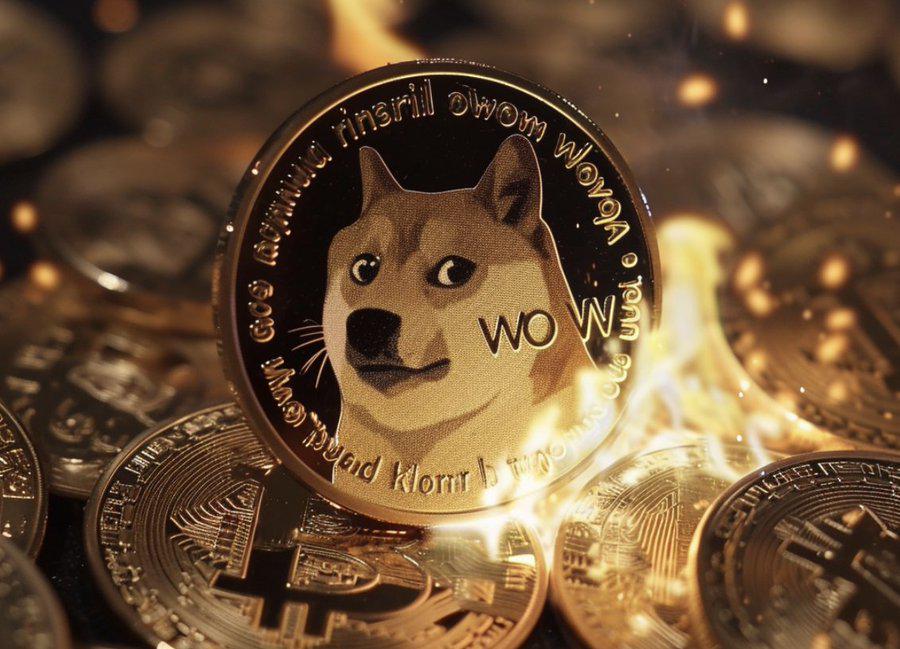
Solana Has High Hype, But Low Likelihood
On May 23, Brian Kelly, CEO of BKCM, predicted on CNBC’s "Fast Money" that Solana (SOL) could become the next cryptocurrency to launch a spot exchange-traded fund (ETF) in the U.S. However, this bold prediction was quickly met with skepticism from industry experts who pointed out several major regulatory and market hurdles.
First, the SEC has already categorized Solana as a security, as referenced in lawsuits against major exchanges such as Coinbase and Kraken. This classification significantly complicates Solana's path to approval. Additionally, unlike Bitcoin and Ethereum—which both have futures ETFs—Solana lacks this critical market infrastructure.
James Seyffart, an ETF analyst at Bloomberg, stated that before any spot ETF can be launched for Solana, it must first have futures products listed on the Chicago Mercantile Exchange (CME), or Congress must establish a robust regulatory framework for cryptocurrencies.
Currently, Bitcoin and Ethereum are the only two cryptocurrencies with approved futures ETFs in the U.S. Major ETF issuers also show little interest in launching ETFs for other digital assets. BlackRock, a leading ETF provider, has stated it has no plans to launch ETFs for alternative coins including Solana.
Although Franklin Templeton, an asset manager overseeing trillions of dollars, recently praised Solana and its co-founder Anatoly Yakovenko, sparking speculation about a potential future application for a spot Solana ETF, very few ETF providers have expressed intent to file for one.
Nate Geraci, president of ETF Store, echoed Seyffart’s view, stating that without a futures market and clearer regulations, a spot Solana ETF is unlikely. He emphasized that Congress must first establish a clear legal regulatory framework for cryptocurrencies before such a product could have any chance of approval.
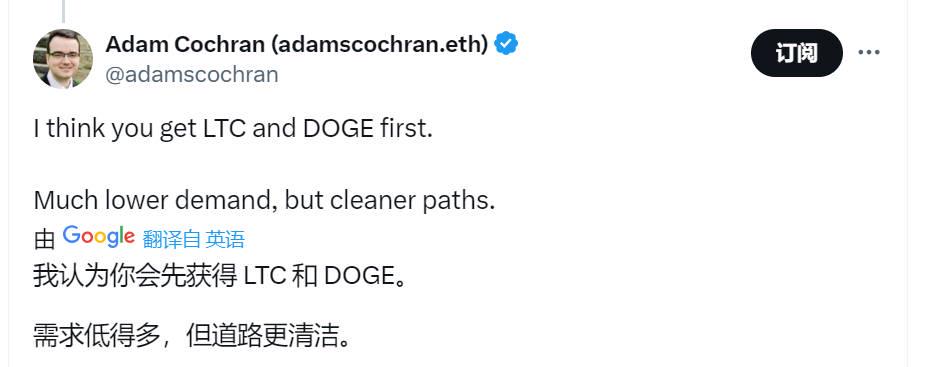
Adam Cochran, partner at Cinneamhain Ventures, believes Litecoin (LTC) or Dogecoin (DOGE) might be more likely candidates for the next ETF approval due to their simpler regulatory profiles. Both use a proof-of-work (PoW) consensus mechanism similar to Bitcoin, potentially making their regulatory paths less contentious.
On May 23, Grayscale launched two new investment trusts: Grayscale Near Trust (NEAR) and Grayscale Stacks Trust (STX). Rayhaneh Sharif-Askary, Grayscale’s Head of Product and Research, said the firm is committed to introducing new products that give investors exposure to emerging and growing segments of the crypto ecosystem. Some believe moves by institutions like Grayscale could signal potential future ETF candidates, though the landscape remains unclear.
Consensus and Security Classification Are Hard Barriers
On May 23, during a Twitter Space hosted jointly by PANews and OKX titled “What Will Ethereum Spot ETF Bring?”, panelists discussed this very issue. Da Chengzi @0xVeryBigOrange, host of Zero x Ganhuo Store, said the analysis will certainly start from the top 10, perhaps even the top 5, in market capitalization—excluding Bitcoin and Ethereum. “I think SOL is almost impossible because of ongoing litigation disputes. BNB is also out of the question. DOGE might have a slightly higher chance.”
“I’ve been watching DOGE lately, but I still think the probability of any other token getting an ETF soon is extremely low. There’s a qualitative leap between having an ETF and not having one. You can apply elimination logic here—smaller market cap tokens don’t even need to be considered,” added Da Chengzi.
Ethereum ecosystem developer 0xAA @0xAA_Science shares a similar view: “After Ethereum, I also think we should go by market cap. I hope meme coins get more opportunities, because fairly launched memes may be the least securities-like. But I don’t think the U.S. will be ready to accept mainstream investment in memes anytime soon—so let’s take it slow.”
Mindao @mindaoyang, founder of dForce, noted several key metrics mentioned earlier, including token concentration. From this perspective, among the top 20 tokens, Bitcoin and Ethereum have been in the market for over 10 years, resulting in highly dispersed holdings. In contrast, Solana has only existed for four or five years. Moreover, its foundation holds a high degree of centralization—FTX previously held 10%, and key insiders collectively may hold more than 20%. Therefore, Solana is essentially ruled out.
Another prerequisite for Bitcoin and Ethereum ETF approvals is trading on the Chicago Mercantile Exchange (CME) in the U.S., as ETFs require a reference price. Besides Bitcoin and Ethereum, no other crypto assets are currently traded there. I think there could be a gap of at least two to three years before a third ETF appears. If a third does emerge, Dogecoin might meet the criteria—but its market cap is too low. A $20+ billion market cap feels underwhelming for an ETF.
Bitcoin and Ethereum now hold a dominant position as ETF assets. Their narratives are fundamentally different—Ethereum’s story overlaps heavily with Solana’s. So why would you need Solana or others if you already have Ethereum? There’s little narrative differentiation. At least in the next two to three years, I believe only BTC and ETH will be viable as investable ETFs; others simply aren’t visible on the horizon.
Data analyst Phyrex @Phyrex_Ni believes it's quite possible on an annual timescale. On DOGE specifically, we must examine the SEC’s conditions for approving spot ETFs. First, the asset must not be classified as a security. DOGE may satisfy this condition.
Second, there must be sufficient consensus. Consensus includes both market capitalization and resistance to market manipulation. When the SEC rejects ETF applications, concerns about market manipulation are often cited. DOGE exhibits clear signs of market manipulation—whenever Elon Musk tweets anything related to DOGE, the market reacts immediately, often with sharp price spikes. This indicates high centralization and susceptibility to manipulation.
Therefore, regardless of who chairs the SEC or whether FIT21 passes, the likelihood of DOGE obtaining a spot ETF remains extremely low—this is fundamentally tied to its market structure and valuation.
Secondly, in terms of market cap, the gap between DOGE and others is substantial. Everyone knows Solana is out of the picture. Even if Solana achieved full market consensus, its core problem remains the SEC’s stance. The SEC cares about its credibility—especially since it has explicitly named Solana as a securities case in its lawsuit against Coinbase. That legal battle will happen; it’s just a matter of timing.
Even if Gary Gensler (SEC Chair) were replaced, the legal proceedings involving Solana and Coinbase would continue. BNB is unlikely. Ripple (XRP) could be a possibility, but no one has actually won a case against the SEC. Ripple hasn’t truly won—it merely went from losing 100 points to losing 80.
Across the entire cryptocurrency space, those deemed securities often lack broad consensus, while those with strong consensus may not qualify as securities. According to the SEC’s official stance, the only cryptocurrencies explicitly confirmed *not* to be securities—aside from BTC and ETH—are BCH, LTC, DOGE, and STX—just six in total. Beyond these, no other token has received such a clear determination.
Additionally, as Mindao pointed out, a token must first be listed on CME. If that foundational step isn’t even visible, the path becomes much harder.
Looking ahead, even if new ETFs do emerge, it would only be possible if FIT21 passes and brings a fundamental redefinition to how cryptocurrencies are regulated. Only then could new candidates appear—and only then could we identify who they might be. If this foundational stance remains unchanged, it’s entirely possible that no existing token will meet the necessary criteria—even on an annual basis.
Join TechFlow official community to stay tuned
Telegram:https://t.me/TechFlowDaily
X (Twitter):https://x.com/TechFlowPost
X (Twitter) EN:https://x.com/BlockFlow_News
 PANews