Understanding the Crypto "Meta-Game": The Core Drivers of Market Narratives and Behavioral Shifts
TechFlow Selected TechFlow Selected
Understanding the Crypto "Meta-Game": The Core Drivers of Market Narratives and Behavioral Shifts
Each metagame is different; they share similarities, but no two are exactly the same.
 Navigating Web3 tides with focused insights
Author: MIDAS CAPITAL
Translation: TechFlow
Introduction
The concept of a meta-game is one of the more esoteric ideas in crypto—one without a concrete definition or fixed structure. It's something you "just know when you see it." Yet once you've seen it, it's hard to unsee. In today’s piece, I’ll attempt to unpack my understanding of it, hoping readers walk away with a clearer grasp of what a meta-game is and how to think about it.
Before we begin, it should be noted that the concept of the meta-game was popularized by Cobie in his article Trading the Metagame. Prominent traders like Light Crypto and Dan from CMS Holdings have also discussed the idea across various podcasts. While the idea isn’t new, I hope to offer some fresh insights and build a structured framework around it.
The best way to understand the meta-game is through game theory, a branch of behavioral economics. It involves understanding the rules of the game, your opponent’s best response function, and your own optimal response function given all available information. We will use intuition and examine data to analyze these games and determine how to optimally play each one.
It’s important to recognize that every meta-game is different. They share similarities, but no two are identical. Therefore, having an overarching framework and building strategy on top of it is crucial. This is what we’ll explore today.
What Is a Meta-Game?
I won’t define the meta-game outright. Instead, it’s more useful to explain how its mechanics operate and the framework through which we understand it. A meta-game consists of several components, summarized as follows:
-
Base Mechanism
-
Behavioral Shift
-
Best Response Function
-
Reflexive Loop
The base mechanism can be thought of as the foundation of the meta-game, broken down as follows:
-
A catalyst—often (but not limited to) price movement—that sparks a narrative, with prices moving in line with the narrative. The reason behind the price movement often traces back to protocol upgrades, KPIs, or other events/indicators.
-
The nature of the catalyst forms the base mechanism, which supports a reflexive loop.
Behavioral shift refers to how market participants express their views on the catalyst.
The best response function describes how you, as a trader, should respond to the catalyst, how other market participants perceive the catalyst, and how they are likely to react. The best response function involves considerations around position sizing, entry, and exit.
The reflexive loop can be categorized as follows:
-
Market participants identify the base mechanism → enter the game → prices behave according to the game’s rules → the rules become increasingly apparent → more participants identify the mechanism → more players join → and so on.
These four components provide a high-level overview of how a meta-game develops, evolves, and eventually dissipates.
Theoretical Framework
Below is a flowchart detailing how to go from identifying a meta-game, to understanding it, and ultimately extracting value. Let’s walk through this step-by-step. First, some theory, then we’ll look at examples and data.
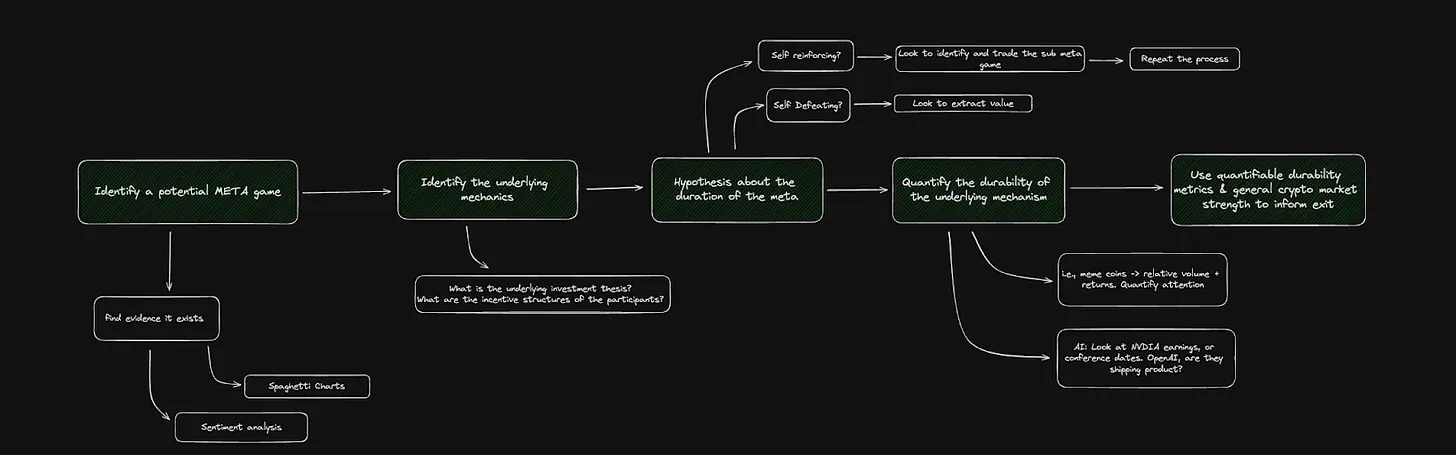
Step 1: Identify potential meta-games—observe or look for:
-
Emerging narratives, sentiment analysis, anomalous price behavior.
-
Protocols or sectors positioning themselves as solutions to known problems.
-
Widely known and understood binary events.
Step 2: Identify the base mechanism
-
Given the catalyst and how it’s perceived, how does it drive changes in market participant behavior?
-
There are two types of base mechanisms: self-reinforcing and self-defeating
-
Self-reinforcing: A persistent base mechanism where the catalyst is ongoing, so the meta-game lasts for some time. For example, BTC ETF inflows/outflows—since data is released daily, this can be seen as a repeated interaction game.
-
Self-defeating: A base mechanism that drives a certain behavior, causing the meta-game to quickly dissipate. For example, Facebook rebranding to META—a one-time event, effectively a single-shot interaction game.
-
Step 3: Hypothesize the duration of the meta-game
-
Nuances in the base mechanism determine the game’s duration, as well as entry and exit strategies.
-
Generally, self-reinforcing meta-games spawn sub-meta-games, while self-defeating ones vanish as quickly as they appear.
Step 4: Quantify the persistence of the base mechanism
-
Make assumptions about whether the game is self-reinforcing or self-defeating, then find data that confirms or invalidates those assumptions.
-
For example, if playing a meme meta-game, looking at relative trading volume (as a proxy for attention) is useful.
-
For instance, if trading the BTC ETF meta-game, analyzing ETF flows, their sources, and how prices react to these data points is helpful.
-
This largely comes down to intuition driven by data availability.
Step 5: Use quantifiable metrics and general market strength to guide exits.
-
There is no specific or repeatable exit strategy.
-
Exit timing differs for every meta-game; generally, intuition is key.
-
Looking at data such as market cap, relative volume, etc., helps—but ultimately, it’s a discretionary decision.
Meta-Game Examples
Let’s examine some current and past meta-games, along with their underlying logic and data. In this section, we’ll look at a self-reinforcing meta-game (ETH killer trade), a self-defeating one (Facebook rebranding to META), and an ongoing one (BTC ETF flows).
Example 1: ETH Killer Meta-Game
I assume this is a meta-game most readers are very familiar with—it was one of the key trades of the 2021 bull run. Below is a table outlining the basic parameters of the meta-game.
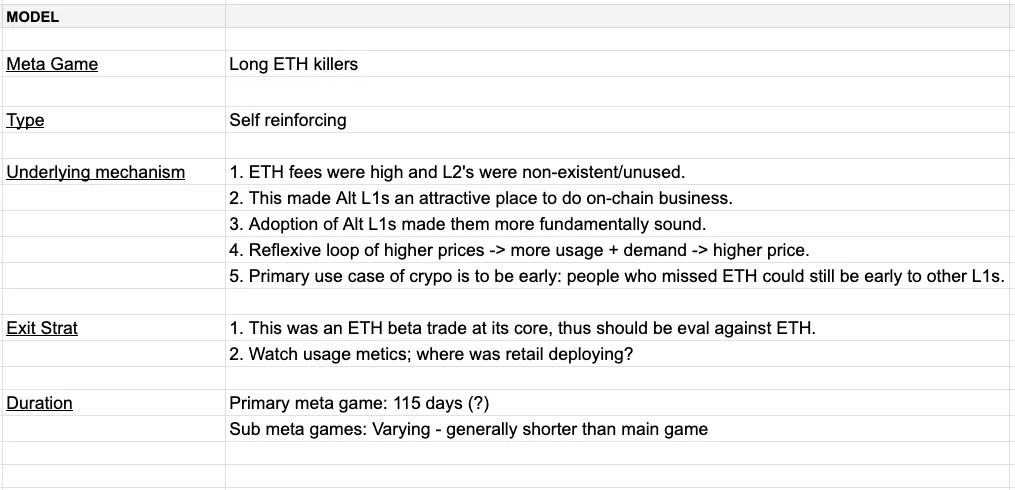
If the table isn’t clear, let me take a moment to walk through this meta-game in detail. Recall the 2021 bull market: retail came in to gamble, ETH fees were expensive, scalability solutions were lacking, and Solana and Avalanche positioned themselves as solutions (i.e., faster and cheaper transactions). This is the base mechanism.
The base mechanism is self-reinforcing (reflexive): as long as we’re in a bull market, ETH fees remain high, reinforcing the case for going long ETH throughout the cycle. As SOL and AVAX outperformed ETH, the trade became clearer, attracting more participants. The nature of the base mechanism supported an upward reflexive loop.
Given the meta-game’s persistence, it spawned sub-meta-games—derivative plays off the main game. Specifically, the DeFi booms on SOL and AVAX, and the emergence of FOAN trades. Market participants began positioning Phantom, Harmony, Cosmos, and Near as the next Alt L1 plays. Mechanically, those who felt they missed the main game found adjacent sub-games to participate in.
Generally, sub-meta-games offer smaller returns and don’t last as long as the main game.
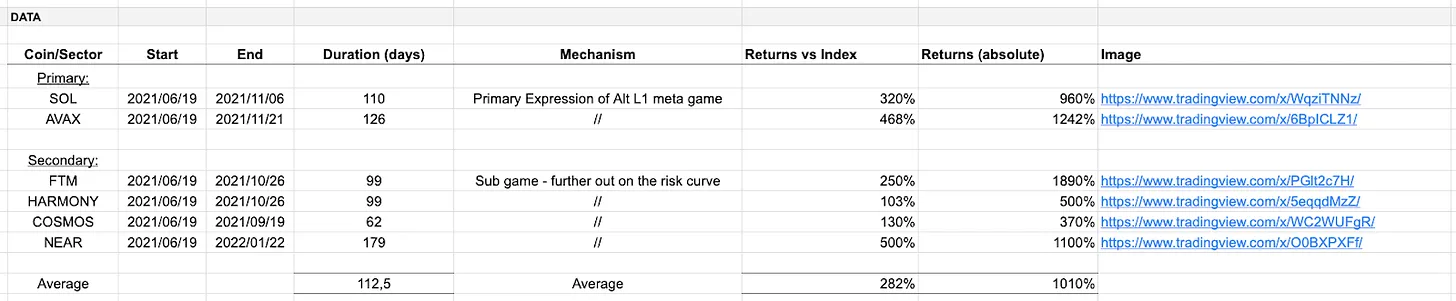
-
Primary → main meta-game; Secondary → sub-meta-game
-
Start, End, Duration → time parameters
-
Mechanism → description of the base mechanism
-
Return vs Index → performance metric relative to a major or thematic benchmark
-
Absolute Return → performance metric in absolute terms
The parameters of the game are largely subjective. Objectively, it’s clear that X outperformed Y, but determining exactly when performance started and ended is subjective. The same applies to index selection—how do we define outperformance? The table simply aims to approach some objective truth.
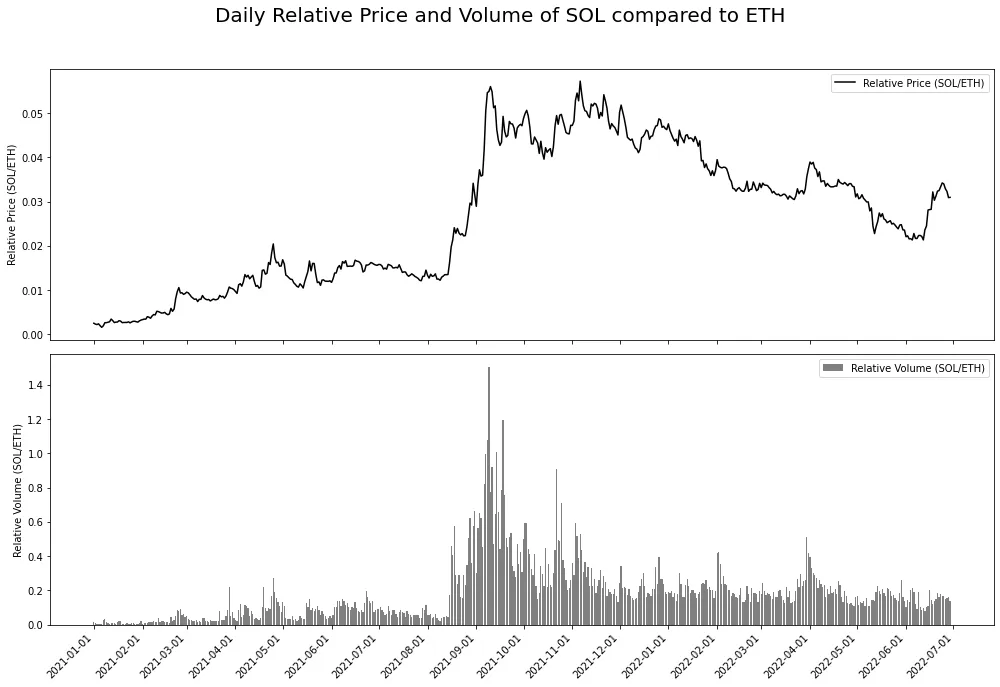
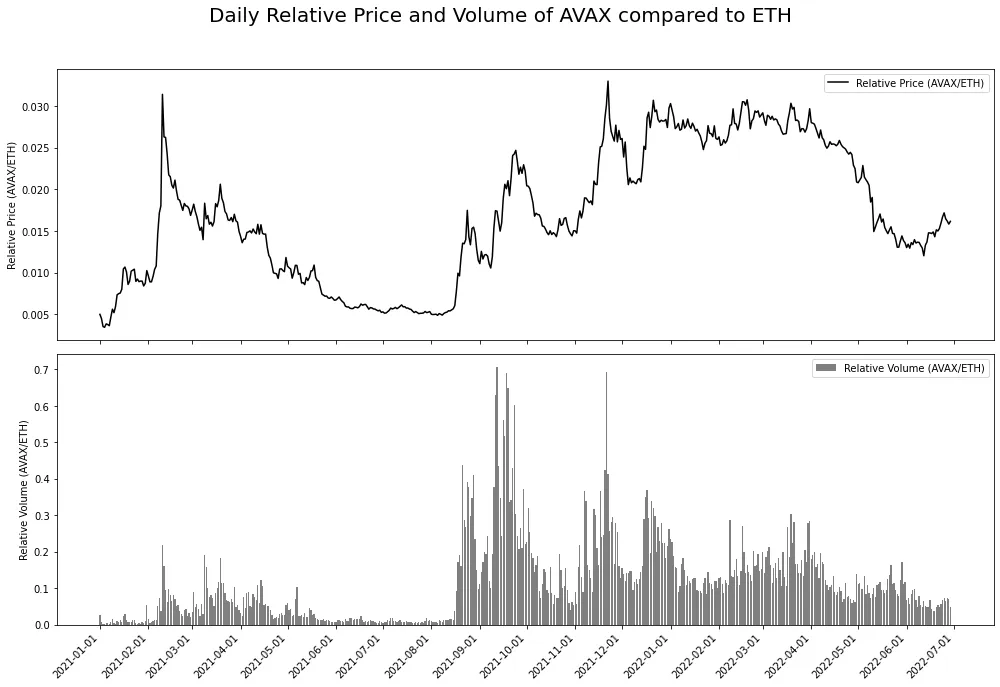
Below are two charts—SOL vs ETH and AVAX vs ETH. They show the relative trading volume and relative price performance of SOL and AVAX against ETH, sourced from Binance Futures API. The idea is simple: use relative volume as a proxy for relative interest and see how it aligns with relative price performance.
Notably, excess returns from this meta-game were found in the second half of 2021. I suspect this is because the summer 2021 price drop paused all games temporarily, yet the narrative continued to attract participants. When the market rebounded, capital allocation became directional. This may be motivated reasoning, but I believe there’s some truth to it.
To consider an exit strategy, we must revisit our assumptions about the base mechanism. This meta-game was a solution to a persistent problem (high ETH fees), rooted in a bull market condition. Thus, the most basic exit strategy would be to sell when you believe the bull market is nearing its end.
Example 2: Facebook Rebrands to Meta
On October 28, 2021, Facebook rebranded to META, sparking a speculative frenzy around metaverse-related crypto projects—an obvious base mechanism. The key difference between this and the previous example lies in duration. Example 1 was self-reinforcing, while Example 2 was self-defeating—meaning the catalyst here was a one-time event. This slightly alters the game dynamics; let me explain.
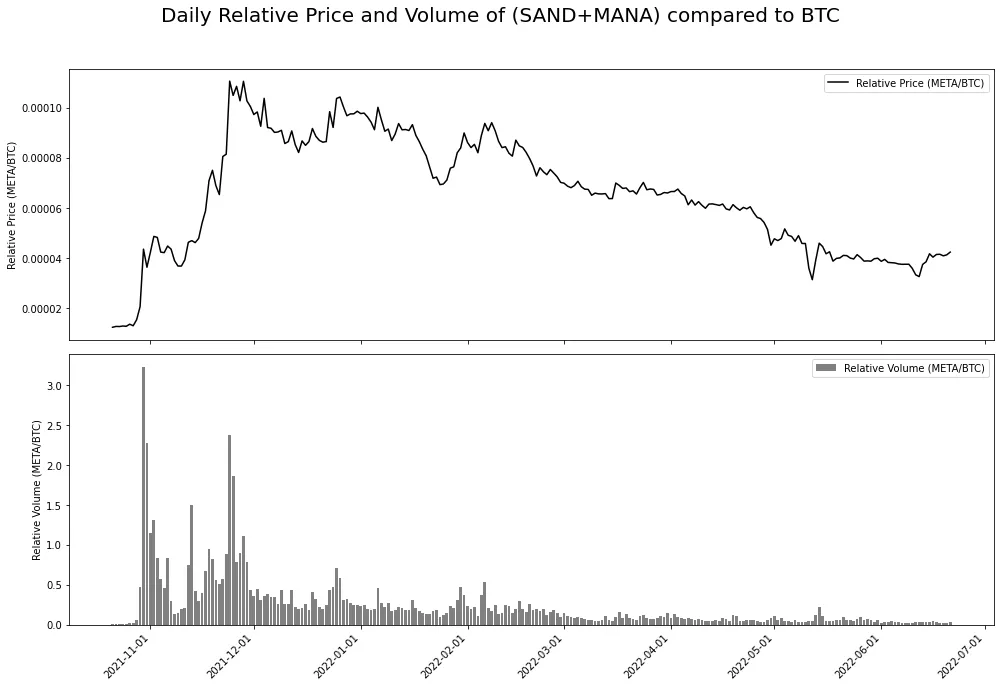
Look at the chart below—it shows shifts in attention over time. If we assume each project has some equilibrium share of attention economy, that’s our baseline. After the one-time catalyst, we see a massive repricing in the metaverse tokens’ attention share. This drove abnormal price movements, which attracted even more attention. However, as the catalyst faded, the meta-game rapidly unraveled. This can also be understood through fragility: over time, coordination points become more vulnerable to external forces (e.g., broader macro price trends)—largely, Bitcoin’s -9% drop on November 26 marked the end of this rally. Over time, the ability of a one-time catalyst to serve as a coordination point weakens—reflected in declining attention.

Prior to the rebrand, Axie Infinity already had semi-closed growth, and the metaverse concept was gaining traction in Silicon Valley. All ingredients were present—the META rebrand was merely the spark. The primary beneficiaries were Decentraland ($MANA) and Sandbox ($SAND)—both repriced immediately.

Again, to consider an exit strategy, we revisit our assumption about the base mechanism: a one-time catalyst leads to a self-defeating dynamic. Therefore, one should actively seek ways to exit the trade. Looking at the chart below, we see it reflects the stylized example above—relative volume serves as a proxy for attention share. Additionally, understanding market structure is important: $SAND and $MANA trading volumes cannot sustainably be three times that of $BTC—it defies logical order.
Example 3: BTC ETF Meta-Game
Note: This section was originally written in late March. Updated thoughts on this meta-game follow later in this section.
This is an example of a currently ongoing meta-game; most crypto market participants are engaged in this trade. Its base mechanism is bullish ETF inflows, for several reasons:
-
We are approaching the halving, and coins flowing into ETF products are multiples of new supply. This makes the scarce supply + token narrative more compelling.
-
ETF approval grants legitimacy to crypto as an asset class and provides a new investor base access to buy BTC.
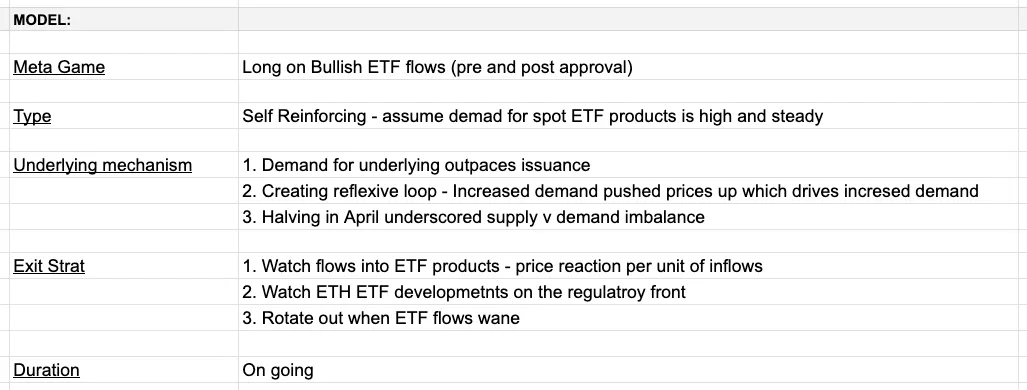
Similar to the ETH Killer meta-game (Example 1), this one is self-reinforcing. ETF products trade seven days a week, so BTC price loosely trades as a beta to these ETF flows. Given the base mechanism, we can make a few assumptions about ETF flows and price:
-
ETF inflows are positive for BTC price
-
ETF outflows are negative for BTC price
As a basic model, this is a straightforward game. But as with everything in life, the devil is in the details. Since GBTC was originally a closed-end fund, the vast majority of outflows come from GBTC—these are expected to slow in the second half. All else equal, reduced GBTC outflows should boost net inflows—bullish.
Updated Thoughts on This Meta-Game:
I suppose this serves as a reflection on my original BTC ETF meta-game thesis. Since I first wrote this section, much has changed—particularly, the halving has occurred, and ETF flows have declined and occasionally turned negative. I believe this meta-game is still ongoing, but reflexivity is now operating in reverse: ETF inflows have shifted to outflows, and prices have responded accordingly. The relationship between ETF flows and BTC price performance appears quite clear in both directions.
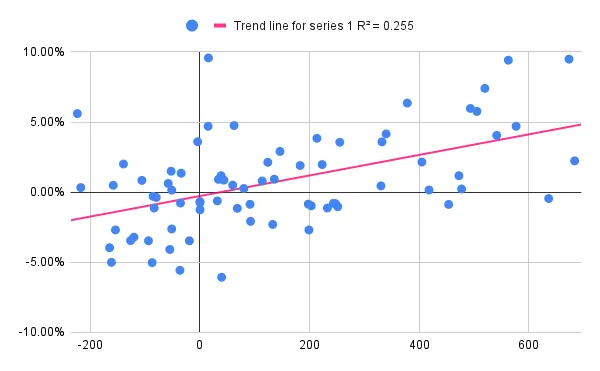
It’s worth noting that ETF flows and price aren’t mechanically linked—as with all meta-games, this is somewhat a shared illusion. As ETF flows stabilize—likely averaging zero daily—I expect this meta-game to dissipate. Notably, attention to ETF flows correlates with magnitude: large inflows and outflows make headlines, while normal days go unnoticed. As this meta-game recedes into the rearview, I expect only outlier days will draw attention.
In the near future, we may see a similar ETH ETF meta-game emerge. All else equal, I anticipate:
-
As ETF approval odds become clearer, ETH trading will heat up—we can use Bloomberg ETF analysts’ commentary and probability estimates as proxies.
-
Post-approval risk-downgrade, as the market analyzes ETF inflows versus ETHE (Grayscale product) outflows.
-
If inflows match BTC levels (which I doubt), it’s bullish. Subpar inflows are bearish, potentially bullish for Solana.
Assuming ETH ETF fees will resemble BTC ETF fees, I’m not entirely sure what higher fees imply—Occam’s Razor suggests it’s bearish. BTC price action and BTC ETF inflows set the stage for strong ETH ETF performance, making it somewhat a foregone conclusion. As we begin trading the ETF meta-game, I believe the market will price ETH ETFs based on BTC ETF performance. If BTC ETFs see massive outflows between and after ETH ETF approvals, I believe the ETH ETF could fail. Other interesting things to watch include whether ETH in ETFs will be staked and whether ETF holders receive those yields—this seems unlikely due to “securities laws, Howey test, etc.,” but would be a surprise if it happened.
Some Final Thoughts
Market behavior follows certain regularities or logic—assets that violate these norms tend to revert to the mean quickly. These logics/laws are largely dynamic, but the Overton window (i.e., policy window) shifts slower than most realize. Moreover, there are immutable laws—like gravity—that cannot be violated.
Meta-games aren’t just an investment framework—they’re more of a mental model. It’s difficult to build a rigid structure around how these games develop, evolve, and behave because they’re all different. Identifying them and theorizing how they might unfold requires a degree of intuition honed through market experience and first-principles thinking.
I’ve detailed a self-defeating, a self-reinforcing, and an ongoing meta-game. Other examples include:
-
Meme, 2021 (self-defeating)
-
ETH Merge, 2022 (self-defeating)
-
Crypto x AI, 2024 (self-reinforcing)
-
SOL killers, 2024 (unclear)
-
Meme, 2024 (self-defeating)
-
RWA, 2024 (self-reinforcing)
-
New launches, 2024 (variable)
-
BTC ETF beta, 2024 (self-reinforcing)
There are many kinds of meta-games, each unique. Yet the core process remains the same: identify the meta-game, understand its base mechanism, infer its duration, then plan how best to extract value.
Join TechFlow official community to stay tuned
Telegram:https://t.me/TechFlowDaily
X (Twitter):https://x.com/TechFlowPost
X (Twitter) EN:https://x.com/BlockFlow_News
 @midascapitalx