








Crypto Morning Brief: Sun Yuchen Accuses WLFI Contract of Hidden Backdoor; Major Token Unlocks This Week for CHEEL, DEP, and Others
TechFlow Selected TechFlow Selected
Crypto Morning Brief: Sun Yuchen Accuses WLFI Contract of Hidden Backdoor; Major Token Unlocks This Week for CHEEL, DEP, and Others
The second round of U.S.-Iran negotiations may take place within a few days.
 Navigating Web3 tides with focused insights
Author: TechFlow
Market Highlights – Yesterday
U.S. Military to Block Maritime Traffic to Iranian Ports Starting Tonight at 10 PM
The U.S. Central Command (CENTCOM) announced that its forces will begin enforcing a maritime blockade on all vessels entering or departing Iranian ports at 10:00 AM Eastern Time on April 13 (10:00 PM Beijing Time today). This blockade will apply uniformly to vessels of all nationalities operating in and around Iranian ports—including all Iranian ports in the Arabian Gulf and the Gulf of Oman. CENTCOM forces will not impede the freedom of navigation for vessels transiting the Strait of Hormuz en route to or from non-Iranian ports. Additional information will be formally communicated to commercial mariners prior to the commencement of the blockade. All mariners are advised to monitor Notices to Mariners broadcasts and contact U.S. Navy forces via VHF Channel 16 when operating near the entrances to the Gulf of Oman and the Strait of Hormuz.
Second Round of U.S.-Iran Talks May Occur Within Days
According to The Wall Street Journal, informed officials revealed that regional countries are racing to bring the United States and Iran back to the negotiating table following a marathon round of peace talks in Islamabad that failed to yield an agreement. Although both sides have issued tough statements, diplomatic channels remain open—and a second round of negotiations could take place within days. Regional nations are coordinating with the U.S. to extend the fragile two-week ceasefire announced late Tuesday. Iranian officials have proposed “alternative measures,” including continuing symbolic uranium enrichment activities or reducing their enriched uranium stockpile—but no compromise has been reached.
Caixin: Applications for Second Batch of Hong Kong-Compliant Stablecoin Licenses Underway
According to Caixin, applications for the second batch of Hong Kong-compliant stablecoin licenses are already underway. Reliable sources indicate that Futu Securities and OSL Group are among the applicants vying for these licenses. However, in November last year, China’s central bank and 12 other ministries reiterated their stance against virtual currency trading within mainland China and classified stablecoins as virtual currencies—effectively barring stablecoin trading in mainland China.
Justin Sun Accuses WLFI of Embedding Backdoor in Smart Contract; Claims Personal Token Wallet Illegally Blacklisted
Justin Sun publicly accused World Liberty Financial (WLFI) on X of embedding a blacklist function into the WLFI token smart contract—a feature enabling unilateral freezing or restriction of any token holder’s assets without notice, justification, or recourse. He labeled this practice “the antithesis of decentralization.”
Sun stated he was an early supporter of WLFI and invested heavily during the project’s initial phase—but emphasized that this backdoor functionality was never disclosed to investors. He further claimed that as early as 2025, the WLFI team had illegally blacklisted his personal WLFI token wallet, calling himself “the first and largest victim.”
In his post, Sun enumerated multiple allegations against the WLFI team: charging users fees, secretly implanting backdoors to control user assets, freezing investor funds without disclosure or due process, and conducting opaque governance voting—with predetermined outcomes and critical information withheld from voters. He asserted that none of these actions “were ever authorized through any fair, transparent, or good-faith community governance process.”
Sun called on the WLFI team to unlock affected tokens and maintain full transparency with the community.
WLFI Co-Founder Zach Witkoff Publicly Responds to Recent Allegations, Clarifies Misinformation
According to WLFI co-founder Zach Witkoff’s post on X, he responded publicly to a recent article circulating on X that raised questions about WLFI. Upon verification, Witkoff confirmed the article’s author is neither affiliated with nor employed by WLFI.
In his response, Witkoff clarified the following points: First, WLFI has absolutely no connection to the TRUMP meme coin—these two should not be conflated. Second, WLFI bears no relation to “fight fight fight” or CIC Digital Corporation. Third, early WLFI holders purchased tokens at $0.015 and $0.05 per token, respectively; the current price stands at $0.08. Fourth, WLFI’s core product is not transaction fees, but rather the compliant stablecoin USD1—which generates yield by holding U.S. Treasury securities. By volume and market capitalization, USD1 is currently the world’s second-largest compliant stablecoin.
Witkoff added: “Before writing a long thread, one should conduct more thorough research.”
BitTensor Co-Founder Accuses Covenant AI Founder of Betraying Community; Proposes Locked Staking Mechanism
According to Jacob Robert Steeves, BitTensor co-founder, who posted on X, he spoke out publicly regarding the Covenant AI incident, describing recent developments as “deeply shocking.” He accused Covenant AI founder Samuel Dare of intentionally inflicting maximum harm on both himself and the protocol—causing losses to all TAO holders, especially those who bought into the subnetwork vision. “He betrayed everyone,” Steeves stated. He also apologized to users who suffered losses as a result.
Steeves said he does not intend to respond further to Samuel Dare’s accusations on X, adding that Dare “is likely experiencing a mental breakdown, having flown too close to the sun.”
As a countermeasure, Steeves proposed implementing a “Locked Stake” mechanism—introducing a time-bound commitment dimension (“time + stake”) at the protocol level, enabling subnetwork operators to explicitly signal long-term confidence in their project’s value. This would enhance transparency and strengthen investor protections. He noted this design was among the final initiatives Samuel Dare worked on before leaving the Opentensor Foundation—and remarked: “The real regret is that we didn’t implement it sooner.”
Regarding subnets 3, 39, and 81, Steeves said miners and former Covenant team members are organizing to assume responsibility; the code has been open-sourced, and the subnets’ functionality and vision remain unchanged. He plans to discuss this proposal further in an open call on the BitTensor Discord next Thursday. Steeves concluded by reaffirming BitTensor as the most decentralized AI protocol today—and added: “Next time, we’ll train trillion-parameter models.”
Ethereum Foundation Completes Sale of 5,000 ETH
According to Onchain Lens, the Ethereum Foundation sold all 5,000 ETH at $2,221 each, receiving 11.1 million DAI in return.
As previously announced on April 8, the Ethereum Foundation stated it would use CoWSwap’s TWAP functionality to convert 5,000 ETH into stablecoins, as part of its ongoing efforts to fund R&D, grants, and donations.
The Ether Machine and Dynamix’s $1.6 Billion SPAC Merger Terminated
According to CoinDesk, The Ether Machine—an Ethereum treasury and yield management entity—and special purpose acquisition company (SPAC) Dynamix Corporation (ticker: DYNX) jointly announced Friday that they have mutually agreed to terminate their planned $1.6 billion merger, citing unfavorable market conditions. Per filings submitted to the U.S. Securities and Exchange Commission (SEC), The Ether Machine must pay Dynamix a $50 million termination fee within 15 days.
The merger agreement was first disclosed in July 2025, with plans to list The Ether Machine on the Nasdaq under the ticker ETHM. The deal included a fully committed $1.5 billion PIPE financing (reportedly the largest all-common-stock PIPE since 2021), plus approximately $170 million held in Dynamix’s trust account. Post-merger, the combined entity was expected to hold over 400,000 ETH on its balance sheet.
The Ether Machine serves as an Ethereum treasury and yield tool, generating returns via staking and DeFi strategies while maintaining a large ETH reserve. According to CoinGecko, it currently holds 496,712 ETH—valued at over $1.1 billion.
Bhutan May Have Halted Bitcoin Mining, Redirecting Hydropower to India
According to CoinDesk, after selling 70% of its Bitcoin holdings, Bhutan may have ceased or significantly scaled back Bitcoin mining operations—a stark contrast to other major institutions and sovereign nations increasing their crypto and gold allocations (El Salvador now holds over 7,618 BTC). Economic pressures reportedly shifted its hydropower output toward electricity exports to neighboring India instead of Bitcoin mining. Meanwhile, falling BTC prices, rising network difficulty, and halving-related margin pressure have collectively squeezed mining profitability.
To date, Druk Holding and Investments—the Bhutanese sovereign wealth fund managing the nation’s Bitcoin assets—has not issued any public comment regarding fund transfers or the status of its mining operations.
Michael Saylor Posts Bitcoin Tracker Update Again—May Acquire More BTC Next Week
Michael Saylor, Founder and Executive Chairman of Strategy, reposted Bitcoin Tracker information on X with the caption: “Think ₿igger.”
Per historical precedent, Strategy always discloses new Bitcoin purchases the day after publishing such messages.
CHEEL, DEP, and Other Tokens Face Major Token Unlocks This Week
Data from Token Unlocks shows significant token unlocks scheduled this week for CHEEL, DEP, and others:
- CHEEL: 6.42 million tokens unlock on April 13, valued at ~$2.67 million (~0.82% of circulating supply);
- DEP: 1.7 billion tokens unlock on April 14, valued at ~$1.91 million (~6.90% of circulating supply);
- XCN: 296.38 million tokens unlock on April 15, valued at ~$1.4 million (~0.78% of circulating supply);
- CONX: 1.32 million tokens unlock on April 15, valued at ~$15.95 million (~1.52% of circulating supply);
- STRK: 127 million tokens unlock on April 15, valued at ~$4.28 million (~4.22% of circulating supply);
- ARB: 92.65 million tokens unlock on April 16, valued at ~$10.43 million (~1.75% of circulating supply);
- DBR: 618.33 million tokens unlock on April 17, valued at ~$9.1 million (~12.90% of circulating supply);
- KAT: 189.29 million tokens unlock on April 18, valued at ~$1.52 million (~8.08% of circulating supply);
- YZY: 20.83 million tokens unlock on April 18, valued at ~$6.37 million (~4.67% of circulating supply).
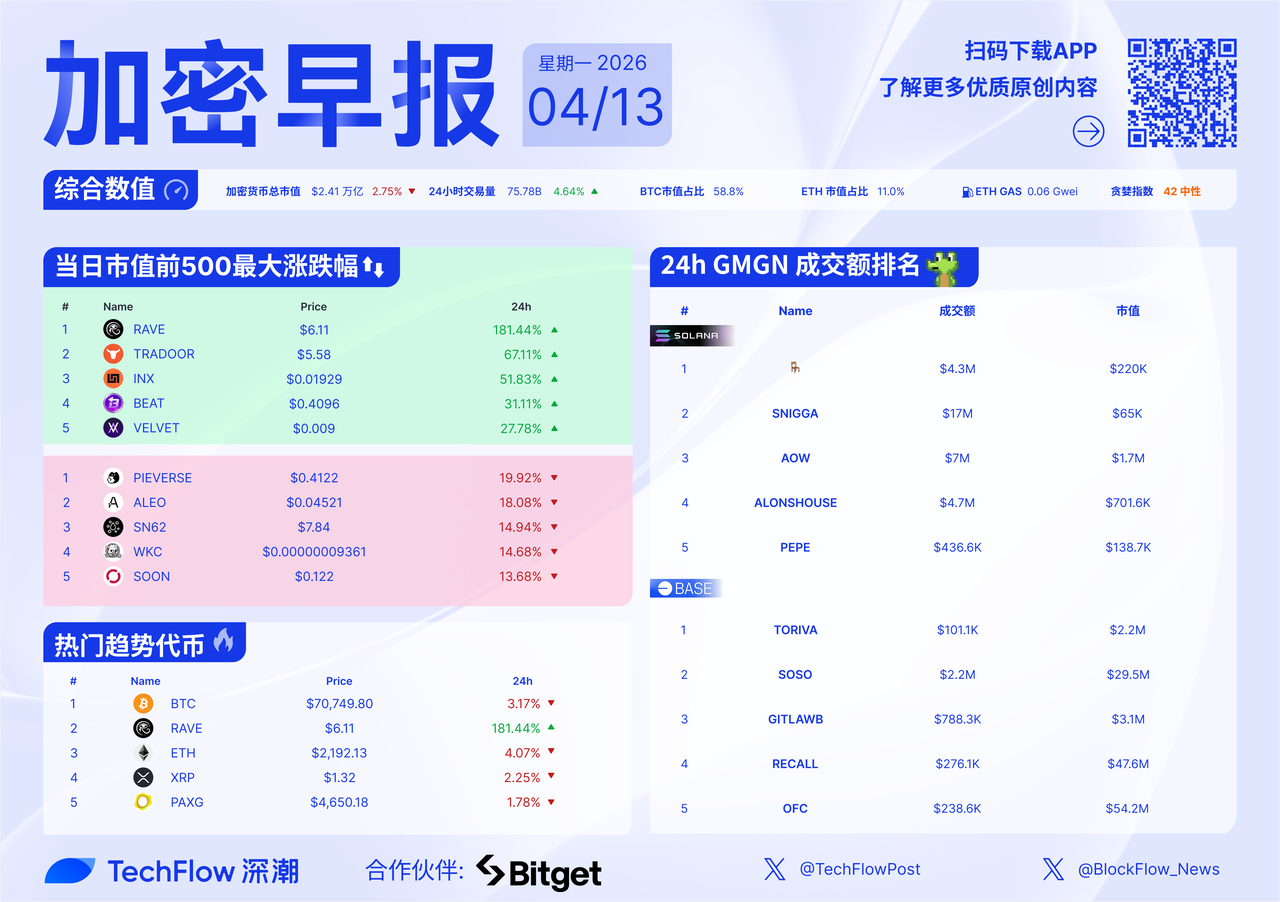
Market Data
Recommended Reading
Sam Altman Posts After Molotov Cocktail Attack at Home: “I Love My Family—and Believe AI Belongs to Everyone”
https://www.techflowpost.com/zh-CN/article/31081
This article details Sam Altman’s public statement following a Molotov cocktail attack at his home, expressing deep affection for his family and unwavering belief in AI democratization. He emphasized that AI technology should empower individuals—not be controlled by a few labs determining humanity’s future—and discussed the rapid evolution of the AI industry alongside its societal implications and challenges. Altman also reflected on his work at OpenAI and offered recommendations for the AI sector’s future trajectory.
From Accidental Leak to Emergency Washington Meeting: How Anthropic Rewrote Cybersecurity Rules in Two Weeks
https://www.techflowpost.com/zh-CN/article/31060
This article details the development of Anthropic’s latest AI model, Claude Mythos, and its impact on cybersecurity. Beginning with the model’s accidental leak, it explores its powerful vulnerability-discovery capabilities and associated risks, analyzing its profound implications for financial systems and cybersecurity industries. To address potential security threats, Anthropic launched the “Glass Wing” initiative—partnering with multiple tech giants to proactively patch global software vulnerabilities and establish defensive advantages ahead of widespread open-source model adoption.
Interview with Claude Code Lead: “Programming Is Solved”—Software Engineers Will Ultimately Be Replaced by Builders
https://www.techflowpost.com/zh-CN/article/31075
This article explores the evolution of Claude Code and its transformative impact on software engineering, examining how AI-powered programming tools are reshaping traditional coding practices and forecasting future technological trends. Anthropic’s Boris Cherny shares profound insights on team leadership, product development, AI safety, and technological innovation.
A 300-Year-Long Shot? Solo Miner Hits Jackpot—Claims Full $220,000 Bitcoin Block Reward
https://www.techflowpost.com/zh-CN/article/31077
This article recounts how an independent miner with 70 TH/s computing power successfully mined Bitcoin block #944,306 using CKpool’s solo mining mode—earning the full 3.128 BTC reward (~$222,000). Statistically, this hash rate yields a block roughly once every 300 years. CKpool’s developer confirmed the event, noting miners at this scale have only a ~1-in-100,000 daily probability of solving a block. While solo mining carries negative expected value, its outsized rewards continue attracting enthusiasts.
Millions of Errors Per Hour: Investigation Reveals Google AI Search’s “Accuracy Illusion”
https://www.techflowpost.com/zh-CN/article/31078
This article examines Google’s AI Search feature (AI Overviews), which reports a 91% accuracy rate—but produces tens of millions of incorrect answers hourly. Even when answers are factually correct, over half lack supporting citations—and cited sources often suffer from low credibility. Google contested the testing methodology and benchmarks used, while underscoring that AI features rely heavily on search ranking systems to improve accuracy.
Join TechFlow official community to stay tuned
Telegram:https://t.me/TechFlowDaily
X (Twitter):https://x.com/TechFlowPost
X (Twitter) EN:https://x.com/BlockFlow_News
 深潮TechFlow











