Interview with Kelp DAO Founder: LRT Breaks the Re-staking Zero-Sum Dilemma, Plans Development on Platforms like Solana
TechFlow Selected TechFlow Selected
Interview with Kelp DAO Founder: LRT Breaks the Re-staking Zero-Sum Dilemma, Plans Development on Platforms like Solana
This article will explore KelpDAO's insights into the Restaking sector, the project's future product roadmap, its perspective on competitors, and its views on the Chinese-speaking market.
 Navigating Web3 tides with focused insights
Written by: TechFlow
As the Solana ecosystem rises once again and its community increasingly chants "surpass Ethereum," Ethereum loyalists often point to the Restaking narrative as a key argument reinforcing Ethereum's dominance.
As a pivotal narrative in this cycle, the Restaking sector has undeniably drawn significant attention: on one hand, it has attracted massive capital inflows—CoinGecko data shows its market cap exceeds $9 billion; on the other, continuous innovation has emerged, evolving from native restaking protocols primarily based on LSTs to LRT protocols enabling diversified yield strategies. Among these, KelpDAO stands out as a leading project, boasting over $850 million in TVL (Total Value Locked) and more than 40,000 active restakers.
At this critical juncture, as KelpDAO launches its community-driven "Mega Million Marathon" campaign aiming to reach a $1 billion TVL milestone, we had an in-depth conversation with Amitej Gajjala, founder of KelpDAO, discussing the team’s insights into the Restaking landscape, future product plans, competitive dynamics, and perspectives on the Chinese-speaking market.
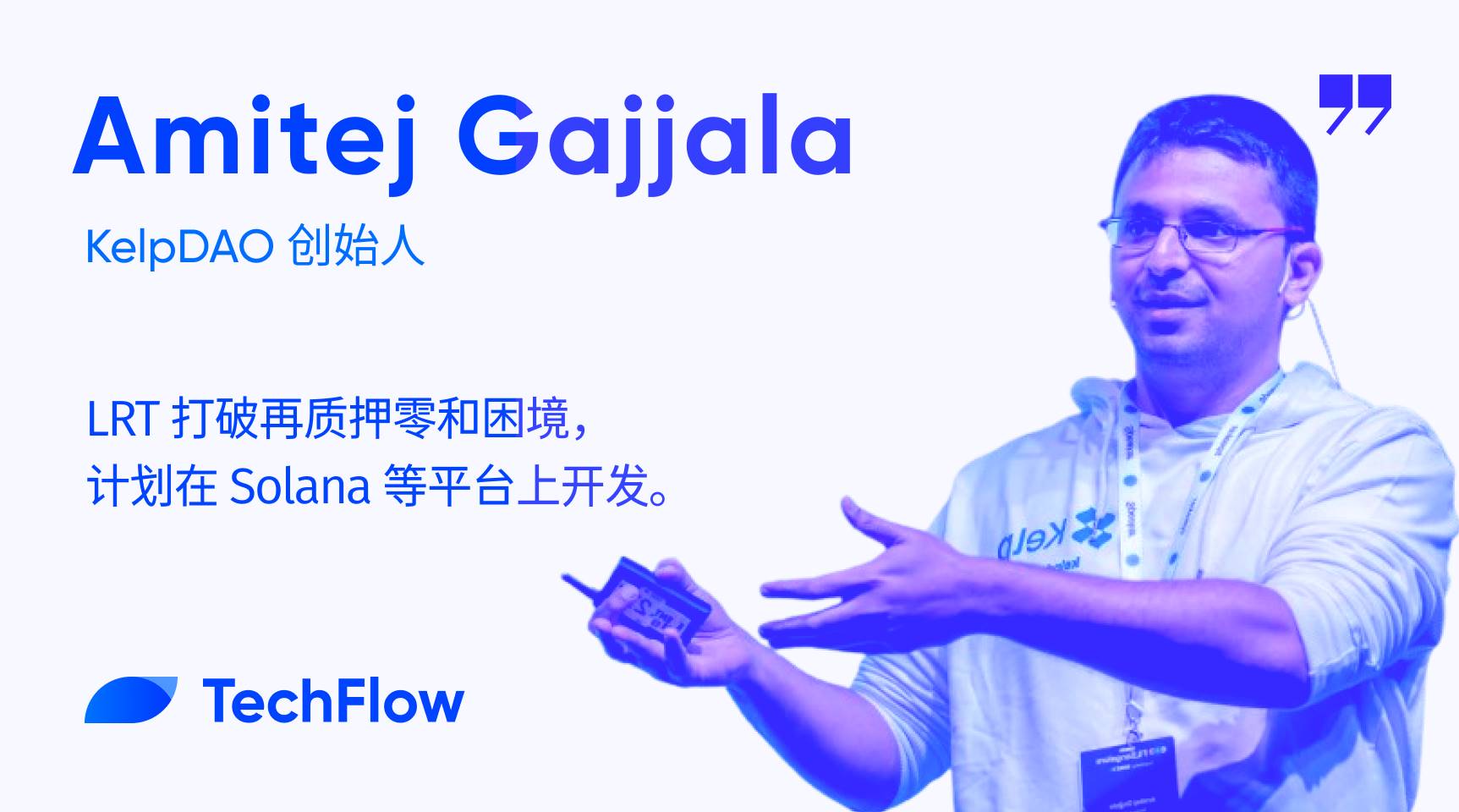
In the interview, Amitej Gajjala stated candidly: “Increasing adoption can make Ethereum and similar platforms strong competitors to traditional finance. KelpDAO also plans to develop staking solutions on platforms such as Solana, BNB Chain, and Bitcoin, expanding our products across multiple ecosystems.”
This article takes you through KelpDAO’s past, present, and future, exploring how this representative LRT project meets user needs through multi-layered financial innovation—and what lessons and inspirations its success offers to today’s Web3 entrepreneurs.
Key Takeaways
-
The transformative power of crypto markets stems from three factors: their global nature without geographical restrictions, allowing anyone to participate; the open-source nature of all systems and code, enabling developers worldwide to freely build upon existing technologies; and the introduction of tokens that assign real economic value to these innovations.
-
DeFi platforms must offer substantial incentives to retain users. EigenLayer must also increase rewards to prevent TVL outflows, creating a zero-sum game. KelpDAO mitigates this by building a liquidity layer atop restaking platforms like EigenLayer.
-
Kelp DAO is somewhat analogous to protocols like Lido but focuses on restaking rather than staking. It supports both LSTs and native tokens across multiple L2s, acting as an abstraction layer above EigenLayer—users can invest without worrying about underlying technical interactions, simplifying processes and reducing friction and fees.
-
Kelp DAO’s smart contracts have been audited by three renowned security firms: Sigma Prime, MixBytes, and Code4rena. Additionally, our cross-chain functionality allows users to stake assets confidently and withdraw them when needed.
-
Kelp DAO actively partners with media outlets in China, South Asia, Europe, and the U.S. to raise awareness and educate potential users—a crucial factor in building a large user base. We also collaborate with major hardware and software wallets to enable direct liquid staking within wallet interfaces.
-
Kelp DAO’s current focus is expanding its user base and increasing TVL. The team also plans to build restaking platforms on Solana, BNB Chain, Bitcoin, and non-EVM chains to enhance accessibility and expand influence.
-
Integrating real-world assets onto blockchain platforms could drive mass DeFi adoption. Meanwhile, L2 solutions—with their lower gas fees and faster transaction speeds—are playing a vital role in attracting broader audiences into the crypto ecosystem.
-
EigenLayer itself does not directly provide additional rewards; instead, rewards come from services built on top of it. The more services deployed on EigenLayer, the higher the potential rewards for users.
-
LRTs have the potential to serve as aggregation layers across various restaking platforms like EigenLayer, significantly improving user experience.
-
For any young entrepreneur, regardless of industry, the most critical step is identifying genuine problems affecting a broad market. Understanding and solving real needs forms the foundation of successful ventures.
Kelp DAO Origins: Building a Liquidity Layer on Restaking Platforms to Break the Zero-Sum Game
TechFlow: Given your initial career as a business analyst in tech, how did you first get involved in crypto? What drew you into the space, and why did you choose to focus on the Restaking narrative?
Amitej Gajjala:
One of the most formative experiences in my career came from my background in business management. I studied at a top-tier college in India and graduated from a leading business school. Later, I worked at AT Kearney, a premier management consulting firm in India and Southeast Asia. That period was crucial—it honed my ability to understand business operations and organizational dynamics.
My passion for startups began in the late 2010s, a pivotal time for India’s startup ecosystem, as major unicorns like Flipkart and PhonePe gained momentum. I joined Swiggy, India’s largest food-tech company, as Head of Strategy & Transformation. Over three years, I acquired valuable skills in scaling organizations and building efficient teams.
By late 2019, during the DeFi Summer, I became deeply interested in blockchain. Protocols like Uniswap and Aave were gaining traction, and I started seriously researching crypto, particularly the staking space. As I dug deeper, I realized the transformative potential of this technology to revolutionize the entire financial industry. At that moment, everything clicked—I decided to leave traditional employment and fully commit to a career in crypto.
TechFlow: You mentioned you saw transformative potential—do you mean because it operates on a distributed ledger with open standards, enabling permissionless integration with other protocols without silos?
Amitej Gajjala:
Yes, I believe the transformative nature of crypto markets comes down to three main reasons:
First, the market is global and borderless, allowing anyone to participate regardless of location.
Second, all systems and code in crypto are open source. This means developers worldwide can freely use and innovate upon existing technologies. The appeal of open-source is evident—just as Linux transformed internet infrastructure, crypto has undergone a similar revolution in recent years, and this trend is expected to accelerate over the next decade.
Third, the introduction of tokens gives tangible economic value to these technologies. Developers globally are leveraging these open systems to build a new, enhanced version of the internet.
TechFlow: Around three years ago, you founded Kelp DAO—or more precisely, Stader Labs. I entered the crypto space around late 2021, just before Ethereum’s transition from Proof-of-Work (PoW) to Proof-of-Stake (PoS) in summer 2022, when Restaking began gaining traction. Can you share the origin story of Kelp DAO? What inspired you to create Stader Labs, which eventually incubated Kelp DAO? Why did you believe Restaking was a promising direction early on?
Amitej Gajjala:
Stader Labs is not just an incubator—it’s a stable, direct investor behind Kelp. We also share founding members.
In early 2023, we closely monitored the emerging Restaking ecosystem. We realized Restaking would attract massive capital inflows—a trend clearly visible in EigenLayer’s performance, where around $14–15 billion was staked. We also observed that many DeFi applications were offering heavy incentives to maintain their TVL, which risked creating a zero-sum game. So we decided to build a liquidity layer atop restaking platforms like EigenLayer, giving users a significant advantage.
TechFlow: Can you elaborate on this zero-sum game concept?
Amitej Gajjala:
Let’s consider EigenLayer operating in isolation. Users typically deposit assets into EigenLayer for higher rewards. For example, someone might move ETH from Aave or Uniswap to EigenLayer for restaking due to better yields. As a result, other DeFi platforms must offer larger incentives to retain users.
Currently, as DeFi platforms boost incentives, EigenLayer must also increase rewards to avoid TVL outflows. Ultimately, neither platform gains a clear edge, and users face a dilemma—they must choose between traditional DeFi platforms and EigenLayer, unable to benefit from both simultaneously.
Additionally, when users deposit assets into platforms like EigenLayer, they lose liquidity because unstaking takes seven days. Adding a liquidity layer on top of EigenLayer is thus a strategic move, enabling users to maximize returns from both DeFi and restaking.
Kelp DAO Advantages: Simplified Workflow with Withdrawals, Multi-Audit Security
TechFlow: Can you explain how Kelp DAO operates on top of EigenLayer?
Amitej Gajjala:
Kelp DAO interacts with protocols like EigenLayer via smart contracts. When users deposit ETH into Kelp DAO, they receive a synthetic token called rsETH. Essentially, Kelp DAO restakes the user’s ETH on EigenLayer. The user then holds rsETH, representing their restaked ETH.
TechFlow: Are the synthetic tokens issued by Kelp DAO similar to synthetic stablecoins, or do they function differently?
Amitej Gajjala:
Kelp DAO is somewhat like Lido, but focused on restaking instead of staking. While Lido enables liquid staking, Kelp DAO specializes in liquid restaking. When users deposit ETH into Kelp DAO, the platform restakes it on systems like EigenLayer. In return, users receive a synthetic token representing their restaked ETH, maintaining liquidity while their assets are utilized elsewhere.
TechFlow: Can you explain the tokenomics and mechanisms governing this synthetic token?
Amitej Gajjala:
Kelp DAO streamlines the process for users wanting to participate in staking and restaking. Users can stake their ETH or liquid staking tokens (LSTs), such as Lido’s stETH or Stader Labs’ ETHx, through Kelp DAO. Upon doing so, they receive a synthetic token named rsETH. As staking and restaking rewards accumulate, the exchange rate of rsETH against ETH increases, reflecting the growing value of the staked assets.
TechFlow: How does Kelp DAO maintain a competitive edge compared to other projects in the restaking space?
Amitej Gajjala:
First, Kelp DAO is a comprehensive platform that accepts both liquid staking tokens (LSTs) and native tokens. With approximately $40 billion worth of staked tokens already available, we support these assets. A key advantage for users across regions relates to fee efficiency. Typically, converting staked tokens back to their original form incurs double fee costs. However, with Kelp DAO, users can seamlessly stake their LSTs and receive rsETH without paying extra fees.
Second, Kelp DAO emphasizes security and reliability. Our platform benefits from the expertise of the Stader Labs team, which has developed six distinct liquid staking solutions across multiple blockchains. Furthermore, Kelp DAO’s smart contracts have been audited by three renowned security firms: Sigma Prime, MixBytes, and Code4rena. Combined with our cross-chain functionality, users can confidently stake and withdraw assets as needed. These are two primary advantages offered by Kelp DAO.
TechFlow: Why can’t other projects replicate what Kelp DAO is doing? What makes Kelp DAO unique in delivering this solution?
Amitej Gajjala:
It boils down to architectural differences. While some protocols only accept ETH, Kelp DAO also accepts LSTs as part of our collaborative approach, differentiating us from others. Most platforms currently don’t offer withdrawal options, but Kelp DAO does—this is especially beneficial when secondary market liquidity is limited.
TechFlow: Do you mean users can deposit funds and withdraw after a 7-day waiting period?
Amitej Gajjala:
Withdrawals have a 7-day delay, but users can indeed withdraw through our platform. This sets us apart from other protocols that haven’t implemented this feature, leaving users’ funds locked without exit options.
TechFlow: As a Restaking project, Kelp DAO maintains a close relationship with EigenLayer. How do you see this partnership driving mutual growth for both ecosystems?
Amitej Gajjala:
We have a tight collaboration with EigenLayer, working closely with their team on technical development and ecosystem growth.
From the user perspective, interacting with EigenLayer through our platform doesn’t require direct engagement. We act as an abstraction layer above EigenLayer, simplifying the user experience. When users restake via us, we handle the restaking on EigenLayer, allowing them to invest without worrying about underlying technical complexities.
TechFlow: Imagine more platforms like EigenLayer emerge in the future. In an increasingly competitive landscape, how will these platforms sustain reward incentives for liquidity providers?
Amitej Gajjala:
First, it’s important to note that EigenLayer itself doesn’t directly provide extra rewards—the rewards come from services built on top of it. Essentially, the more services deployed on EigenLayer, the higher the potential rewards for users. If the ecosystem expands and we see a surge in services on EigenLayer, users can expect greater yields. Imagine three or four platforms each equivalent to EigenLayer, each hosting multiple services. That means more services across restaking platforms, translating into higher rewards for users. As long as these services continue to value and pay for enhanced security, users will be rewarded.
TechFlow: Can you walk us through the evolution of the Restaking sector? How did EigenLayer come about, and how did the idea of a liquidity layer emerge? Also, what were your initial impressions of this ecosystem, and how do you envision its future development?
Amitej Gajjala:
EigenLayer emerged to solve a critical need: certain services require not only substantial economic security—sometimes billions of dollars—but also customizable slashing conditions. For example, an oracle provider may set specific penalties based on validators’ accuracy in reporting on-chain data. Similarly, an MEV protocol might require validators to construct blocks in a particular format, penalizing deviations.
EigenLayer is built on two core assumptions. First, there are protocols needing programmable slashing conditions to ensure economic security. Second, a large pool of staked ETH represents a reusable source of economic security.
A year after launch, EigenLayer’s growth appears to validate these assumptions. It now manages over $16 billion in TVL and supports at least 60 services or applications built on its platform, demonstrating strong demand for its security model.
Moreover, liquidity layers like Kelp DAO, built atop EigenLayer, further strengthen the ecosystem by offering users higher yields and utility. These liquid restaking tokens (LRTs) can be used across DeFi—for activities like lending or participating in protocols such as Uniswap, Balancer, or Gearbox. This ability to reuse assets within DeFi significantly drives ecosystem expansion.
TechFlow: Given the widespread community engagement with Kelp DAO’s recent incentive campaigns, can you share the achievements your team has made? Beyond rewards, what other factors contributed to the campaign’s success?
Amitej Gajjala:
Our incentive strategy significantly boosted our appeal to users. Initially, we offered 100 EigenLayer points for the first 30,000 ETH staked, followed by 50 points, attracting 55,000 to 60,000 ETH. Last week, we relaunched the campaign, offering 100 EigenLayer points plus $50,000 worth of USDC to the first 100 stakers. This brought an additional 10,000 to 20,000 ETH to the Kelp DAO platform. The campaign concluded last week, and we plan to launch another one today or tomorrow. Once finalized, we’ll immediately share details of the upcoming event.
PS: At the time of publishing, Kelp DAO’s "Mega Million Marathon" is in full swing. The campaign offers over $1 million in rewards to users who restake via Ethereum mainnet and L2 networks. Rewards include USDC, ARB tokens, OP tokens, SD tokens, EigenLayer points, and Kelp Miles. Kelp DAO currently accepts native ETH, Stader Labs’ ETHx, and Lido Finance’s stETH, supporting native rsETH minting across 7 chains. Rewards will be distributed after the campaign ends on May 21, 2024. Interested restakers are encouraged to participate and claim generous rewards.
Click here for campaign details
TechFlow: User acquisition is key to success in crypto. What specific strategies have you employed to acquire users?
Amitej Gajjala:
One of our key strategies is leveraging media partnerships across regions including China, South Asia, Europe, and the U.S. We’ve invested heavily in media outreach and marketing to raise awareness and educate potential users—this has played a vital role in acquiring a large user base.
Additionally, we’ve partnered with numerous hardware and software wallet providers to enable direct liquid staking within wallets. For instance, we’ve integrated with popular wallets like Ledger and OKX Web3 Wallet. We’re also finalizing a partnership with another major wallet provider, which we expect to announce and roll out soon.
TechFlow: You mentioned Kelp DAO’s smart contracts have been audited three times. As the founder, your contribution is undeniable. Regarding cybersecurity, what concerns you most, and how do you continuously strengthen security to protect the liquidity layer?
Amitej Gajjala:
We ensure every smart contract we deploy undergoes multiple audits by top-tier auditors. This is critical—it ensures high-caliber security experts have thoroughly reviewed our code. Our team is highly skilled in smart contract development, but independent audits remain essential before launching any new contract. Ultimately, protecting user funds is our top priority.
TechFlow: In terms of smart contract coding, what exactly does security mean?
Amitej Gajjala:
It means ensuring no hacker or malicious actor can access user funds or disrupt the operation of our smart contracts. Safeguarding user assets is our foremost responsibility.
TechFlow: How challenging is it to develop a perfectly secure smart contract immune to vulnerabilities and hacks?
Amitej Gajjala:
Effective smart contract development relies more on experience and vision than sheer effort. Having a strong architect with a clear vision is crucial—one who can design contracts to minimize potential attack vectors. Equally important is the skill level of the development team. Together, these factors ensure our smart contracts are robust and secure.
Kelp DAO Future: Expansion into Solana, BNB Chain, and Bitcoin Ecosystems
TechFlow: As we enter the second half of 2024, what are Kelp DAO’s next priorities?
Amitej Gajjala:
Our current focus is expanding our user base and increasing Total Value Locked (TVL). Through wallet partnerships and integrations with various DeFi platforms, we see significant growth opportunities, which we aim to realize in the second half of 2024.
Additionally, we plan to extend our product suite to multiple ecosystems by developing staking solutions on platforms such as Solana, BNB Chain, and Bitcoin. We also intend to build restaking platforms on non-EVM chains to broaden our project’s reach and accessibility.
TechFlow: What challenges do you anticipate when expanding into non-EVM ecosystems like Solana and Bitcoin?
Amitej Gajjala:
We plan to expand in Q3. One challenge lies in the unique languages and technical architectures of each ecosystem. However, given our expertise in developing on both EVM and non-EVM chains, this technical aspect isn’t a major hurdle for us.
The bigger challenge is building communities and growing our user base within these new ecosystems. To address this, we plan targeted marketing and educational initiatives to attract potential users and cultivate strong community support.
TechFlow: Can you describe the current state of your community and Kelp DAO’s governance structure?
Amitej Gajjala:
Currently, the Kelp token has not been issued. We plan to gradually implement governance features following the Kelp token TGE (Token Generation Event).
Kelp DAO Industry Insights: Mass Adoption Is Key, RWA and L2 Play Vital Roles
TechFlow: What changes or innovations do you foresee in the LRT space?
Amitej Gajjala:
LRTs have the potential to become aggregation layers across various restaking platforms like EigenLayer. This would allow users to strategically allocate their ETH across different platforms, enhancing flexibility. One of our key innovations is native restaking on L2 networks—users on Arbitrum, Optimism, and other L2s can interact with us seamlessly without paying any gas fees. This is a major advancement, eliminating transaction costs and slippage for a frictionless experience.
Another notable innovation involves liquidity. Direct restaking on platforms like EigenLayer typically locks up liquidity for seven days. But with LRTs, users can immediately trade their tokens on secondary markets or use them as collateral in lending protocols. This flexibility greatly enhances the liquidity and utility of staked assets.
User experience improvements are twofold. First, users no longer need to select validators or research which ones perform well—Kelp DAO manages this automatically. Second, users don’t need to evaluate services based on slashing conditions or security risks. Kelp DAO handles these considerations, ensuring users engage with services that maintain high security standards, without having to navigate complexity themselves.
TechFlow: So, LRTs will improve user experience and potentially serve as liquidity aggregators?
Amitej Gajjala:
Exactly. On the user experience front, the innovations are dual: first, users no longer need to pick validators—we manage that. Second, users don’t need to differentiate services based on slashing or security—we handle those aspects, ensuring only high-security services are used, removing complexity for users.
TechFlow: Considering Restaking is part of DeFi, how do you see the future of DeFi evolving—particularly Ethereum-based DeFi versus non-EVM DeFi?
Amitej Gajjala:
The role of Ethereum in the future financial ecosystem is quite philosophical—it largely depends on the quantity and quality of applications developed within its ecosystem, as well as the performance of competing platforms like Solana. Ethereum is currently the leader, largely due to its vast developer community, making it the go-to choice for many builders. It has the potential to become the world’s financial backbone.
Innovative DeFi applications—especially those pioneering new financial services on blockchain—are crucial for driving DeFi adoption. Higher adoption can position Ethereum and similar platforms as strong competitors to traditional finance. The emergence of diverse financial applications on these platforms is key to this transformation. I’m optimistic we’ll make significant progress in this direction over the next decade.
TechFlow: What do you think will be the turning point that shifts public attention from traditional finance to decentralized finance?
Amitej Gajjala:
Integrating real-world assets onto blockchain platforms could be a game-changing catalyst for adoption. Additionally, L2 solutions—with their lower gas fees and faster transaction speeds—are playing a crucial role in attracting a broader audience into the crypto ecosystem. These elements are key growth drivers. As the user base grows, traditional finance may take crypto more seriously and begin offering more solutions leveraging this technology, further encouraging widespread adoption.
TechFlow: Beyond gas fee differences, what are the main distinctions among various Layer 2 solutions?
Amitej Gajjala:
We’re still in the early stages of L2 development. While platforms like Arbitrum and Optimism lead today, ZK-based L2s such as Scroll and Linea also have significant potential to gain traction. Each L2 could dominate depending on its ability to attract a strong developer ecosystem capable of building innovative applications.
TechFlow: What criteria does Kelp DAO use when selecting specific L2 networks to partner with?
Amitej Gajjala:
Our strategy combines business development efforts with an assessment of potential TVL on specific L2 platforms. This helps us effectively identify and prioritize opportunities.
TechFlow: Given the competitive landscape, from both a founder and ecosystem perspective, what bottlenecks do you observe hindering TVL growth? What strategies have proven effective in attracting more TVL and increasing daily and monthly active users, and how do you plan to further improve these metrics?
Amitej Gajjala:
Our top priority is attracting sustainable TVL. While rapid growth is desirable, we prioritize sustainability to avoid drawing short-term speculators or yield farmers solely chasing quick profits. We aim to attract a diverse user base that understands and values the long-term benefits of our platform. To achieve this, we combine media exposure, targeted marketing, and educational initiatives to build an informed and loyal community.
TechFlow: Given Kelp DAO’s success and your shift from engineering to business focus, what advice do you have for aspiring Web3 entrepreneurs with business backgrounds? Specifically, what guidance do you have on team-building and finding skilled architects to collaborate with?
Amitej Gajjala:
For any young entrepreneur, regardless of industry, the most critical aspect is identifying real problems that affect a large portion of the market. Understanding and solving genuine needs is the foundation of building a successful company.
TechFlow: Yes, so the industry doesn’t matter, right?
Amitej Gajjala:
Exactly. It’s a fundamental principle. Today, companies must focus on solving real, substantive problems. While many businesses currently prioritize superficial metrics like social media ratings, the most successful entrepreneurs are those tackling genuinely challenging issues. If the problem is significant enough, there will always be an opportunity to capture value and generate revenue by solving it. Therefore, identifying and focusing on real problems is crucial for long-term success.
Join TechFlow official community to stay tuned
Telegram:https://t.me/TechFlowDaily
X (Twitter):https://x.com/TechFlowPost
X (Twitter) EN:https://x.com/BlockFlow_News
 深潮TechFlow