








Berachain: A New MEME Playground or a DeFi Utopia?
TechFlow Selected TechFlow Selected
Berachain: A New MEME Playground or a DeFi Utopia?
Berachain is the canvas for an infinite economy game.
 Navigating Web3 tides with focused insights
Author: Arnav's Musings
Translation: TechFlow
A team that wears huge, ridiculous bear masks to crypto conferences and successfully raised seed funding at a $420.69 million valuation—all to build another L1, this time themed around pot-smoking bears. Yes, I fully understand the skepticism toward this idea. In fact, when I first heard about it, I thought it was utterly stupid.
That was until I took the time to understand Proof of Liquidity and the power of the Bera community—my perspective shifted, not just on Berachain, but on how communities can fundamentally nurture, sustain, and independently thrive.
Introduction
Berachain is an Ethereum Virtual Machine (EVM)-compatible Layer 1 built on the Cosmos SDK, originating from the 2021 Bong Bears NFT collection. From these memes emerged Proof of Liquidity (PoL), the core of Berachain’s mission.
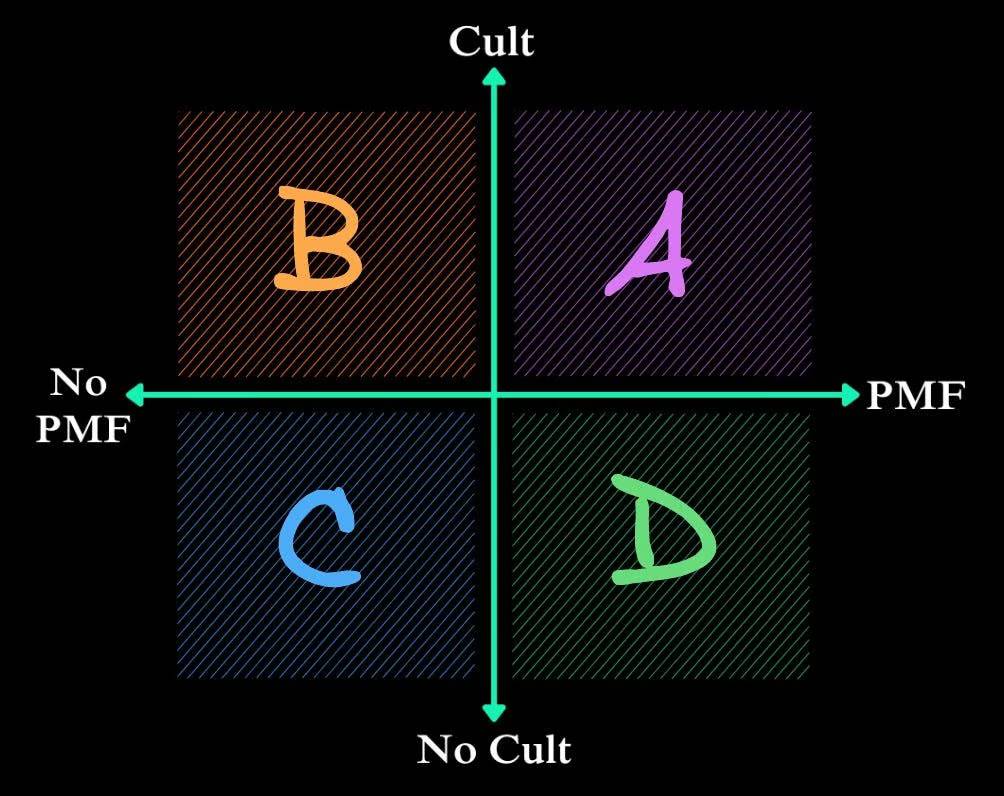
Before you dismiss Berachain, ask yourself why you invest in other tokens. Why do some tokens maintain absurdly high fully diluted valuations (FDVs) despite having only a handful of users? The answer is simple—I believe all tokens fall somewhere along this spectrum:
-
Cult = Community's investment of time + effort + money into an asset
-
PMF = Sustained demand for a given protocol (or speculation thereof)
-
Quadrant A = Sent to Valhalla
-
Quadrant B = Most high-FDV tokens in crypto today
-
Quadrant C = You should probably switch to AI
-
Quadrant D = Many upcoming middleware/infrastructure tokens
Many cryptocurrencies achieve billion-dollar FDVs purely through strong community backing. Take Cardano, for example—despite lacking users and total value locked (TVL)—it maintains an FDV of approximately $18 billion, yet its community continues to grow and gain recognition among retail investors. Other primarily community-focused assets (aside from memes) include Litecoin, Cronos, and others.
Is this bad? Much like internet protocols (HTTPS, TCP/IP, etc.), blockchains themselves will eventually become synonymous with their brands. This means branding becomes the key differentiator for launching successful blockchains. People trust brands—so blockchains must either become brands or perish.
The Bera Community
Needless to say, Berachain possesses one of the strongest brands in cryptocurrency. But just how strong?
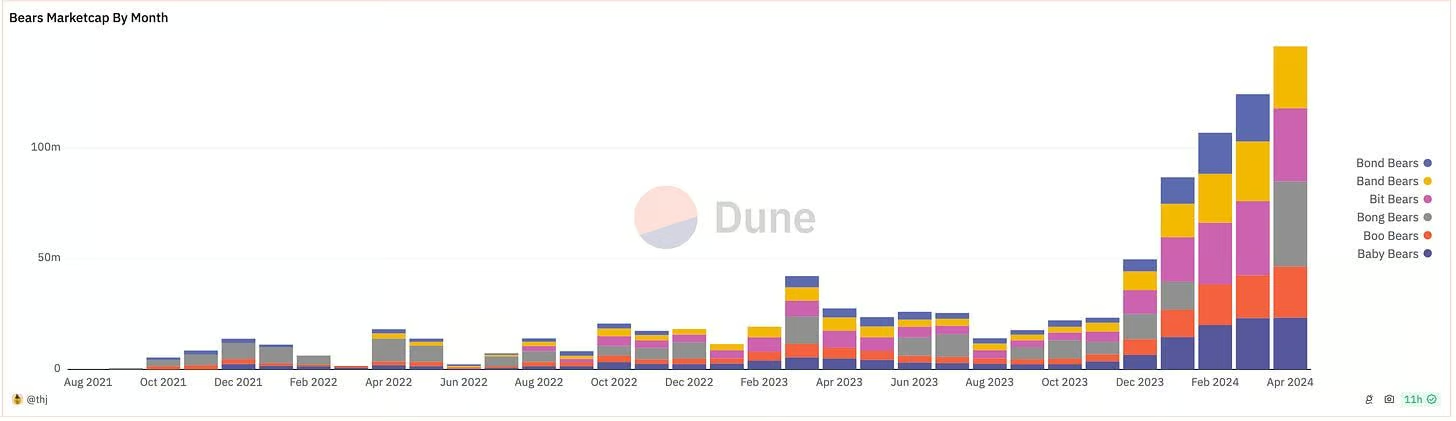
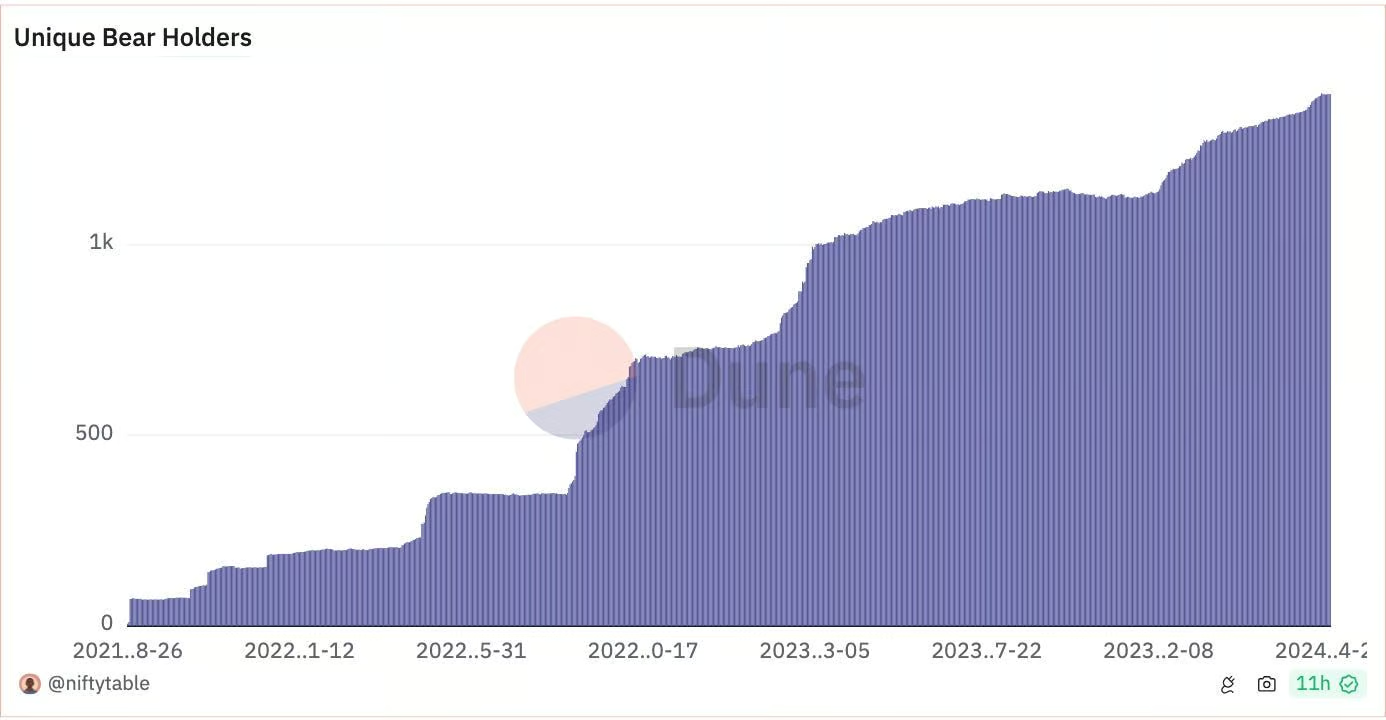
The Bong Bear genesis series and its newer versions have a market cap exceeding $150 million, with consistent growth in price, volume, and holder count over the past two years.
An interesting side note: early holders were well-rewarded (e.g., Chainlink, Axie, etc.), and your community organically flourished, almost taking on a life of its own. Take "The Honey Jar" as an example—a community-run initiative led by Janitoor. Jani started as a major Bong Bear holder and now leads a team of over 20 people, drawing more than 100,000 users into the Berachain ecosystem.
The Honey Jar
The Honey Jar (THJ), founded by Jani in January 2023, is central to the Berachain community. Throughout the bear market, THJ worked relentlessly—producing countless lore articles, competitions, podcasts, Twitter Spaces, NFT mints—and gradually built one of the most prolific communities in crypto. At the heart of this community lies an NFT collection called "Honeycomb," comprising 16,420 NFTs, serving as a "benefits aggregator" within the THJ ecosystem.
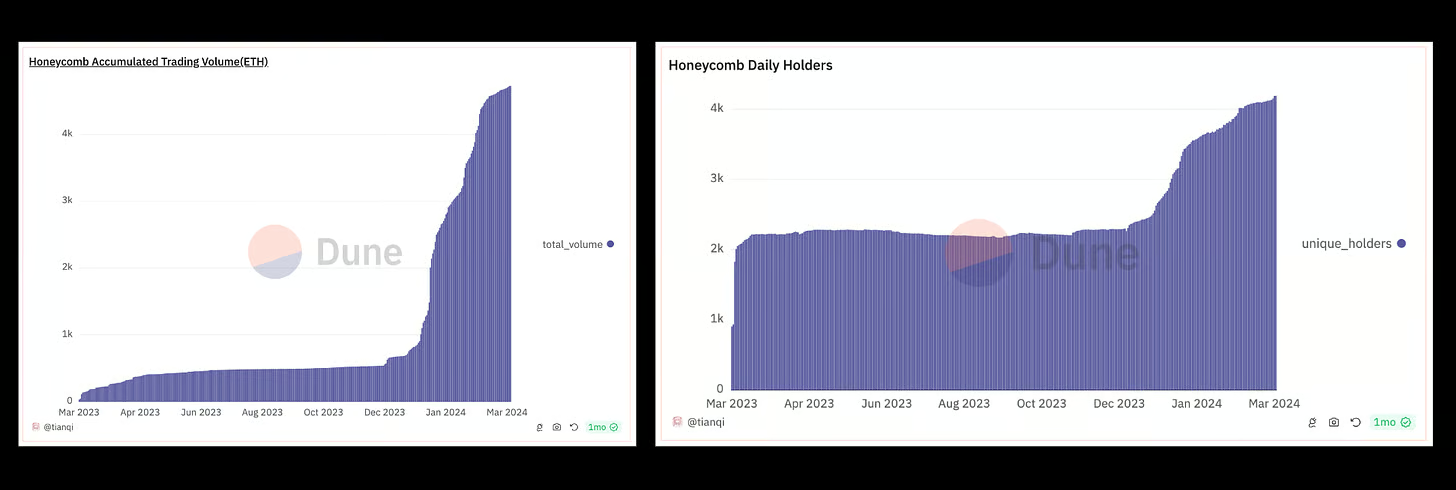
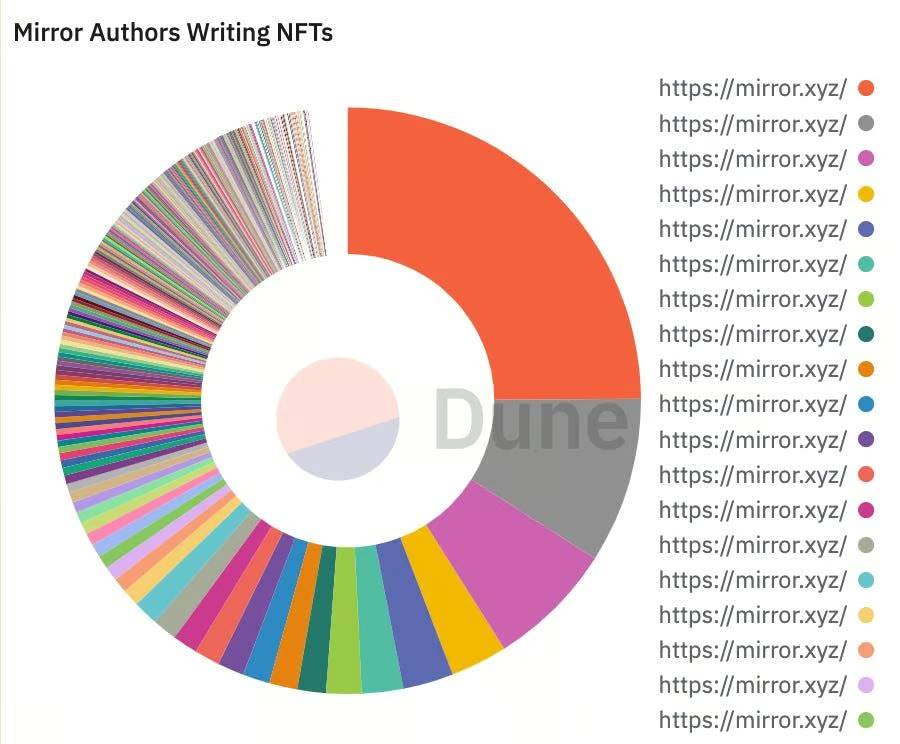
An interesting stat about the NFT collection: 4,229 people claimed NFTs for free, and 1,569 of them held for over a year despite prices reaching above 0.6 ETH. Beyond the NFTs, the community ran numerous social experiments on Mirror and Zora, allowing members to mint THJ lore articles and digital assets. THJ quickly became Mirror’s top-earning author, accounting for over 25% of all funds raised on Mirror.
The THJ community also dominated Zora on Base and Optimism.
Essentially, THJ—and by extension, Berachain—demonstrates an exceptionally high "cult" index: they are willing to spend significant time, energy, and money.
But why go through all this trouble before mainnet?
As Janitoor (@deepname99) put it: “THJ’s strategy has always been to create outposts within large communities, protocols, and L1s—to build wormholes to Berachain (‘Berachain is the destination chain’) by letting others experience Beraculture and Berapil, giving them a chance to get some fur in the game.”
Jani made this argument over a year ago—preparing for an influx of new users and capital, and ensuring rich content would be ready. A year later, that foresight has proven correct.
What’s the takeaway? I can only say that few projects—if any—possess a superweapon as powerful as THJ.
Ecosystem
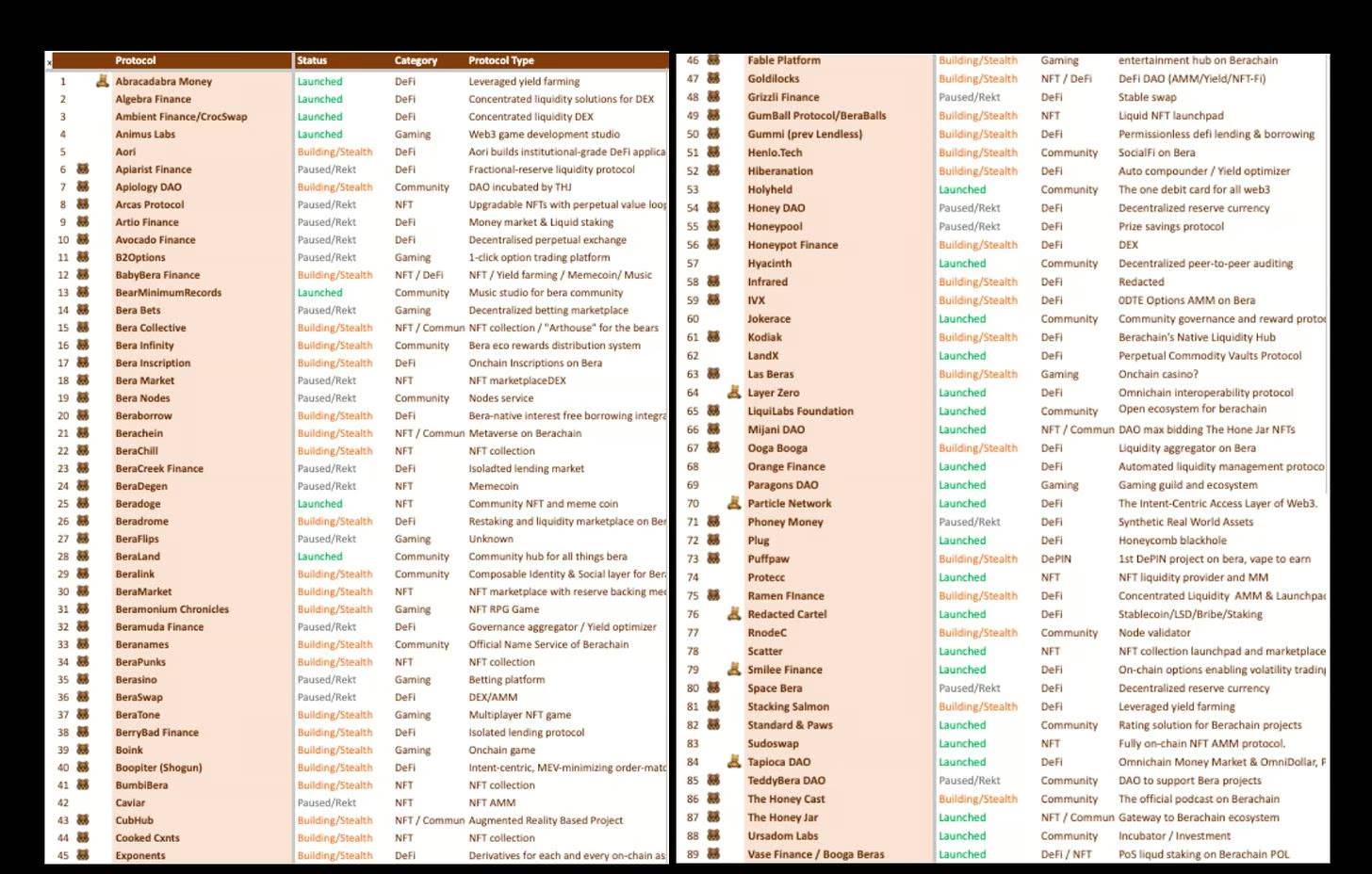
There is a thriving community of over 60 exclusive Berachain projects—from restaking protocols and indie games to money markets, NFT AMMs, liquidity aggregators, launchpads, and more. Additionally, several venture-backed native Berachain projects exist, including Infrared Finance, Kodiak, Beraborrow, Gummi, Beratone, and others.
Other examples of community-driven efforts include The HoneyCast, a Berachain-native podcast running for nearly two years; Beraland, a community-operated Discord hub and project aggregator for Berachain, and more.
Beyond the vibrant Bera-native ecosystem, any existing EVM dApp can easily port to Berachain. Some multi-chain deployments already include Ambient, Thetanuts, Concrete… and many more remain unannounced.
Of course, it’s hard to discuss the Bera ecosystem without mentioning Berapalooza—the hottest event at ETH Denver and now a core highlight at Framework, which co-led Berachain’s latest funding round.
Alright, Berachain has memes—so what?
I won’t sit here selling you on a breakthrough EVM-compatible CometBFT chain. I believe achieving EVM compatibility and integrating existing tech stacks is table stakes. However, I will say this: Proof of Liquidity (PoL) is a generational experiment in DeFi.
ELI5: Proof of Liquidity
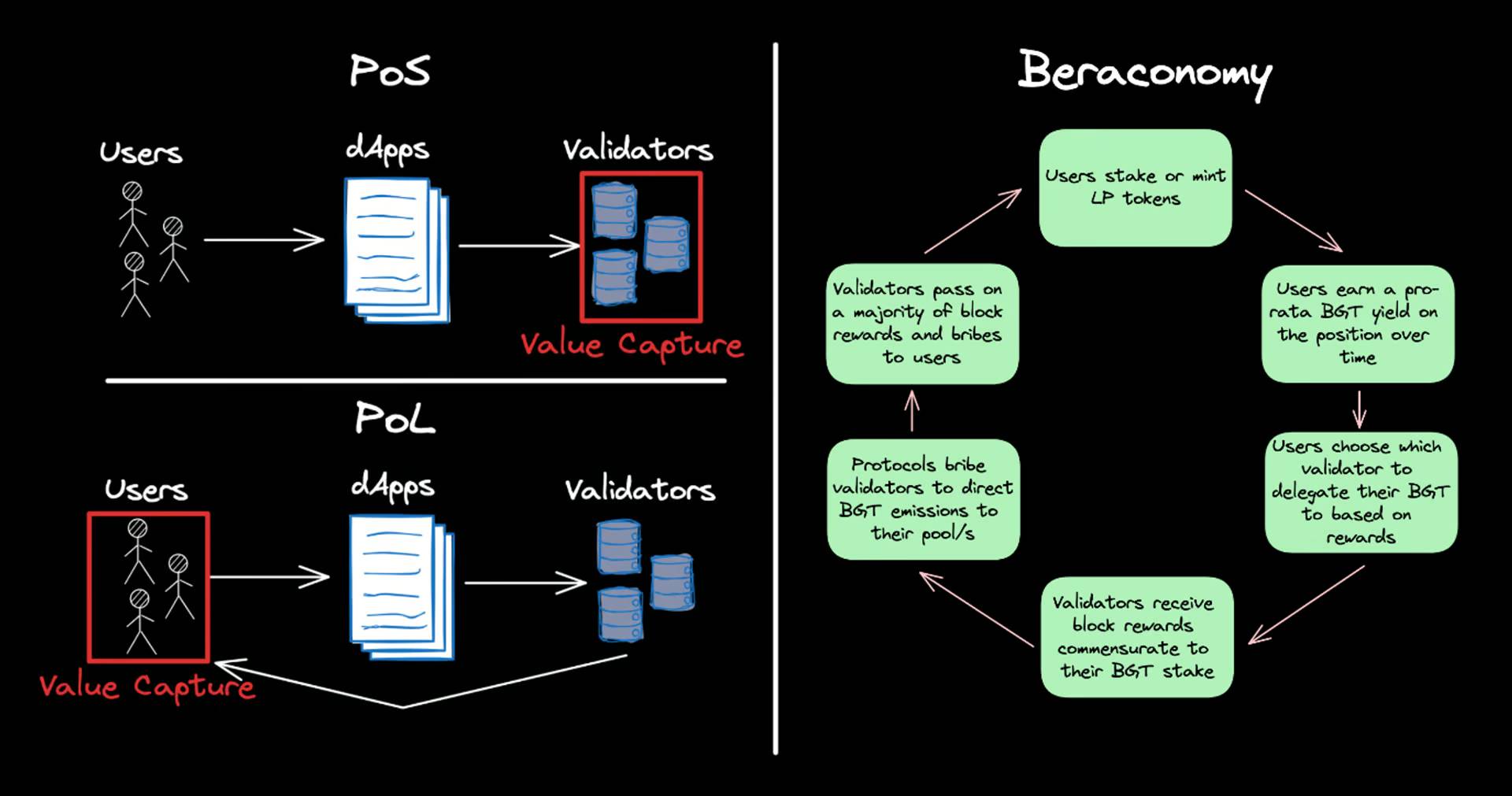
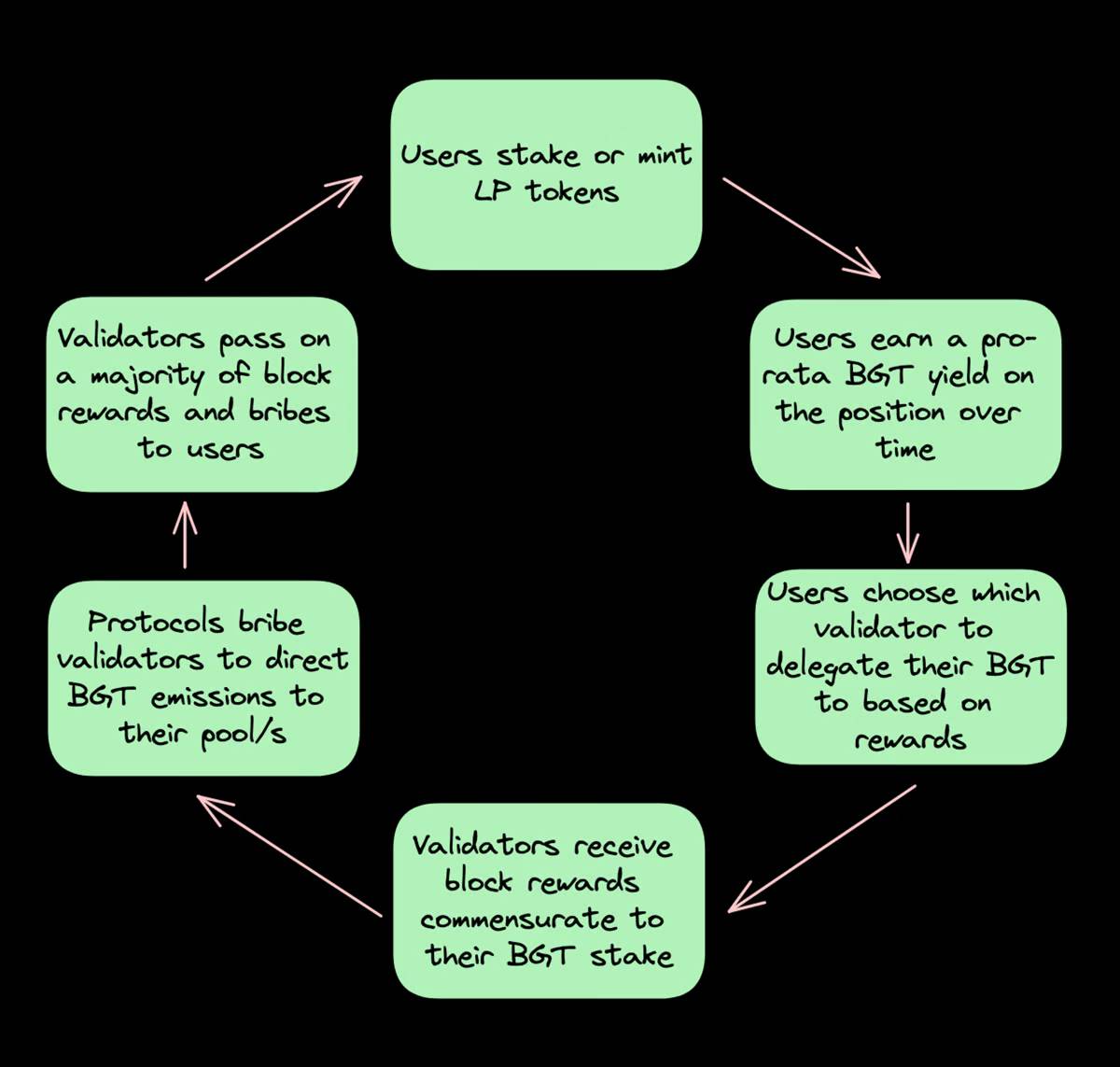
PoL is a novel reward mechanism aligning users, dApps, and validators. In short, users hold/mint LP tokens and earn BGT, which can be delegated to validators who then receive block rewards proportional to their BGT stake. Thus, security is directly tied to liquidity. More specifically, refer to:
Proof-of-Stake (PoS) networks still face limitations:
-
Enhancing economic security reduces ecosystem liquidity
-
Staking concentration among a few players (LSTs/NoOps)
-
Lack of coordination between dApps and underlying protocols
PoL aims to address PoS-related issues by introducing a two-token model that separates the network token (BERA) from the governance token (BGT). With this separation, we can:
-
Systematically build liquidity while improving security, enabling efficient trading and sustainable network growth
-
Align protocols and validators, enabling superior coordination via LP pools, bribes, governance tokens, and more.
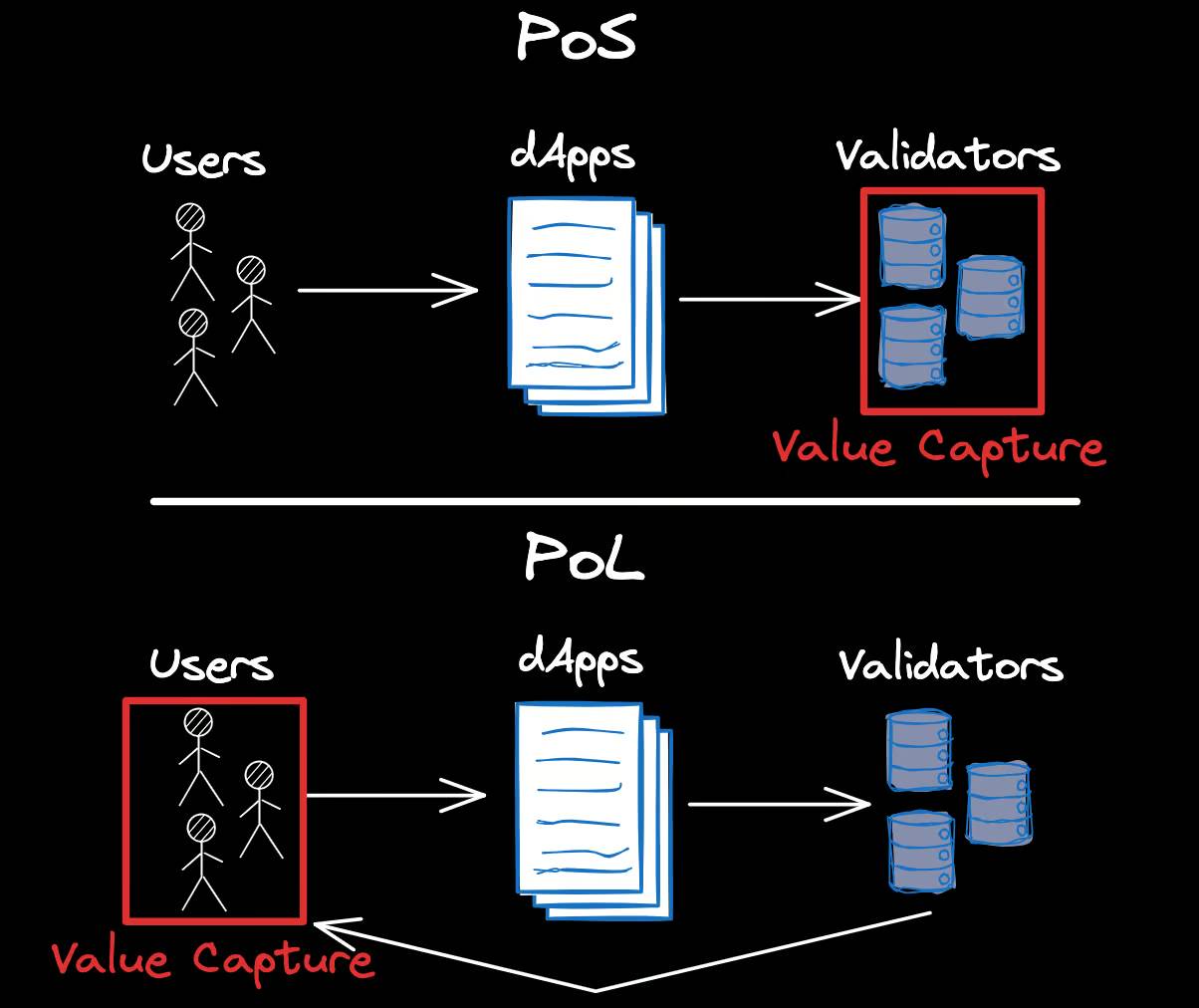
The most exciting part of PoL is that it allows any dApp to "accelerate" its growth in a utilitarian way—a decision made by those who initially provide "value" or liquidity to the ecosystem: BGT holders (i.e., users).
To clarify, ETH and Berachain have fundamentally different goals. ETH aims to be the censorship-resistant layer for all value settlement in Web3, while Berachain aims to be the canvas for infinite economic games. Moreover, Berachain has stated it is an ETH-adjacent chain.
That sounds good, but won't the chain suffer heavily from impermanent loss?
I’ve heard many familiar with PoL ask: Won’t Berachain suffer from impermanent loss since network security depends on staking/minting LP tokens?
First, there’s no silver bullet for LP profitability. DEX designs are rapidly improving, and we’re seeing the rise of MEV-aware designs that return value to the application layer—but fundamentally, LP profitability remains unsolved.
So, will Berachain collapse over time? I don’t think so, for the following reasons:
-
There are ways beyond DEX liquidity to earn BGT. Various venues will be whitelisted (WL) for BGT emissions, whether money markets, options protocols, etc. *Note: Any dApp (native or not) can be WL’d for BGT emissions.
-
Unlike the MEV-Boost paradigm on ETH, where proposers monopolize profits, PoL incentivizes validators (and even protocols) to return most profits to users. So while LPing itself may not be profitable, LPs could receive sufficient kickbacks via validator bribes or increased block rewards. Therefore, I believe Berachain is the canvas for infinite economic games, because user money ultimately returns to users.
-
Finally, there are options to hedge impermanent loss on BGT-generating LP positions. Smilee Finance and GammaSwapLabs have already committed to offering such products on Berachain.
*Note: There will also be stable pools providing secure yield sources.
What if most liquidity leaves the ecosystem?
BGT won’t stop being produced. Instead, it will flow at extremely high APRs to a smaller, more concentrated group of LPs. Speculators will likely keep Berachain in some form of equilibrium.
Unlike PoS networks where rewards are mainly accumulated by seasoned actors, PoL brings value back to its users, fostering long-term health of the DeFi ecosystem as liquidity attracts more liquidity.
Will Berachain work? Skepticism around a $0.1T FDV
Honestly, I don’t know if Berachain will work. I have concerns:
-
I believe PoL only works as intended in an efficient market.
-
Similar to LRTs, I wonder how much backroom dealing will occur to secure more BGT delegation/emissions.
-
Potential staking concentration around a single LST provider.
But here’s what I’ll say: As someone who’s worked in DeFi for over six years, Berachain is one of the largest and most advanced DeFi experiments I’ve ever seen. While we don’t yet know what games will be played, I’m incredibly excited to see how these Beras push crypto forward.
Join TechFlow official community to stay tuned
Telegram:https://t.me/TechFlowDaily
X (Twitter):https://x.com/TechFlowPost
X (Twitter) EN:https://x.com/BlockFlow_News






