JZ INVEST Research Report: War Drags Down Entire Crypto Market—Is BTC's Safe-Haven Status Just a Fantasy?
TechFlow Selected TechFlow Selected
JZ INVEST Research Report: War Drags Down Entire Crypto Market—Is BTC's Safe-Haven Status Just a Fantasy?
If you also seek investment and appreciation benefits and can tolerate higher price volatility, Bitcoin—which possesses characteristics of both risky and safe-haven assets—may be a better choice.
 Navigating Web3 tides with focused insights
Author: JZ

In mid-April, Iran launched an attack on Israel, triggering immediate tensions between the two nations. Bitcoin, often dubbed "digital gold," plunged 15% within two days, briefly dropping toward the $60,000 mark.
Unlike during the outbreak of the Russia-Ukraine war, Bitcoin’s price did not rise amid this geopolitical conflict but instead fell sharply, dragging down the broader crypto market. Does this suggest that Bitcoin lacks characteristics of a safe-haven asset?
In fact, BTC price movements during these international conflicts are influenced by more than just its potential as a hedge. Factors such as local cryptocurrency adoption rates, whether the country faces economic sanctions, and whether residents launch crypto fundraising campaigns can all impact market sentiment and real-world use cases—thereby influencing price trends.
This article reviews Bitcoin’s price performance following three regional conflicts over the past two years, comparing the variables affecting cryptocurrency markets in each case to assess whether Bitcoin truly functions as a safe-haven asset.
Article Outline
One, Russia-Ukraine War
Two, Israel-Hamas Conflict
Summary
One, Russia-Ukraine War
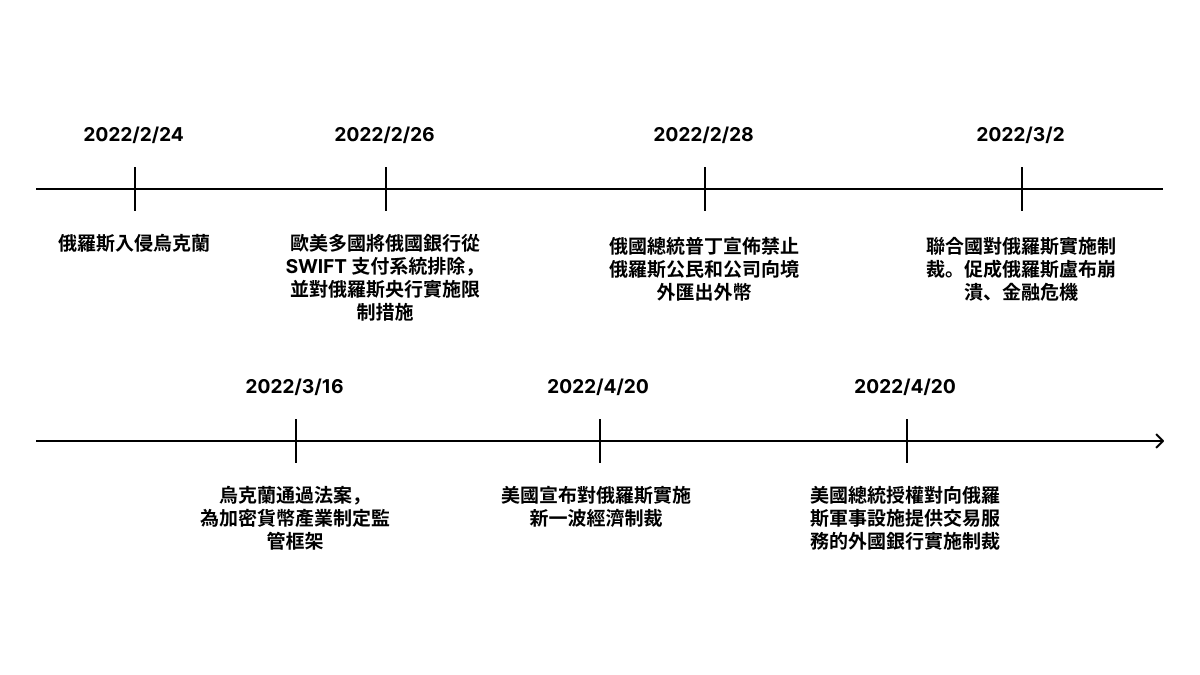
Key Timeline of the War
Bitcoin, Gold, S&P 500 Price Trends
- Bitcoin: Experienced significant volatility on the day the war broke out. It began rising four days later, breaking above $40,000, but then declined continuously from April to July.
- Gold: Rose in price, peaking at $2,068 in March. After the conflict began, it remained above $1,900 for two months, though like BTC, it fluctuated downward from April to July.
- S&P 500: Briefly rose after the war started but steadily declined from April until mid-June.
(The red line in the chart below marks the outbreak of the conflict)
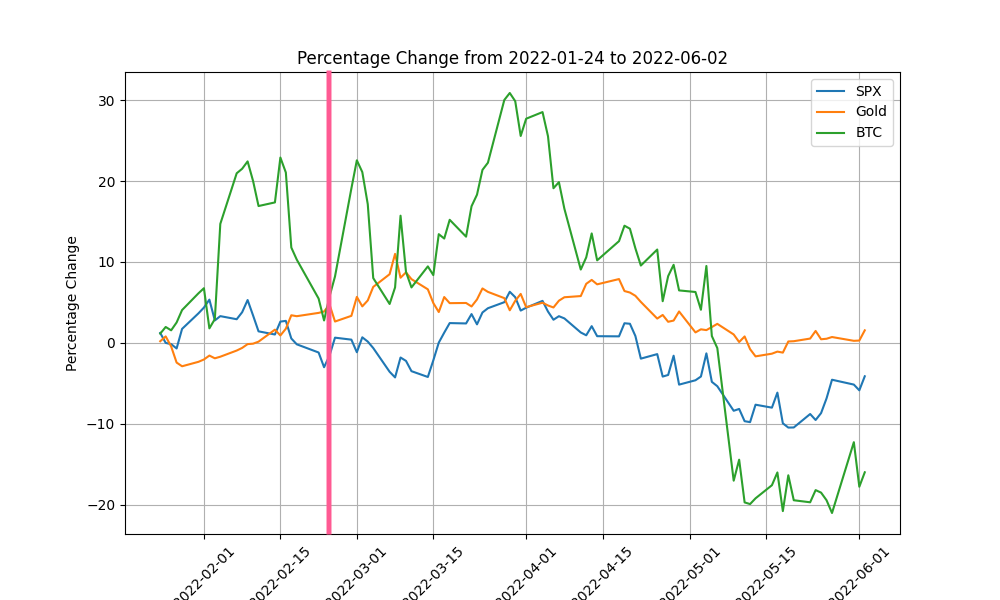
In 2022, due to the Federal Reserve's aggressive tightening policy and global liquidity contraction, Bitcoin ended its two-year bull run and entered a bear market. Although both Bitcoin and gold saw initial gains when the war broke out, they resumed their downtrend about two months later.
However, the S&P 500—an index representing "risky assets"—showed extremely similar price behavior to Bitcoin and gold during this period. Thus, it remains difficult to determine whether BTC functions as a safe-haven or risk asset.
Local Cryptocurrency Adoption Rate

Data source: Triple A
Cryptocurrency Fundraising
According to blockchain analytics firm Elliptic, within less than two weeks of the war starting, the Ukrainian government received over 35,000 cryptocurrency donations totaling more than $35 million.
While this likely had no direct impact on BTC prices, it certainly drew market attention to cryptocurrencies and sparked discussions about their utility during wars and other extreme events.
Economic Sanctions
War often leads to sharp depreciation of a nation’s fiat currency. Assets held in local banks may become trapped domestically due to economic sanctions or government-imposed capital controls. In such emergencies, people seek to transfer or convert their fiat holdings to protect their wealth.
Since invading Ukraine, Russia has faced over 16,500 sanctions imposed by the U.S., UK, EU, Australia, Canada, Japan, and others. The EU stated that up to 70% of Russian bank assets were frozen, with nearly half of its foreign exchange reserves—worth around $350 billion—locked down. Some banks were also cut off from the SWIFT international payment system.
On the Ukrainian side, the central bank imposed restrictions on foreign exchange transactions under martial law, preventing citizens from buying dollars or euros for hedging purposes. Cross-border fund transfers were also limited.
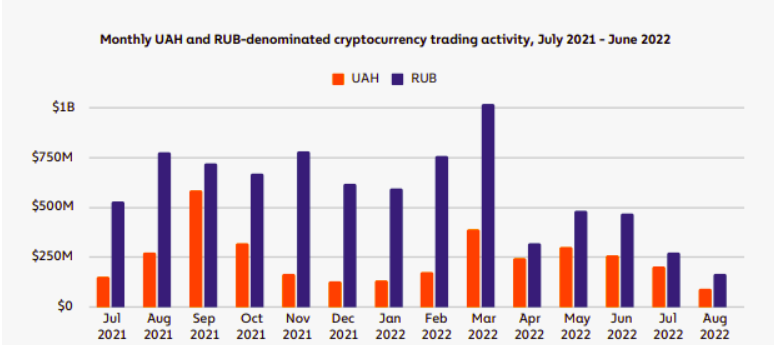
Chainalysis analyzed order book data from Binance and LocalBitcoins—two exchanges accepting local fiat—from July 2021 to August 2022. In March, trading volume in Ukraine’s hryvnia (UAH) increased 121% month-on-month, while Russia’s ruble (RUB) volume rose 35%.
Additionally, Chainalysis tracked monthly cryptocurrency transfer volumes across Eastern European countries from July 2021 to June 2022.
From the start of the war through June 2022, Ukraine saw continuous growth in cryptocurrency transfers.
In contrast, Russia experienced a brief spike in transaction volume in March, followed by relatively flat activity—possibly due to many crypto platforms and exchanges imposing restrictions on users in Russia.
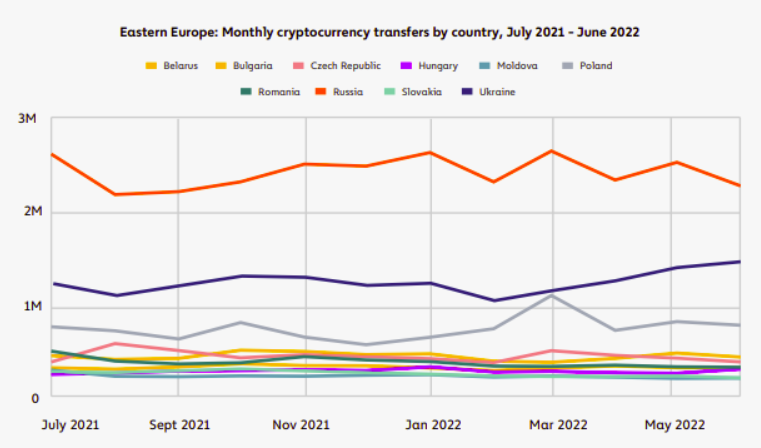
The increase in trading and fund transfers may reflect efforts by individuals and businesses in Russia and Ukraine to move assets offshore or hedge against risks amid economic sanctions and capital controls.
Two, Israel-Hamas Conflict
Key Timeline of the War

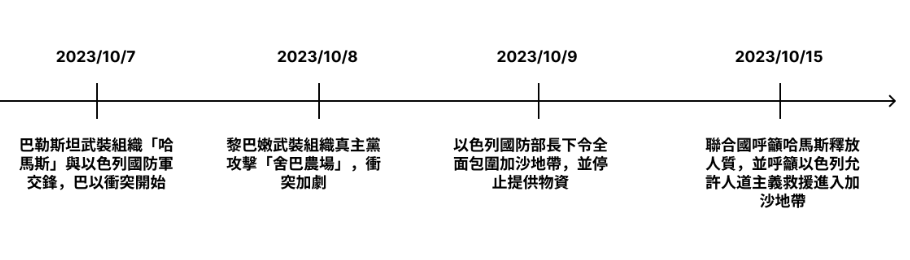
Bitcoin, Gold, S&P 500 Price Trends
- Bitcoin: Dropped slightly initially but began a seven-month rally starting mid-October.
- Gold: Rose steadily after the war, though its gains were far weaker than BTC’s.
- S&P 500: Declined initially after the war began but rebounded by late October and continued rising thereafter.
(The red line in the chart below marks the outbreak of the conflict)
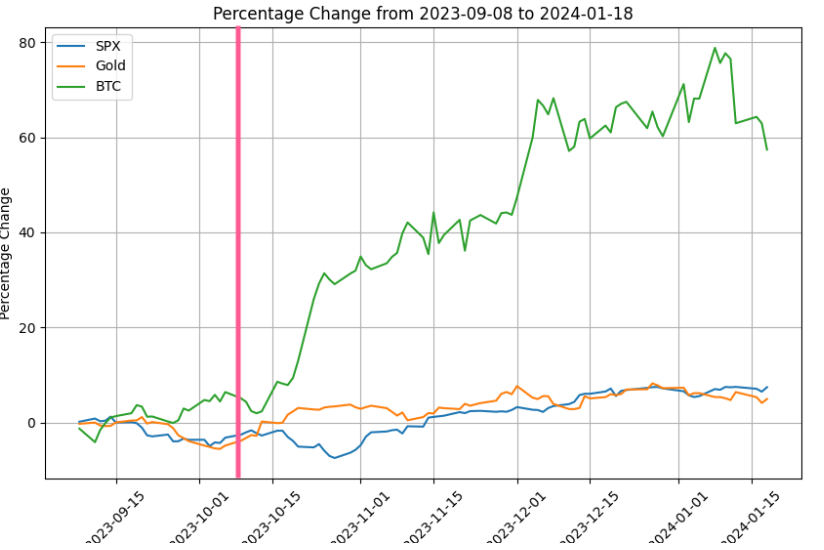
After the war began, Bitcoin and the S&P 500 dipped briefly, while only gold showed immediate gains. However, from mid-October onward, both Bitcoin and the S&P 500 began rising, albeit at different paces.
Regarding Bitcoin’s price, optimistic expectations around the approval of Bitcoin ETFs since mid-2023 helped drive prices upward. After a short-term dip, it entered a seven-month bull run.
Local Cryptocurrency Adoption Rate

Data source: Triple A, Gemini
Cryptocurrency Fundraising
Following the outbreak of war, both sides attempted to raise funds via cryptocurrency for military and humanitarian purposes. Israel’s crypto community established Crypto Aid Israel, while Palestinian groups also used crypto to raise money.
According to research firm BitOK, wallets associated with Hamas received approximately $41 million between August 2021 and June of this year.
Economic Sanctions
Based on the Russia-Ukraine war precedent, cryptocurrencies could serve as tools to circumvent economic sanctions. However, Israel has actively worked to block Hamas’ financial flows—including those in crypto.
According to The Times of Israel, Israeli police collaborated with Binance to freeze nearly 200 accounts linked to Hamas. Additionally, Tether swiftly froze 32 addresses tied to terrorism and warfare one week after the conflict began, holding 873,118.34 USDT in total.
Israel-Iran War
Key Timeline of the War

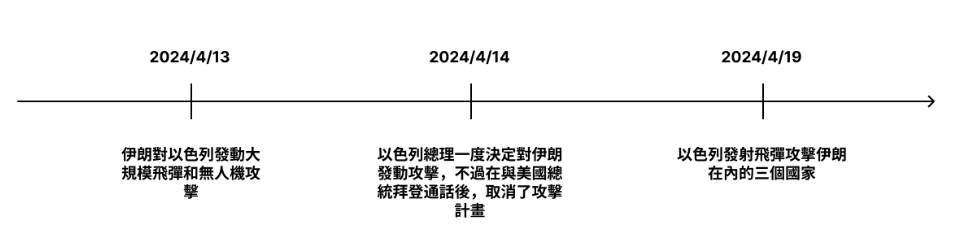
Bitcoin, Gold, S&P 500 Price Trends
- Bitcoin: Plummeted 15% over two days, briefly approaching the $60,000 level, before slightly recovering.
- Gold: Initially rose, then fell, but has since rebounded to around $2,391.
- S&P 500: Has been declining steadily since April 15.
(The red line in the chart below marks the outbreak of the conflict)
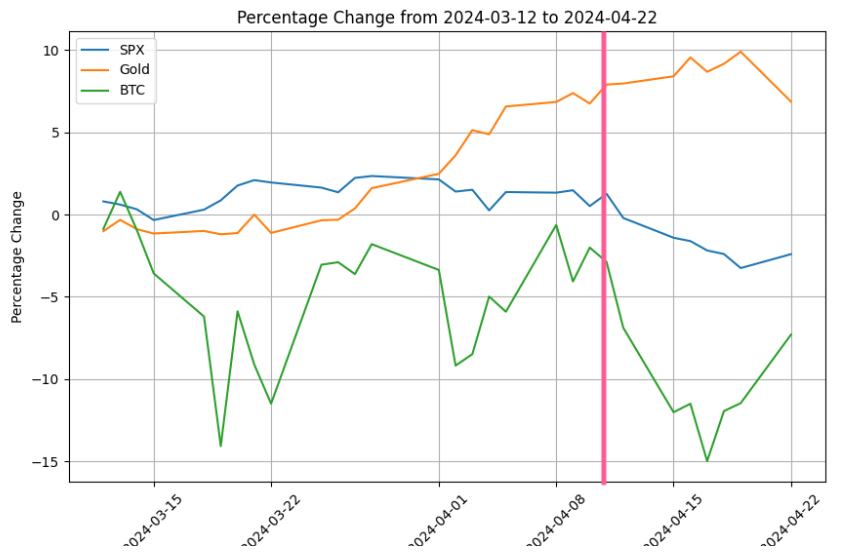
Local Cryptocurrency Adoption Rate

Data source: Triple A, Gemini
Iran ranks sixth globally in cryptocurrency adoption, with more crypto holders than Russia, Ukraine, Israel, or Palestine in this comparison. However, in this Israel-Iran conflict, neither the U.S. nor European nations have imposed sanctions on either side, nor have there been notable crypto fundraising efforts. As a result, interest in wartime crypto use cases has remained relatively low.
Summary
Bitcoin’s fixed supply gives it relative resilience compared to traditional markets, and many crypto investors believe it holds value-storage properties—supporting arguments for its role as a safe-haven asset.
However, reviewing recent price movements during three international conflicts shows that Bitcoin sometimes behaves more like a risk asset—similar to the S&P 500. Broader macroeconomic conditions and overall crypto market sentiment heavily influence its price swings, making it premature to definitively conclude whether Bitcoin possesses safe-haven characteristics.
Cathie Wood previously cited the 2023 U.S. regional banking crisis as evidence that Bitcoin is both a risk asset and a hedge.
We saw this last year: when U.S. regional banks faced crisis, Bitcoin actually rose 40%. With no counterparty risk, Bitcoin is both a risk asset and a safe-haven asset.
Thus, if your goal is to reduce volatility during broad market turmoil, gold may be a better choice due to its lower short- and long-term fluctuations and strong value preservation. But if you also seek investment growth potential and can tolerate higher price swings, Bitcoin—which exhibits traits of both risk and safe-haven assets—might be the superior option.
Join TechFlow official community to stay tuned
Telegram:https://t.me/TechFlowDaily
X (Twitter):https://x.com/TechFlowPost
X (Twitter) EN:https://x.com/BlockFlow_News
 @jzinvest_xyz