








Web3 Communication Infrastructure SendingNetwork: Building a Decentralized TCP/IP to Create a Free and Secure Communication Network
TechFlow Selected TechFlow Selected
Web3 Communication Infrastructure SendingNetwork: Building a Decentralized TCP/IP to Create a Free and Secure Communication Network
Exploring SendingNetwork: Opportunities and Challenges for the Project and Decentralized Communication in This Bull Market.
 Navigating Web3 tides with focused insights
Author: TechFlow
Have you ever received spam calls, junk emails, or phishing messages?
Have you been forced to watch 90 seconds—or even longer—of ads while streaming your favorite shows?
Have you had posts or even entire accounts suspended for reasons beyond your control?
Are your internet bills still climbing as you pay more for a better online experience?
……
These frustrating experiences are pervasive in our daily lives. The Web2 communication world is deeply flawed: under centralized frameworks, issues such as privacy violations, misaligned data ownership, and unequal distribution of benefits are becoming increasingly evident. The demand for more efficient, transparent, private, and economically viable decentralized Web3 communication is growing louder than ever.
Imagine this: in the future, every household owns a Web3 router. These routers and data center nodes distributed globally form a vast decentralized network. Developers leverage this massive infrastructure, combined with decentralized storage projects, to build rich applications that deliver high-speed, scalable network experiences. Users no longer need to worry about privacy leaks—because their account systems are distributed across the network, with core data stored on their own routers or hardware devices. Even more compelling, from an economic standpoint, users can not only pay for internet access using tokens on a pay-as-you-go basis but also share idle bandwidth, storage, and IP resources from their devices, reusing underutilized resources while earning passive income.
In other words: no server can read your chat data; no centralized entity can ban your group chats or accounts; no lagging connections, endless ads, or expensive fees—and you might even earn rewards…
This is exactly what SendingNetwork, a Web3 DePIN communication infrastructure project, is building: effective communication solutions connecting people, devices, assets, protocols, and dApps—integrating social, payments, trading, finance, and more—to provide users with private, secure, and unrestricted decentralized communication services.
This past Tuesday, SendingNetwork announced it completed a $7.5 million seed extension round last October, attracting notable VCs including Nomad Capital, Symbolic Capital, and Web3.com Ventures. Earlier, in February 2023, the project raised $12.5 million in its initial seed round. With total funding now surpassing $20 million, the project has secured substantial capital backing.
As a market indicator, institutional investment in SendingNetwork reflects both confidence in the Web3 DePIN communication infrastructure narrative and strong validation of the project’s vision and execution strategy.
This article dives into SendingNetwork, exploring how it constructs decentralized communication infrastructure across the physical, network, and application layers—delivering permissionless, autonomous, private, and scalable communication environments—and examines the opportunities and challenges facing the project and decentralized communication in this bull market cycle.

Holistic Vision: Building Comprehensive, Efficient, and Economical Decentralized Communication Infrastructure
Before diving into SendingNetwork’s solutions, let’s first clarify the problems at hand.
At the Web2 level, centralization brings urgent issues like privacy breaches, data tampering, monopolies by tech giants, and lack of user data ownership. At the Web3 level, inherent fragmentation between blockchains creates high friction, interoperability challenges, and poor user experience. Additionally, due to blockchain performance limitations, achieving fast and seamless real-time communication remains difficult—hindering mass adoption and collaboration.
As a decentralized communication infrastructure provider, SendingNetwork has developed a clear horizontal and vertical roadmap based on deep market insights.
The horizontal strategy focuses on broader coverage and accessibility to meet diverse communication needs of a wider user base.
-
First, SendingNetwork supports multiple platforms: it works seamlessly across iOS, Android, and Web clients, and integrates with Ethereum and EVM-compatible blockchains. This allows frictionless interaction between different clients, chains, and devices. Users can access all features simultaneously across multiple devices, with identities and data automatically synchronized. Even mobile phones can enjoy the same network performance as desktop computers, making Web3 exploration effortless.
-
Second, SendingNetwork offers comprehensive communication solutions: it provides a full suite of tools including text, voice, and live AMA formats, enabling richer and more flexible communication options to enhance user engagement. It also supports three communication modes—local, proxy, and privacy—perfectly adapting to various usage scenarios.
The vertical strategy focuses on deeper fulfillment of user communication needs.
User communication needs, especially on-chain interactions, are often purpose-driven. SendingNetwork’s “Chat to Trade” concept directly addresses this behavior: merging social interaction with trading so that User A and User B can perform atomic asset swaps directly within a chat.
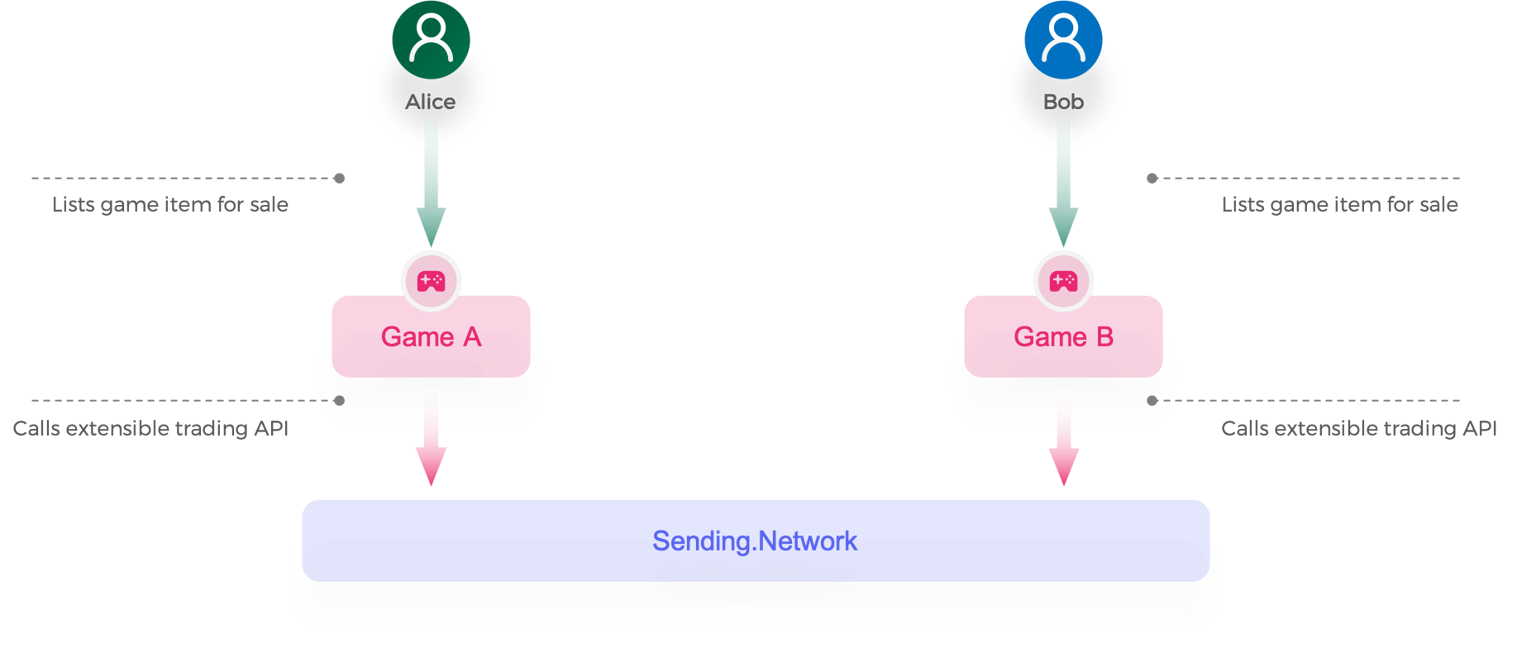
Cross-platform trading further extends the Chat to Trade idea: for example, if Player Zhang lists an NFT on Platform A, Player Li on Platform B can use SendingNetwork’s message API to communicate with Zhang across platforms and complete the transaction seamlessly. This simplifies user operations and enables near-instant execution. Such efficient information exchange and asset transfer will lower barriers, unlock liquidity, and open vast possibilities for ecosystem expansion within high-frequency social contexts.
When assets are involved, security and privacy become paramount. In SendingNetwork’s decentralized P2P communication network, all messages are routed through multiple decentralized relay nodes. Content is end-to-end encrypted using the X3DH protocol and Double Ratchet algorithm, with metadata privacy further protected via secure routing protocols. Moreover, all nodes participating in message forwarding support SGX instruction sets, ensuring all message relaying occurs within trusted execution environments (TEEs), achieving true immutability, censorship resistance, and privacy protection—introducing enterprise-grade security to communications.
Beyond functionality, SendingNetwork builds a low-barrier, high-reward incentive layer to close the value loop: easy participation strengthens decentralization, while users earn passive income by sharing idle bandwidth, storage, and IP resources from their devices—encouraging greater community involvement.
As communication serves as the foundational bedrock supporting the expansive digital universe and its diverse applications, SendingNetwork’s Web3 DePIN infrastructure unlocks rich ecosystem potential—evident in its social product, SendingMe.
As a decentralized instant messaging tool, SendingMe combines chatting, socializing, and trading—allowing users to directly transfer tokens and NFTs within conversations. It creates a free, secure, and streamlined social space for the crypto community, filling a long-standing gap where Web3 users rely on Web2 centralized communication tools. Combined with SendingNetwork’s DID system, social graph, and decentralized app notification features, it opens up extensions in identity verification, user acquisition, and price discovery in DeFi/NFT markets.
Of course, SendingNetwork places strong emphasis on ecosystem development: EVM compatibility reduces learning curves, opening doors to Ethereum’s vast developer community and rich tooling. Meanwhile, the project provides mature SDKs and APIs to simplify integration, complemented by detailed technical documentation and responsive community support.
While the vision is inspiring, execution is even more critical. To realize its "decentralized communication infrastructure" goal, SendingNetwork adopts a layered architectural approach grounded in fundamental communication principles.
Three-Layer Architecture: Turning Decentralized Communication Dreams into Reality
Identity is a crucial component of communication—it defines where information flows. For SendingNetwork to deliver broad horizontal reach and deep vertical service, managing user accounts, wallets, addresses, and devices becomes increasingly complex. To streamline this, enabling seamless cross-chain, cross-system, cross-platform, and cross-device experiences, SendingNetwork enables wallet IDs to be converted into user IDs via Ethereum ENS, creating a bidirectional, many-to-many DID identity system: users can map multiple wallets to a single DID or one wallet to multiple DIDs, supporting Ethereum and EVM-compatible blockchains. This allows users to define and control their digital identities autonomously across any platform integrating SendingNetwork as its underlying communication infrastructure.
Additionally, SendingNetwork uses NFT technology to verify registered IDs, storing these NFT-based identities on-chain. When logging into a new device, the client automatically retrieves the user profile stored on-chain as an NFT, containing account settings and social relationships, enabling automatic synchronization across devices.
Regarding peer-to-peer decentralized communication, SendingNetwork believes the TCP/IP protocol stack—the standard foundation of internet communication—exhibits structural flaws such as privacy leaks, data tampering, and centralized control. SendingNetwork’s three-layer architecture aims to reimagine and reconstruct TCP/IP:

The top layer is the Access Layer, composed of end users.
Client nodes run on users’ smartphones, tablets, computers, and other trusted endpoint devices. Users can choose to connect via local node, proxy node, or privacy node. Functionally, core user data resides on the client device, eliminating additional storage costs and alleviating privacy concerns. All user messages are exchanged through client nodes, with online messages delivered directly without relying on any intermediary nodes.
The middle layer is the Relay Layer, consisting of edge nodes.
As the network backbone, edge nodes are key to enabling efficient decentralized communication. They provide bandwidth and computing resources, cache encrypted messages for offline users, and establish high-speed communication channels with online users. Most edge nodes are operated by users or service providers meeting specific hardware requirements. During operation: edge nodes forward and relay messages while submitting proof-of-work; WatchDog nodes send random challenge messages to monitor node status; Guardian nodes validate work proofs and assess service quality—such as stability—based on WatchDog feedback. Regarding privacy, data cached on edge nodes is encrypted and signed, preventing nodes from viewing or altering user information, ensuring data confidentiality and integrity.
The bottom layer is the Blockchain Layer—the Consensus and Incentive Layer.
For consensus, SendingNetwork employs an innovative dual-proof mechanism: Relay Proof and Availability Proof, jointly measuring edge node contributions. Relay Proof quantifies message relaying workload, ensuring network throughput isn’t bottlenecked by consensus bottlenecks. Availability Proof evaluates node uptime and service quality, guaranteeing high-performance decentralized communication.
After assessing edge node performance via dual proof, the network distributes rewards accordingly and penalizes faulty nodes—creating an effective incentive structure to ensure stable and healthy network growth.
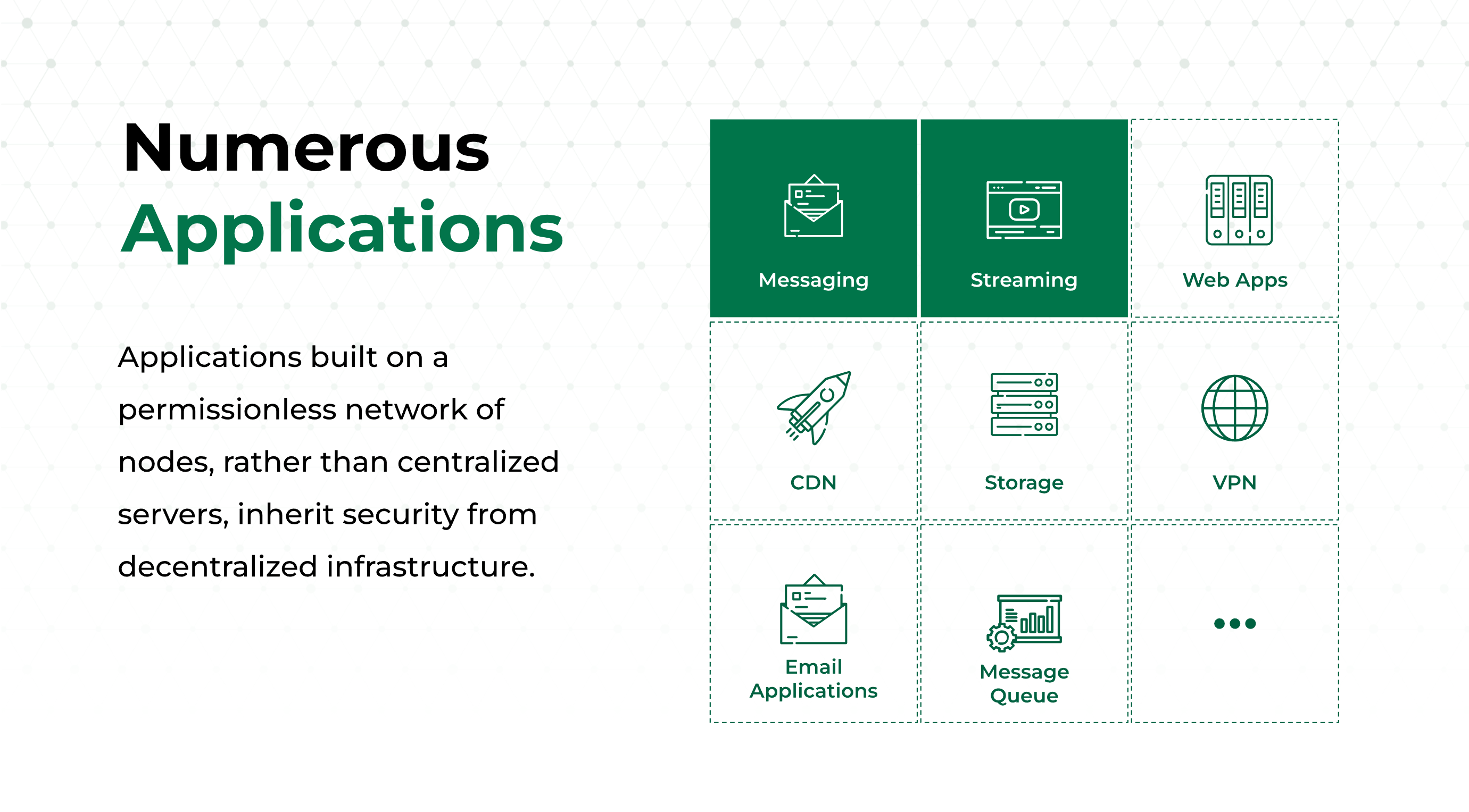
Leveraging this three-tier architecture, SendingNetwork fully decentralizes the TCP/IP stack and unlocks immense value across numerous application-layer protocols such as HTTP(S), SMTP, POP3, FTP, SIP, RTMP, and CDN:
-
Web applications based on HTTP and HTTPS: developers can deploy websites on networks using wallet addresses / ENS domains, benefiting from shared bandwidth mechanisms for faster access, while ensuring censorship resistance and secure connectivity.
-
Decentralized email apps using SMTP / POP3: when sending an email to an ENS domain owner, your app simply locates the corresponding ENS address node via network routing, uploads the email, and the recipient downloads it from the node.
-
CDN resource distribution: developers can distribute data across router devices or data center nodes worldwide. The global node network efficiently utilizes idle bandwidth, delivering faster application performance for both developers and users.
-
Streaming media protocols like SIP / RTMP / WebRTC: leveraging widespread node resources and shared idle bandwidth, content is stored and cached distributively, accelerating access speed and improving stream quality.
-
File transfer protocols like FTP: through the extensive node network combined with Web3 decentralized storage projects, frequently accessed content from IPFS / Arweave is proactively cached, boosting access speed, activity, and application scope.
-
VPN protocols like OpenVPN: applications can utilize shared IP resources from routing devices, greatly expanding available IP pools and providing essential IP and bandwidth infrastructure for VPN services.
-
Message queue protocols like Kafka, RabbitMQ: applications can leverage the wide node network, turning nodes into natural message queue carriers—offering shared, high-speed messaging services for diverse applications.
From project vision and design to sophisticated architectural planning, the team behind SendingNetwork clearly demonstrates exceptional market insight and industry influence.
From 200 Million Users to $20 Million Seed Funding: The Journey of Tech Entrepreneurs
When discussing SendingNetwork, many highlight the founding team’s track record of three successful ventures.
Founders Mason Yang and CEO Joey Yu are longtime friends who previously held key roles at Microsoft, gaining leading-edge expertise in both technical development and market operations.
Years in the internet industry honed their sharp innovation instincts. Fifteen years ago, they left Microsoft to launch their first startup, releasing Dolphin—the then-most-popular browser—in 2010. Within a year, active users surpassed 10 million, eventually reaching over 200 million at its peak. It was the only browser featured in PCWorld’s 2011 Top 100 Best Tech Products list and was later acquired for $90 million. Their second venture focused on AI and raised $100 million in funding.

Their third venture, SendingNetwork, was inspired by Google Play’s sudden removal of Dolphin: back then, tech giants like Apple and Google, leveraging their dominant hardware and OS positions, attempted to capture the browser market through pre-installation tactics. Google Play removed several third-party browsers, including Dolphin. Though widespread support from users, bloggers, and journalists led to its quick reinstatement, the incident deeply revealed the dangers of centralization and the power of community. The idea of building a Web3 decentralized product to resist such authority quietly took root.
Perhaps fueled by their two prior successes and accumulated resources, SendingNetwork already stands out with the hallmark traits of an “internet innovation pioneer”:
On one hand, solid technical execution, compelling storytelling, and nuanced understanding of user needs make SendingNetwork a high-quality project. On the other, this quality, combined with years of cultivated partnerships, fuels rapid and sustained growth.
Ecosystem-wise, SendingNetwork has established collaborations with over 100 projects including Polygon, NFTGo, RootData, and SeeDAO, offering broader audiences seamless access to decentralized communication via SDK integration.
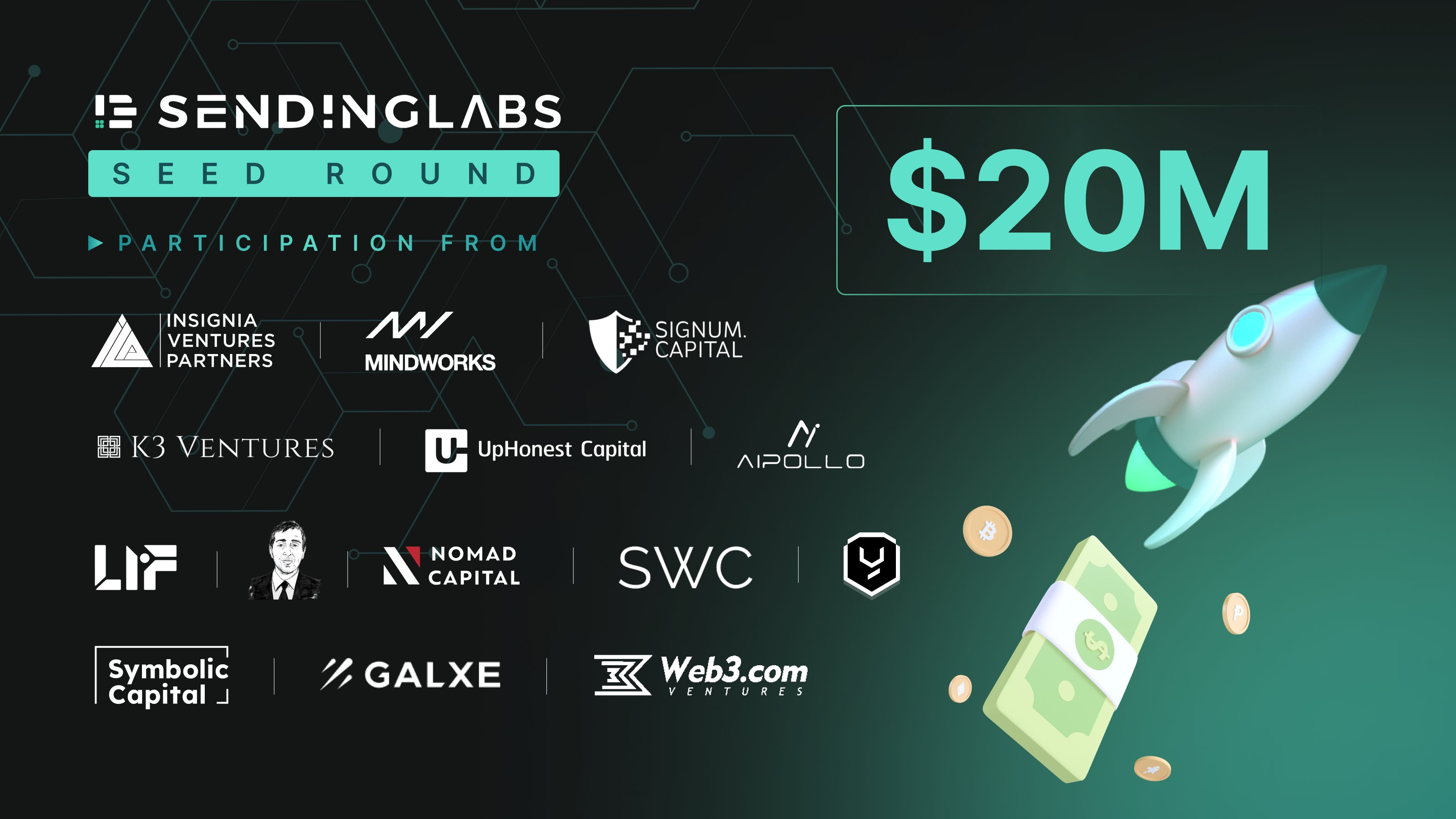
Funding-wise, in February last year, SendingNetwork closed a $12.5 million seed round led by Insignia Venture Partners, MindWorks Capital, and Signum Capital, with participation from K3 Ventures, LingFeng Innovation Fund, UpHonest Capital, and Aipollo Investment. Funds are allocated toward accelerating integration with other Layer1 and Layer2 chains—including plans to add Avalanche, Arbitrum, and non-EVM chains like Solana and Sui—as well as developing industry-specific SDKs and launching a community ambassador program. This week, SendingNetwork announced an additional $7.5 million in seed extension funding, joined by investors including Nomad Capital, Symbolic Capital, Web3.com Ventures, Galxe, SWC Global, Coinbase’s former CTO Balaji Srinivasan, and Yield Guild Games co-founder Gabby Dizon.
Certainly, SendingNetwork has already sparked multiple waves of community discussion. With testnet activities underway, node presales launching soon, and other milestones approaching, SendingNetwork is poised to maintain rapid momentum in the foreseeable future.
Looking Ahead to 2024: Join Testnet for Points, Node Presale Imminent
Currently, SendingNetwork’s testnet campaign is in full swing, rolling out in three phases:
-
Testnet Alpha 1: focused on Relay Proof testing;
-
Testnet Alpha 2: focused on Availability Proof testing;
-
Testnet Beta: introducing enhanced Availability Proof features and integrating applications from specific Layer2 blockchains.
As the core of network stability and efficiency, edge nodes are essential. SendingNetwork encourages eligible users to download the relay node script and participate in testing, offering generous rewards of up to 500,000 points. Participants can also track their point statistics by interacting with the auto-reply bot in the SendingMe app. In the future, points are expected to be convertible into tokens at a defined ratio. Interested users are encouraged to join early, becoming pioneers of the decentralized communication revolution while accumulating future token allocations.

Beyond the testnet, another highly anticipated ecosystem move is the upcoming WatchDog node presale launching in May: this presale will allocate 12% of the total SEND token supply. Committed to transparency, although whitelist slots exist, the majority of allocations will be open to the public on a first-come, first-served basis. Becoming a WatchDog node represents not only a strong earning opportunity within the SendingNetwork ecosystem but also contributes to building a truly decentralized physical node network.
Conclusion
From a market perspective, compute, storage, and communication form the three pillars of decentralized communication and DePIN infrastructure. By focusing on decentralized communication, SendingNetwork lays the groundwork to become a foundational Web3 and DePIN infrastructure. Through the integration of “data + identity + assets + social,” it taps into enduring user needs while expanding the narrative potential of decentralized communication, unlocking rich ecosystem growth opportunities.
-
From the project’s standpoint, the founders’ two prior successful startups not only demonstrate proven capabilities but also bring valuable user bases, operational experience, and partnership resources that accelerate SendingNetwork’s development;
-
Meanwhile, the $20 million in strong funding provides solid financial backing. With testnet progression and the imminent node presale, SendingNetwork’s decentralized communication infrastructure is gradually becoming a reality. We look forward to its continued evolution and to witnessing how decentralized communication reshapes the Web2 landscape—ushering in a more efficient, transparent, private, and economical Web3 future.
Join TechFlow official community to stay tuned
Telegram:https://t.me/TechFlowDaily
X (Twitter):https://x.com/TechFlowPost
X (Twitter) EN:https://x.com/BlockFlow_News
 深潮TechFlow






