








Meme Coins vs Elite Coins: A Cultural Revolution in the Crypto World
TechFlow Selected TechFlow Selected
Meme Coins vs Elite Coins: A Cultural Revolution in the Crypto World
For now, meme coins might be the best honest alternative.
 Navigating Web3 tides with focused insights
By KERMAN KOHLI
Compiled by TechFlow
I never thought I'd write this article. In the last cycle (2021), I didn't understand NFTs, refused to buy anything without "utility," and loved my DeFi tokens.
This cycle, my perspective has shifted dramatically. So what changed?
Broken promises and seeing through eight years of crypto bullshit.
I entered crypto in 2017, which in my view remains one of the most exciting cycles in crypto history (2020 a close second). Why? Because for the first time ever, you could raise funds from anywhere in the world in under ten minutes. Sure, it was full of scams, but the overall innovation couldn't be ignored. Ethereum was an ICO token, as were Aave, Gnosis, and countless others. As someone from New Zealand/Australia, geographically I’d never have access to major capital pools—ICOs gave me hope that talent and merit could rise regardless of location (assuming they could build and market). The idea of people huddled around laptops moving $5 million and closing deals felt insane anywhere else.
Unfortunately, all good things come to an end. The aftermath of 2018/2019 forced us to clean up—wounded retail investors and endless lawsuits followed. While crypto is inherently high-risk, founders and investors sought something “safer.” Thus emerged a new model:
-
Private fundraising in early rounds
-
Private fundraising in later rounds
-
Airdrops at high valuations
How do you participate in these “deals”? Become part of the crypto elite with access, then wait for your assets to appreciate. I’ve been a net beneficiary of this model. I was lucky enough to be an angel investor in certain tokens whose value surged upon public listing. Most of my returns came from public markets. I know many friends and investors who made incredible sums under this new model. All you need now is visibility on Twitter.
Now, I'm not saying people with social capital shouldn’t convert it into financial capital. That’s how the world works. The issue lies in the system’s incentives. I've written about this in various ways before, but let me briefly revisit it.
The “New” Model
The problem with this new model is that it's more corrupt than the traditional financial system. Here’s how it usually unfolds:
-
First-round investors get valuations of $10M–$50M for any token/project. Given most tokens could potentially reach $1B valuation, this implies 20x–100x upside. These rounds are easy to sell and often go to insiders. This isn’t inherently wrong—it mirrors how traditional VC investing works.
-
With sufficient funding, the project begins building and shipping. Once something launches, they dangle the promise of an “airdrop” in front of users. The deal is simple: use our product, and we’ll eventually reward you with our token. Oh, and if you use multiple wallets, you get more because it boosts our metrics.
-
With these inflated metrics, projects can pitch bigger dreams. Growth-stage capital flows in, writing larger checks. If your vision is ambitious enough, you might raise $50M at a $500M valuation. This is where skepticism kicks in—if investors back a $500M valuation, they’re expecting at least $5B down the line. To achieve that, you need top-tier marketing and socially influential backers (or cash flow, which rarely exists at this stage). Keep them on standby, because you’ll need their full cooperation in the next phase.
-
As you near token launch, ramp up marketing and social presence. More people discover the project and eagerly use it, hoping for an airdrop. This loop is as powerful as a 20-year-old man pumping steroids to bulk up.
-
Once hype peaks, launch the token and ensure liquidity for investors and team members. You might even pre-sell on secondary markets. What happens afterward is beyond your control—people dump tokens for liquidity and move on to the next project.
Note: Some teams don’t execute like this—they enforce proper 4-year vesting for team and investors, conduct meaningful airdrops, and strive for accurate data. These are exceptions, and I hope such projects stand out.
The outcome of this cycle is essentially a pile of products people don’t truly want—but the cycle repeats anyway. Why? Because this is currently the only way to make money in the market. Early and growth round opportunities are limited. Your only shot is dumping money into untested smart contracts, using broken products across multiple wallets, and hoping for $1K–$10K months later. So what about token utility?
-
Most tokens promise “governance.” Well, most are held by insiders, so your voice doesn’t matter. How do you know? You’d have to spend significant time analyzing wallet distributions and past governance votes.
-
What about cash flow? Yes, some may generate revenue, but will token holders receive it? Almost certainly not. This might change with UNI’s fee switch, but until then we’re stuck.
-
Innovation? Key team members are already millionaires—beyond this point, they may only care about producing *something*. How do you know? Only through insider conversations within the industry.
-
Growth? Well, airdrops and metrics are fake, so nothing is real. Most users and capital will flow to the next “hot” project, forgetting you entirely—leaving you as a relic of the last cycle. There will always be a newer project with hotter investors and more airdrop farmers, capturing attention.
-
Future price appreciation? Well, you need to understand the entire supply schedule and when more tokens unlock, so insiders don’t dump on you and exit with liquidity.
The system operates by perpetuating short-term, profit-driven behavior via fabricated data. People aren’t stupid—and frankly, they’re fed up. With a new option available—meme coins—why keep supporting other projects that enrich insiders?
A Revolution Within a Revolution
Crypto was supposed to level the playing field and enable transparent, fair distribution.
Bitcoin exemplifies this perfectly:
-
No pre-mine
-
Fair distribution via proof-of-work
-
No promised utility beyond being a cultural symbol
I’m not saying every token needs or should do this, but it does represent a revolutionary quality of crypto compared to traditional finance:
-
New dollars printed for those closest to the printing press
-
Opaque information, hard to verify
-
Value rarely belongs to those who create it (citizens)
In many ways, today’s crypto system resembles the old way—tokens allocated to insiders, data hard to verify, investors capturing most value. In contrast, memes uniquely respond to crypto’s original promise.
Let me start with a common phrase people say:
“When the hype dies, memecoins will go to zero”
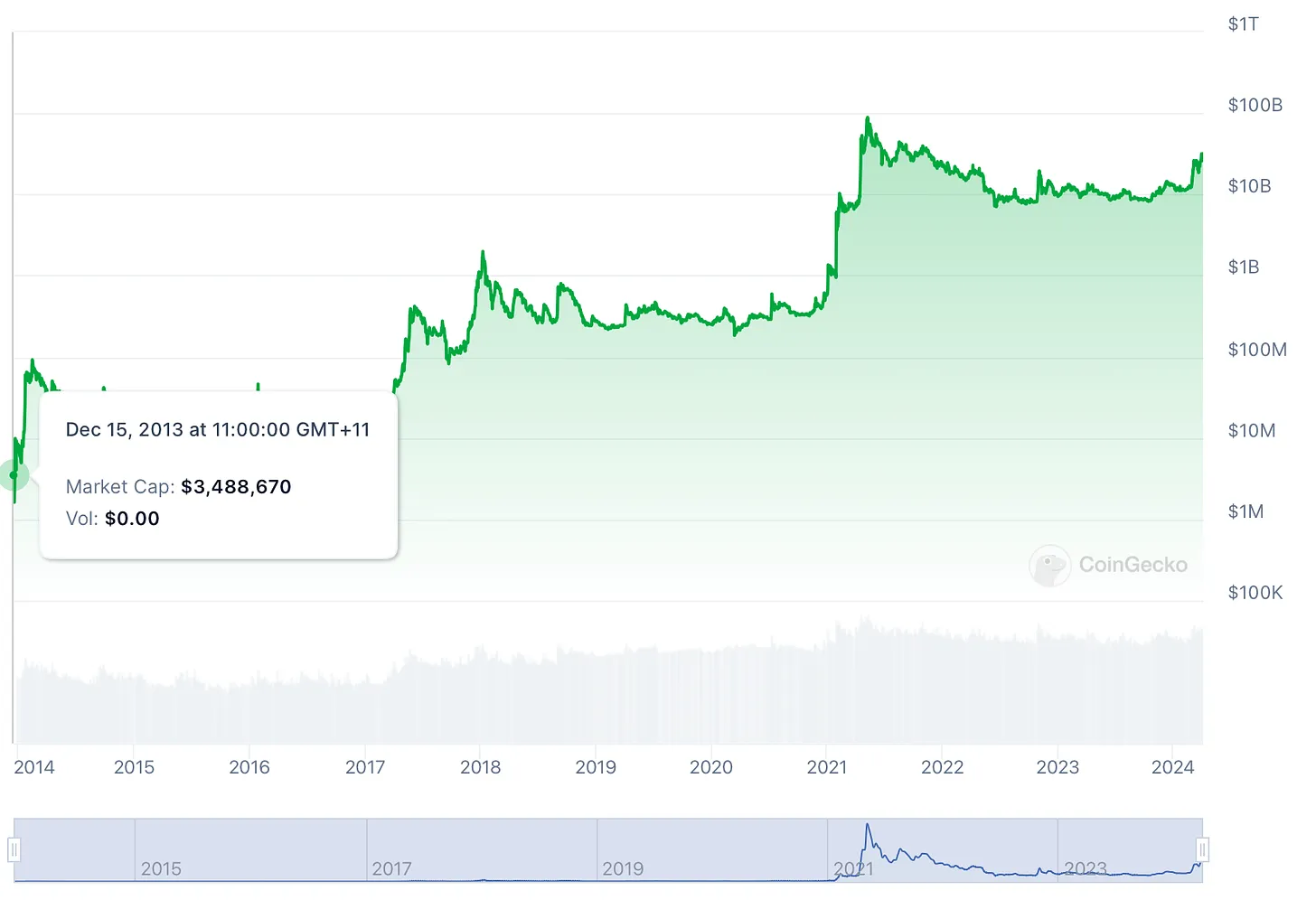
I used to say this too. But let’s look at the data, okay? Here’s Dogecoin’s market cap chart since 2014 (price涨幅 too large to plot linearly, so log scale). This is a token with no utility—except its logo is a widely recognized dog breed called Shiba Inu.
You would have made more investing in Dogecoin than NVIDIA.
Should this token go to zero? Quite the opposite. It keeps climbing sharply, even outpacing Bitcoin. An ~8000x return for investors is hard to ignore.
You might say, “Well, Dogecoin is special—it’s an outlier.” I think that’s an unsatisfactory answer requiring deeper examination. Let’s review some of Dogecoin’s traits:
-
No pre-mine
-
Runs on proof-of-work, no “presale”
-
Offers no utility beyond being a cute internet joke
Dogecoin doesn’t lie. It doesn’t favor those with social capital. No insiders get special access. If you believe in the network culture and crypto, you can get in yourself.
But I want to further illustrate my point with another, similar example.
$DEGEN
I’ve written about Farcaster before, but now a new trend is emerging—one that will likely grow very popular in the coming months and years. To illustrate, let’s use something different: Reddit. Recently, Reddit IPO’d at a $6B valuation. Much of this value was created by platform users. Yet Reddit’s best offer to users was merely the chance to participate in the IPO at a multi-billion dollar valuation. They might earn a decent return, but it won’t meaningfully change their life trajectory.
When Farcaster launched and I was writing about it, a small experiment called $degen was underway. The idea was simple: you receive a certain amount of $degen and can distribute it by commenting “50 $degen” on good Farcaster posts. The more tips you give, the more you earn. Simple in many ways, yet exceptionally effective at value distribution. As usual, I was skeptical and dismissed it as “just another Ponzi with no utility—it’ll go to zero.” But $degen succeeded by capturing the hearts and minds of the Farcaster community. As Farcaster grew, so did $degen’s price.
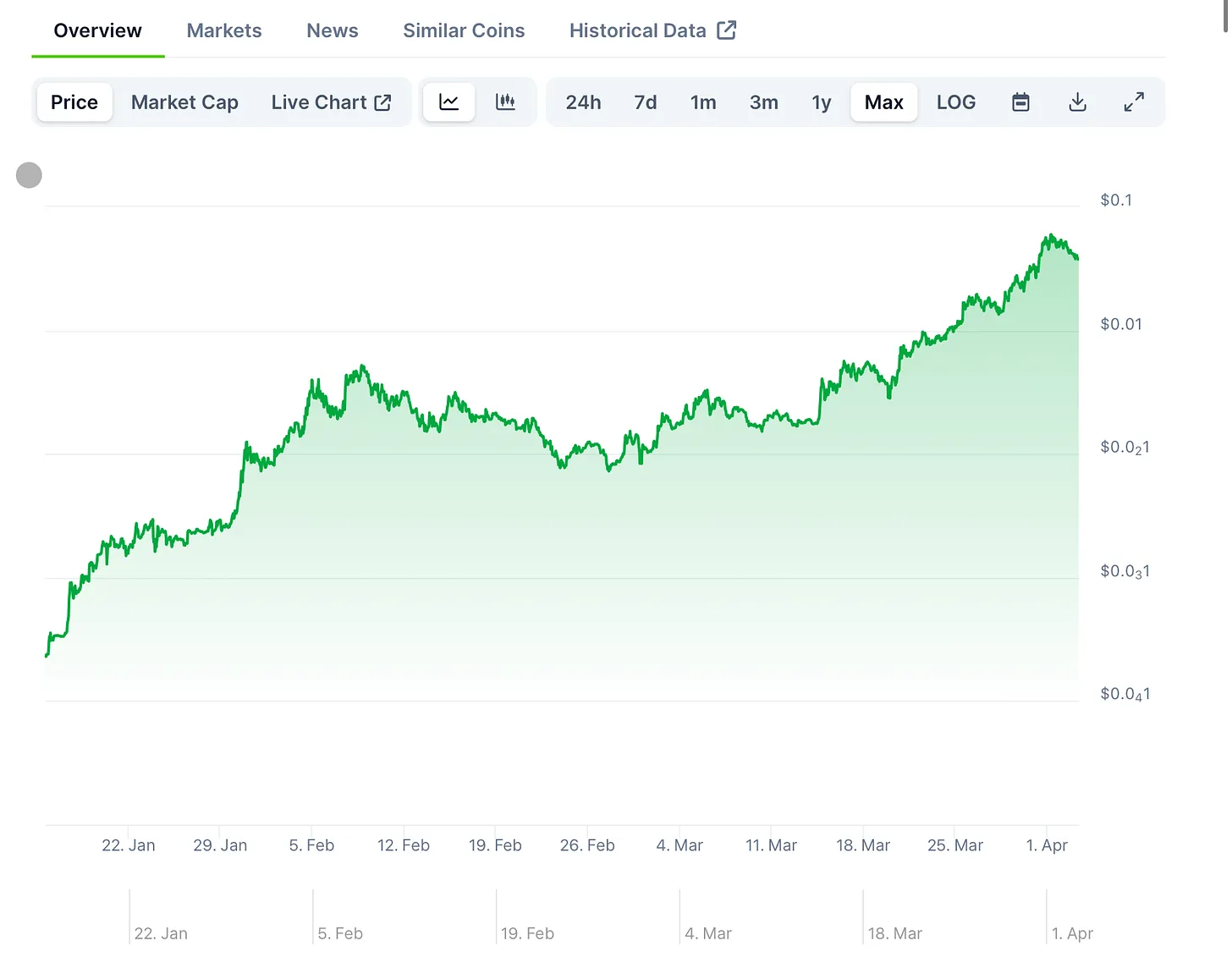
$degen is still young (only three months old) and will face many challenges ahead. While it represents something new and novel, I believe it will stand the test of time—even through bear markets. Still, looking at this chart, it’s easy to wonder, “What if I had invested at X dollars?”
What I want to highlight here is what real participation can achieve. One of the largest $degen holders I know is Cooper Turley. He’s been deeply involved in Farcaster and $degen. His public wallet holds nearly $250K in $degen—earned purely through participation.
These are the stories I came to crypto for—not to replay the same corrupt systems with new projects.
During $degen’s rise, it’s now being used as a marketing strategy for startups. Alex Masmej, building at the intersection of TikTok and crypto, uses $degen as the primary currency for his product Dracula. This creates a symbiotic relationship between Dracula and $degen. Memes as marketing channels are becoming a more prominent theme for the future—I’ll expand on this next.
Despite $degen having a small pre-allocation and selling tokens to “Farcaster” insiders, the amount is much smaller—personally, I find it reasonable. Although I regret not buying more during $degen’s surge, I took a mid-curving approach and hold little.
$WIF
Dogwifhat. Now the most hated meme on crypto Twitter. When I first heard of it, I was disgusted. I remember thinking, “Ugh, degenerates making garbage again.” But after learning the dog’s story, I found it compelling enough to change my mind. I hold a small amount of $wif—and I joined quite late (market cap already in billions).
See, the photo of dogwifhat existed long before it became a token. It was already a beloved internet meme, full of life. Seeing the picture, you can’t help but say, “That’s a pretty cute dog with a hat.”

At the end of 2023, a Solana developer launched $wif. After the token surged in the first two days, he sold his entire stake for $32,000, leaving a “clean” distribution—no leftover supply. Had he not sold, his stake would now be worth over $1B. With allocation essentially first-come-first-served, wif has grown to unprecedented scale.
$wif is incredibly simple: it’s just a cute dog wearing a hat. No need to worry about investors pitching you, no promises, no cash flow. It is what it is.
It’s both delightfully chaotic and deceptively simple. But most people probably missed it.
Zooming Out
“But author, are you seriously suggesting we should all invest in tokens that literally do nothing—just cute dogs or communities, with no other value?”
First, your investment decisions are yours alone—not the scope of this article. Second, what’s the alternative? Look at the top 100 tokens on CoinGecko—you’ll find many with:
-
Zero real utility beneath the surface—mostly lies
-
Massive dumps looming from investors
-
No cash flow generation
So relatively speaking, memecoins and “utility” tokens are the same. I prefer tokens that are honest about what they are—ones that don’t require me to analyze 100 variables while juggling other tasks.
“But won’t they all go to zero in a bear market?”
Well, guess what—everything drops 50%–99% in a bear market. What you describe isn’t unique to memecoins. At least with memecoins, there’s no lie or false promise—as most tokens eventually reveal. AI / L2 / ZK tokens are currently the worst offenders. They exaggerate tech, over-supply tokens, and list at absurdly high valuations. I despise these tokens.
Crypto is plagued by lies—a corrupt industry. Memecoins, in an ironic twist, have become the resistance. Call it a revolution within a revolution.
Now they’re easy to buy (Solana), easy to understand (cute dog), and honest (no complex tech or financial jargon to confuse you).
Love them or hate them, they’re here to stay.
They may deflate like other market products in 2–3 years, but I bet the best memecoins will live in our minds and deliver massive returns in the 2028 bull run—just like Dogecoin.
The question is: Are you a skilled meme connoisseur, or a fool buying scammy shitcoins from devs trying to get rich quick and exit? That’s for you to decide.
The Future of Crypto
Memecoins might also represent a financially nihilistic future—where people gamble their way out of poverty. There should be another path: investing at low cost in technologies that make humanity happier or more productive. Not just selling dreams.
While I could spend my time on memes, I believe better identity, reputation, and data primitives can help build a healthier on-chain society. This is where I choose to focus and build. Based on my recent writings about airdrops, I’ve learned a lot behind the scenes—and I’m excited to share it with you.
I hope these new products can help solve current problems in crypto.
For now, though, memecoins may be the most honest alternative available.
Disclosure: Despite my bullishness on memes, I keep less than 5% of my portfolio in them. I expect this allocation to grow significantly as memes demonstrate lasting power and remain overlooked by elites—and potentially appreciate substantially.
Join TechFlow official community to stay tuned
Telegram:https://t.me/TechFlowDaily
X (Twitter):https://x.com/TechFlowPost
X (Twitter) EN:https://x.com/BlockFlow_News


