








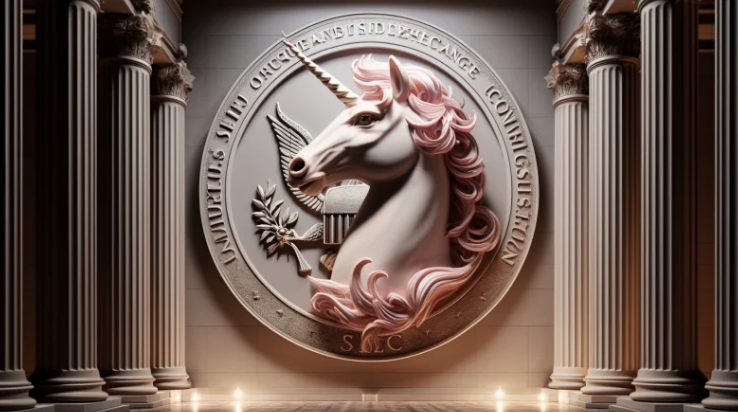
Uniswap Responds to SEC Lawsuit with Official Statement: Fighting for DeFi
TechFlow Selected TechFlow Selected
Uniswap Responds to SEC Lawsuit with Official Statement: Fighting for DeFi
Uniswap founder says Uniswap is legal, but the SEC cares more about protecting opaque systems than consumers.
 Navigating Web3 tides with focused insights
Compiled by: Lynn, Mars Finance
Decentralized cryptocurrency exchange Uniswap disclosed on Wednesday that it had received notice from the U.S. Securities and Exchange Commission (SEC) indicating its intent to take enforcement action. Uniswap’s native token UNI immediately dropped 9.5% following the news.
At a press conference Wednesday afternoon, Uniswap COO Mary-Kathryn Redmond and Chief Legal Officer Marvin Amori told reporters that the Wells Notice focused primarily on allegations that Uniswap operates as an unregistered securities broker and an unregistered securities exchange. It remains unclear whether Uniswap’s native token UNI is implicated as a potential security in the SEC’s notice.
Amori said he believes Uniswap does not meet the SEC’s current definition of an exchange. He also pointed to the recent ruling in the SEC’s case against Coinbase—where a judge determined that the Coinbase wallet is not a broker—as a positive sign that Uniswap could similarly prevail on similar claims. (The judge did allow other SEC allegations against Coinbase to move forward.)
According to information published by Fortune, the U.S. Securities and Exchange Commission has moved to file a lawsuit against UniSwap (UNI), aiming to hinder the rapidly growing DeFi industry.
The U.S. Securities and Exchange Commission (SEC) has issued a Wells Notice to leading decentralized finance (DeFi) platform Uniswap, signaling its intention to sue the company. A Wells Notice is a preliminary warning informing recipients that a regulator is considering bringing charges against them. Such notices are typically followed by enforcement actions.
The SEC has been investigating Uniswap. The agency’s specific allegations against Uniswap Labs—the company that developed the Uniswap protocol but does not control it—are not yet clear. However, based on recent lawsuits against other crypto firms like Coinbase, the SEC may allege that Uniswap Labs offered unregistered securities to the public or operated as an unregistered broker or exchange.
Uniswap recently announced that its protocol has facilitated over $2 trillion in trading volume, highlighting increasing interest from mainstream finance in this technology. Sources close to Uniswap Labs told Fortune the company is preparing for a “good fight” in court. They argue that the company’s decision to operate publicly in New York rather than overseas demonstrates its legitimacy.
In response to the SEC’s litigation threat, UniSwap founder Hayden Adams released the following statement:
Today Uniswap Labs received a Wells Notice from the U.S. Securities and Exchange Commission.
I’m not surprised. Just frustrated, disappointed, and ready to fight.
I firmly believe the products we offer are legal and our work aligns with the historical trend. But it’s become increasingly clear that instead of working to establish clear, informed rules, the SEC has chosen to focus its efforts on attacking long-standing, well-behaved actors like Uniswap and Coinbase—while turning a blind eye to bad actors like FTX.
When I first set out to build Uniswap, my goal wasn’t to reimagine finance.
It was an experiment in a fully decentralized, fully automated on-chain market. I didn’t know if it would work or if anyone would use it.
Today, the Uniswap protocol has processed over $2 trillion in trading volume. Thousands of teams and developers have forked our code or built on top of it. We’ve created new financial infrastructure that is transparent, fair, secure, and accessible—powering the entire industry.
Our team at Uniswap accomplished all of this from our office in New York, USA.
People often ask me why I chose to stay in the United States. My answer is simple: I believe blockchain is an incredibly powerful technology. Like the internet, it’s here to stay. So someone needs to solve this—and that someone might as well be us.
And when the technology you create improves people’s lives, you don’t need to hide.
The SEC’s mission is “to protect investors, maintain fair, orderly, and efficient markets, and facilitate capital formation.” That’s a noble mission. But today, I believe Uniswap is doing far more to fulfill that mission than the SEC itself.
Yes, I’m frustrated that the SEC seems more concerned with protecting opaque systems than protecting consumers. To defend our company and our industry, we must now fight a U.S. government agency.
This battle will take years—possibly going all the way to the Supreme Court—with the future of fintech and our industry hanging in the balance. But if we stand united, we can win.
I believe freedom is worth fighting for. I believe DeFi is worth fighting for.
Of course, we won’t stop operating. Stay tuned!
Official blog post from Uniswap:
Fighting for DeFi
Today, Uniswap Labs received a Wells Notice from the Enforcement Division of the U.S. Securities and Exchange Commission (SEC), notifying us of their intent to recommend legal action against us. During this period, we will continue to offer our full suite of existing products and keep delivering new ones. Given the SEC’s ongoing lawsuits against Coinbase and other companies, along with their complete unwillingness to provide clear guidance or registration pathways for companies operating legally in the U.S., we can only conclude this is the latest political effort targeting the best builders in blockchain technology.
While the SEC claims “most” tokens are securities, the reality is that tokens are digital file formats—like PDFs or spreadsheets—that can store various forms of value. They are not inherently securities, just as not every piece of paper is a stock. The vast majority of traded tokens are absolutely not securities—they are stablecoins, community and utility tokens, and commodities like Ethereum and Bitcoin. Tokens traded on secondary markets like Uniswap are not investment contracts. And even in cases where tokens might represent securities, the SEC refuses to open any path for companies to register them.
We firmly believe the products we offer are not only legal but transformative. They make markets transparent and verifiable, reduce gatekeepers, and empower people worldwide by enabling low-cost, convenient participation in the global economy.
Who We Are
Uniswap Labs is a U.S.-based software company headquartered in New York. Our founder and CEO, Hayden Adams, created the Uniswap protocol as an attempt to build software embodying the advantages of the decentralized Ethereum blockchain—advantages such as immutable core functionality, unrestricted access, and no single or centralized point of control.
The Uniswap protocol brings unprecedented innovation to market structure: transparent execution; shared infrastructure based on open-source code, not walled gardens; users holding their own assets instead of entrusting them to potentially mismanaged institutions; direct, fully automated trading without (often monopolistic) intermediaries. Additionally, through Uniswap’s automated market maker, anyone can create markets for illiquid assets—something impossible under traditional structures or legacy intermediaries.
Six years ago, automated market makers existed only in theory. Today, the Uniswap protocol is widely adopted across the crypto space and has become critical infrastructure for blockchain markets. It is Ethereum’s largest use case, consuming 25% of Ethereum’s block space. It has processed $2 trillion in trading volume without a single hack. It’s integrated into thousands of applications built by teams around the world and is the most copied open-source smart contract protocol, forked over 2,000 times.
Uniswap Labs built popular consumer-facing trading platforms entirely based on blockchain. Our mobile app allows users to self-host their assets—like a personal safe on the blockchain accessible only to the owner. Our website enables users to securely buy and sell tokens.
We do this work because we believe blockchain can give American and global consumers more choices and greater control over their assets. We believe this is worth fighting for.
If the SEC protects opaque systems while attacking transparent new technologies that bring opportunity and lower costs to Americans, then the U.S. will fall behind in innovations that deliver choice and freedom to consumers. We are disappointed that, to protect innovation and economic freedom, we may have to fight a U.S. government agency.
The Law Is Clear
Regardless of what the SEC decides to do, the law is clear on these issues:
No Congressional Authorization: The SEC only has jurisdiction over securities, such as assets properly classified as “investment contracts.” The court ruling in SEC v. Ripple clearly stated that secondary market trading of digital assets generally does not constitute an investment contract—and these are precisely the types of assets traded on the Uniswap protocol. Even the SEC Chair acknowledged in congressional testimony that new regulation for tokens requires new legislation passed by Congress—the SEC lacks this authority. We achieved a decisive legal victory in Risley v. Uniswap Labs, which emphasized that Congress—not the SEC—must shape crypto regulation, stating that private plaintiffs’ securities claims are “best left to Congress.” Moreover, the SEC’s recent decision to settle solely on dealer issues with Shapeshift—while completely ignoring the fact that it is also a DEX—clearly reveals a pattern of arbitrary enforcement, possible only when an agency acts beyond the constraints of actual law.
Not a Securities Exchange or Broker: Even if Ripple and the Supreme Court’s Howey Test didn’t rule out the SEC’s arguments, the Uniswap protocol, web application, and wallet still do not meet the legal definitions of a securities exchange or broker. This was made evident in the recent SEC case against Coinbase, where the court dismissed the SEC’s claim that a crypto wallet constitutes a broker—even when fees are charged. Even the SEC appears to recognize that its existing legal definitions don’t cover on-chain self-custody decisions, which is why the agency proposed new exchange rules last year attempting to encompass such activity. Those rules haven’t been finalized, and we’ve already explained why they would be invalidated even if enacted.
Not Issuing Securities: The UNI token is not a security, as it fails to meet the legal definition of any type of security, including an “investment contract.” Under U.S. law and the established Howey Test, an investment contract involves investing money in a common enterprise with an expectation of profit derived solely from the efforts of others. There is no contract or commitment between Uniswap Labs and its 300,000+ token holders. There is no common enterprise, and the token’s value is not solely dependent on the efforts of Uniswap Labs. Although the SEC recently subpoenaed the Ethereum Foundation, the Commodity Futures Trading Commission (CFTC) has consistently stated that both Bitcoin and Ethereum are not securities. Furthermore, the Uniswap technology ecosystem, like Bitcoin and Ethereum, is fully decentralized.
We firmly believe our products comply with the law and our work aligns with the tide of history. While our legal team fights this battle, we will continue doing what we do best: BUILD.
Join TechFlow official community to stay tuned
Telegram:https://t.me/TechFlowDaily
X (Twitter):https://x.com/TechFlowPost
X (Twitter) EN:https://x.com/BlockFlow_News






